C&D test shows 2009 Cadillac CTS-V Outraces the Competition

Car & Driver via Autoblog — Car & Driver runs an annual event called the Lightning Lap.  They get the fastest cars in the world together, and run them all on the same track under similar conditions and publish the results.

This year they included the 2009 Cadillac CTS-V in the mix.  How did the new high performance Cadillac do?  Amazing.  Check the details.  The new Corvette Z51 won for under $60K; but the CTS-V posted the 2nd highest times in the event for vehicles under $60K, and 6th highest overall of 22 performance cars!  Go Cadillac!

Remarkable thrust from the LSA [The Cadillac CTS-V has an LSA engine] with no hint of the angry bull bellow that afflicted the previous CTS-V. Remarkable, too, is its six-speed manual gearbox, providing precise shifts and crisp engagements. Remarkable balance, allowing the driver to drift and pivot this big sedan with ease. Remarkable brakes, offering formidable stopping power without a hint of fade, lap after lap.

The BMW M3 came in just behind the new CTS-V, followed by the Mercedes C63 AMG.  Not sure why the new Corvette ZR1 was not in the test.

The Cadillac did 0.92g’s in the first section; have to love that.
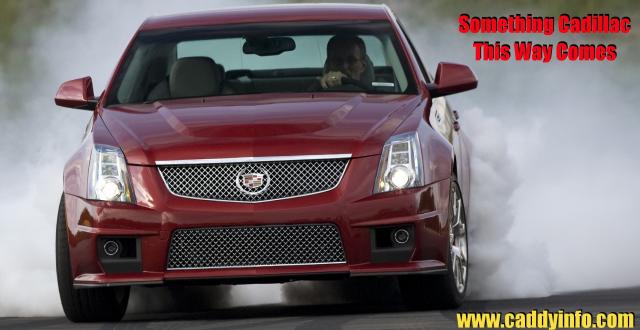
2009 Cadillac CTS-V Supercharged Performance

2009 Cadillac CTS-V Supercharged Performance

I know, 6th. But the first five were the Mosler MT900s, Dodge Viper SRT10, Ferrari 430 Scuderia, Nissan GT-R, and Corvette Z51. Very fast company, and none of them have four door, four seats, and Cadillac luxury.
Corvette ZR1 LS9 engines making the numbers

The Corvette Blogger via Jalopnik reports some independent chassis dyno results for the new 2009 Corvette ZR1 supercar.    Now the LS9 supercharged 6.2L V8 in the Corvette ZR1 is not identical to the LSA 6.2L supercharged V8 in the new CTS-V.  The one in the Corvette is hand built and hardened a bit compared with the more production engine in the CTS-V.  The Corvette makes 638hp, the CTS-V 556hp.  The Corvette has a larger supercharger at 2.3L vs 1.9L for the Cadillac.  But it is interesting to see how the Corvette engine performs none the less as a ruler for where we might see the CTS-V perform.

Results?  The average chassis dyno was 548hp.  With tuning the shop was able to get them up to around 567hp.  At 15% transmission/drivetrain loss, the 548hp matches up well enough with the claimed 638hp of output at the crankshaft.   Put another way, 548hp represents 14% drivetrain loss which is in the expected range.

Hopefully we will see the CTS-V manuals put up similar numbers, hitting around 475hp on the chassis dyno.

Cadillac Escalade Hybrid Green at Heart

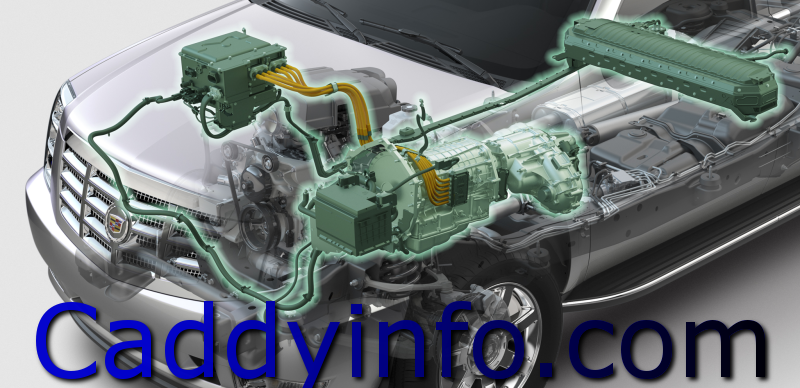
The Cadillac Escalade Hybrid has a fundamentally different powertrain than the base Escalade.  The Escalade Hybrid is a true 2-stage hybrid powerplant, able to move on battery power or on gas propulsion.

Energy Storage System (ESS)

Providing power to the hybrid’s electrically variable transmission’s (EVT) two electric motors is a 300-volt nickel-metal hydride Energy Storage System (ESS). This battery pack is located under the second-row seat, where it takes up virtually no additional space and does not interfere with second- or third-row ingress/egress.

The primary function of the ESS is to provide power (300 volts) to the EVT and to store captured energy produced during regenerative braking. In addition to supplying power to the EVT, the ESS also provides power to the air conditioning compressor and the Accessory Power Module (APM), which converts the high-voltage supply to 42 volts for the electric power steering system, and 12 volts for the vehicle battery and other 12-volt electrical accessories.

Battery pack durability and reliability are maintained via optimized charge and discharge cycles, as well as a dedicated cooling system that draws air from the passenger compartment. As part of the vehicle’s emission control system, the ESS is warranted for eight years/100,000 miles.

In city driving, this advanced hybrid power system enables Escalade to launch and drive low speeds on electricity alone. So cruising along the avenue, the Escalade may use no fuel at all.   As additional power is demanded, the system blends output from the battery and gas engine smoothly.
The key to Escalade’s two-mode hybrid system is that the electric power used to propel the vehicle is generated by the hybrid system itself. When the brakes are applied or the vehicle is coasting, the electric motors within the hybrid system create electricity that is stored in the 300-volt battery. This stored energy is used to move the vehicle and the regenerative braking cycle is renewed.

A key contributor to the Escalade Hybrid’s fuel economy is the gasoline engine’s Auto Stop mode. Once the vehicle reaches 0 mph, the gasoline engine is automatically shut down. By leaving the engine off and allowing the vehicle to move only under electric power, such as during heavy stop-and-go traffic, fuel consumption and emissions are greatly reduced.

If you need the seating, room, and towing capacity of a fullsize SUV, the Cadillac Escalade is an excellent choice.  With the addition of the Escalade Hybrid to the Cadillac line, you can have your luxury and quietly glide past the gasoline station too.