I enjoyed Cartest back in the day in the dos version, and picked up the latest JAVA stand-alone version of CarTest 2000. CarTest is a simulation that makes it easy to compare a variety of parameters for your vehicle to determine likely effect if you change that parameter.
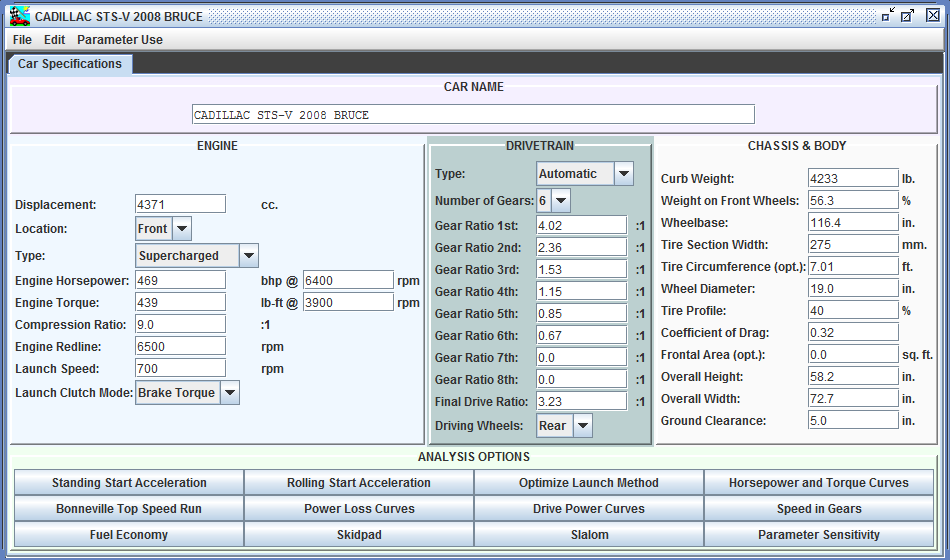
STS-V Cartest General parameters
One parameter that gave me pause is the redline. I think of the redline for the STS-V as 6800 RPM, but I note that the ‘max shift speed’ for the 6L80E transmission is 6500 RPM, and the fuel shut-off for the LC3 is 6700 rpm, so I need to research where the V shifts further.
Cartest predicts a 2008 STS-V will go 0-60 mph in 4.68 sec with a 1 foot roll-out at 65F 29.9 baro 0% humidity and a 160 lb driver.
In my first test for my 08 STS-V at 87F and 29.69 baro humitity 64% I measured 5.39 sec 0-60 mph. If I put these parameters into Cartest the prediction would be 4.92 sec for those conditions. In the test I learned that I would need to launch my V carefully for the best times (no news there).
In my second test Conditions: Weather: 100F per the car, 96.5 at the weather station; baro 28.85 in I measured 5.29 sec; Cartest predicts 5.26 sec for 0-60 mph for those conditions.
I read these Cartest predictions as what I should have been able to do with the V on those days.
The car specific parameters are set by creating and modifying Car Specific parameters to be used in the place of the general parameters used below:
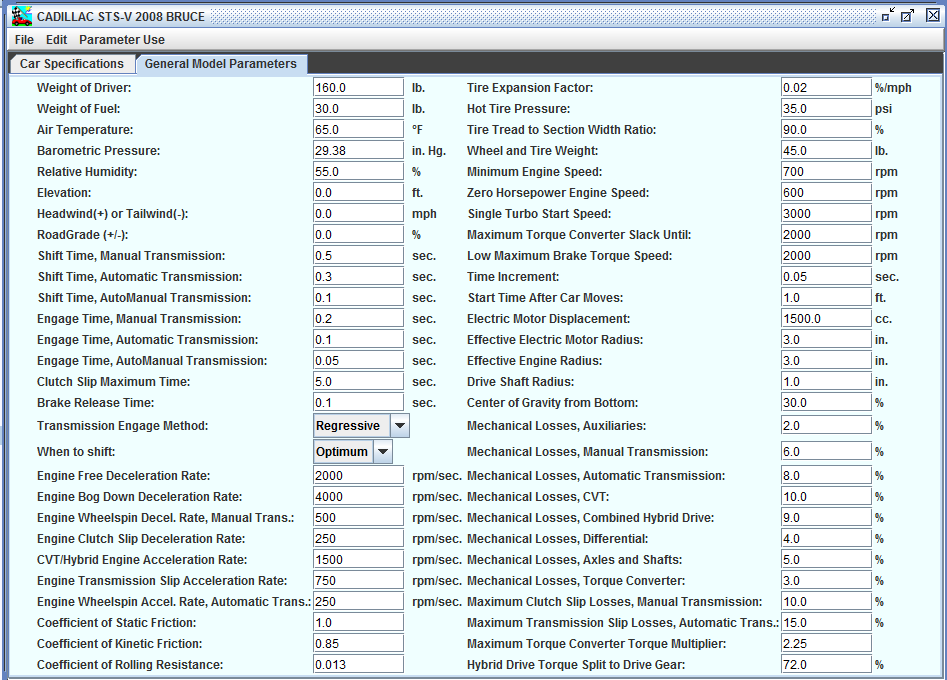
Car Test General Parameters that can be modified with Car Specific Files
The fun part of CarTest of course is predicting things we don’t know. For example, I am hoping that my upcoming Spectre Intake will add 40 whp and 40 lb-ft of torque. Here is a comparison back on the perfect 65F day with CarTest default standard conditions:
| Selected Cars: |
1. CADILLAC STS-V 2008 BRUCE |
2. CADILLAC STS-V 2008 BRUCE SPECTRE |
|
|
|
| Time to Speed sec |
|
|
| 0- 30 mph |
1.75 |
1.61 |
| 0- 40 mph |
2.75 |
2.18 |
| 0- 50 mph |
3.75 |
3.68 |
| 0- 60 mph |
4.75 |
4.66 |
| 0- 70 mph |
6.41 |
6.20 |
| 0- 80 mph |
8.00 |
7.65 |
| 0- 90 mph |
9.71 |
9.20 |
| 0-100 mph |
11.62 |
10.93 |
This resulted in the table above, predicting that the STS-V 0-60 time at 65F 29.9 baro 55% humidity with me driving with the new intake (hopefully) will drop from 4.75 sec to 4.66 sec.
The Quartermile time would have more effect — dropping from 13.35 sec @ 105.55 mph to 13.12 sec @ 107 mph. Yes, I know that some people have done under 13 sec with modified STS-V’s, and good. One has to consider the conditions stated, which makes a difference.
Wow you might think — add 40 hp and only get ~0.1 improvement 0-60? How does that make sense? The STS-V is not hp limited on the 0-60 run — it is traction limited. Look at the whole table from 0-100 mph above and you can see a clear advantage predicted for the intake.
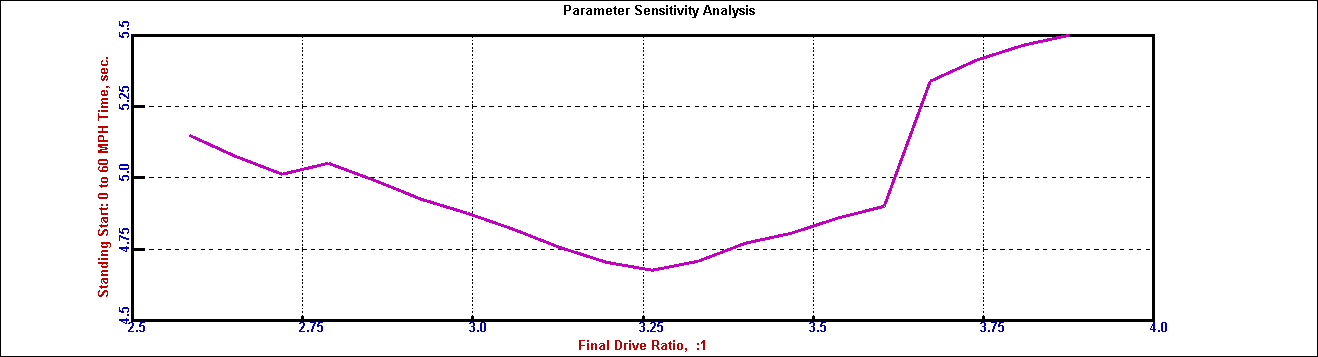
Another fun option to consider — what is the ideal final drive ratio for the STS-V to maximize 0-60 time:
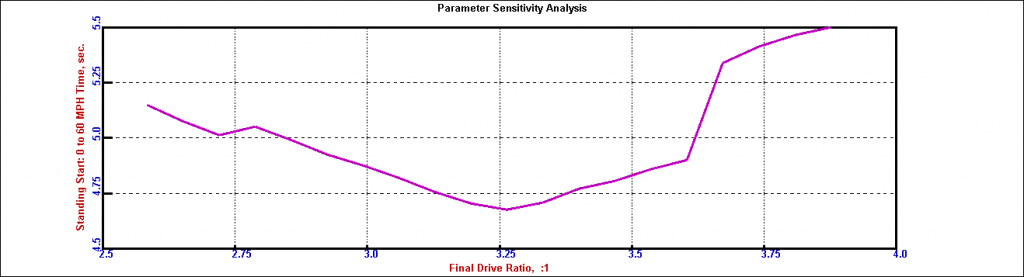
Parameter Sensitivity - Final Drive Ratio
What this graph shows is the 0-60 time on the Y axis, using a variety of final drive ratios along the X axis. The actual final drive in the STS-V is 3.23:1, which appears to be almost perfect for the car.
Remember my questions about the redline? What WOULD the ideal redline be:
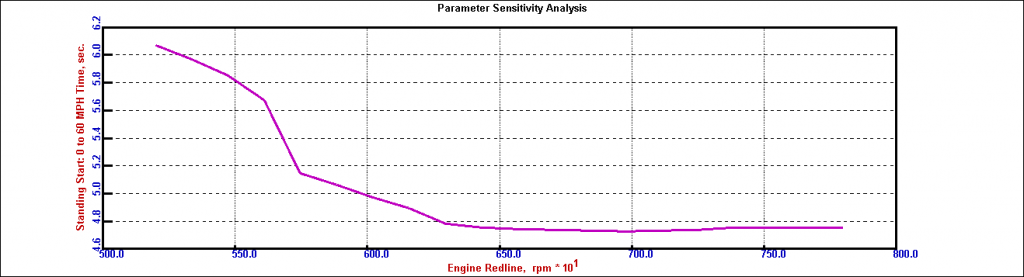
Parameter Sensitivity: Redline
This graph shows 0-60 mph time on the Y axis, and Redline on the X axis. There is very little change from 6500-7500 rpm, which suggests that 6500 rpm is a good choice.
Another fun aspect of CarTest is the Top Speed Calculator. A ‘stock’ STS-V is electronically limited to 155 mph. CarTest estimates that on a perfect endless flat road it could do 172 mph. The Spectre intake might raise this to 178 mph. In a standing mile, the STS-V should hit around 149 mph at 34 seconds, so at the Texas Mile which measures from a rolling start it might do somewhat over 150 mph. There is an overboost mode that kicks in over 150 mph after 150 seconds that drops the boost from 12 psi, but it would not come up in the time required for a mile.
I am glad I ‘refound’ CarTest, and that it is still available at all, and at a reasonable price. Nothing replaces actually testing changes on your car, but I like to have some predicted results to use for trades: IF I do this for that much money what would happen? Trades that one can work through without actually spending money are preferred.
I also should mention that when the Cadillac & GM Performance Division Engineers spent time getting the STS-V just right, they clearly made some good choices.