Adding boost pressure to the LC3 4.4L DOHC VVT V8

The Cadillac STS-V (2006-2009) uses the 4.4L supercharged Northstar engine, making 469 hp and 439 ft-lb of torque.  Can it make more?

Cadillac used a modified variant of the Magnuson MP122, or Eaton M122 supercharger, with a integrated intercooler using Laminova cores.  The powerplant was designed specifically to be supercharged.  The stock LC3 V8 uses 12 psi, or pounds per square inch, of supercharging.  In other words, if atmospheric pressure is 14.7 psi, then air flooding into the LC3 at maximum pressure is 14.7 + 12 psi = 26.7 psi.  In supercharger terms, it is at 26.7 / 14.7 = 1.82 pressure ratio.

As a rule, 1 psi of supercharging makes 4% more horsepower.  Technically, 14.7 psi of supercharging would make 100% more power, or 6% per PSI.  But, with inefficiencies, 4% per PSI is an achievable thumbrule.  Looking at this backwards, one might find that a non-supercharged 4.4L V8 would have made 316 hp.  This is very close to the 320 hp rating of the 4.6L VVT DOHC normally aspirated Northstar; no surprise.

So what would happen if we increase the boost level on the LC3 V8 from 12 psi up to say 14 psi or 17 psi?  Notionally, in a perfect world the 469 hp stock would increase to 492 hp at 14 psi, or to 530 hp at 17 psi.  However, there are issues to be considered such as the capability of the supercharger to make that much pressure efficiently, as well as the capability of the intercooler to take away additional heat produced.

A popular way to increase the output pressure of a supercharger is to substitute a smaller pulley for one or the other end or both ends of the supercharger pulley drive.  For the STS-V LC3, the crank pulley appears to be 5.88″ outer diameter, and the supercharger snout pulley is 2.8″ outer diameter.  Actually, I know the snout pulley diameter of 2.8″, and Cadillac said that the ratio between the two was 2.1:1.   Also, when D3 created a 10% overdrive pulley, they chose to make it 6.47″ outer diameter, which is 10% more than 5.88″.  This strikes me as an odd outer diameter, but note 5.9″ = 15 cm, so perhaps the crank pulley is metric?

Another choice is to change the supercharger snout pulley from 2.8″ to 2.55″.  Remember our ratio — crank:snout pulley ratio so 5.88:2.8 stock = 2.1:1

If we change the crank pulley to 6.47″, then the pulley ratio changes to 6.47 :2.8 = 2.3.  Now 2.3/2.1 = 1.1, or 10% faster, so 10% more boost, or 1.2 psi increase.

Likewise, a 2.55″ snout pulley would be 5.88:2.55 = 2.3 and 2.3/2.1 = 1.1 or 10% faster, so 10% more boost, or 1.2 psi increase.

Either way, 1.2 psi increase for 1.2 * 0.04 /psi = .048 or 4.8% increase.  So a 13 psi LC3 might increase from 469 hp at the crank to 491 hp at the crank or 24 hp.

In an ideal world then, another PSI of boost would also add another 24 hp.  For example, if we used a 6.47″ crank and 2.55 supercharger snout pulley for 6.47:2.55 = 2.5:1 ratio we could get to 2.537/2.1= 1.21 or 21% increase or 2.52 PSI. This would theoretically gain 47 hp and get from 469 to 516 hp.

A different approach is taken with the Stiegemeier Snake Bite kit.  By modifying the internal gearing on the supercharger, and porting and cleaning up the flow paths within the supercharger, up to 17 PSI of boost is produced with the stock/OEM supercharger snout pulley and crank pulley.    Theoretically this would gain 5PSI * 4%/PSI = 20% or 93 hp, boosting the LC3 from 469 to 563 hp.  However, again with real world inefficiencies the actual gain would be expected to be less.  I don’t see a claimed/measured gain on their website for this application.

So how do people get up to figures like 461 whp (wheel hp, or hp at the wheels on a dyno) or 576 crank hp (hp at the crankshaft on an engine test dyno) for the STS-V LC3?  Through a careful combination of a variety of modifications.

The actual boost the engine pulls has to overcome the intake resistance.  So add a higher flow intake and the engine effectively has more boost as a result.  Add more intercooler cooling and the engine can make and sustain more power.  Tune the engine for a specific car and environment and the engine can make more power.    Through careful tuning and multiple dyno runs the community and Professional Tuners have slowly pulled higher levels of performance from the LC3.

With the CTS-V release and adoption of the LSA supercharged 6.2L V8, there is less market for LC3 tuning and the focus has shifted to the newer cars.  That does not change the inherent goodness and balance of the 4.4L Supercharged LC3 engines, and I am having a great time considering and researching tuning approaches for mine.

HEY!

See anything you disagree with?  Did I get it ALL wrong? Do you agree and want to share your experiences?  Put a comment up and join the conversation!
PIDs, FMHEs, Fans, and Intercooler Pump Flow Rates

I have a variety of topics today, but maybe they will all come together in the end.  If not, at least they will help me progress my thinking.

PIDS

The Society of Automotive Engineers (SAE) established a number of standard parameter identifiers (PIDs) so that as on-board diagnostics matured (OBDII) there would be  standard way to interface with an automobile and determine current status, parameters, etc.  Unfortunately, today the majority of PIDs in use by manufacturers are non-standard PIDs.  Further, instead of publishing the list of non-standard PIDs in use, the manufacturers sell their list to diagnostic equipment manufacturers.  That leaves small businesses out of the picture since they can’t afford to purchase the rights to the annual PID lists from multiple manufacturers.

I have been using the Harrison R&D CanScan interface and software to datalog the STS-V.  I need to monitor the intake air temperature sensor after the intercooler, IAT2, which unfortunately is a non-standard PID, and the software doesn’t have the hexidecimal code for that one.  HPTuners has done a lot of GM work with their scanning and tuning solutions.  I ordered a HPTuners VCM Scanner setup to use for datalogging.  It can be upgraded later to the full tuning suite if needed.

Once I can monitor the IAT2 temps then I can get more detailed logs of how my stock intercooler cooling system performs before considering any changes.

FMHE

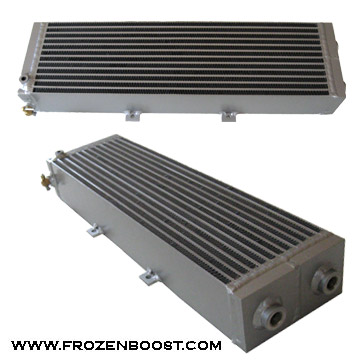
Front mounted heat exchangers:  the popular under-bumper heat exchanger is a 26″ wide x 7″ tall x 3.5″ deep water to air heat exchanger that fits under the nose of the STS-V.  Scanning google it is also a popular add to other supercharged cars.  First, it retails for $179 which makes it affordable.  Second, it fits in a variety of applications.  Here is a link to the one at frozonboost.com:

FrozenBoost.com FMHE

Very little data on how efficient it is, but I have read a number of happy reports with good results.  Also, this one has been used in some current STS-V installations with good results.

Fans

One of my favorite FMHE solutions is the one at revanracing.com, which has dual puller fans behind a heat exchanger.  It is 26x12x4.5 (29″ wide with side mounts). Unfortunately although the width looks good the height is a bit tall for the STS-V nose where only 8″ is available.  I would like to add 2 puller fans to the 7″ tall FMHE but I am not sure there is room yet.  More study needed.

Pump Flow Rates

Another topic for discussion in intercooler cooling modifications is the flow rate for the intercooler pump.  The stock bosch-sourced intercooler pump on the STS-V is a centrifugal unit and flows 8 gallons per minute (gpm) or similar.  Some replacements claim flow rates of up to 30 gpm, which apparently can move the fluid through the core too fast to effectively remove heat.   This is something that would need more inputs for study — like temperature sensors at the in/out of the laminova intercooler system, and in/out of the heat exchanger and tests with datalogs in a variety of conditions.  I think for now I will leave this topic for later, and let others experiment in this area.  One of the features however of the 7″ FMHE is it has an easy place to put a temperature sensor.

On a separate note, at steady state driving the temperature change across a radiator is often only 10F.   The issue is how well the FMHE handles temperature transits such as wide open throttle induced sudden supercharger heat.

Summary

I am having a great time analyzing / studying the various engineering issues around intercooler cooling, and the body of work that people have done to test and install improved cooling solutions on their vehicles.  I think the important thing is to review it all, then setup an appropriate experiment and test, test, test.  That way we will have persuasive data on what works and what just costs money.  It is not lost on me that all of the changes people are making may make very little difference in the real world.  So my plan in general is consider, research, design an experiment, test the stock setup, select a mod, mod, test the mod.  Hopefully that will yield persuasive data, and along the way make for interesting articles here on the blog.


Datalogging the Cadillac STS-V – CANScan

This could be subtitled, datalogging for dummies.  Today was a regular sort of everything-is-complicated project day.

I wanted to get some datalogs on my 2008 Cadillac STS-V to start to study & understand how it reacts to intake air, temperature, etc.  In order to do that I needed to grab my netbook, my CanScan to connect the netbook to the Cadillac, and maybe a camera, and we’re off!

Well, no.  First I had to spend an hour looking for my netbook, a Dell Mini 9, which I seldom use.  This also makes it perfect for the datalogging project, but means that I spent the first hour finding the netbook, and then there was a delay while getting it recharged and able to operate on battery, researching why the battery was not charging properly, etc.

Luckily while I looked for my netbook I found the CanScan USB in the garage, by Harrison R&D.  The CanScan is a USB to CAN bus interface module.  The Cadillac speaks CAN bus, so with this interface module my netbook, once I found it, using the appropriate software, also from Harrison R&D, could speak to the Cadillac.  I also had not used the CanScan in years but luckily it was on the tool shelves.

In between I found my Flip video camera and worked on getting it charged.  For naught as it turned out, as I didn’t actually take any pics, and by the end realized that my model does not charge on the USB port, but rather takes disposable AA batteries.  Oh good.

Anyway, with the netbook and the software and the interface and the flip camera with new batteries and in the STS-V and remembering how to get it all to play together,  I was able to capture this datalog of a drive around the block:

Click the graph to open a larger version; perhaps right-click and put it in another tab or window then come back.  I’ll wait.

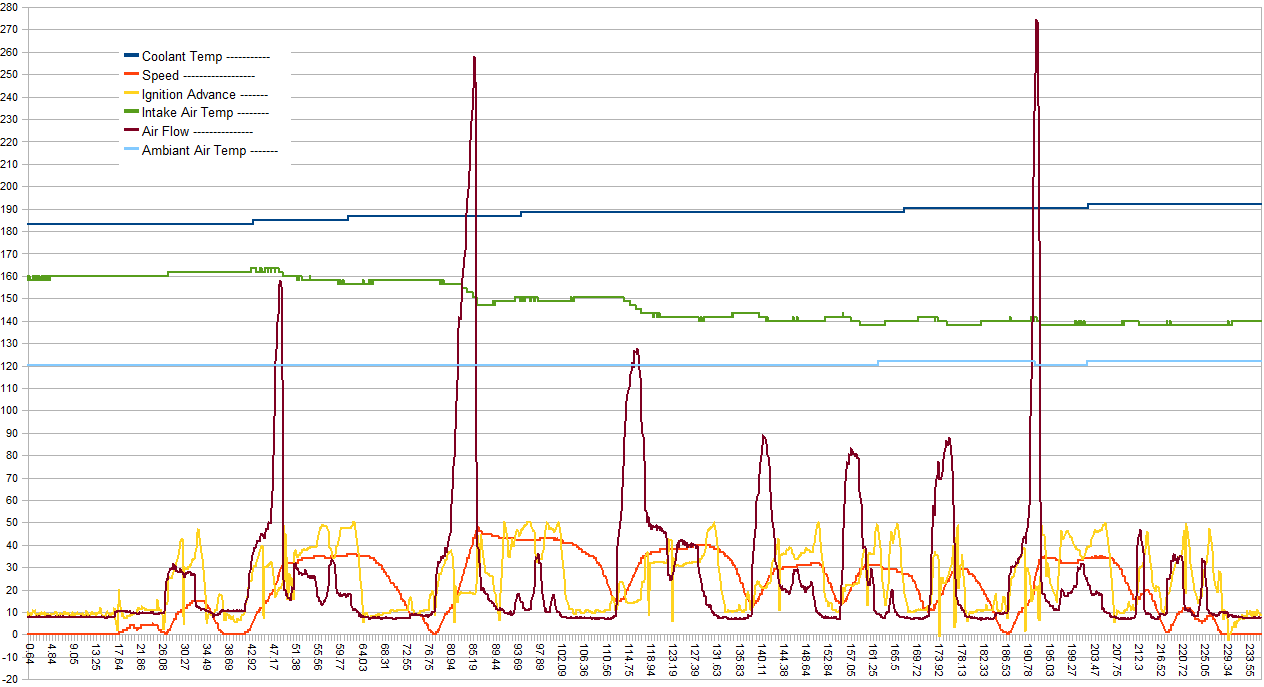
The datalog shows coolant temperature, vehicle speed, ignition advance, intake air temp, air flow, and ambient air temp over time (the y axis is shared, the x axis is time).

The brown spikes are heavy throttle application causing high air flow.  The Red is vehicle speed, which goes up with the high throttle angles.  The yellow squiggle is advance as the PCM juggles timing.

The Green line at the top, Intake Temp, and the light blue line, ambient air temp, are of interest. The darker blue at the very top is the radiator coolant temp, which is less interesting today.  I was not able to find something called Intake Temp 2, which perhaps would be the air after the supercharger.  Ambient air is perhaps the outside air, and Intake Temp is the air entering the supercharger.  So with the temp here around 95F and the Cadillac in the driveway, the hood is hot, the engine is hot, and starting my drive the Intake temp was 160F and decreased slowly as the relatively cooler air of the drive flowed over the engine compartment.  The Ambient Temp was 120F, remaining near there throughout the drive.

I am tempted to think the value shown as IAT is IAT2, since even with heat soak it is hard to think the car would be at 160F at the intake to the Supercharger, but hopefully I can find the right info to ask the gadget to send the IAT2 temperature as well in my next test.

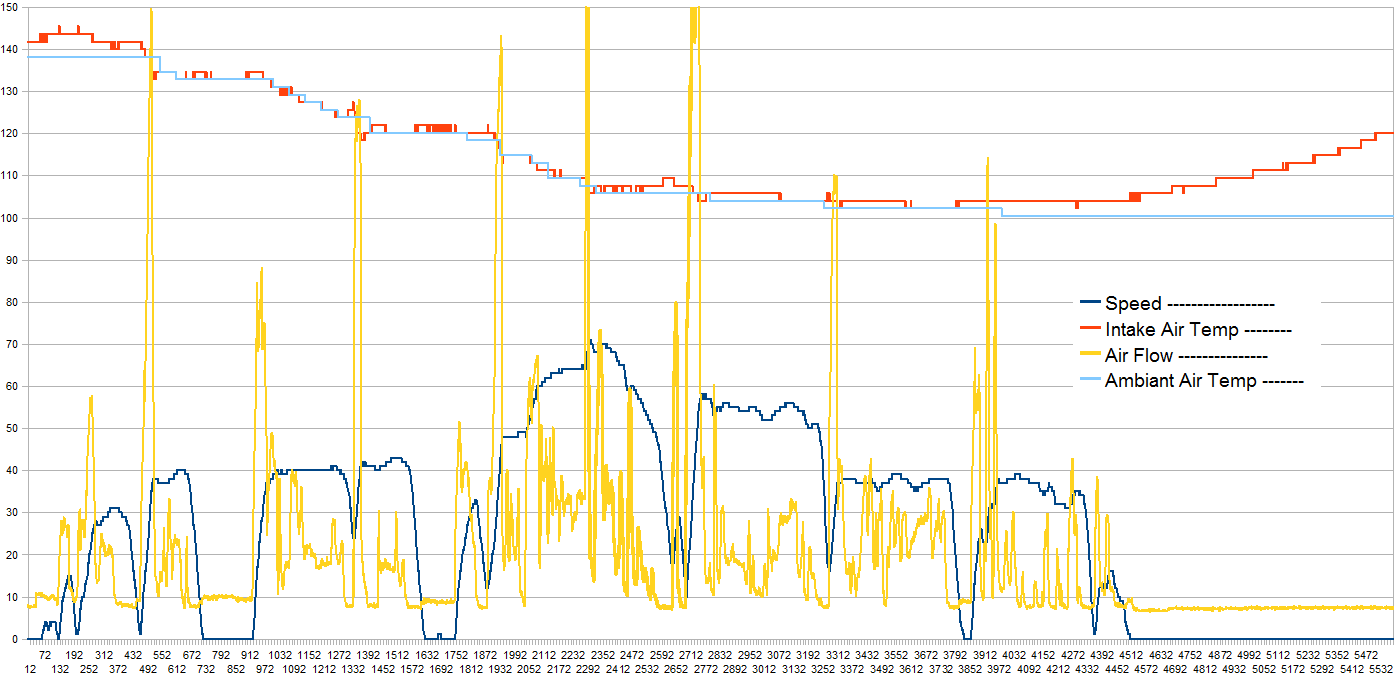
Here is a comparative (and also too crowded) datalog showing IAT falling to near ambient temp when on the highway, then zooming up when in traffic.

Datalog of a run up and down the Highway, then stop for Icecream and stuck in traffic