Cadillac ATS the Journey – The Transcript

Cadillac has begun a series of video previews for the upcoming Cadillac ATS smaller-than-a-CTS model on youtube.

Interestingly, Cadillac had previously said that the ATS name was not final, but certainly they are using it here to refer to this model (along with everyone else), so perhaps it is becoming more final now.

Here is a transcript from the audio:

Dave Mikels, Energy & Powertrain Integration Engineer:

This is like the Mecca for auto enthusiasts.  It was labelled by Jackie Stewart as ‘The Green Hell’.  Its an experience like no other.

Chris Berube, Lead Development Engineer:

These trips to Germany and the Nurburgring are extremely special to me.  I like the culture’s focus on everything being right and precise.

Mark Reuss, President, GM North America:

If you want to compete with everybody who’s the best in the world, this is where they do it.

Dave Mikels, Energy & Powertrain Integration Engineer:

Making a car that is great on the ‘Ring, you will disappoint no one.  And that is the whole reason we come here.

Chris Berube, Lead Development Engineer:

The Nurburgring itself is special in a number of ways,  It’s not the fact that its famous — in some cases it is infamous — once you enter the track and you start driving it, it requires and demands your full attention.

Our test period here is a 2 week period.  We work through the weekend; we basically maximize our time here. There is certainly a lot of pressure on this program.  We are targeting some competitors who are known to be leaders, and have been for quite some time.  If I had to describe the ATS to someone, I’d really focus on the low mass, agile, fun to drive — yet at the same time, it is a Cadillac, and it will have luxury appointments in it.

We want to come out of here having pushed the boundaries, increased the strength of  the car, and be able to demonstrate that when we get home.

Dave Mikels, Energy & Powertrain Integration Engineer:

Being successful here is what makes our cars successful.

Next on ATS:  Rear toe?
Cadillac STS-V LC3 Boost vs Engine RPM, Gear

Taking an export from my HP Tuners datalog, I have been doing a bit more data analysis of various parameters.

Perhaps I am doing something wrong, but there appears to be a ‘hiccup’ in the csv export of the HP Tuners, in that the RPM is exported to the comma delimited file with a comma-formatted value.  For example, 2450 rpm is exported as 2,450 rpm so when imported as a comma delimited value it gets split into 2 and 450.  So, once I manually fixed that in my target file then I could import the data and begin to make some charts.

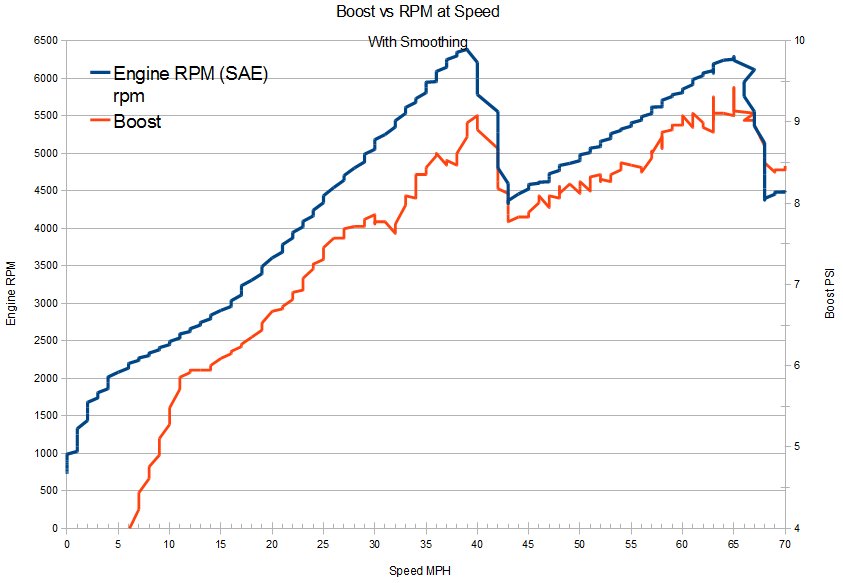
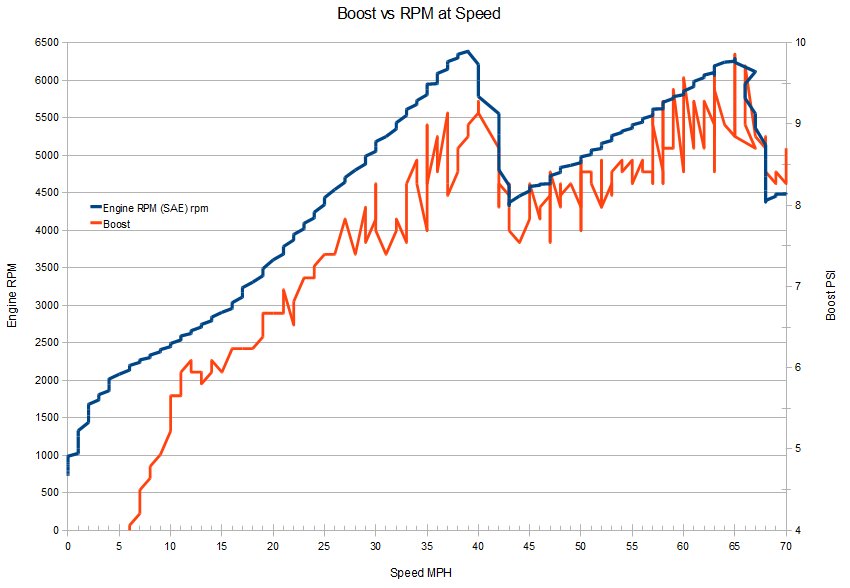
These charts show RPM across speed 0-60 mph, along with Boost at the same speeds.

RPM vs Speed vs Boost PSI

RPM is shown on the left Y axis, and Boost PSI on the right Y axis.  Speed in MPH is along the X axis.

Boost is certainly spikey measured this way.  There may also be other factors involved.

The Boost PSI is calculated by comparing the Manifold Absolute Pressure (MAP) with the V’s Barometric calculation (Baro).  One can see that the V does not shift at exactly the same RPM at 1-2 and at 2-3 although I believe they are both specified to shift at 6500 RPM.

This is the same graph with some smoothing done by averaging of values, 2 prior to and 2 after each point.

RPM vs Speed vs Boost PSI Smoothed

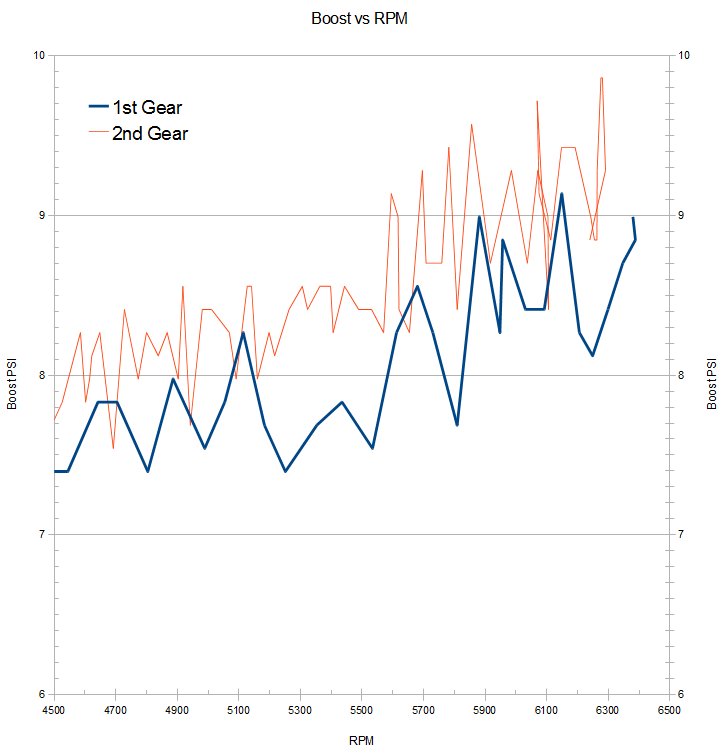
Finally, here is a graph showing boost in the target range of 4500 RPM to 6500 RPM with boost in 1st gear shown in blue and boost in 2nd gear shown in red:

Boost by RPM by Gear

Summary

My conclusion is that boost is in fact higher in 2nd gear than 1st gear.  This is perhaps due to more air flow into the intake at speed?  I am not certain.

On the graph Boost appears to settle around 9 PSI at high RPMs.  Boost in this dataset peaks at 9.86 PSI which in the smoothed set is 9.43 PSI.  The STS-V was designed for 12 PSI of boost.  If we assume the supercharger makes 12 PSI of boost then this reading after the Laminova tube intercooler suggests that the pressure drop of air across the intercooler is 2.57-2.14 PSI.

Cadillac STS-V: MAT vs IAT2 vs IAT Advance

I am continuing to study the effects and behavior trends for intake air temperatures (IAT) versus after the intercooler air temps (IAT2), versus Manifold Air Temps (MAT).

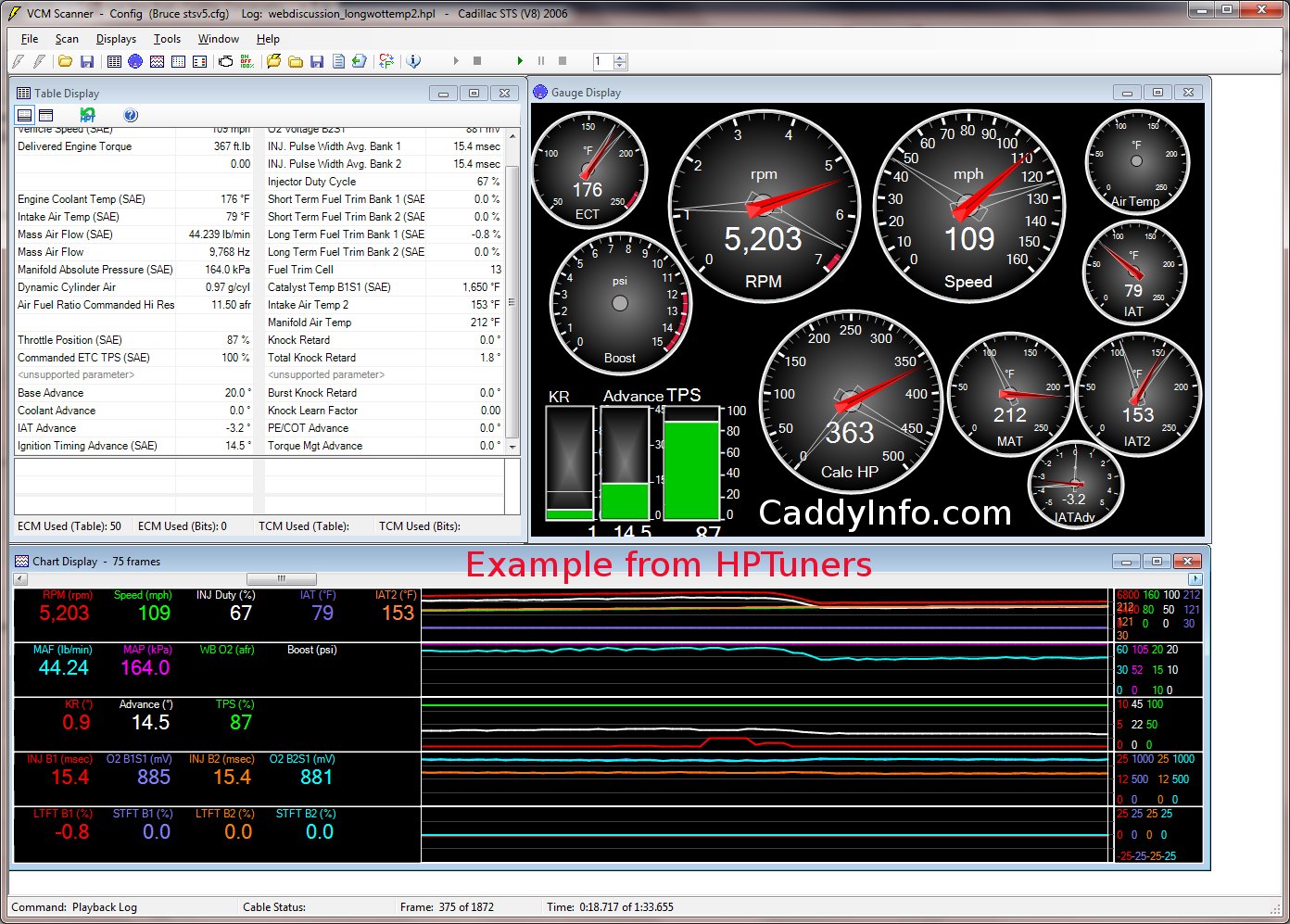
This graph is a tuner discussion taken from an .hpl download in this thread.  It is not my STS-V, just interesting to see the data from this run.  In the run the author was studying the relationship between MAT, IAT2, and the effect of IAT on timing advance (IAT Advance).

HPTuner Dashboard from a web example

What this dash shows is a moment in time as the STS-V is about to shift from 2nd to 3rd gear at 6188 RPM and 64 mph.  The IAT incoming air temperature is 79F, so a mild day.

The IAT2 is 117F, taken off the sensor.  The MAT is a predicted value for the actual manifold temperature as follows:

ok there is some hidden logic here you cannot see, the IAT2 PID displays the raw IAT2 sensor reading. The IAT Spark table uses a prediction from the IAT2 reading that is meant to compensate for the slow moving IAT2 sensor. To predict IAT2 temperatures faster than the IAT2 sensor can actually measure them. Now for the happy coincidence: The MAT value is calculated from this predicted IAT2 value (using the usual Bias and Filter tables) and for your application the bias tables are all 0. Meaning MAT = Predicted IAT2.

So in other words, the IAT2 is useful, but the MAT perhaps reflects the value that the IAT Advance will use.  What we see here is that the MAT temp of 109F the IAT Advance is 0 degrees.

Later in the run as the MAT goes up to 212F the IAT Advance falls as low as -3.2 degrees.

Hp Tuners test drive snapshot example2

Summary:

MAT is perhaps as important as IAT2 in understanding the LC3 Supercharged V8’s responses to temperature over time.  After adding MAT to the Table display in HP Tuners one can select F instead of the default of K degrees, and same for the gauges so that MAT shows apples to apples with the IATs.

Generally the MAT changes much more rapidly than the IAT2 value, which as described is the purpose of its use.  It swings higher than the IAT2 max, but also recovers faster to lower temps.