Tires: Going for the Spare

I like my Cadillacs as touring cars.  Cadillac models  make terrific road trip cars since they are comfortable to travel over long distances, yet offer terrific performance.
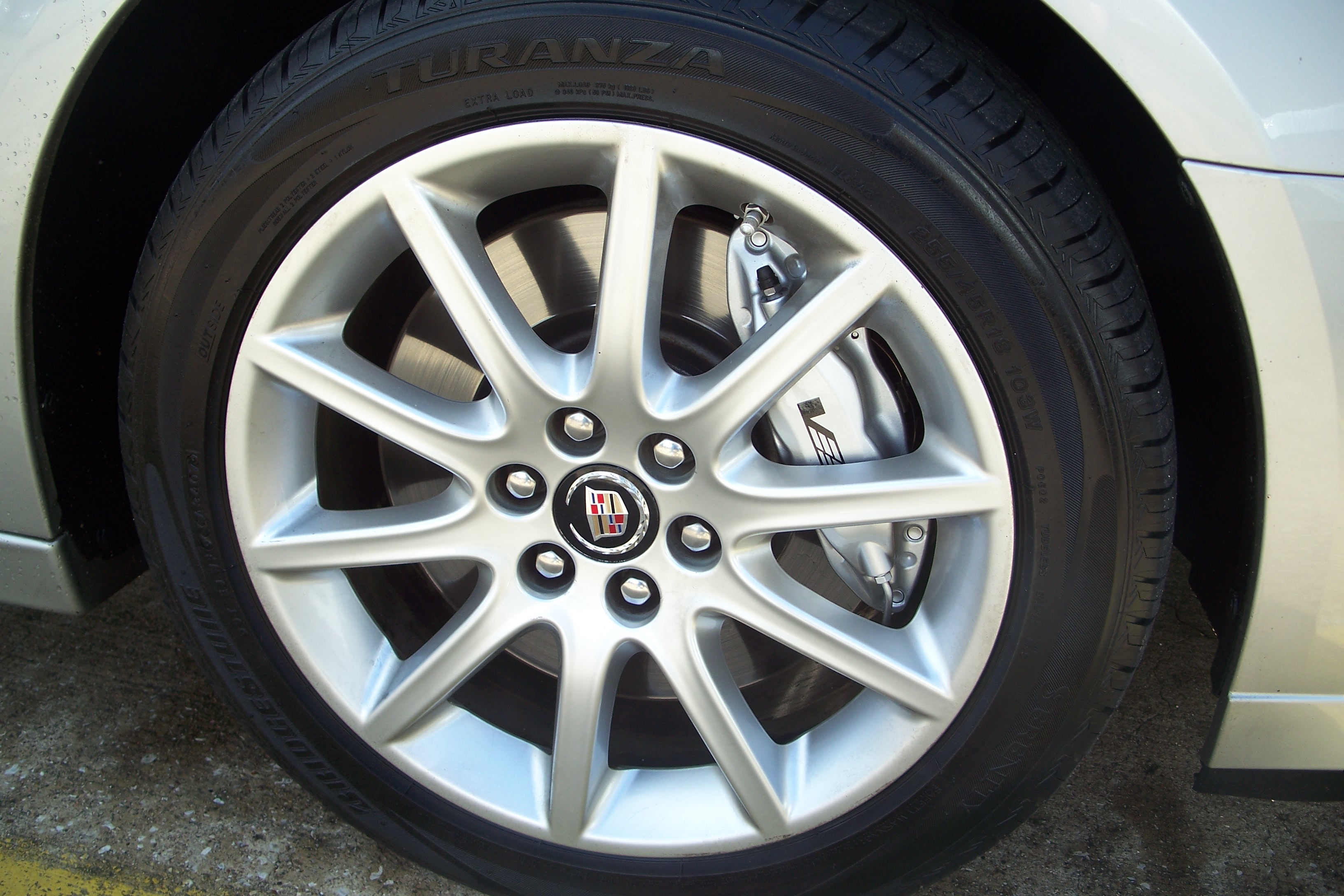
 

2008 STS-V wheels on a Test Drive V

Because of my recent tire issue I recognize I am sensitive on this topic, and perhaps old-fashioned, but I would like to have a spare tire in the trunk for when you just have to have a spare.  My 2008 Cadillac STS-V does not have a spare; it came with runflat tires instead.  This seemed news to the roadside assistance people, who although they were happy to come put on the spare for me were not all that much help other than to offer to tow the car.   I happened to be alone on a Sunday morning that day, but if I had been on vacation with my Wife it would be been a bigger deal.

The front wheels on the V are 18″ x 8.5″ x 51mm offset; the rears are 19″ x 9″ x 56mm offset.  The front tires are 255/45-18 and the rears are 275/40-19.   The OEM wheels are made by Speedline, and are nice wheels.

The wheels are different sizes front to back, and all the tires are directional, which means they have to be mounted to rotate in a specific direction.  So the right front can’t be put on the left front without remounting the tire on the wheel.  This is perhaps the root of the issue with having a spare, and why the car came with the runflats.

My first thought was since the outer diameter of the 255/45-18 and the 275/40-19 are very similar, just put the 18s on all the way around the STS-V, front and back.    Then purchase a spare wheel/tire, and put it in the trunk, along with a jack, etc.  So plan A would require 3 new 18″ wheels and 3 new tires.

The directional spare tire/wheel 50% of the time would be on ‘wrong’, but would do to get us to the next stop or two until we could get a proper tire mounted.

Next I think plan B is to consider that the front and rears ARE almost the same outer diameter.  So if a front wheel/tire will mount on the rear, then the same spare could also work for getting to the next stop or two.  There is a difference in offset between the fronts and rears, and wheel width, but I will have to examine on the V for fitment.    This would also impact ‘plan A’, since it is possible that a front wheel/tire won’t work on the rear at all.

BUT if a front wheel/tire will work on the back, then a front spare wheel/tire would work as a spare for all corners, and plan B can be to just get one 18″ wheel/tire combo, put it in the trunk with jack and wrench and mark it done at less out of pocket.  That would satisfy my sense of frequently not needed versus like to have.  The tire pressure monitoring system won’t like ANY of this, but that can be sorted out.
 

CarTest – Cadillac STS-V vs Driver, Temp, WHP, Final Drive, Redline, TopSpeed

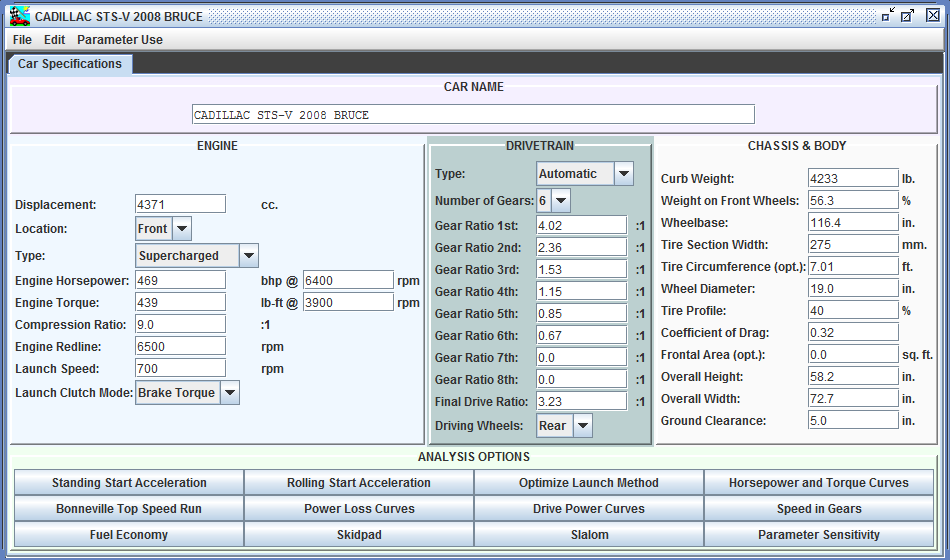
I enjoyed Cartest back in the day in the dos version, and picked up the latest JAVA stand-alone version of CarTest 2000.  CarTest is a simulation that makes it easy to compare a variety of parameters for your vehicle to determine likely effect if you change that parameter.

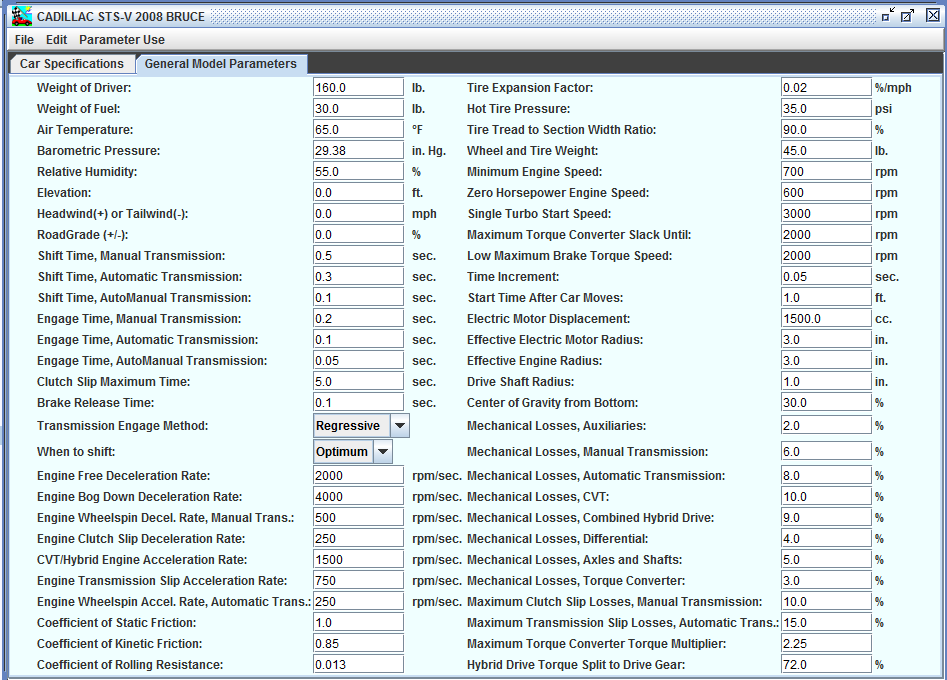
STS-V Cartest General parameters

One parameter that gave me pause is the redline.  I think of the redline for the STS-V as 6800 RPM, but I note that the ‘max shift speed’ for the 6L80E transmission is 6500 RPM, and the fuel shut-off for the LC3 is 6700 rpm, so I need to research where the V shifts further.

Cartest predicts a 2008 STS-V will go 0-60 mph in 4.68 sec with a 1 foot roll-out at 65F 29.9 baro 0% humidity and a 160 lb driver.

In my first test for my 08 STS-V at 87F and 29.69 baro humitity 64% I measured 5.39 sec 0-60 mph.  If I put these parameters into Cartest the prediction would be 4.92 sec for those conditions.  In the test I learned that I would need to launch my V carefully for the best times (no news there).

In my second test Conditions: Weather: 100F per the car, 96.5 at the weather station; baro 28.85 in I measured 5.29 sec; Cartest predicts 5.26 sec for 0-60 mph for those conditions.

I read these Cartest predictions as what I should have been able to do with the V on those days.

The car specific parameters are set by creating and modifying Car Specific parameters to be used in the place of the general parameters used below:

Car Test General Parameters that can be modified with Car Specific Files

The fun part of CarTest of course is predicting things we don’t know.  For example, I am hoping that my upcoming Spectre Intake will add 40 whp and 40 lb-ft of torque.  Here is a comparison back on the perfect 65F day with CarTest default standard conditions:

Selected Cars: 1. CADILLAC STS-V 2008 BRUCE 2. CADILLAC STS-V 2008 BRUCE SPECTRE
Time to Speed sec
0- 30 mph 1.75 1.61
0- 40 mph 2.75 2.18
0- 50 mph 3.75 3.68
0- 60 mph 4.75 4.66
0- 70 mph 6.41 6.20
0- 80 mph 8.00 7.65
0- 90 mph 9.71 9.20
0-100 mph 11.62 10.93

This resulted in the table above, predicting that the STS-V 0-60 time at 65F 29.9 baro 55% humidity with me driving with the new intake (hopefully) will drop from 4.75 sec to 4.66 sec.

The Quartermile time would have more effect — dropping from 13.35 sec @ 105.55 mph to 13.12 sec @ 107 mph.  Yes, I know that some people have done under 13 sec with modified STS-V’s, and good.  One has to consider the conditions stated, which makes a difference.

Wow you might think — add 40 hp and only get ~0.1 improvement 0-60?  How does that make sense?  The STS-V is not hp limited on the 0-60 run — it is traction limited.   Look at the whole table from 0-100 mph above and you can see a clear advantage predicted for the intake.

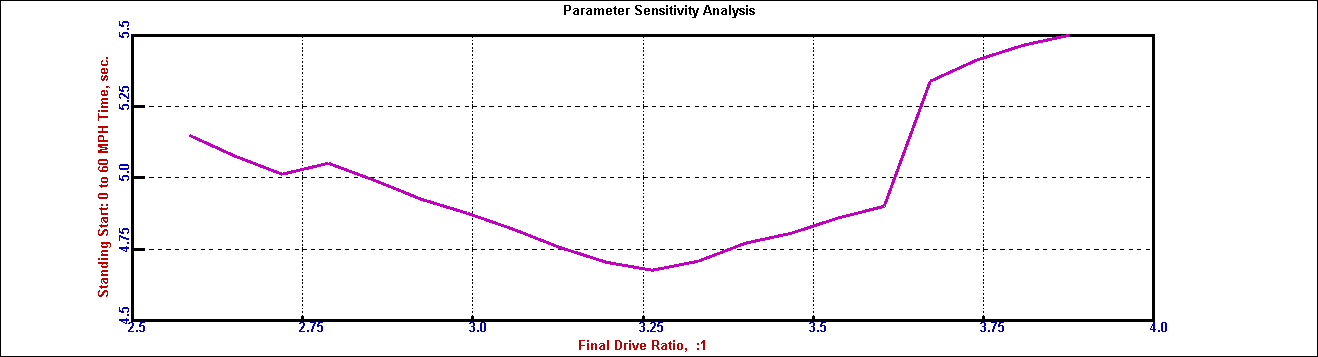
Another fun option to consider — what is the ideal final drive ratio for the STS-V to maximize 0-60 time:

Parameter Sensitivity - Final Drive Ratio

What this graph shows is the 0-60 time on the Y axis, using a variety of final drive ratios along the X axis.  The actual final drive in the STS-V is 3.23:1, which appears to be almost perfect for the car.

Remember my questions about the redline?  What WOULD the ideal redline be:

Parameter Sensitivity: Redline

This graph shows 0-60 mph time on the Y axis, and Redline on the X axis.  There is very little change from 6500-7500 rpm, which suggests that 6500 rpm is a good choice.

Another fun aspect of CarTest is the Top Speed Calculator.  A ‘stock’ STS-V is electronically limited to 155 mph.  CarTest estimates that on a perfect endless flat road it could do 172 mph.  The Spectre intake might raise this to 178 mph.  In a standing mile, the STS-V should hit around 149 mph at 34 seconds, so at the Texas Mile which measures from a rolling start it might do somewhat over 150 mph.  There is an overboost mode that kicks in over 150 mph after 150 seconds that drops the boost from 12 psi, but it would not come up in the time required for a mile.

I am glad I ‘refound’ CarTest, and that it is still available at all, and at a reasonable price.  Nothing replaces actually testing changes on your car, but I like to have some predicted results to use for trades: IF I do this for that much money what would happen?  Trades that one can work through without actually spending money are preferred.

I also should mention that when the Cadillac & GM Performance Division Engineers spent time getting the STS-V just right, they clearly made some good choices.

Cadillac goes with Alpha & Omega

Cadillac apparently has internally approved development of a modified Zeta platform called Omega.   The Zeta platform is the GM Full-size Rear-wheel Drive platform.  GM platforms lately have received greek letters for their internal references.  The Zeta was originally designed as a replacement for the W, H, and K platforms, but was not used, instead becoming the underpinnings of the Chevrolet Camaro.  The long wheel-base version of Zeta has also arrived in the form of the Chevrolet Caprice police vehicle.

Zeta has an independent suspension utilizing MacPherson struts coupled with a dual ball joint lower A-arm in front and a four link independent setup in back.   Holden is working on a variant of Zeta to make it lighter and more economical.  One would suppose the new Cadillac Omega platform would be lighter and more premium — utilize more expensive components for the same platform in order to save more weight and improve performance.

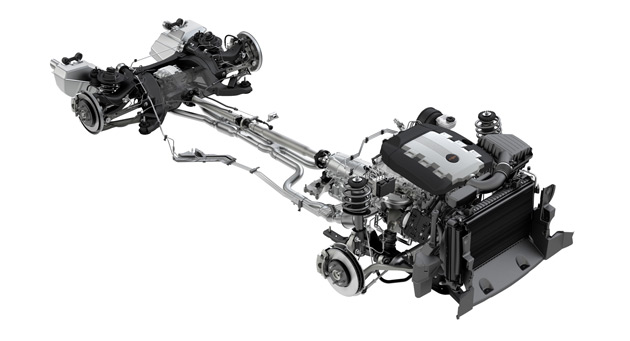
GM Zeta Rear Wheel Drive Platform

The upcoming Gen V V-8 is the suggested powertrain for the new Top-Cadillac.  This seems a good selection to me as it should give terrific power and relatively good fuel economy for what promises to be a heavier vehicle.

The upcoming ATS will be on the Alpha platform, and the refresh of the CTS will also go onto a long-wheelbase Alpha.  Alpha was originally designed as a small rear-wheel drive program.  The advantage of the new Omega platform perhaps is that it allows for a even longer wheelbase for the upcoming Top-Cadillac.  Also, with the addition of the Omega platform for the larger Top-Cadillac (ULS?) Cadillac will have a nice mix of platforms to develop from.  The upcoming XTS is on the Epsilon II Front-wheel drive platform, although it may be all-wheel drive with rear-wheel drive bias.   It will be interesting to see how the XTS, ATS, CTS, and SRX fare in the showroom.