Cadillac STS-V First PerformanceBox Test

I have a RaceLogic PerformanceBox which can be used to measure vehicle performance in a variety of tests.  The Performancebox is a GPS based meter and data logger.

Unfortunately, I don’t get to use it all the time, so when I do there is a short period of re-familiarization.  For my first tests, no data got written to the memory card.  After I changed the setup to “yes, please write data” things improved dramatically.

Here was the best run written to the card today:
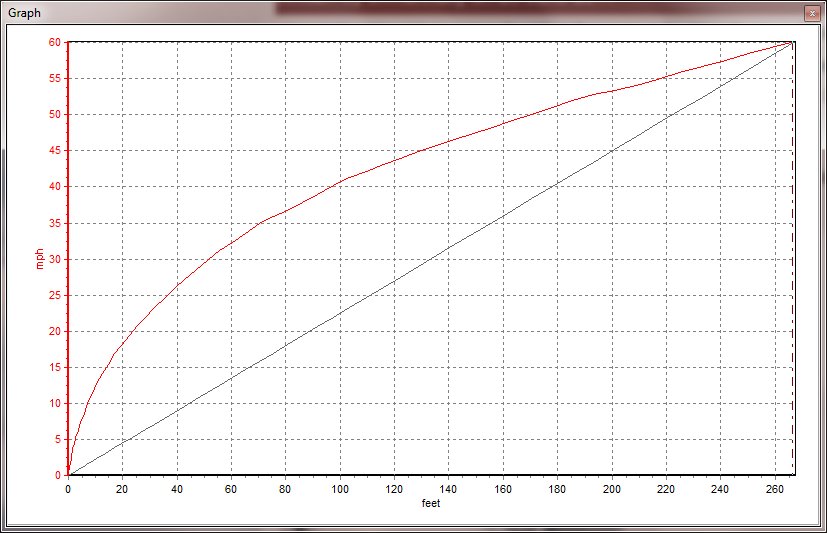
MPH vs Distance shows challenge getting off the line


Accel results
Speed(mph)     Time(s)
0-60                   05.4

With 1 ft roll-out details:

Speed(mph) Time(s) Dist(f)
0 0.00 0
10 0.71 7.13
20 1.45 23.53
30 2.23 51.94
40 3.09 96.6
50 4.21 170.2
60 5.39 265.8

Roll-out is a determination for ‘when’ the test time begins.  At a drag strip, there is up to 1 foot of roll-out before the timing lights are tripped, hence the term.  In other words, due to surface quality and wheel-spin it took me 0.59 sec to get 1 foot forward, but at the track that time would not have been included in the results and is not included above.

Weather Conditions: 87F; barometric pressure 29.69 in; humidity 64%.  Fuel: Full

Not sparkling time for the Cadillac STS-V, which Cadillac measured at 4.9 sec 0-60 mph with roll-out.  Most magazine tests ran high 4.x to low 5.x sec.  Road & Track measured 4.7 sec 0-60 mph for the STS-V.

I feel the 2008 STS-V is capable of a better time.  Getting the STS-V off the line involves a great threat of wheel-spin to be avoided.  Of course, my test area is not a sticky well prepared launch spot like at the drag-strip, but it does closely model real world circumstances.

On the bright side, this is a new ‘best’ for my personal vehicle measurements; my previous best was 0-60 in 5.95 sec in my modified CTS 3.6L and was measured on the AP-22 meter in more favorable circumstances.

Stock
STS-V


Mod CTS 3.6L
Speed (mph) Time(s) Dist(f) Time(s) Dist(f)
10 0.71 7.13 0.68 4
20 1.45 23.53 1.40 21
30 2.23 51.94 2.33 55
40 3.09 96.6 3.31 105
50 4.21 170.2 4.55 187
60 5.39 265.8 5.95 301

A line by line comparison — albeit of apples and oranges since different days, different gadgets — echoes the same issue — get the STS-V off the line faster and it would have much better times, and at 60 mph is 35 feet ahead of the CTS.

T is for Texas STS-V @Cadillac


I have been having to travel a lot lately, so the Wife’s Chihuahua Arnold is not getting to go on as many walks, rides, fun stuff as he would prefer. So when I am home, he is available in case I do anything mildly interesting.

For Father’s Day this year I asked for vanity plates for the new-to-me 2008 Cadillac STS-V.    I picked them up today, and ran out tonight to a) take the dog for a fun Cadillac ride and b) grab a snap.  Arnold decided he NEEDED to be in the picture, so here it is with him in the foreground.

You order them online in Texas, then the Registration office emails when they are in, and updates your registration sticker to reflect the new tags.

Love the new plates.  They look odd enough that they don’t look like real license plates, but they match the Cadillac well and I am happy with the result.

A tale of two Blown 4.4L V8s – BMW & @Cadillac

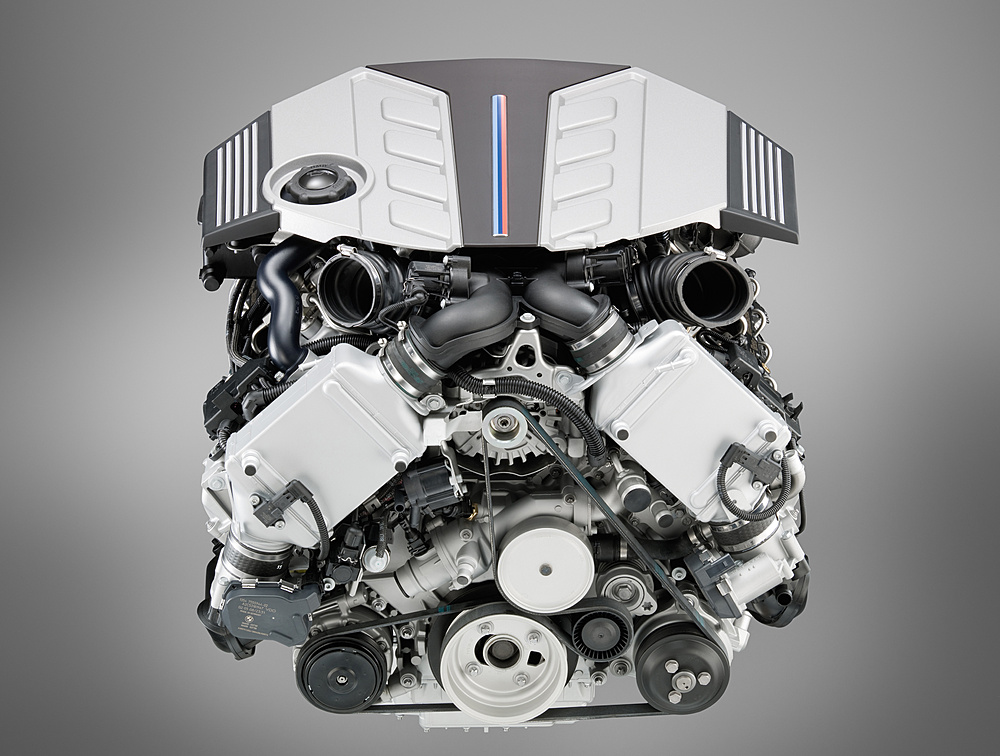
The new 2012 BMW M5 uses the twin-scroll, twin-turbo 4.4L V8 from the BMW X5M/X6M SUVs.  In the 2009 BMW trucks this powerplant made 547 hp, in 2010 555 hp, but in the new M5 makes 552 hp.   This all seems to need a bit more sorting.

This engine is the BMW S63, which is a twin-scroll version of the N63 V8.  For the 09 trucks it makes 547 hp at 6000 rpm and 500 lb ft of torque at 1500-5650 rpm.  As in the N63, the turbos are mounted in the V of the engine.  The engines do not appear to use the BMW valvetronic (variable valve timing used instead of a throttle), since there is a perception that it is not needed with a turbocharged vehicle, but are double Vanos systems (variable valve timing,  abbr. from German variable Nockenwellensteuerung, or variable camshaft control).

BMW S63 Engine

BMW fansites were predicting 585-600 hp for the S63 in the M5, so 552 hp is a bit of a surprise.

A blown 4.4L V8 seems familiar — ah yes, that’s what I have in my 2008 Cadillac STS-V!  Of course, mine is supercharged and not a turbo model as in the BMW, and makes only 469hp instead of 552 hp.  The Cadillac uses 12 psi of boost, while the BMW pushes that dial up to 22 psi of boost.  At around 4 % improvement per PSI, a LC3 running 17 psi would make similar numbers, but would run out of the boost range for the custom Eaton M122 supercharger in the Cadillac V8.  (The Stiegemeier snake bite kit does hit 17 psi however…)

[Updated] The BMW N63 makes similar boost pressure to the Cadillac LC3, at 11.6 psi but with a 10:1 compression ratio for the BMW.  The N63 was rated at 400 hp vs the 469 for the 12 psi Cadillac.  Both the N63 and S63 are direct injected engines.  The S63 uses twin-scroll turbos, cross-flow turbo plumbing, lower compression at 9.3:1, and higher boost to build to 552 hp.

The BMW SUVs have launch control, so hopefully the M5 will benefit from this as well.

A bit surprising that BMW stopped short of exceeding the Cadillac CTS-V’s 556 hp.  A shame really, as I would love to see Cadillac turn up the wick on the LSA 6.2L Supercharged V8 in the CTS-V a bit further to 600+ hp.

More on HP: Confusingly the BMW engines are still rated in PS (German: Pferdestärke = horse strength), which is a DIN standard mathematically different from British hp used in the USA.  PS has been replaced by the kilowatt, but is still used.  The 2010 BMW X5M made 414 kW, or 554 hp.  F10.5post.com is quoting the new M5 at 560PS which converts to 552 hp, but is actually less than the 563 PS in the 2010 X5 M.  Autoblog and Jalopnik are quoting the X5M at 547hp, but that was the 09 model.  I’m sure this will get sorted, hashed, and be more clear presently.