Cadillac Commercial Confusion — Escalade Hybrid gets 20mpg city, 21 mpg highway!

The good news is there are a LOT of tweets lately on the social media site Twitter.com about the new Cadillac Escalade Hybrid. The bad news is that a lot of the audience is getting the message wrong. The base Cadillac Escalade is a full size SUV and gets 12 mpg city and 19 mpg highway as found on the Cadillac website

The Escalade Hybrid does much better, at 20 mpg city and 21 mpg highway.

So what are people saying after watching the commercial?

Cadillac Escalade hybrid – 12MPG Highway, 19MPG city. Scares me to think of the mileage it got PRE-hybrid

so an escalade hybrid would get 12 miles per gallon?

Reading the fine print of car commercials is painful to me. Example, the Escalade hybrid: 12 city/19 highway. Terrible, even for a hybrid

Cadillac’s ad agency needs to fix this quickly.  You only get one chance to make a first impression.  Apparently the commercial says the Escalade Hybrid gets 50% better city mpg than the non-Hybrid Escalade.  The small print (thank you Lawyers!?) shows that this is relative to the non-Hybrid Escalade’s 13 mpg.  People are reading the small print to mean that the Hybrid gets 13 mpg which is wrong.  The Escalade Hybrid gets 20 mpg City.  Woops.
Cadillac is defined by Performance and Luxury, not by Cylinder Count

The Press has been agonizing over the idea that a new future Cadillac might have a 4-cylinder engine.  I addressed this a while back.  However, Autonews.com had an editorial on the subject today, (subscription required), bemoaning the idea that a REAL Cadillac cannot have a 4-cylinder engine and that it would be the Cimarron all over again.  All the bad things I mentioned in the previous article.

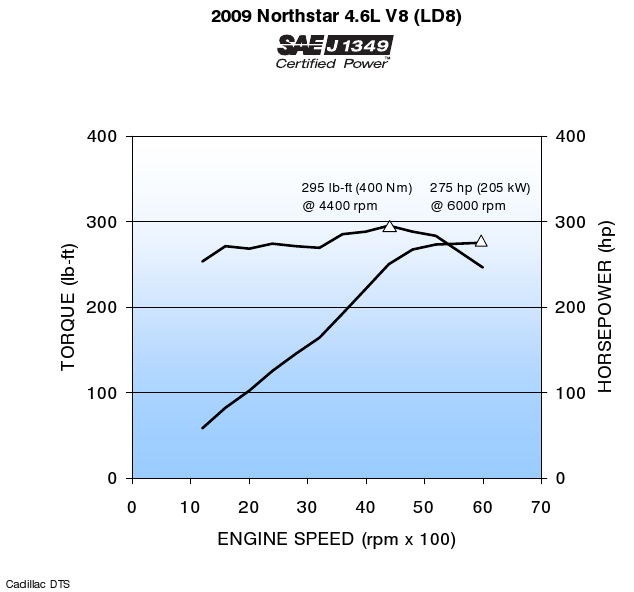
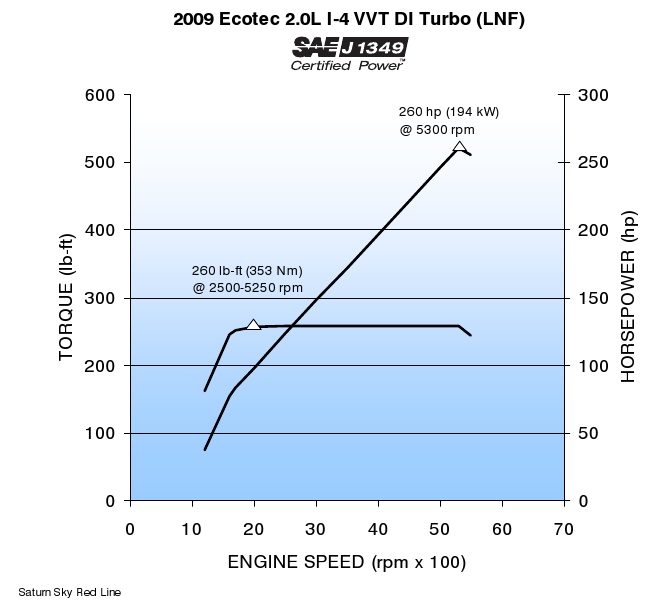
Let’s look at the facts.  Here are the performance output graphs for two powerplants:

Engine Dyno Saturn Sky Redline 2L Turbo 4

Engine Dyno Saturn Sky 2L Turbo 4

Engine dyno Cadillac DTS Northstar V8

Engine dyno Cadillac DTS Northstar V8

What do these show? That for a Driver, the GM Powertrain’s I4 Turbo will perform identically to the Northstar V8.

As one of my GM Engineer friends said, horsepower sells but you drive torque. Why do we WANT V8 or V12 or V16 engines? Because they give terrific torque at very low RPM very smoothly. So, especially in a large Luxury Cadillac, high torque at a low RPM means that the vehicle moves out smartly as soon as you engage the accelerator. So what is the problem with small displacement 4-cylinders? They tend not to make as much torque, and they make power higher in their RPM band. They use gearing to take advantage of the higher RPM power. But that means the power is not RIGHT THERE when I put my foot down.

How can we mitigate that? By using direct injection, high compression, and turbocharging as done with the I4 turbo. Now it puts out torque and horsepower similar to our current V8, for identical performance with better fuel economy at idle and off-power. We already have it available, in production. A new powertrain control module tune available now raises output to 280-290 hp for this engine, so it actually will be somewhat stronger than the Northstar V8 in the current DTS.

But what we WANT is that performance. It does not matter if it comes from an engine with 8 cylinders, or 6 (like my CTS) or 4 like a 1915 Cadillac or even 1 like the first Cadillacs. It matters that the engine is a precision built powerplant that provides smooth power delivery RIGHT NOW when I want to go. THAT is the definition of Cadillac. It is a premium high-precision vehicle that focuses on performance and luxury.

Bring me the new latest technology and stop worrying about change. Make a terrific Cadillac with luxury and performance and people won’t care how many cylinders it has.

Cadillac CTS Arrives Down Under

Car Advice in Australia notes that Cadillac will begin sales of the current Cadillac CTS with next month’s Australian International Automobile Show.   With a great direct injected variant of the familiar Holden Alloytech engine and Cadillac luxury appointments and performance tuning, the CTS should run well in Australia.

The Australians like hot cars.  The CTS brings sharp acceleration, quick and precise handling, and a good top speed.    Hopefully if the CTS sells well then the new 556hp (415 kW) CTS-V will also be available soon.


3.6L VVT LY7 V6

3.6L VVT LY7 V6


Holden in Melbourne helped mark GM’s 100th birthday last week.  In 1926 General Motors Australia was formed which merged with Holden Motor Body Builders in 1931 to become General Motors-Holden’s Limited (GMH).  Leading celebrations at Fishermans Bend, GM Holden Chairman and Managing Director, Mark Reuss, said Holden and Australia had played a key part in the development of General Motors.

“Australians can feel a real sense of pride in the contribution this country has made to GM’s 100 year history,” Reuss said.

“Before Holden Motor Body Builders merged with GM Australia back in 1931, the Holden name was already synonymous with building car bodies for General Motors brands such as Buick, Cadillac and Chevrolet.

“That significant role in General Motors’ worldwide operations continues today. The G8 sedan was designed, engineered and is built here in Australia for Pontiac and we led design and engineering for the new Chevrolet Camaro.

Mark Reuss’ 25 year stint with GM has seen him responsible for GM’s production studios, Executive Director, Architecture Engineering and GM Performance Division, and Executive Director, North American Vehicle Systems and Architecture.  So Australia has a great point-man to bring in the best GM vehicles from around the world, like the Cadillac CTS.    And Holden has a good voice at the table as they continue to team within GM to produce increasingly exciting vehicles for the World market.