About bwnunnally

Bruce Nunnally is an independent Blogger who writes Cadillac Conversations on all things Cadillac. Connect with Bruce on Google+

@Cadillac STS-V Supercharger & Intercooler Ideas #Motorama

The Cadillac STS-V (2006-2009) featured the 4.4L DOHC VVT LC3 V8 with a custom Eaton M122 Supercharger and integrated intercooler.

This photo shows the Cadillac LC3 engine without the ‘beauty cover’, looking from the rear of the engine — so the front of the Cadillac would be right and away.
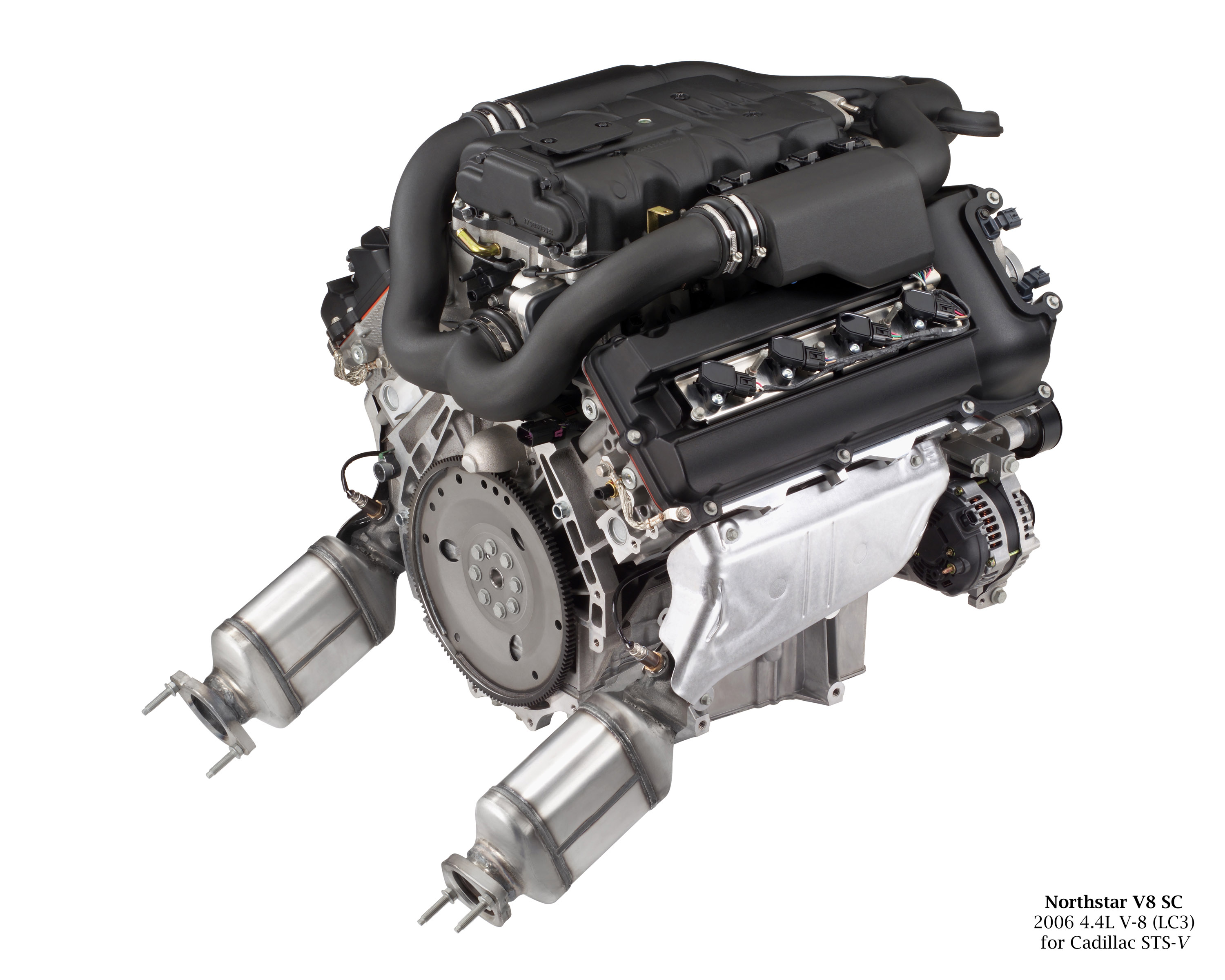
Air flows in the black tubes at the top of the engine to the ‘back’ of the engine, and into the supercharger.  Note the noise baffles in the intake tubing intended to isolate the whine of the supercharger.

This view is of the supercharger+intercooler from the back:
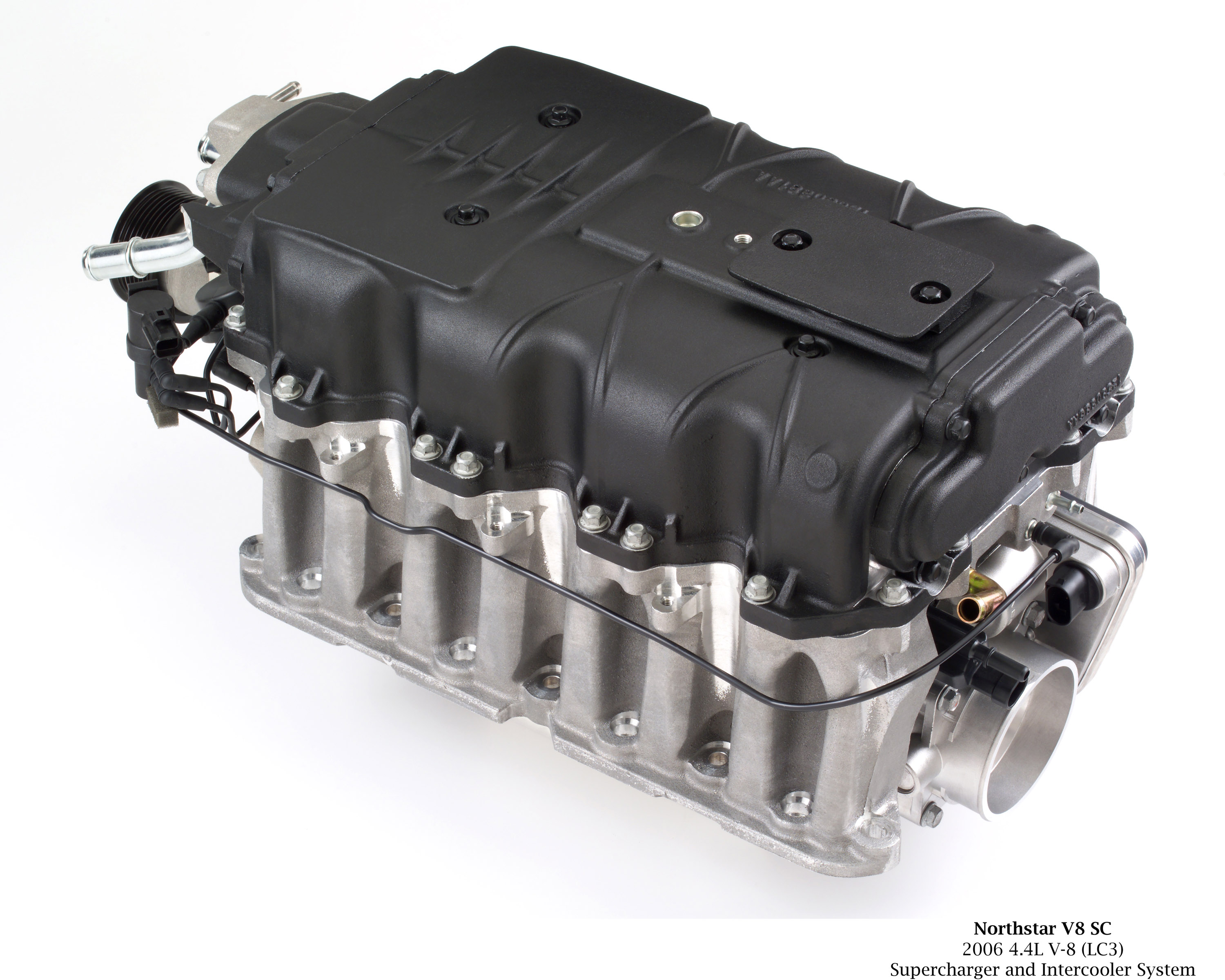
 

and the next view is the reverse angle or ‘front facing’ shot of the coolant in/out tubes flowing to the intercooler (black part).  The ‘snout’ is the drive for the supercharger.  A belt runs from a pulley below to turn the Supercharger, pressurizing the incoming air.
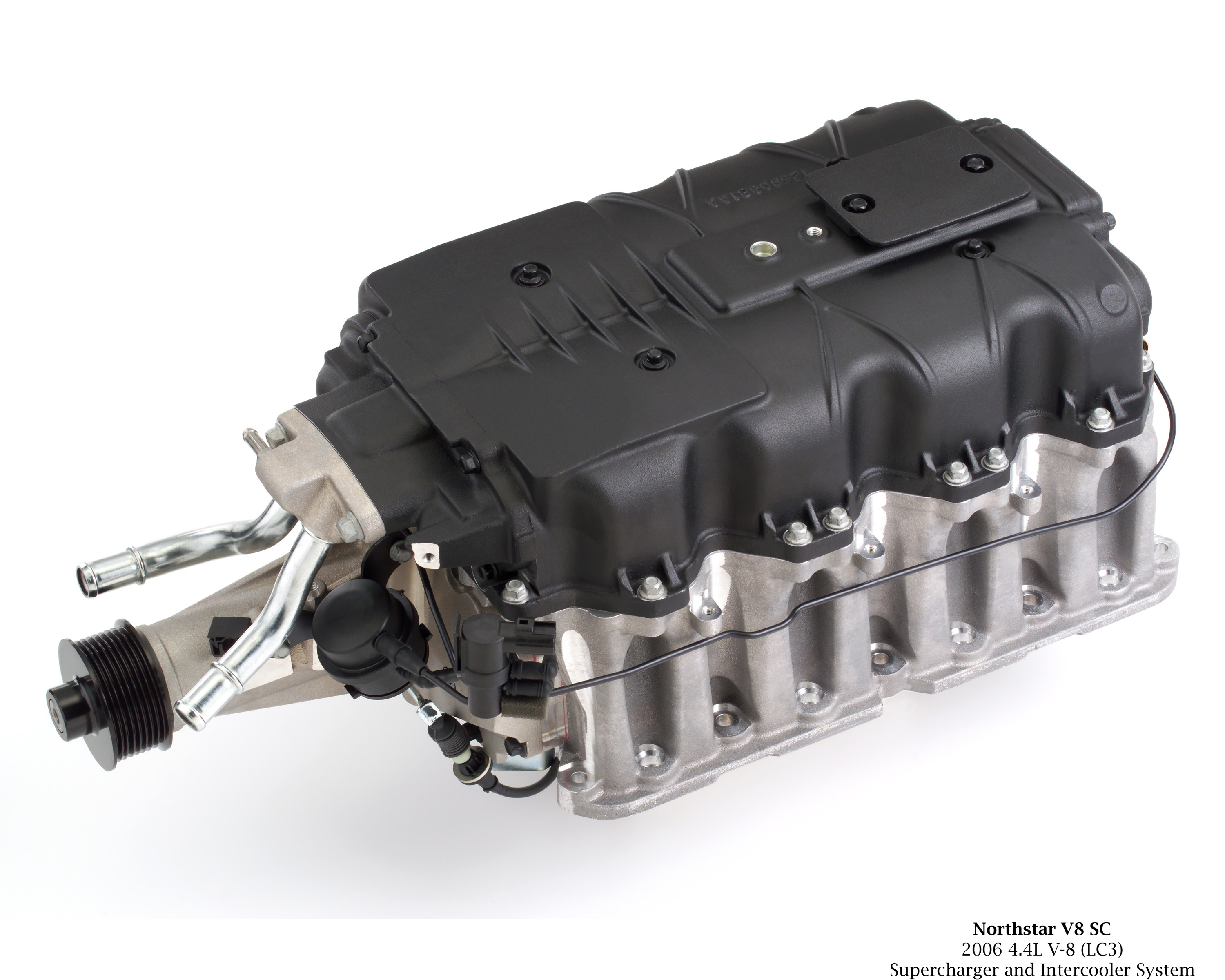
Once you open and separate the supercharger and intercooler they look like this — note the intercooler is flipped upside down here, as if you simply removed it by ‘opening it up’:

STS-V Intercooler removed from Supercharger

The intercooler is an air to water system, and features Laminova laminar flow heat exchange tubes.

The air flows into the back of the supercharger through the long intake.  Then it is pumped up from the center of the supercharger through the intercooler past the Laminova tubes, and then it flows down the sides of the intercooler casing and the supercharger casing and into the engine.

Each of the four Laminova tubes look like this up close:
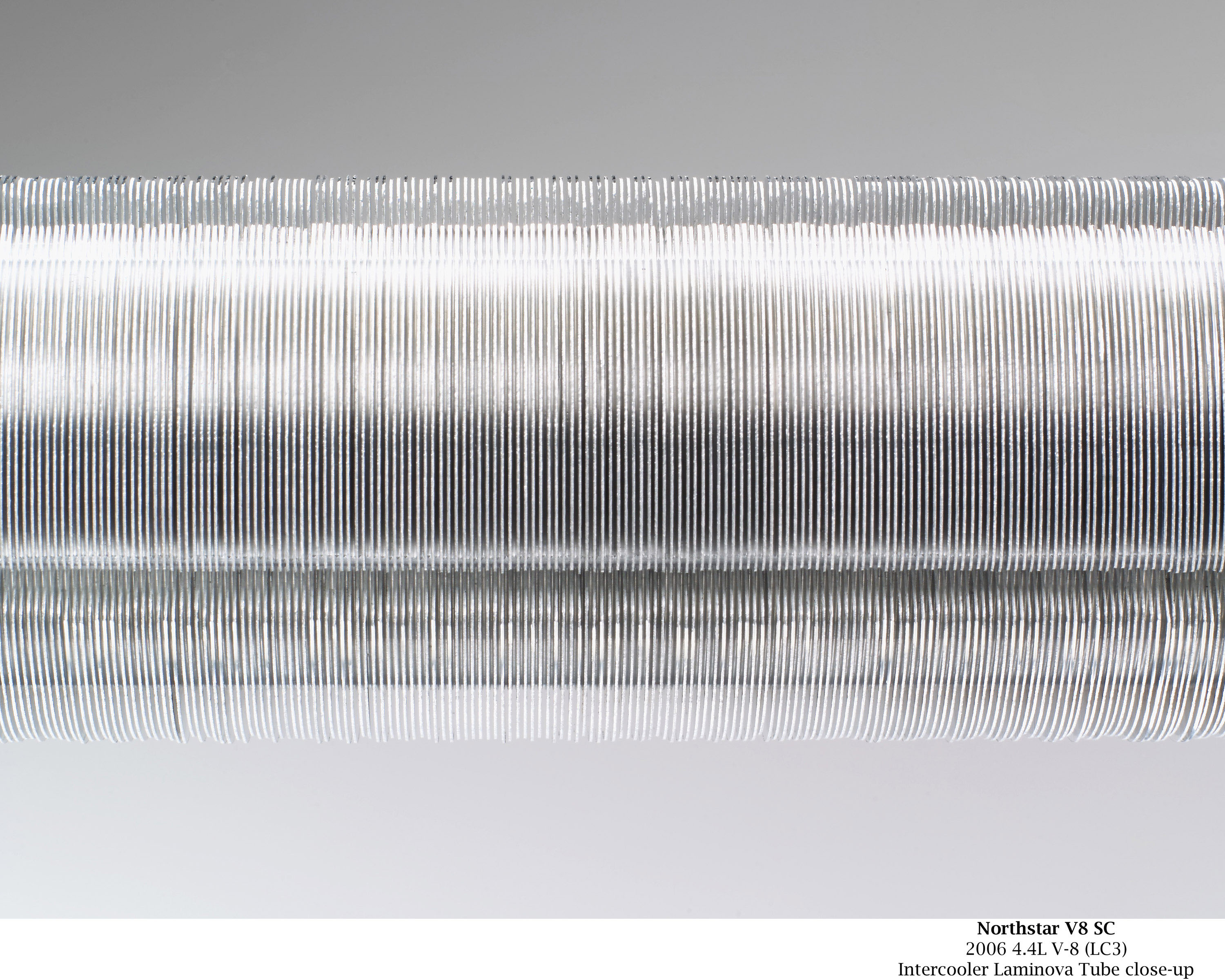
Laminova STS-V Intercooler Tubes

The science of the Laminova design is to create huge surface area with minimal air flow restriction.  The very thin fins, 0.2 mm each, along each Laminova tube collect the heat from the air passing through the 0.3 mm gaps between the fins.  The surface area presented to the air flow is approximately 5 times greater than a conventional plate-style intercooler according to Laminova, as well as reducing noise and pulsation.

The heat is conducted to channels surrounding the solid core of each Laminova tube, where liquid coolant is passing through to remove it.

It appears that the coolant flows into the intercooler, circulates through all 4 Laminova intercooler tubes, and then flows back to the intercooler heat exchanger.  The heat exchanger is like a small radiator.  The intercooler coolant system is completely separate from the engine cooling system/radiator.

The advantage of the Laminova design is that they have a very good efficiency with low pressure disruption and light weight.   A disadvantage is cost.

The CTS-V LSA engine uses a finned box air to water intercooler:
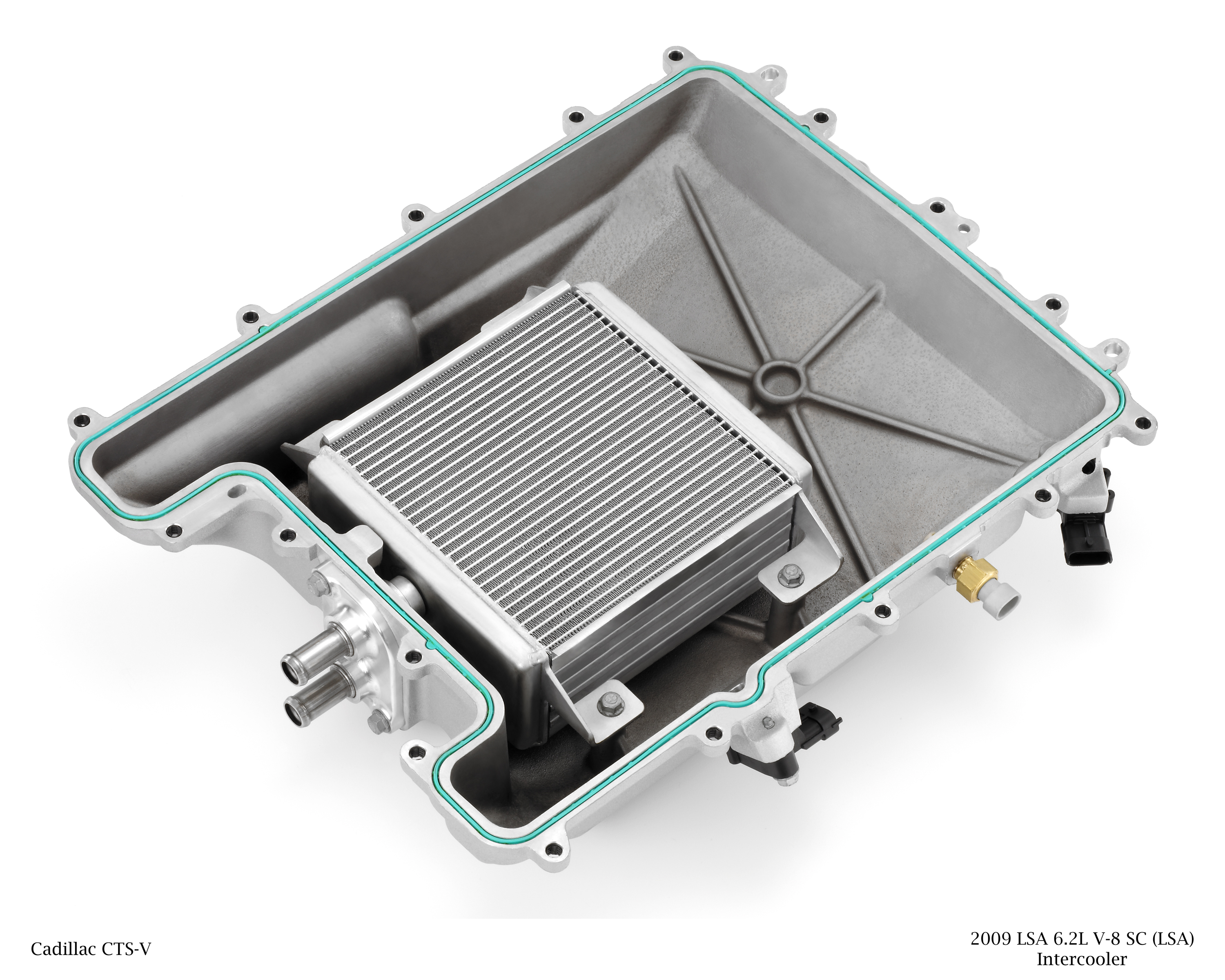
This shot shows the CTS-V LSA intercooler upside down.

How can the STS-V intercooler be improved?

An interesting ‘science project’ for the STS-V intercooler would be to replace the intercooler endcaps that direct coolant flow through one Laminova core after another with a custom endcap that directed coolant flow in parallel with all 4 Laminova cores and out after one pass.

One expert mentions that it is helpful to ‘index’ the 4 Laminova cores, so that the large fins are facing the air flow.  I am not clear looking at the images what is intended, as the Laminova cores appear to be uniform and symmetrical, unless the intent is to rotate the ‘sleeves’ the cores are contained in?

Owners are also experimenting with larger heat exchangers at the other end of the system, larger fluid reservoirs to allow more fluid to circulate and absorb heat, and higher capacity intercooler coolant pumps to circulate fluid.

On the slots that allow flow across the Laminova tubes, are the cross-pieces structurally needed?  If removed, so that the slots were just continuous single slots — flow would be increased.

Do you see other avenues to explore?

 

Cadillac Club Sweden & CaddyInfo.com Celebrate år fyra

år fyra — year four if my translation gadget works!

I would like to take a moment to celebrate that Cadillac Club Sweden continues in 2011 as a Cadillac Club Supporter of  CaddyInfo.com.

The Cadillac Club Sweden subforum on CaddyInfo was created in 2007.  There Cadillac Club Sweden members discuss Cadillacs and related topics in Swedish.  The Forum is moderated by Cadillac Club Sweden officers.  CaddyInfo’s other Cadillac discussions are most frequently in English (or American at least).

The use of an international forum like CaddyInfo for a Cadillac Club forum brings Cadillac fans together from around the world to discuss and enjoy these great automobiles.    If you are looking for a home for your Cadillac related discussions please contact me here at CaddyInfo.com.

CaddyInfo.com is Cadillac Discussion and Information website for the Cadillac Enthusiast.  CaddyInfo offers a discussion forum, technical information pages, Cadillac news, and twitter @caddyinfo.

Cadillac Club Sweden (C.C.S) was founded in Stockholm, Sweden October 1993.  The purpose of the club is to maintain and take care of Cadillac automobiles in original shape and with suitable activities promote members interest in Cadillac.


Improving a tenth at a time…

100F out today here in Texas, but testing must go on.  Mostly because inquiring minds want to know and my interest is piqued about how this could be simpler and yet any more subtle in execution.

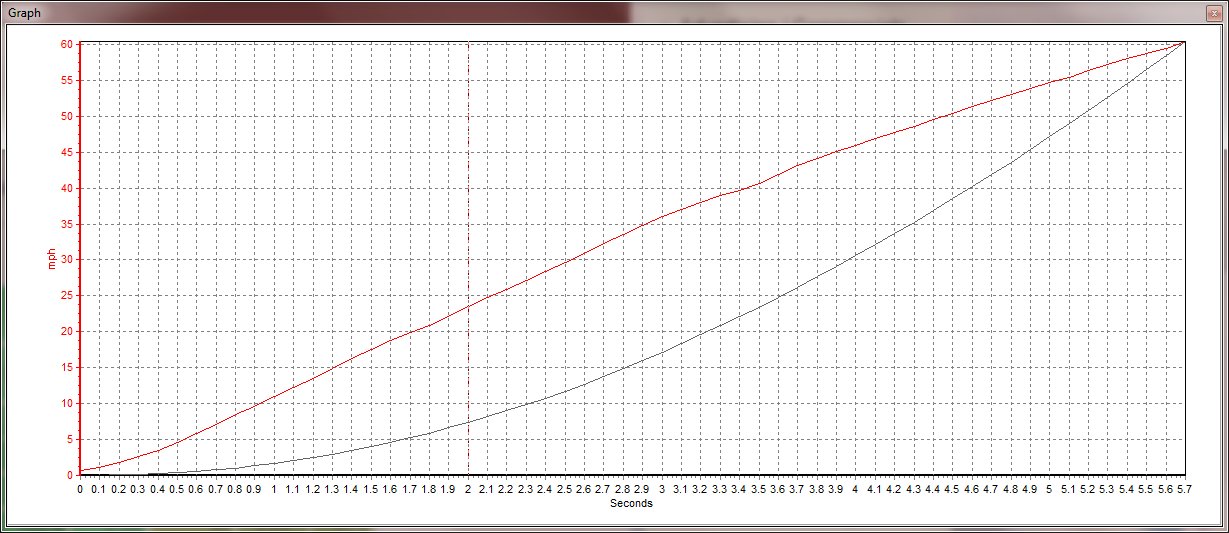
Speed vs Time (red) and Distance Travelled (gray)


And the table with comparison to last best run:

Today’s Test
Rollout Previous Test
Speed (mph) Time(s) Dist(f) 0.37 Speed (mph) Time(s) Dist(f)
10 0.93 6.33 0.56 10 0.71 7.13
20 1.71 23.73 1.34 20 1.45 23.53
30 2.53 53.59 2.16 30 2.23 51.94
40 3.43 100.4 3.06 40 3.09 96.6
50 4.45 168.07 4.08 50 4.21 170.2
60 5.66 265.64 5.29 60 5.39 265.8

Conditions: Weather: 95.6F baro 28.85 in Fuel: almost empty (car indicated 100F outside; 96F per the weather underground)

Today I wanted to try accelerating briskly until 20 mph or so then wide open throttle.  My goal was to get to 20 mph as rapidly as possible without wheelspin, figuring that even with full throttle there would be little wheel spin after 20 mph.  I was partially correct.

I also discovered that there is a cusp wherein the 6speed automatic will shift from 1 to 2 early in the low 20s if you are not at wide open throttle, which is bad for acceleration.  Manually shifting the automatic is right out because the redline at 1st comes up too fast for the manual shift to be effective.

Good news is a slightly faster best time, at 5.29 sec 0-60 with rollout.  Remember our goal is 4.9 sec 0-60 with rollout.  Low on fuel so 84 lbs lighter this run, which can also cause this difference in 0-60 times vs the earlier test.  The hotter temps act against acceleration, and 20F hotter is significant.

This simple method did improve my 1 foot acceleration time from 0.59 to 0.37 so there is that.  Also my 60′ time from a dismal 2.8 to 2.66 sec.  A reasonable 60′ time for street car on street tires is under 2.2 sec, so I am off in the first 60 ft and its me not the V.

I do think that this will be a matter of defining an exact technique to get the last few 0.1’s out however — brisk but not tire screeching acceleration up to 18-20 mph then full throttle before the transmission can decide to downshift to 2nd or similar.

In the real world it doesn’t matter much, but learning to drive the car can’t but help.

Intake update: the Spectre intakes are due from Streetsideauto.com in the next week or two, and then we’ll get before and after dyno tests run at True Street Motorsports in McKinney Texas per my  Project Cadillac Tuning Plan