Found this interesting info graphic from a Corsa performance ad on a Lingenfelter site:
Corsa vs Stock Exhaust for Corsa 14157
The graphic shown is for the 14157 system versus the stock 2005 Cadillac STS system. This is particularly interesting for the STS-V since this is the same Corsa system that D3 sells for the STS-V.
The text notes: * Flow bench-tested 42.3 gain in exhaust flow vs. stock muffler.
This I read to mean that the graph is for flow through a single Corsa muffler versus a single stock muffler. So in other words, the dual Corsa mufflers probably flow around 437 x 2 =874 CFM and the stock mufflers flow around 308 x 2 = 616 CFM. Recall our target is 2.2 CFM/HP for 0 backpressure, so with a modified STS-V making 500 hp plus S/C load we would need 560 hp of exhaust or 560 x 2.2 = 1232 CFM.
I am guessing that the STS-V stock exhaust flow is similar to the STS stock exhaust flow.
We can see from the numbers then that the stock exhaust flow is insufficient, and that the Corsa’s are an improvement, but there is still some margin for further improvement.
I am split on my next Cadillac update. The choices are to replace the mufflers with performance, high flow mufflers, or to begin to experiment with intercooler cooling system improvements.
For the exhaust I am settled on replacing the stock, low-noise mufflers with Magnaflow 14326 mufflers. The exhaust system itself is stainless steel, and appears to already be bent properly. The cost should be around $100 ea x2 for the hardware, plus installation. I suspect it will free up 10-15 whp.
The intercooler system uses Laminova tubes with a small heat exchanger in front of the car. I plan to add a 2nd front mounted heat exchanger in serial with the stock heat exchanger. The original LC3 testing was done assuming harsh heat conditions with high intercooler coolant temps. Later when required to SAE certify, the engineers also needed to reduce the temperature for the intercooler coolant; the engine famously went from 440hp with the original assumptions to 469 hp with the cooler assumptions. So I suspect that anything we can do to reduce the temperature of the intercooler coolant is worthwhile in terms of more hp.
Technically, reducing the intercooler air temp does not add more oxygen to the air, since at that point the mass of air coming into the system out of the supercharger is fixed. However, what cooler air across the intercooler does do is allow the LC3 engine to run more timing, which it will do automatically, and achieve more power. Reducing the temperature of the intercooler coolant is one way to achieve cooler intercooler exhaust (IAT2).
Another thumbrule I have read is that Laminova heat exchangers operate best if the area of the heat exchanger is equal to the area of the coolers. I had to think about that a bit to understand what was meant. For the Cadillac the area of the Laminova coolers would be 96 square inches. The area of the stock heat exhanger would be 21×14=294 square inches, which would appear to meet the thumbrule.
It is inviting to do something really revolutionary like put an intercooler reservoir in the spare tire compartment and run hoses the length of the Cadillac, but probably better to stay conservative for a daily driver.
I am happy with my Ambient / IAT / IAT2 measurement capability. I would like to have a direct measure of intercooler coolant temp before the next changes, but I am unsure how best to achieve and log that.
My Cadillac is a 2008 STS-V with a Spectre Intake. This is a 4,233 lb sports luxury V-Series sedan with a 4.4L supercharged & intercooled V8.
Today in hot weather it ran a 0-60 time of 5.42 sec (0 feet-5,280 feet), or 4.98 sec including 1 foot of rollout as at a dragstrip, (1 foot-5280 feet).
The 60′ time for this run was 2.3 sec.
Previous measured times for my STS-V with me driving were 5.39 sec w/rollout and 5.29 sec w/rollout, so today’s time of 4.98 sec w/rollout is an improvement of 0.3 sec. Between the runs I have changed the tires, added the Spectre intake, and changed the MAF. Side by side, today’s run would have been 17 feet ahead of the previous run at 60 mph.
w/rollout
Speed(mph)
Time
0.44
Dist(f)
10
1.01
0.57
6
20
1.75
1.31
23
30
2.46
2.02
49
40
3.31
2.87
93
50
4.30
3.86
159
60
5.42
4.98
248
Here is the graph:
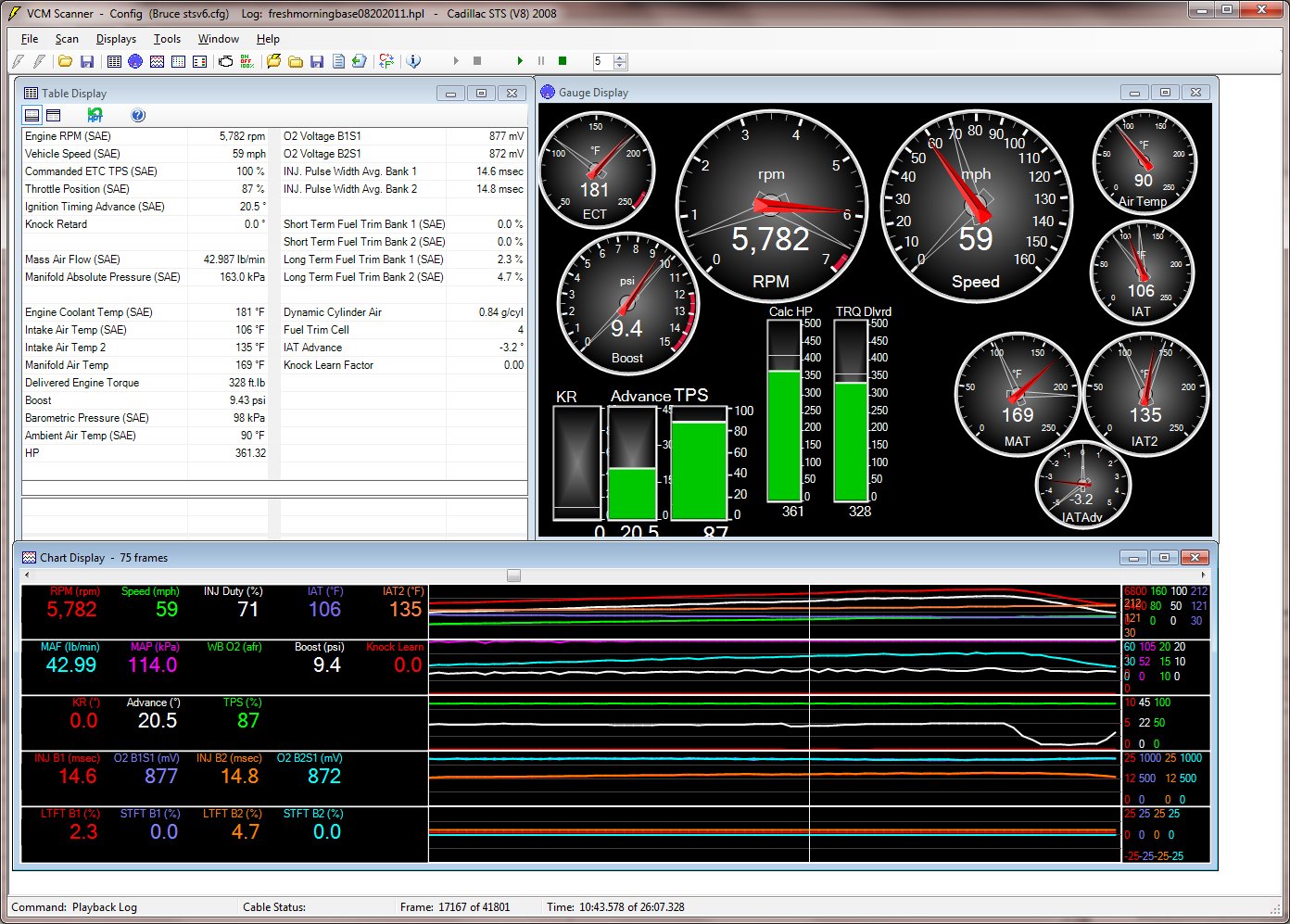
Here is a view from HPTuners of the peak near 60 mph for this run showing that I am getting -3.2 degrees of advance due to the ambient and IAT2 / MAT temps at this point; it heads as low as -4 degrees.
IAT Advance at -3.6 degrees
I believe that because the boost is calculated from Manifold pressure and barometric pressure, that it reflects boost after the pressure drop across the Laminova intercooler tubes. So some pressure going in, 9.4 psi getting to the engine in this snapshot.
Here was a video of the HP Tuner scan of the 0-60 run:
I captured a second run at 5.45 sec w/o rollout or 5.08 sec from 1 foot.
w/rollout
Speed(mph)
Time
0.37
Dist(f)
10
1.06
0.69
6.2
20
1.87
1.50
22.58
30
2.61
2.24
48.61
40
3.41
3.04
92.88
50
4.38
4.01
158.55
60
5.45
5.08
248.34
My rollout is still a bit high — taking too long to get from 0-1 foot. I would like to see rollout around 0.3 sec.
Summary
Today’s run shows a clear improvement from the previous mark. I would like to see under 5 sec without rollout considered.
The IAT Advance is pulling timing from the engine based on the incoming air temp out of the supercharger. Either running the car in cooler weather (!) or improving the intercooler cooling perhaps would help. This is with the stock calibration; it may be possible to simply adjust the tune to be somewhat less aggressive on IAT Advance. Adjusting shift times and possibly RPM may also reduce 0-60 times.