Datalog analysis of Cadillac STS-V Ambient vs IAT1 vs IAT2

I have been planning new data-logging experiments and modifications, so I have been reviewing the datalogs I did last August in the summer temperatures.  For my next datalog I will attempt to capture comparative data to this info:
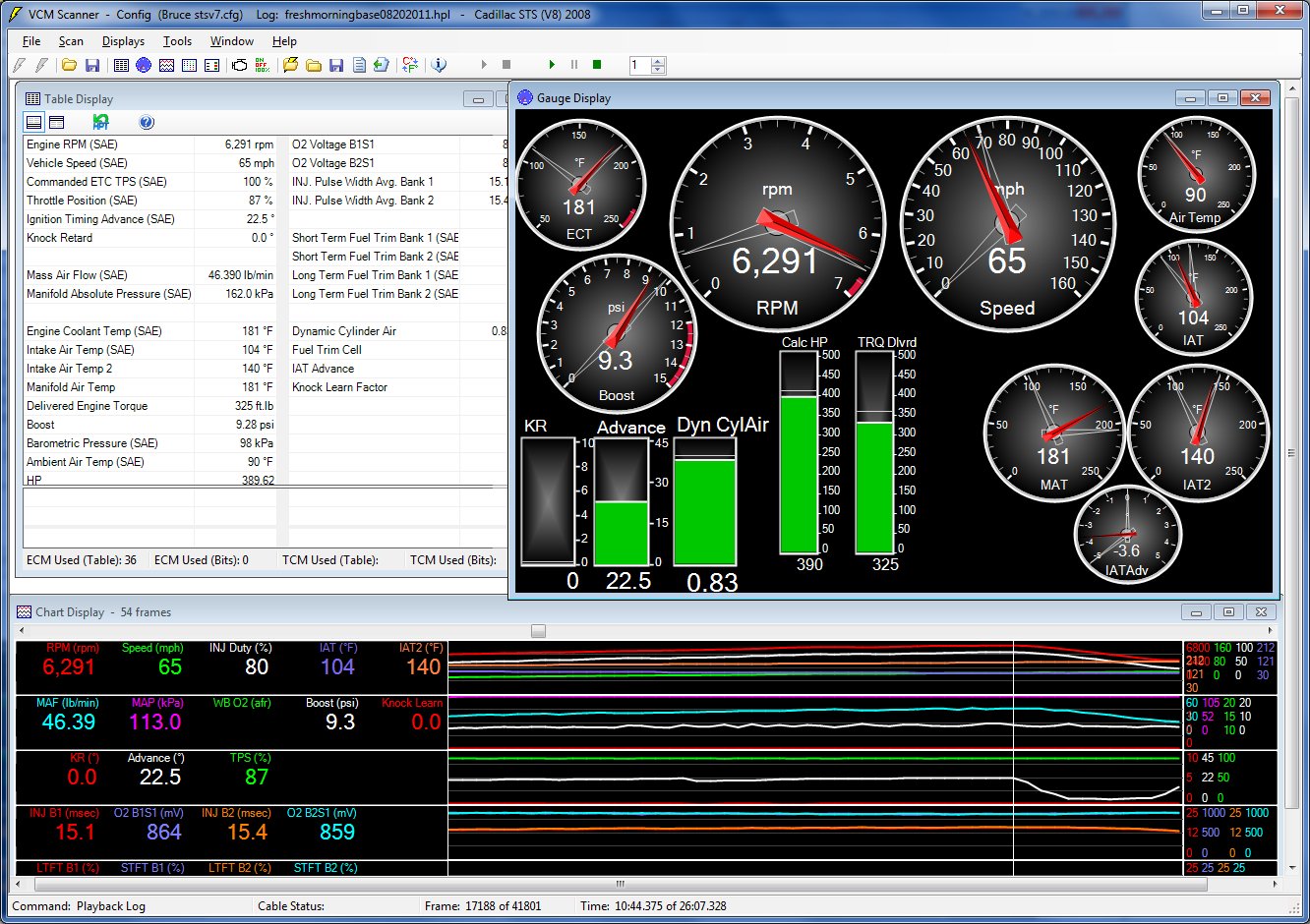
This screen is an HP Tuners VCM Scanner guage snapshot of parameters after a 0-60 run culminating at 65 mph.

Baseline from August


MPH (Temps in Deg Fahrenheit)

Item 0 30 45 60
Ambient 90 90 90 90
IAT1 113 117 113 106
IAT2 118 120 127 135
MAT 120 121 136 169

What we can see from this table, is that at the beginning of the 0-60 run the Ambient temp is 90F, and stays at 90F through the run.

IAT1: The IAT1, which is incoming air temperature as read in the intake air tubing, starts at 113F.  It has rapidly gone up to this value because the STS-V is stopped.  However, as the V accelerates to 30 mph it rises to 117F.   By 45 mph it has returned to 113F, and by 60 mph due to the incoming 90F air cooling it has resolved to 106F.  Conclusion:  heating of the incoming air at the IAT1 sensor does in fact effect the air temperature, and thus performance.   Conventional wisdom is that the incoming air is not in the intake tube long enough to become heated. Net Rise: -7F

IAT2: The IAT2, which is air after it has been heated by the supercharger and cooled by the intercooler, starts at 118F, a 5F increment over IAT1.  By 30 mph it has risen to 120F.  At 45 mph it has risen further to 127F, and by 60 mph has peaked at 135F.  Net rise: +17F.  Keeping in mind the IAT1 went down 7F in this time.

MAT: The manifold air temperature is a calculated value the engine uses to predict the temperature of air in the manifold.  It tends to go up at a higher rate than IAT2.  The MAT starts the run at 120F, is about the same at 30 mph at 121F, but rises to 136F by 45 mph and on to 169F by 60 mph.  Improvements in the IAT2 should have even greater improvements in the MAT value.  Net rise: +49F.

As a result of the high MAT temp by 65 mph as shown in the image, IAT temps are causing 3.6 degrees of advance to be pulled.  This begins at 59 mph when the IAT2 hits 135F and the MAT is at 157F at -3.2 degrees.
This was a video capture of the dashboard of the 0-60 run from August:
Fan of the Cadillac STS-V intercooler heat exchanger

I have been thinking more about the STS-V intercooler heat exchanger design and replacement ideas.

Cadillac uses a separate cooling system for the Laminova style intercooler tubes, featuring a bosch intercooler pump and a 23.5″x14″x2″ outer measures intercooler radiator heat exchanger in front of the main radiator in the nose of the V.  So let’s call that a 20″ by 12″ working area.

The D3 solution is two-fold:  replace the heat exchanger with a tube and fin heat exchanger with 10″ pusher fan, and add a tank to hold additional intercooler coolant.

Other aftermarket solutions have included adding a new chin mounted heat exchanger instead of the current heat exchanger, or along with the current heat exchanger, or in series with a a tube and fin replacement.

After reading various experiments with adding fans on other vehicles, I am convinced that adding an intercooler heat exchanger fan is advantageous.  Although it is intuitive to think that a pusher fan could provide a block to the incoming airflow, testing has shown that is not the case on other models.

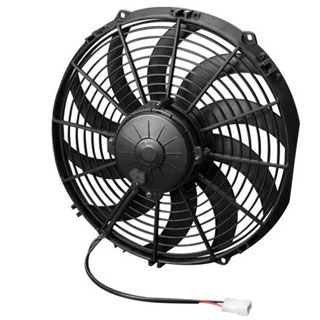
My plan is to keep the stock OEM heat exchanger, but add a 12″ pusher fan. I am thinking of a SPAL 12″/12v pusher fan or similar; space is a concern.  Use a fan controller to interface although it would be best if only on when the car is up to temperature etc.  The intercooler heat exchanger is in front of the main radiator, so pushing air through one will impact the other.

VA10-AP70/LL-61S * 12"C / 12V 12" Curved Blade High Performance Fan / 12V Pusher


Separately, I like the idea of using the LS9 coolant reservoir as additional coolant capacity especially in this system that is very capacity limited.

Supercharged 3.6L Cadillac CTS?

KPE is the distributor for a supercharger kit soon to be released by IPF Tuning targeted at the GM LLT 3.6L V6 engine.  The stock engine in the 2008-2011 CTS made 304 hp.  With this new supercharger a 3.6L V6 would have 400+ hp — a bit more power than the stock LS6 or LS2 V8s in the 04-08 CTS-V!

The kit targets the LLT due to its use as the standard engine in the Chevrolet Camaro, but fitment there also enables fitment for the Cadillac CTS 3.6L.  It is not clear if the same kit will work equally well on the 2012 LFX engines until further testing and tuning has been done.

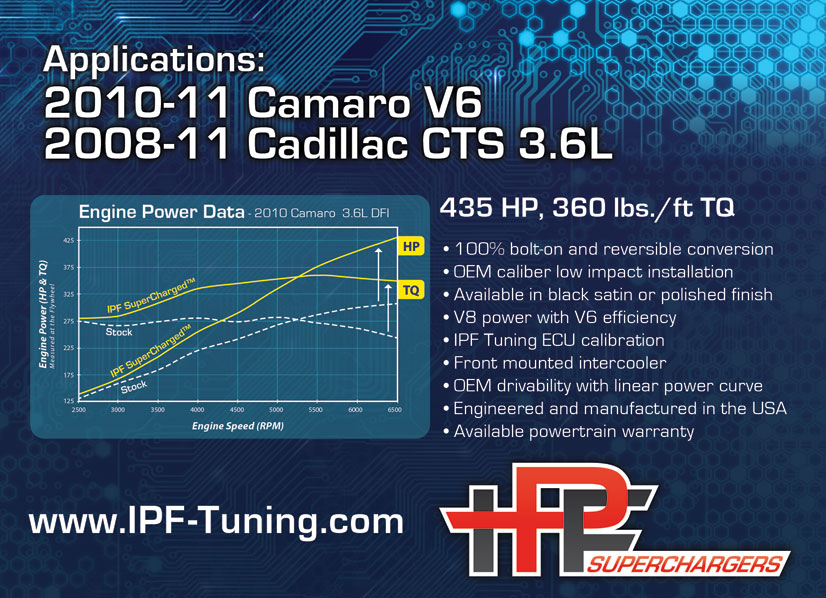
IPF’s test claims are an improvement to 435 hp and 360 lb ft of torque.  For the CTS 3.6L that power would change it from a 6.3s 0-60 time to under 5.1s under ideal conditions, and get it into the 13s in the quarter mile.  Cost of the kit for the Camaro is US$5,590, with a $1K deposit for pre-orders.  As of this article kits do not appear to be shipping yet.

Although $5K+ seems expensive that is a reasonable market price for a full supercharger kit.  Remember there are advantages to buying a pre-engineered kit with some certainty of working properly when installed!


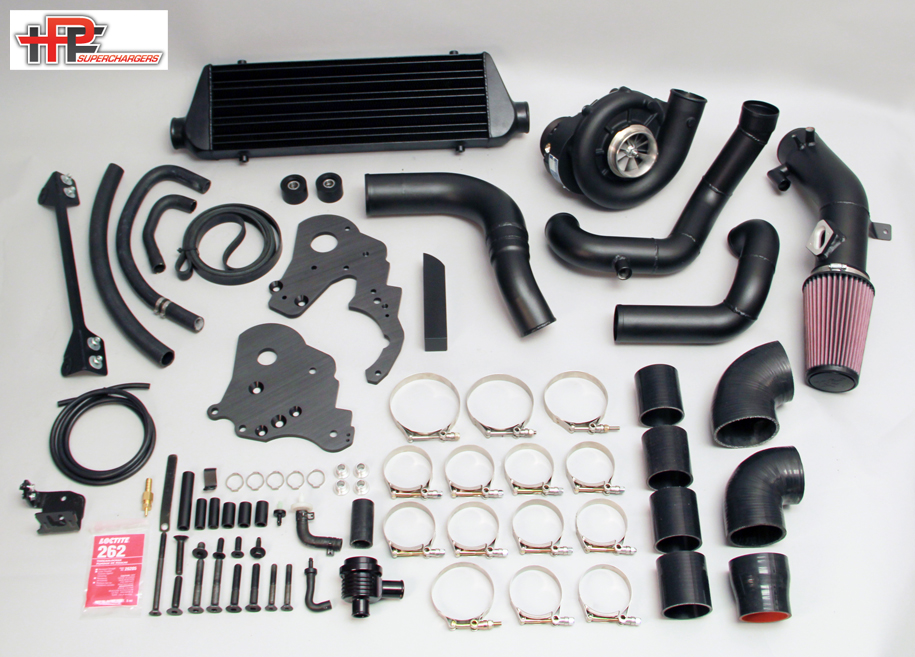
The kit appears to be complete, to allow for easy installation.  It includes supercharger, intercooler, and appropriate custom brackets and mounting hardware.

The Supercharger head unit is a Vortech V3 Self contained unit! No drilling into the oil pan or complicated plumbing. The intercooler is a thick core for maximum cooling efficiency with minimal pressure drop. Silicone hoses and couplers and stainless steel clamps. All the hardware is high quality and made in the USA. A Powertrain Warranty is available from IPF and is valid when the kit is installed by an ASE Certified Technician.  The kit will sell for $5590.00 plus shipping. The Powertrain Warranty is $275.00 which covers engine and transmission. Again most of the forced induction (Turbo kits) do not offer a Powertrain Warranty!!!

This is a video of a Camaro V6 with the supercharger kit installed.

The video notes:

IPF Supercharged and tuned 2011 Chevrolet Camaro V6 (LLT); For more information and available applications for select GM models, check out www.IPF-Tuning.com

KPE Products Contact info:

Dave Loucks
888-222-4291
dave@kpe-products.com
www.KPE-Products.com
www.IPF-Tuning.com

We are currently producing the IPF Supercharger for the 2010-11 Camaro V6. The kits will begin shipping the week of January 16th. There are some kits on backorder but we can still take preorders as of today. Camaro enthusiasts can still put down a deposit to guarantee they get one out of this initial production run!

After we complete this first production of IPF Superchargers for the Camaro, we will be moving on the CTS. Our intent is to have the CTS kit available in the next 90 days. Please let me know if you have any other questions. Thanks!

The guys at DREVolution Motorsports are reporting that they are actually measuring 420-430 Hp at the wheels from Camaro testing.  That would suggest almost 500 hp at the crank.

Click for IPF Tuning on Facebook