Gonna pump YOU up – Intercooler Pumps in Series to Maximize Cooling #Motorama

Update:

Although the info shown is relevant for 4 Laminova cores in series, the Cadillac design does not have 4 in series but rather has A-B in parallel and C-D in parallel flow.  I caused some confusion in the way I asked my question of Laminova as it turns out.  I am leaving this for consideration, but the pressure head through 2 Laminova cores instead of through 4 cores would be different.

In my analysis of pump flow rates versus the intercooler pressure head it became clear that at higher flow rates the stock pump has restricted flow.  In fact, instead of flowing 8 gallons per minute (gpm) it is probably flowing under 4 gpm.  We could find a new source for a intercooler coolant pump that can flow 9 gpm against a 1.4 bar resistance; that would be ideal.  However, there is a way to work with the parts we have to overcome this hurdle.

Note that I don’t have a sophisticated model of the overall flow resistance, but that my conjecture is that the flow across the heat exchanger is around a 1 psi resistance, and that system resistance for the hoses etc is 0.4 psi.  In my modeling a second front mounted heat exchanger is shown as another 1 psi of resistance.

The stock intercooler coolant pump is a centrifugal pump.  When two or more centrifugal pumps are placed in series, the resulting pump performance is obtained by adding their heads at a constant flow rate.  [Ref: Engineering Toolbox]

For our previous graphing this basically means if you put two pumps in series you ‘stack’ the two pumps’ flow versus pressure diagram on top of each other.

Using this insight, one way to overcome the pressure head presented by our intercooler system with the parts we know is to put 2 of the stock Bosch pumps in series in the flow.  If that works well, how would 2 of the Jabsco Cyclone 50840-12 pumps work?  Hmm, what if we put THREE Bosch pumps in series?  What about the Cyclones?

Good questions.  I wondered this also, so I continued with our previous graphs & calcs to do the analysis:
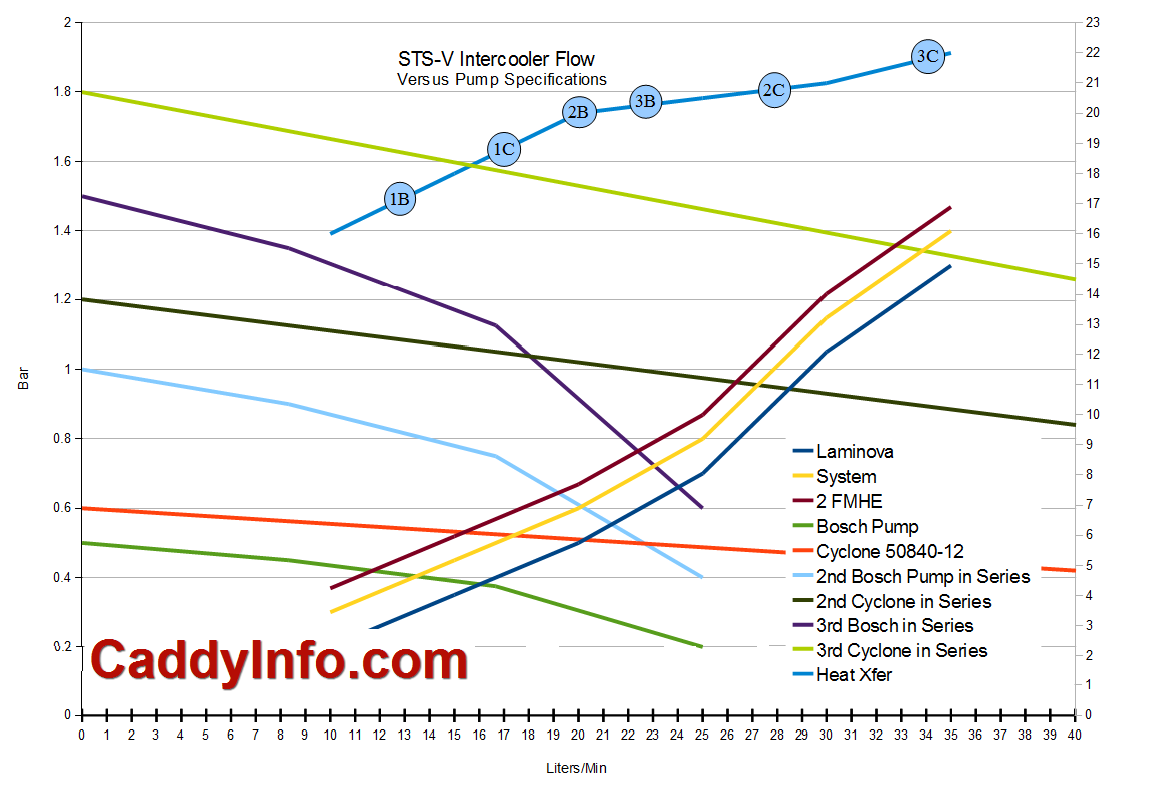
Multiple Intercooler Pumps in Series vs Intercooler Flow

Lots of complication, but let’s look at it.  First, the light green line bottom left is the stock intercooler pump flow.  Bottom left orange line is one cyclone pump.

See the light blue line that flows down from 1 bar and matches and doubles the green line flow line from one pump?  That is the line for 2 stock intercooler pumps in series.  The darker green line that runs down from 1.2 bar is for two Cyclone pumps in series.

What about 3 pumps?  The purple line running down from 1.5 bar is 3 stock pumps in series.  The yellow-green line running down from 1.8 bar is for 3 cyclone pumps in series.

What does all this mean?  Here’s some tabular data:

Liters/Min Gallons/Min Heat Xfer
Pump Core Only System Core only System KW Delta
Bosch 16 13 4.2 3.4 16.5
Cyclone 20 18 5.2 4.7 18.0 9.1%
Bosch x2S 21 20 5.5 5.2 19.0 15.2%
Cyclone x2S 29 27 7.6 7.1 20.5 24.2%
Bosch x3S 24.5 23 6.4 6.0 20.0 21.2%
Cyclone x3S 35 34 9.2 8.9 21.5 30.3%

This tells us that the flow rate through the system with 1 stock pump of 3.4 gpm goes up to 5.2 gpm if you add another pump, or 6.0 gpm with 3.

The system flow rate of a Cyclone goes from 4.7 gpm alone to 7.1 gpm with 2 or 8.9 gpm with 3.

Is more flow always better?  Well, yes, up to a point.  On the flow diagram I have summarized the heat transfer for each combination with the circles with letters in them.  1B= one Bosch, 1C= one Cyclone, 2B= two Bosch, 2C=two Cyclone, 3B=3 Bosch, 3C= 3 Cyclone pumps in series on the line at the top of the flow diagram.  That line they are all on is the heat transfer graph for the Laminova cores; it uses the right axis for its values, which are in kilowatts of heat transfer.  In the table I have read off the approximate values from the graph.

What we see is that 2 Bosch (2B) pumps give us a 15% improvement in heat transfer, and 2 Cyclone pumps (2C) give a 24% improvement.  Going to 3 pumps does improve it further but to a reduced degree.  Adding 1 Bosch pump to the stock pump adds 15%; adding a 3rd only adds 6% more.  Replacing the stock pump with 2 Cyclone pumps adds 24%; adding a 3rd Cyclone pump only adds 6% more.

Conclusion

My conclusion is that an optimal mix of expense versus reliability and complexity is to add a 2nd Bosch or replace the stock pump with 2 Cyclone pumps in series.  That should give us the best bang for the buck improvement in flow and heat transfer relative to expense.

Issue

What is the safe pressure for the intercooler cooling system on the STS-V?   What PSI is the relief/overflow cap set for?  If it is set  for 5 psi (0.3 bar) can the system function above that?  Response:  Because of the pressure drop across the Laminova cores at high flow rates there is a high pressure side of the system from the pump to the cores, and a low pressure side from the Laminova cores through the heat exchanger and the refill/pressure relief back to the pump.  The 5 psi relief won’t trigger unless the pressure in the system at THAT point is above 5 psi.

Plans

I like the additional front mounted intercooler idea. It seems a good way to add system coolant capacity and some additional cooling.  Additional coolant capacity acts as a delaying function for changes in coolant temperature.  Each of the Jabsco Cyclone pumps runs around $210; so 2 for $420.  The front-mounted heat exchanger (FMHE) for under the bumper I have in mind  is $179. It would take 5 hours of labor or so to remove and replace the front clip to install ($400).  So for a total budget of $1,200 or so the overall intercooler cooling system could be 24% more effective.  If you do the work yourself parts alone would be $600.
 

How COOL is THIS: Intercooler Pressure versus Pump Output and Flow @Motorama

Update:

Although the info shown is relevant for 4 Laminova cores in series, the Cadillac design does not have 4 in series but rather has A-B in parallel and C-D in parallel flow.  I caused some confusion in the way I asked my question of Laminova as it turns out.  I am leaving this for consideration, but the pressure head through 2 Laminova cores instead of through 4 cores would be different.


Intercooler coolant pumps are at heart 12v water pumps.  Extra points if they are light and quiet, and very long lasting.  They are rated in gallons per minute, or liters per minute, or liters per hour.  However, with pumps one also has to know at what pressure.  If an 8 gpm pump is pumping against NO resistance then it can pump 8 gpm of fluid.  However, if it is pumping against some resistance, like the four cores of a STS-V intercooler, it has a harder job and the flow rate will drop.

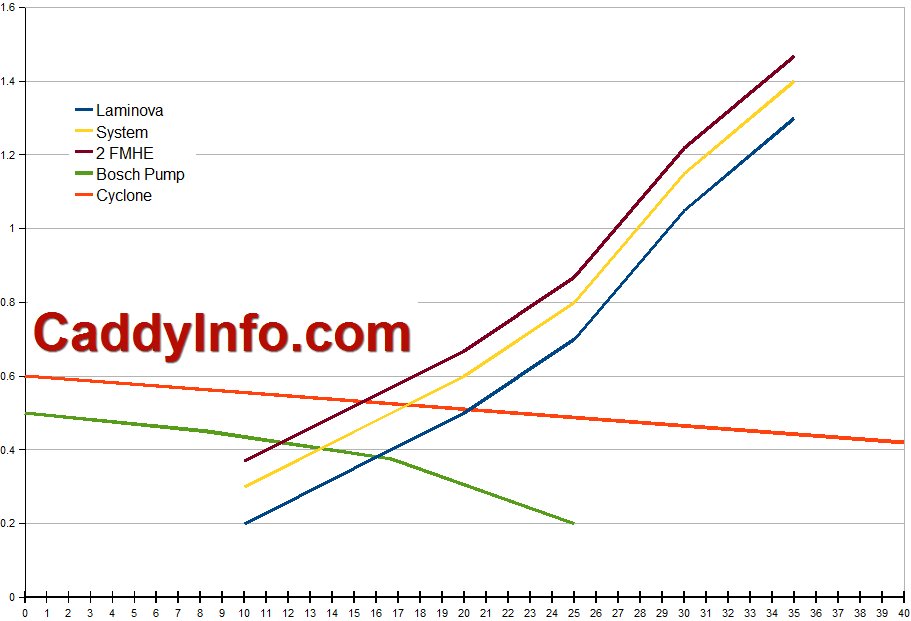
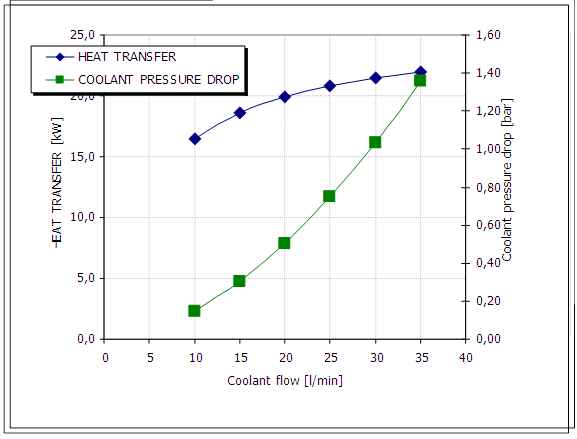
Laminova was kind enough to send me this graphic showing pressure versus flow through four Laminova cores sized for the Cadillac STS-V application in serial:

Below is a graph with heat transfer vs. flow rate for a 4 x 39.5 mm cores in 392 mm length, coolant in series over the cores. (calculated with 350g/s 110ºC for the charge air, 30ºC coolant with flow from 10 to 35 l/min). As you can see performance continues to increase with increased flow, but at 35 l/min you have almost 1,4 bar pressure drop, then add the radiator etc. So be careful when choosing pump, normally there are graphs for flow vs. backpressure for the pumps available.

Laminova Cores bar of pressure vs lpm of flow

Let’s examine this graphic.  First, a bar of pressure is a bit less than the English atmosphere (A), so 1 atm (atmosphere) = 1.01325 bar.  Let’s stay in bar for now, as it is frequently used for discussion of our topic.  But when you read bar you can think 14.5 psi if you prefer.  A liter per minute is 0.2642 gallons per minute (gpm).

What the graphic shows is that as the coolant flow increases from 10 lpm (2.6 gpm) to 35 lpm (9 gpm) the pressure required to push the water through the 4 STS-V Laminova intercooler cores increases from 0.15 bar (2.1 psi) to 1.4 bar (20 psi).  It takes a LOT of pressure to reach a 9 gpm flow rate.  The good news is the heat transfer for the system of cores continues to improve right up to 9 gpm, flattening out after that rate of flow.

If we could increase the flow rate from 16 lpm (4 gpm) up to 35 lpm (9.2 gpm), the heat transfer will increase from around 16 kw up to around 22 kw, or 38% more intercooling at max rate.

It is inviting to think then, that the STS-V 8 gpm intercooler pump is about right on the money; unfortunately, that pressure it has to pump against lowers its output quite a bit.  Let’s see how much.

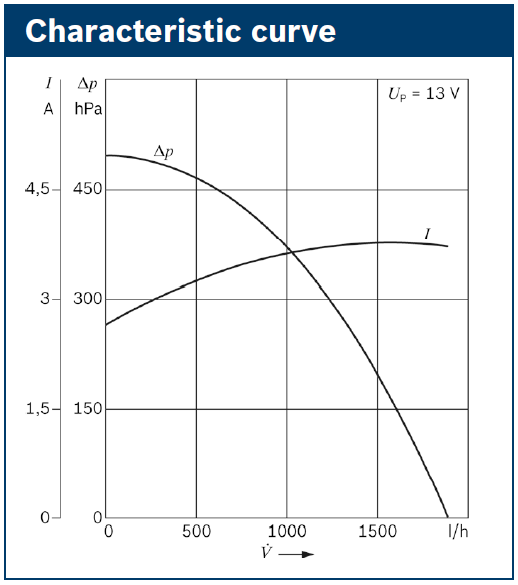
The Cadillac STS-V uses a Bosch sourced 8 gpm (gallon per minute) pump.  Here is a diagram of the Bosch pump output:

Bosch Intercooler Pump Flow vs Pressure

This diagram introduces new units again, but we’ll get through it.  Along the x axis we have Volume of flow in liters per hour.  Along the y axis we have delta pressure in hPa, which is hectopascals of pressure.  1000 hectopascals  = 1 bar.

So this Bosch pump will flow 0 liters per hour at 0.5 bar, and up to 1800 liters per hour (30 lpm, 7.9 gpm) at no pressure.  Good, as it is rated for 8 gpm.

Now, how do we determine how much a Bosch pump in our STS-V would flow against the pressure through the intercooler, hoses, and heat exchanger?  We graph them together based on flow rates versus pressure and see where their graphs cross.   That will be the point where the flow rate of the pump against the resistance in the system is equivalent.

I have included the Jabsco 50840-12 Cyclone aftermarket intercooler pump for comparison as well, reading off their flow graphic.  This is a popular replacement intercooler pump for the STS-V.

Laminova System Cyclone Bosch Pump
FLOW L/Min Pressure bar Flow L/Min Pressure Bar Flow L/Min Pressure bar
10 0.20 0.3 0 0.6 0 0.5
15 0.35 0.45 40 0.42 8.33 0.45
20 0.50 0.6 80 0.2 16.67 0.38
25 0.70 0.8 120 0 25 0.2
30 1.05 1.15
35 1.30 1.4

This data table shows the resistance through the Laminova cores alone, then an equivalent resistance value for the whole intercooler cooling system.  I don’t know a good value for this so I used 0.1 bar or 1.4  psi of pressure to represent the intercooler heat exchanger (1 psi), hoses (0.4 psi), etc.  We can change it to another more accurate value later, and can model 2 heat exchangers, etc.

The data is really easy to relate to if we put each set on an XY graph, so let’s do that!

Calculated Flow Rates:

Cadillac STS-V Intercooler Flow Rate vs Pump Output & Pressure - Bar versus Liters per Minute

So reading from the graph, I find this tabular result:

Liters/Min Gallons/Min
Pump Core Only System Core only System
Bosch 16 13 4.19 3.41
Cyclone 20 18 5.24 4.72

In other words,  the 8 gpm Bosch pump will pump 4 gpm if it were only pumping through the 4 Laminova cores in serial (theoretical value), or 3.4 gpm through the whole system.

The higher flow Cyclone pump will or 4.7 gpm through the whole system, or 38% better than the stock pump.

A second FMHE (front mounted heat exchanger) might cost 1 psi and thus 2 lpm or 0.5 gpm of flow.  Also notable is that the Cyclone pump with a 2nd FMHE still probably flows more than the stock pump and single FMHE.  Heat transfer probably increases by 0.5 kw, or 38% of the increased flow rate of 1.3 gpm.

Ideas for further study:

Design an experiment to test actual flow rate through the system.  Ideal to me would be to add a flow rate indicator (gauge).

Source a replacement intercooler coolant pump that can pump 9 gpm against a 1.5 bar head pressure in order to optimize intercooler cooling.  This is likely to need to be a positive displacement pump rather than a centrifugal pump.

See an error?   Applause for the effort?  Chime in via the comments section!!

Adding boost pressure to the LC3 4.4L DOHC VVT V8

The Cadillac STS-V (2006-2009) uses the 4.4L supercharged Northstar engine, making 469 hp and 439 ft-lb of torque.  Can it make more?

Cadillac used a modified variant of the Magnuson MP122, or Eaton M122 supercharger, with a integrated intercooler using Laminova cores.  The powerplant was designed specifically to be supercharged.  The stock LC3 V8 uses 12 psi, or pounds per square inch, of supercharging.  In other words, if atmospheric pressure is 14.7 psi, then air flooding into the LC3 at maximum pressure is 14.7 + 12 psi = 26.7 psi.  In supercharger terms, it is at 26.7 / 14.7 = 1.82 pressure ratio.

As a rule, 1 psi of supercharging makes 4% more horsepower.  Technically, 14.7 psi of supercharging would make 100% more power, or 6% per PSI.  But, with inefficiencies, 4% per PSI is an achievable thumbrule.  Looking at this backwards, one might find that a non-supercharged 4.4L V8 would have made 316 hp.  This is very close to the 320 hp rating of the 4.6L VVT DOHC normally aspirated Northstar; no surprise.

So what would happen if we increase the boost level on the LC3 V8 from 12 psi up to say 14 psi or 17 psi?  Notionally, in a perfect world the 469 hp stock would increase to 492 hp at 14 psi, or to 530 hp at 17 psi.  However, there are issues to be considered such as the capability of the supercharger to make that much pressure efficiently, as well as the capability of the intercooler to take away additional heat produced.

A popular way to increase the output pressure of a supercharger is to substitute a smaller pulley for one or the other end or both ends of the supercharger pulley drive.  For the STS-V LC3, the crank pulley appears to be 5.88″ outer diameter, and the supercharger snout pulley is 2.8″ outer diameter.  Actually, I know the snout pulley diameter of 2.8″, and Cadillac said that the ratio between the two was 2.1:1.   Also, when D3 created a 10% overdrive pulley, they chose to make it 6.47″ outer diameter, which is 10% more than 5.88″.  This strikes me as an odd outer diameter, but note 5.9″ = 15 cm, so perhaps the crank pulley is metric?

Another choice is to change the supercharger snout pulley from 2.8″ to 2.55″.  Remember our ratio — crank:snout pulley ratio so 5.88:2.8 stock = 2.1:1

If we change the crank pulley to 6.47″, then the pulley ratio changes to 6.47 :2.8 = 2.3.  Now 2.3/2.1 = 1.1, or 10% faster, so 10% more boost, or 1.2 psi increase.

Likewise, a 2.55″ snout pulley would be 5.88:2.55 = 2.3 and 2.3/2.1 = 1.1 or 10% faster, so 10% more boost, or 1.2 psi increase.

Either way, 1.2 psi increase for 1.2 * 0.04 /psi = .048 or 4.8% increase.  So a 13 psi LC3 might increase from 469 hp at the crank to 491 hp at the crank or 24 hp.

In an ideal world then, another PSI of boost would also add another 24 hp.  For example, if we used a 6.47″ crank and 2.55 supercharger snout pulley for 6.47:2.55 = 2.5:1 ratio we could get to 2.537/2.1= 1.21 or 21% increase or 2.52 PSI. This would theoretically gain 47 hp and get from 469 to 516 hp.

A different approach is taken with the Stiegemeier Snake Bite kit.  By modifying the internal gearing on the supercharger, and porting and cleaning up the flow paths within the supercharger, up to 17 PSI of boost is produced with the stock/OEM supercharger snout pulley and crank pulley.    Theoretically this would gain 5PSI * 4%/PSI = 20% or 93 hp, boosting the LC3 from 469 to 563 hp.  However, again with real world inefficiencies the actual gain would be expected to be less.  I don’t see a claimed/measured gain on their website for this application.

So how do people get up to figures like 461 whp (wheel hp, or hp at the wheels on a dyno) or 576 crank hp (hp at the crankshaft on an engine test dyno) for the STS-V LC3?  Through a careful combination of a variety of modifications.

The actual boost the engine pulls has to overcome the intake resistance.  So add a higher flow intake and the engine effectively has more boost as a result.  Add more intercooler cooling and the engine can make and sustain more power.  Tune the engine for a specific car and environment and the engine can make more power.    Through careful tuning and multiple dyno runs the community and Professional Tuners have slowly pulled higher levels of performance from the LC3.

With the CTS-V release and adoption of the LSA supercharged 6.2L V8, there is less market for LC3 tuning and the focus has shifted to the newer cars.  That does not change the inherent goodness and balance of the 4.4L Supercharged LC3 engines, and I am having a great time considering and researching tuning approaches for mine.

HEY!

See anything you disagree with?  Did I get it ALL wrong? Do you agree and want to share your experiences?  Put a comment up and join the conversation!