Autoblog would buy a Cadillac CTS-V before a Cadillac XLR-V

In the Autoblog Garage: 2009 Cadillac XLR-V offers an interesting summary of the 2009 Cadillac XLR-V Experimental Luxury Roadster, V-Series. The blog has a nice selection of great images of the XLR-V.

A reasonable question that Autoblog asks is why would an enthusiast pay $100K for an XLR-V with a 443hp Supercharged Northstar 4.4L engine instead of roughly $60-65K (prices STILL not announced) for a new CTS-V with a 556hp Supercharged OHC V8?

S/C Northstar Engine

S/C Northstar Engine

I know at least from my personal perspective there are advantages and disadvantages of each vehicle. The XLR cars of course are 2-seat roadsters, with folding hard top convertibles. The CTS cars are full size sports sedans. I like to joke that the XLR is a Corvette chassis with a Cadillac engine, while the CTS-V is a Corvette Engine in a Cadillac chassis. Actually the LSA engine in the CTS-V is unique to the CTS-V (so far), but it makes a nice summary.

Engine Sketch

Engine Sketch

I agree that it would be fun if Cadillac had retooled and put the 556hp LSA engine in the XLR-V this year, but the 4.4L Supercharged Northstar is a jewel of an engine. Since both cars are faster than they have to be anyway, XLR-V owners may legitimately want the smoother power delivery of the DOHC VVT Direct Injected Northstar engine.

2009 Cadillac CTS-V : Supercharging Ahead

Hemmings Auto Blog has a nice blog on History of the Supercharger

I was delighted to see that ideas like small fans blowing into the carburetor were invented in 1902, very close to the birth of the automobile. Cadillac’s new 2009 CTS-V with a supercharged 6.2L OHV V8 makes 556 hp and 551 lb-ft of torque. Let’s talk about the supercharger.

CTS-V Supercharger

CTS-V Supercharger

The new LSA Engine in the 2010 Cadillac CTS-V uses an Eaton TVS1900 1.9L four-lobe roots type supercharger.

The TVS supercharger’s patented design features four-lobe rotors and high-flow inlet and outlet ports that greatly enhance thermal efficiency, deliver higher volumetric capacity, and enable higher operating speeds. The TVS supercharger is capable of running with a high thermal efficiency (up to 76 percent) across a very wide operating range.

All TVS superchargers have a 2.4 pressure ratio capability and a thermal efficiency that exceeds 70 percent, which enables more compact packaging and greater output.

CTS-V TVS1900 Supercharger Thermal Profile

CTS-V TVS1900 Supercharger Thermal Profile

The engine designation for the CTS-V is the LSA. The Supercharger is well incorporated into the design and presentation of the engine. In the cutaway below you can the supercharger just below the top beauty cover’s “Supercharged” lettering (that’s truth in advertising!):

CTS-V LSA Engine cutaway

CTS-V LSA Engine cutaway

Just on top of the supercharger in the image is this water to air intercooler. Supercharging the intake air compresses and pressurizes the air. This raises the temperature of the intake air, which is not desirable. The intercooler acts to reduce the temperature of the air as it exits the supercharger on the way to the engine.

CTS-V Intercooler

CTS-V Intercooler

The LS3 V8 engine in the 2009 Chevrolet Corvette makes 430-436 hp, depending on optional exhaust or standard, and 424-428 lb-ft of torque. So the LS3 engine in the CTS-V would have made no more than 430hp. The LSA Supercharged engine used in the Super CTS-V makes 556hp, a nice net addition of 126hp due to the blower.

With everything going on with the US Economy, I am not sure how many CTS-V’s Cadillac will sell this year at around US$60K a copy.  Have no doubt — the CTS-V is a Super, World-class if not World leading Sports Sedan.  I hope that Cadillac sells a ton of them, so that one can trickle down to the Caddyinfo Garage!

C&D test shows 2009 Cadillac CTS-V Outraces the Competition

Car & Driver via Autoblog — Car & Driver runs an annual event called the Lightning Lap.  They get the fastest cars in the world together, and run them all on the same track under similar conditions and publish the results.

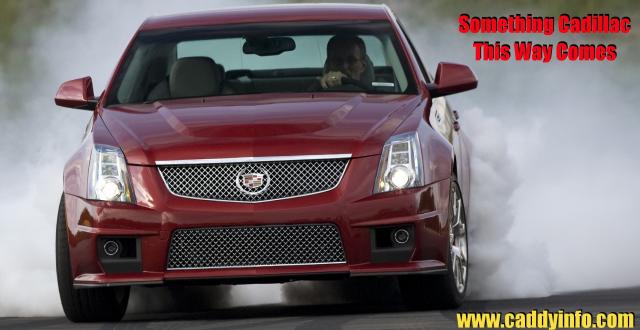
This year they included the 2009 Cadillac CTS-V in the mix.  How did the new high performance Cadillac do?  Amazing.  Check the details.  The new Corvette Z51 won for under $60K; but the CTS-V posted the 2nd highest times in the event for vehicles under $60K, and 6th highest overall of 22 performance cars!  Go Cadillac!

Remarkable thrust from the LSA [The Cadillac CTS-V has an LSA engine] with no hint of the angry bull bellow that afflicted the previous CTS-V. Remarkable, too, is its six-speed manual gearbox, providing precise shifts and crisp engagements. Remarkable balance, allowing the driver to drift and pivot this big sedan with ease. Remarkable brakes, offering formidable stopping power without a hint of fade, lap after lap.

The BMW M3 came in just behind the new CTS-V, followed by the Mercedes C63 AMG.  Not sure why the new Corvette ZR1 was not in the test.

The Cadillac did 0.92g’s in the first section; have to love that.

2009 Cadillac CTS-V Supercharged Performance

2009 Cadillac CTS-V Supercharged Performance

I know, 6th. But the first five were the Mosler MT900s, Dodge Viper SRT10, Ferrari 430 Scuderia, Nissan GT-R, and Corvette Z51. Very fast company, and none of them have four door, four seats, and Cadillac luxury.