Update:
Although the info shown is relevant for 4 Laminova cores in series, the Cadillac design does not have 4 in series but rather has A-B in parallel and C-D in parallel flow. I caused some confusion in the way I asked my question of Laminova as it turns out. I am leaving this for consideration, but the pressure head through 2 Laminova cores instead of through 4 cores would be different.
Intercooler coolant pumps are at heart 12v water pumps. Extra points if they are light and quiet, and very long lasting. They are rated in gallons per minute, or liters per minute, or liters per hour. However, with pumps one also has to know at what pressure. If an 8 gpm pump is pumping against NO resistance then it can pump 8 gpm of fluid. However, if it is pumping against some resistance, like the four cores of a STS-V intercooler, it has a harder job and the flow rate will drop.
Laminova was kind enough to send me this graphic showing pressure versus flow through four Laminova cores sized for the Cadillac STS-V application in serial:
Below is a graph with heat transfer vs. flow rate for a 4 x 39.5 mm cores in 392 mm length, coolant in series over the cores. (calculated with 350g/s 110ºC for the charge air, 30ºC coolant with flow from 10 to 35 l/min). As you can see performance continues to increase with increased flow, but at 35 l/min you have almost 1,4 bar pressure drop, then add the radiator etc. So be careful when choosing pump, normally there are graphs for flow vs. backpressure for the pumps available.
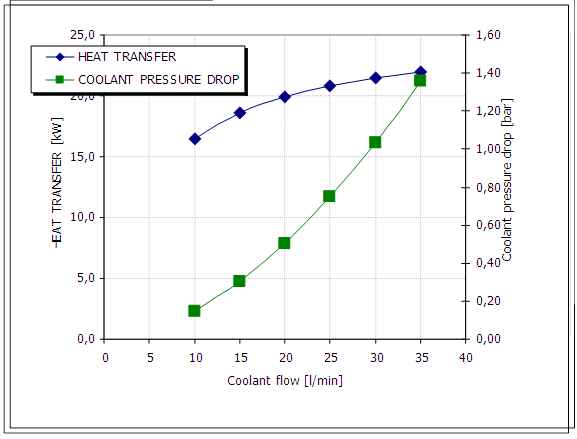
Laminova Cores bar of pressure vs lpm of flow
Let’s examine this graphic. First, a bar of pressure is a bit less than the English atmosphere (A), so 1 atm (atmosphere) = 1.01325 bar. Let’s stay in bar for now, as it is frequently used for discussion of our topic. But when you read bar you can think 14.5 psi if you prefer. A liter per minute is 0.2642 gallons per minute (gpm).
What the graphic shows is that as the coolant flow increases from 10 lpm (2.6 gpm) to 35 lpm (9 gpm) the pressure required to push the water through the 4 STS-V Laminova intercooler cores increases from 0.15 bar (2.1 psi) to 1.4 bar (20 psi). It takes a LOT of pressure to reach a 9 gpm flow rate. The good news is the heat transfer for the system of cores continues to improve right up to 9 gpm, flattening out after that rate of flow.
If we could increase the flow rate from 16 lpm (4 gpm) up to 35 lpm (9.2 gpm), the heat transfer will increase from around 16 kw up to around 22 kw, or 38% more intercooling at max rate.
It is inviting to think then, that the STS-V 8 gpm intercooler pump is about right on the money; unfortunately, that pressure it has to pump against lowers its output quite a bit. Let’s see how much.
The Cadillac STS-V uses a Bosch sourced 8 gpm (gallon per minute) pump. Here is a diagram of the Bosch pump output:
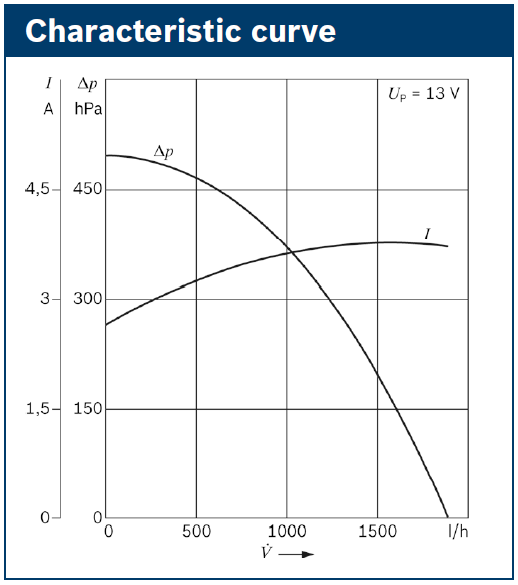
Bosch Intercooler Pump Flow vs Pressure
This diagram introduces new units again, but we’ll get through it. Along the x axis we have Volume of flow in liters per hour. Along the y axis we have delta pressure in hPa, which is hectopascals of pressure. 1000 hectopascals = 1 bar.
So this Bosch pump will flow 0 liters per hour at 0.5 bar, and up to 1800 liters per hour (30 lpm, 7.9 gpm) at no pressure. Good, as it is rated for 8 gpm.
Now, how do we determine how much a Bosch pump in our STS-V would flow against the pressure through the intercooler, hoses, and heat exchanger? We graph them together based on flow rates versus pressure and see where their graphs cross. That will be the point where the flow rate of the pump against the resistance in the system is equivalent.
I have included the Jabsco 50840-12 Cyclone aftermarket intercooler pump for comparison as well, reading off their flow graphic. This is a popular replacement intercooler pump for the STS-V.
| Laminova |
|
System |
Cyclone |
|
Bosch Pump |
|
| FLOW L/Min |
Pressure bar |
|
Flow L/Min |
Pressure Bar |
Flow L/Min |
Pressure bar |
| 10 |
0.20 |
0.3 |
0 |
0.6 |
0 |
0.5 |
| 15 |
0.35 |
0.45 |
40 |
0.42 |
8.33 |
0.45 |
| 20 |
0.50 |
0.6 |
80 |
0.2 |
16.67 |
0.38 |
| 25 |
0.70 |
0.8 |
120 |
0 |
25 |
0.2 |
| 30 |
1.05 |
1.15 |
|
|
|
|
| 35 |
1.30 |
1.4 |
|
|
|
|
This data table shows the resistance through the Laminova cores alone, then an equivalent resistance value for the whole intercooler cooling system. I don’t know a good value for this so I used 0.1 bar or 1.4 psi of pressure to represent the intercooler heat exchanger (1 psi), hoses (0.4 psi), etc. We can change it to another more accurate value later, and can model 2 heat exchangers, etc.
The data is really easy to relate to if we put each set on an XY graph, so let’s do that!
Calculated Flow Rates:
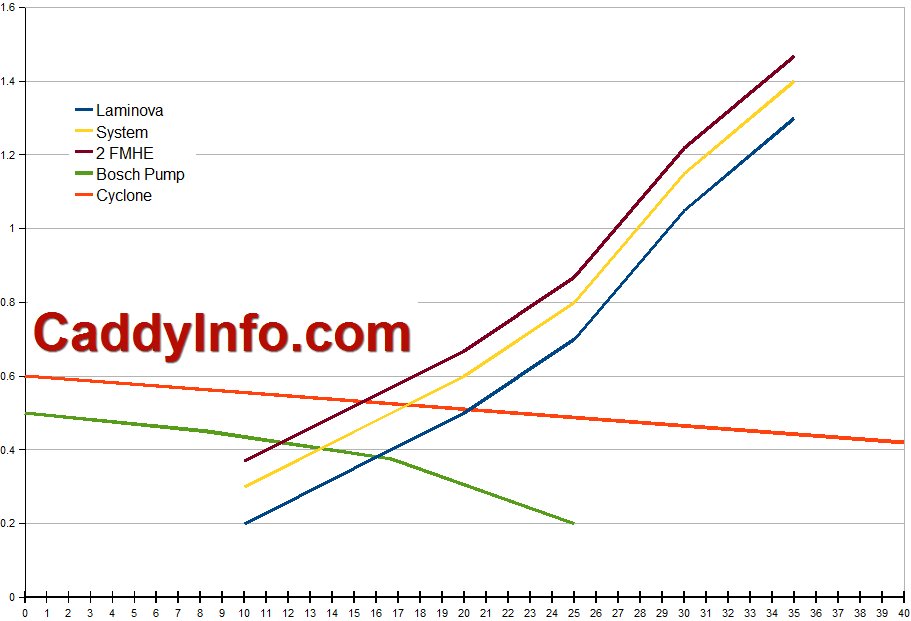
Cadillac STS-V Intercooler Flow Rate vs Pump Output & Pressure - Bar versus Liters per Minute
So reading from the graph, I find this tabular result:
|
Liters/Min |
|
Gallons/Min |
|
| Pump |
Core Only |
System |
Core only |
System |
| Bosch |
16 |
13 |
4.19 |
3.41 |
| Cyclone |
20 |
18 |
5.24 |
4.72 |
In other words, the 8 gpm Bosch pump will pump 4 gpm if it were only pumping through the 4 Laminova cores in serial (theoretical value), or 3.4 gpm through the whole system.
The higher flow Cyclone pump will or 4.7 gpm through the whole system, or 38% better than the stock pump.
A second FMHE (front mounted heat exchanger) might cost 1 psi and thus 2 lpm or 0.5 gpm of flow. Also notable is that the Cyclone pump with a 2nd FMHE still probably flows more than the stock pump and single FMHE. Heat transfer probably increases by 0.5 kw, or 38% of the increased flow rate of 1.3 gpm.
Ideas for further study:
Design an experiment to test actual flow rate through the system. Ideal to me would be to add a flow rate indicator (gauge).
Source a replacement intercooler coolant pump that can pump 9 gpm against a 1.5 bar head pressure in order to optimize intercooler cooling. This is likely to need to be a positive displacement pump rather than a centrifugal pump.
See an error? Applause for the effort? Chime in via the comments section!!