Next Cadillac update? Intercooler FMHE or Exhaust

I am split on my next Cadillac update.  The choices are to replace the mufflers with performance, high flow mufflers, or to begin to experiment with intercooler cooling system improvements.

For the exhaust I am settled on replacing the stock, low-noise mufflers with Magnaflow 14326 mufflers.  The exhaust system itself is stainless steel, and appears to already be bent properly.  The cost should be around $100 ea x2 for the hardware, plus installation.  I suspect it will free up 10-15 whp.

The intercooler system uses Laminova tubes with a small heat exchanger in front of the car.  I plan to add a 2nd front mounted heat exchanger in serial with the stock heat exchanger.    The original LC3 testing was done assuming harsh heat conditions with high intercooler coolant temps.  Later when required to SAE certify, the engineers also needed to reduce the temperature  for the intercooler coolant; the engine famously went from 440hp with the original assumptions to 469 hp with the cooler assumptions.  So I suspect that anything we can do to reduce the temperature of the intercooler coolant is worthwhile in terms of more hp.

Technically, reducing the intercooler air temp does not add more oxygen to the air, since at that point the mass of air coming into the system out of the supercharger is fixed.  However, what cooler air across the intercooler does do is allow the LC3 engine to run more timing, which it will do automatically, and achieve more power.  Reducing the temperature of the intercooler coolant is one way to achieve cooler intercooler exhaust (IAT2).

Another thumbrule I have read is that Laminova heat exchangers operate best if the area of the heat exchanger is equal to the area of the coolers.    I had to think about that a bit to understand what was meant.    For the Cadillac the area of the Laminova coolers would be 96 square inches.  The area of the stock heat exhanger would be 21×14=294 square inches, which would appear to meet the thumbrule.

It is inviting to do something really revolutionary like put an intercooler reservoir in the spare tire compartment and run hoses the length of the Cadillac, but probably better to stay conservative for a daily driver.

I am happy with my Ambient / IAT / IAT2 measurement capability.  I would like to have a direct measure of intercooler coolant temp before the next changes, but I am unsure how best to achieve and log that.

Cadillac STS-V: MAT vs IAT2 vs IAT Advance

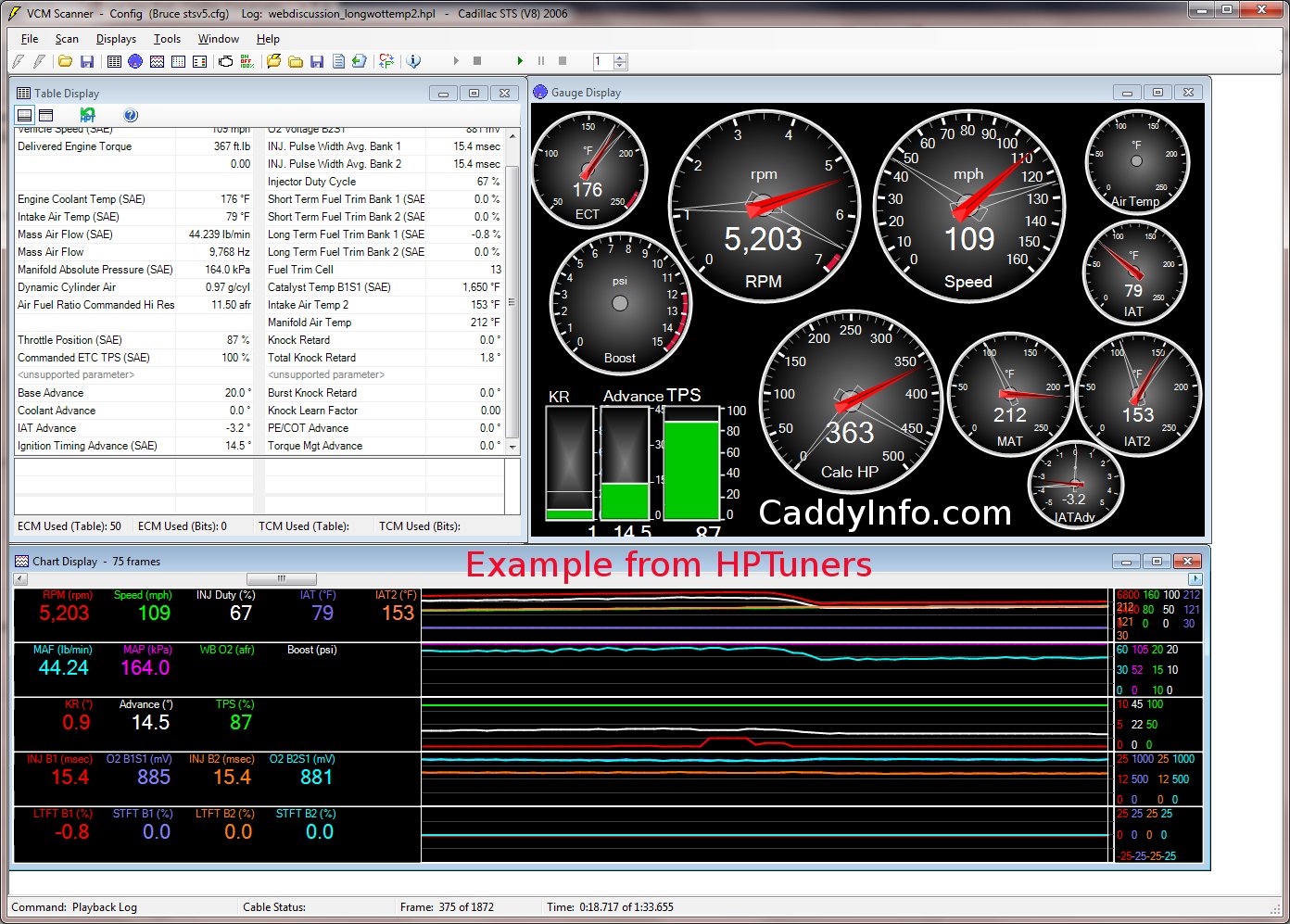
I am continuing to study the effects and behavior trends for intake air temperatures (IAT) versus after the intercooler air temps (IAT2), versus Manifold Air Temps (MAT).

This graph is a tuner discussion taken from an .hpl download in this thread.  It is not my STS-V, just interesting to see the data from this run.  In the run the author was studying the relationship between MAT, IAT2, and the effect of IAT on timing advance (IAT Advance).

HPTuner Dashboard from a web example

What this dash shows is a moment in time as the STS-V is about to shift from 2nd to 3rd gear at 6188 RPM and 64 mph.  The IAT incoming air temperature is 79F, so a mild day.

The IAT2 is 117F, taken off the sensor.  The MAT is a predicted value for the actual manifold temperature as follows:

ok there is some hidden logic here you cannot see, the IAT2 PID displays the raw IAT2 sensor reading. The IAT Spark table uses a prediction from the IAT2 reading that is meant to compensate for the slow moving IAT2 sensor. To predict IAT2 temperatures faster than the IAT2 sensor can actually measure them. Now for the happy coincidence: The MAT value is calculated from this predicted IAT2 value (using the usual Bias and Filter tables) and for your application the bias tables are all 0. Meaning MAT = Predicted IAT2.

So in other words, the IAT2 is useful, but the MAT perhaps reflects the value that the IAT Advance will use.  What we see here is that the MAT temp of 109F the IAT Advance is 0 degrees.

Later in the run as the MAT goes up to 212F the IAT Advance falls as low as -3.2 degrees.

Hp Tuners test drive snapshot example2

Summary:

MAT is perhaps as important as IAT2 in understanding the LC3 Supercharged V8’s responses to temperature over time.  After adding MAT to the Table display in HP Tuners one can select F instead of the default of K degrees, and same for the gauges so that MAT shows apples to apples with the IATs.

Generally the MAT changes much more rapidly than the IAT2 value, which as described is the purpose of its use.  It swings higher than the IAT2 max, but also recovers faster to lower temps.


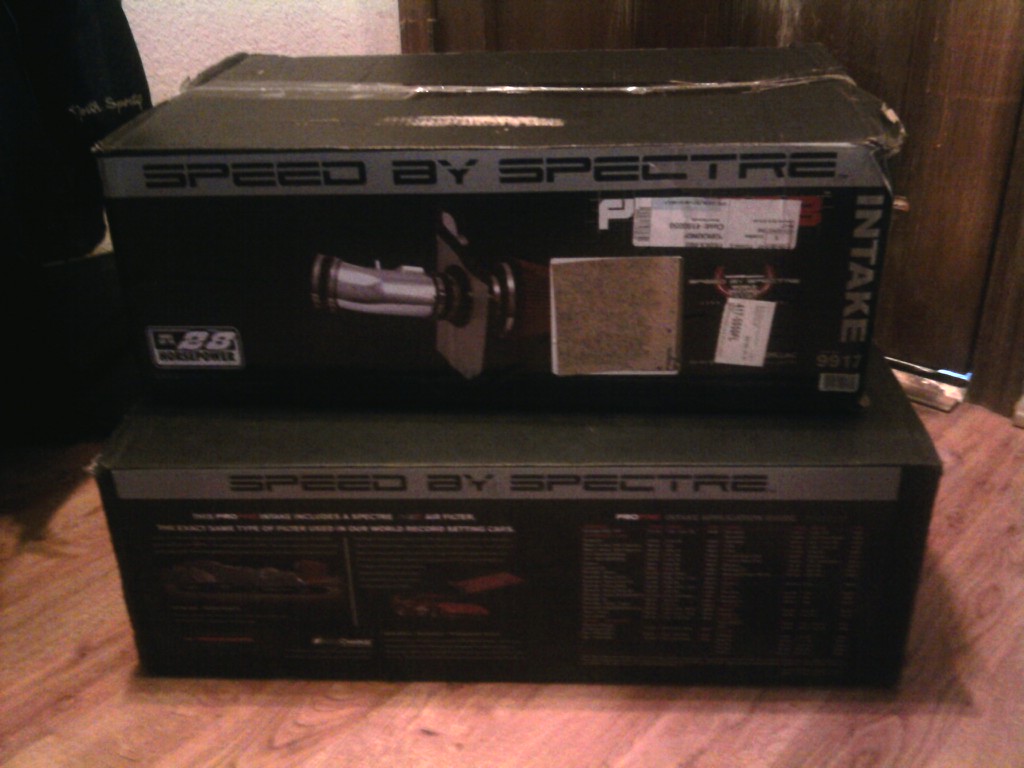
Spectre Intake: boxes on the doorstep

Boxes arrived with the Spectre Performance intake system for the Cadillac STS-V LC3 4.4L Supercharged V8 today (Monday).   Sorry for the camera phone pics, but grabbed the snap while bringing my Wife home and running back to my next appointment.

Spectre Performance Intake

Spectre Performance Intake

The system is offered in two parts, the ‘bottom’ end from MAF to filter (?) and the ‘top’ end from throttle body to MAF.  I ordered both parts, so two boxes from StreetSideAuto.

Friday is the dyno/install/dyno test day at True Street Motorsports in McKinney.