
Cadillac Escalade Hybrid – the counter-argument

I am a fan of well expressed opinions, even if I disagree with them. I think that our level of discourse is very important, and the better the debate the more actual information and truth sneaks in.

Keith Ritter over at Consult Keith blogged a nice thought piece which at heart contains this statement:

Cadillac’s brand message is not about environment-friendly or great gas mileage.  A Cadillac has always been A STATEMENT about who you are and that you’ve “made it.”  It’s about Kate Walsh and your vehicle turning you on and not about gas mileage.

I would like to disagree. Cadillac has always been a vehicle for the Affluent. But more to the point, Cadillac is about precision, technology, performance, and luxury.   Cadillac has had many WORLD firsts in technology, starting with the electric starter for example.  Cadillac has traditionally had the best, the latest, and the most innovative.    Although in the 80s GM lost their way a bit with badge engineering, the latest and newest technology is an important part of the Cadillac DNA.

Cadillac Escalade Powertrain Status display

Cadillac Escalade Powertrain Status display

The hybrid powertrain in a Cadillac Escalade is no more amazing to me than having the new lane change detection system in the Cadillac STS or heads-up displays in the STS-V and XLR-V. Cadillac gets the latest technology, premium powertrains, and luxury accessories that GM as the World’s largest vehicle manufacturer can bring to the streets.

Also, keep in mind that most people are not choosing between a Cadillac Escalade Hybrid, which is a fullsize SUV, and an economy car.  There is a valid and necessary market for these vehicles among people who need the room, want the up-high driving position, storage space, need the towing capacity, etc.  Not all vehicles fit all people; there are a variety of markets. IF you NEED or WANT a fullsize SUV, and you want it to get the best MPG possible, the Escalade Hybrid is a good choice.

The only surprising thing in the current markeing plan is that the new E-flex technology started out in a Chevrolet Volt instead of in the new smaller-than-a-CTS upcoming Cadillac model.  And I suspect we will see the E-flex powertrain in a Cadillac as the next production example.
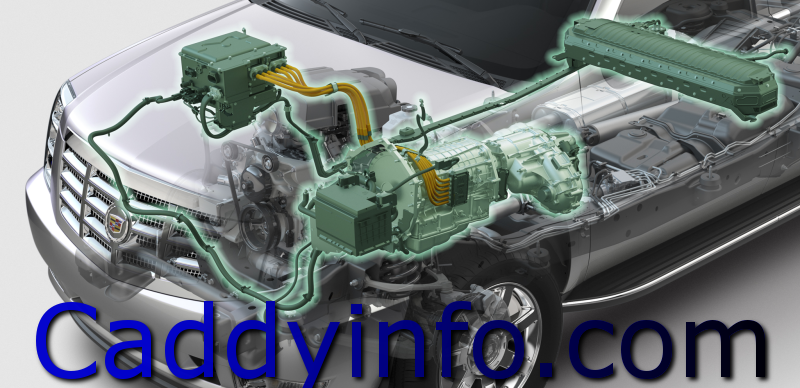
Cadillac Escalade Hybrid Green at Heart

The Cadillac Escalade Hybrid has a fundamentally different powertrain than the base Escalade.  The Escalade Hybrid is a true 2-stage hybrid powerplant, able to move on battery power or on gas propulsion.

Energy Storage System (ESS)

Providing power to the hybrid’s electrically variable transmission’s (EVT) two electric motors is a 300-volt nickel-metal hydride Energy Storage System (ESS). This battery pack is located under the second-row seat, where it takes up virtually no additional space and does not interfere with second- or third-row ingress/egress.

The primary function of the ESS is to provide power (300 volts) to the EVT and to store captured energy produced during regenerative braking. In addition to supplying power to the EVT, the ESS also provides power to the air conditioning compressor and the Accessory Power Module (APM), which converts the high-voltage supply to 42 volts for the electric power steering system, and 12 volts for the vehicle battery and other 12-volt electrical accessories.

Battery pack durability and reliability are maintained via optimized charge and discharge cycles, as well as a dedicated cooling system that draws air from the passenger compartment. As part of the vehicle’s emission control system, the ESS is warranted for eight years/100,000 miles.

In city driving, this advanced hybrid power system enables Escalade to launch and drive low speeds on electricity alone. So cruising along the avenue, the Escalade may use no fuel at all.   As additional power is demanded, the system blends output from the battery and gas engine smoothly.
The key to Escalade’s two-mode hybrid system is that the electric power used to propel the vehicle is generated by the hybrid system itself. When the brakes are applied or the vehicle is coasting, the electric motors within the hybrid system create electricity that is stored in the 300-volt battery. This stored energy is used to move the vehicle and the regenerative braking cycle is renewed.

A key contributor to the Escalade Hybrid’s fuel economy is the gasoline engine’s Auto Stop mode. Once the vehicle reaches 0 mph, the gasoline engine is automatically shut down. By leaving the engine off and allowing the vehicle to move only under electric power, such as during heavy stop-and-go traffic, fuel consumption and emissions are greatly reduced.

If you need the seating, room, and towing capacity of a fullsize SUV, the Cadillac Escalade is an excellent choice.  With the addition of the Escalade Hybrid to the Cadillac line, you can have your luxury and quietly glide past the gasoline station too.

How can Cadillac Succeed at Marketing the new Smaller-than-a-CTS?

With the success in sales of the Cadillac CTS from 2003 forward, Cadillac has slowly moved this model upstream.  Although originally entry level CTS models sold for just under US$30K, most examples on Dealer lots now are in the high 30s to mid 40s.    Cadillac plans to slide in a new car in 2010 that is a bit smaller than the CTS, and a bit less pricey.  To make room for the new line, the price of the CTS has gone up a bit.  The new Cadillac has not been publicly named yet.  I am voting for it to be called the Cadillac αTS, for Alpha Touring Sedan.  I would make the A a Greek Alpha to signify that this is a special car.

When the Automotive press thinks of an inexpensive Cadillac, especially perhaps one with a 4-cylinder engine, they immediately yell CIMARRON!!!  The Cimarron basis was a Chevrolet Citation that was optioned up and rebadged as a  Cadillac.  It was not an inspiring car to begin with, and it was not a great car with a Cadillac badge on it.

Okay, so we have a business story on how not to execute the design and marketing for the new car.  But where is a good plan for how TO do it?  I suggest that Cadillac should consider the BMW 135i.    It continues to suffer from Bangle design, but look at other facets of the model.    As the top of the 1-line, it got the same 3L 300hp twin-turbo engine as the 335i.  The interior is high quality and well laid out.   From the driver’s seat of a 135i one can not tell that you are not in a 335i or 5, 6, or 7 series BMW.  The 135 FEELS like a BMW and shares a lot of interior styling cues with the rest of the line.  The 135i has full entertainment, leather, and navigation features of the larger BMWs.

How does the 135i fall down?  It is pricey, at $35k.  The 128i is the price leader for this model, so okay I guess.  Also, $35K is not as much as it used to be.  Beauty is in the eye of the beholder, but I feel the small BMW is challenged there.  The small size may have contributed to it looking like it does, but ugly is also something I hope Cadillac avoids in the new model.  Especially since the Cadillac will actually be the size of the larger 335i and not the 135i.

So what is the message?  Sure, bring us an alpha-chasis Cadillac that is lighter and more agile.  Offer it with a 4-cylinder turbo that gets good performance and mileage (a la 128i).  But give us the option of the big engines in the small car if that’s what we want, full boat interior touches, and autocross capabilities.  If the new CTS-V is the M5 matchup, please make the new Cadillac αTS the 335i matchup.   Yes, sure, bring high MPG lower performance option models along or along later, but show performance and luxury up front.  Those are what Cadillac is about.