Cadillac Muffler/Exhaust selection based on Target HP

For a zero back-pressure exhaust, it can be shown that one should target 2.2 cfm (cubic feet per minute) of flow through the exhaust per engine horsepower of output.

The Cadillac STS-V has a dual-2.5″ exhaust with dual mufflers.  The stock mufflers probably flow 160-200 CFM each, or 320-400 CFM together.

The stock LC3 engine makes 469 hp through the stock mufflers.  However, this is a supercharged engine so at redline it likely makes 469 +~60 hp = 530 hp or so, and the exhaust needs to be suited to this figure.  Moreover, I would like to tune my STS-V to make 500+ hp not considering the supercharger load, so 560 hp with the charger.  Therefore I am targeting 600 hp with the supercharger load (rounding up).  Therefore the exhaust needs to flow 2.2 cfm/hp x 600 hp = 1,320 CFM.  Each muffler therefore should flow 1320/2 = 660 CFM.

What are some example flow rates for commonly used mufflers on the STS-V?   For 2.5″ mufflers:

Stock:  160-200 CFM x 2 = 320-400 CFM

Borla: 373 CFM x 2 = 746 CFM (at 15 inches of Water)

Corsa: 226 CFM x2 = 452 CFM

Gibson: 267 CFM x 2 = 534 CFM (at 15 inches of water)

Magnaflow 11226 (14326 polished) : 588 CFM x 2 = 1176 CFM (shown on a Dynomax video), at 20 inches of water.

and one that is relatively new but I have not heard tested on the STS-V is the Dynomax VT

Dynomax VT 17956: 841 CFM x 2 = 1684 CFM (shown on a Dynomax video), at 20 inches of water.

The 17956 is not recommended for dual 2.5″ installations.   The difference between the 17956 for single installations or the 17156 for dual appears to be the resistance of the spring for the diverter valve.  This Dynomax muffler has a diverter valve built-in, so at cruise it diverts flow for less noise.  The dual-muffler p/n is 17156.  This muffler is 4.5 in. x 9.75 in. 2.5 in. ID 14 in. Shell Length 19 in. Overall Length.  The Magnaflow 11226 is 4 x 9 x 20 inches.

Dynomax VT video:

I am thinking of either the Magnaflow mufflers, or the Dynomax VT 17156s.  Either should be a better match for the potential of the LC3 S/C V8 than the stock setup.  I had a Corsa cat-back system on my CTS 3.6L and loved it, but they don’t offer a system for the STS-V.
Cadillac STS-V LC3 Boost vs Engine RPM, Gear

Taking an export from my HP Tuners datalog, I have been doing a bit more data analysis of various parameters.

Perhaps I am doing something wrong, but there appears to be a ‘hiccup’ in the csv export of the HP Tuners, in that the RPM is exported to the comma delimited file with a comma-formatted value.  For example, 2450 rpm is exported as 2,450 rpm so when imported as a comma delimited value it gets split into 2 and 450.  So, once I manually fixed that in my target file then I could import the data and begin to make some charts.

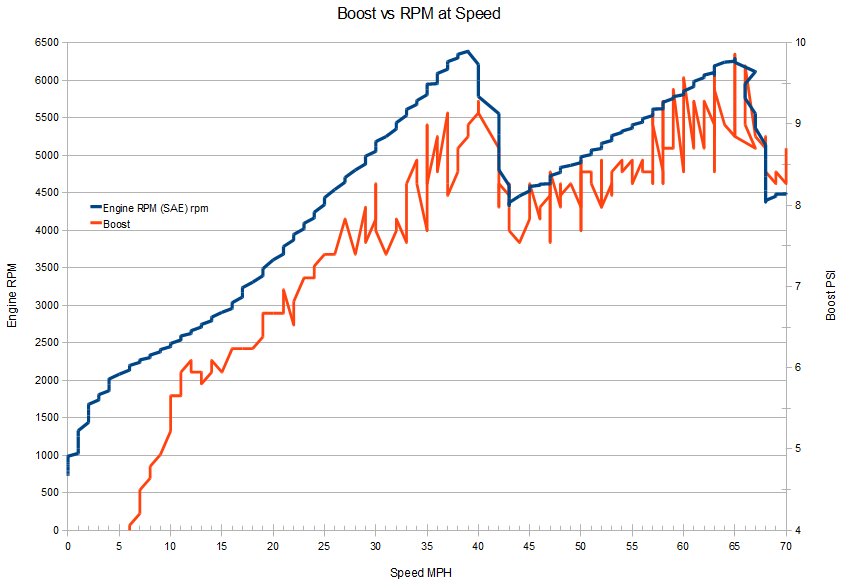
These charts show RPM across speed 0-60 mph, along with Boost at the same speeds.

RPM vs Speed vs Boost PSI

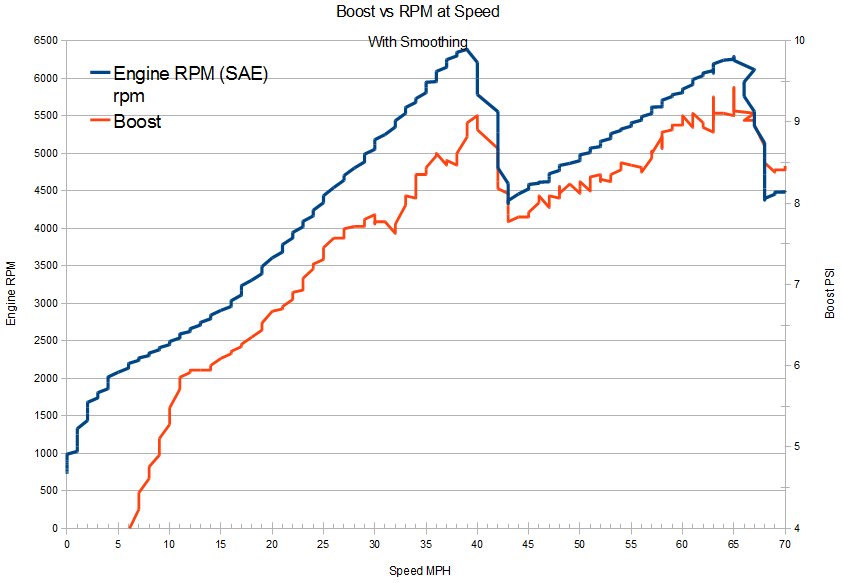
RPM is shown on the left Y axis, and Boost PSI on the right Y axis.  Speed in MPH is along the X axis.

Boost is certainly spikey measured this way.  There may also be other factors involved.

The Boost PSI is calculated by comparing the Manifold Absolute Pressure (MAP) with the V’s Barometric calculation (Baro).  One can see that the V does not shift at exactly the same RPM at 1-2 and at 2-3 although I believe they are both specified to shift at 6500 RPM.

This is the same graph with some smoothing done by averaging of values, 2 prior to and 2 after each point.

RPM vs Speed vs Boost PSI Smoothed

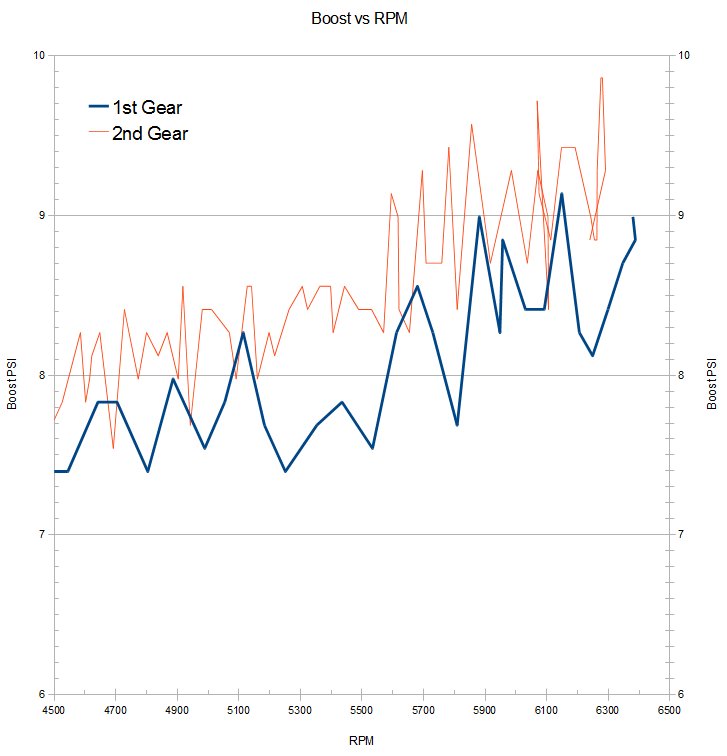
Finally, here is a graph showing boost in the target range of 4500 RPM to 6500 RPM with boost in 1st gear shown in blue and boost in 2nd gear shown in red:

Boost by RPM by Gear

Summary

My conclusion is that boost is in fact higher in 2nd gear than 1st gear.  This is perhaps due to more air flow into the intake at speed?  I am not certain.

On the graph Boost appears to settle around 9 PSI at high RPMs.  Boost in this dataset peaks at 9.86 PSI which in the smoothed set is 9.43 PSI.  The STS-V was designed for 12 PSI of boost.  If we assume the supercharger makes 12 PSI of boost then this reading after the Laminova tube intercooler suggests that the pressure drop of air across the intercooler is 2.57-2.14 PSI.

Updated Baseline Cadillac STS-V 0-60 time

This morning it was a fresh 91F out, so I ran some new baselines for the STS-V.  Just tickling the 5 sec line at 91F.

Weather: 91.4F; Baro 29.12 Hg. (14.3 psi); Humidity 10%.  Fuel: half-tank.  Altitude: 600 feet above sea level.

My Cadillac is a 2008 STS-V with a Spectre Intake.  This is a 4,233 lb sports luxury V-Series sedan with a 4.4L supercharged & intercooled V8.

Today in hot weather it ran a 0-60 time of 5.42 sec (0 feet-5,280 feet), or 4.98 sec including 1 foot of rollout as at a dragstrip, (1 foot-5280 feet).

The 60′ time for this run was 2.3 sec.

Previous measured times for my STS-V with me driving were 5.39 sec w/rollout and 5.29 sec w/rollout, so today’s time of 4.98 sec w/rollout is an improvement of 0.3 sec.  Between the runs I have changed the tires, added the Spectre intake, and changed the MAF.  Side by side, today’s run would have been 17 feet ahead of the previous run at 60 mph.

w/rollout
Speed(mph) Time 0.44 Dist(f)
10 1.01 0.57 6
20 1.75 1.31 23
30 2.46 2.02 49
40 3.31 2.87 93
50 4.30 3.86 159
60 5.42 4.98 248

Here is the graph:

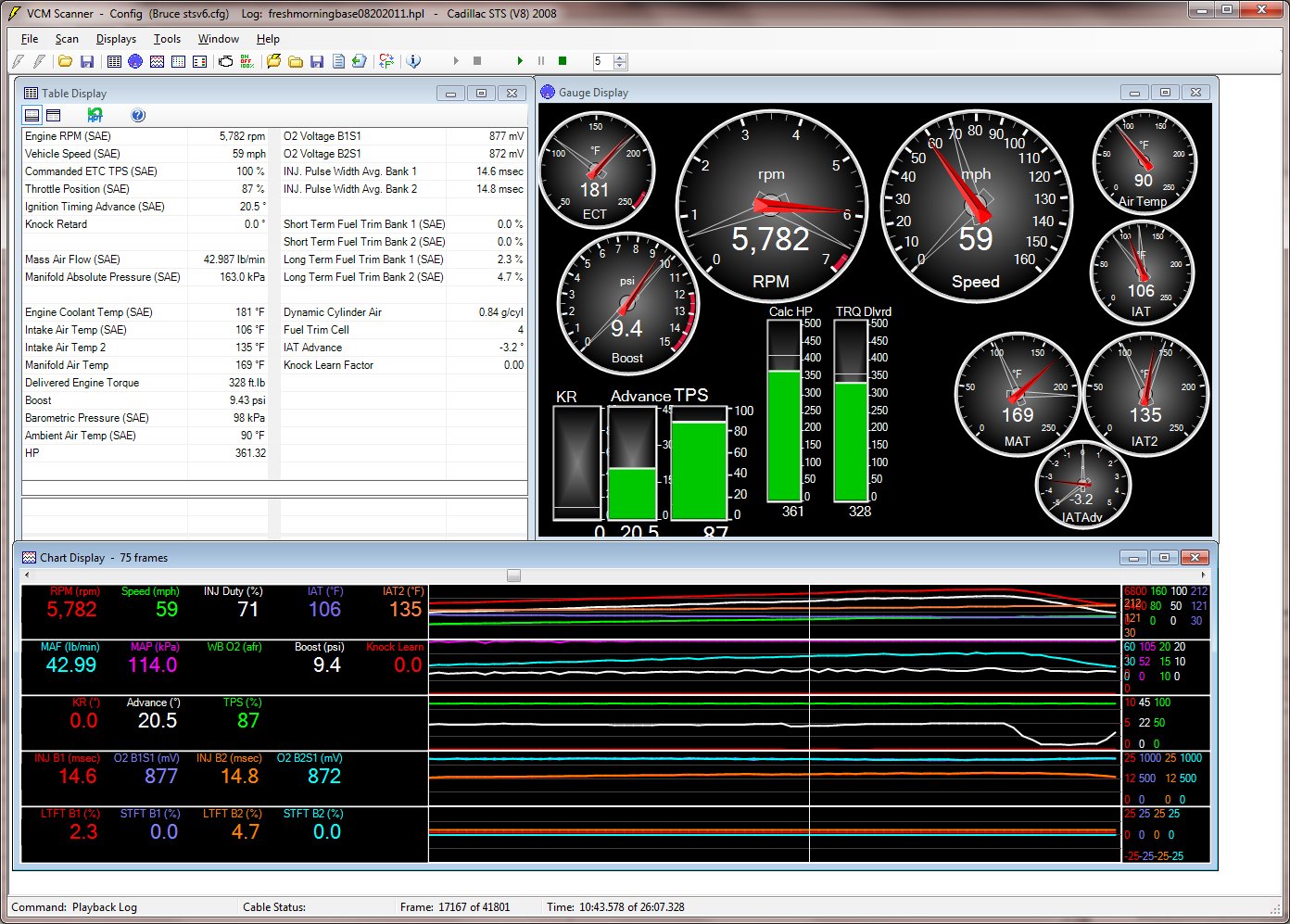
Here is a view from HPTuners of the peak near 60 mph for this run showing that I am getting -3.2 degrees of advance due to the ambient and IAT2 / MAT temps at this point; it heads as low as -4 degrees.

IAT Advance at -3.6 degrees

I believe that because the boost is calculated from Manifold pressure and barometric pressure, that it reflects boost after the pressure drop across the Laminova intercooler tubes.  So some pressure going in, 9.4 psi getting to the engine in this snapshot.

Here was a video of the HP Tuner scan of the 0-60 run:

I captured a second run at 5.45 sec w/o rollout or 5.08 sec from 1 foot.

w/rollout
Speed(mph) Time 0.37 Dist(f)
10 1.06 0.69 6.2
20 1.87 1.50 22.58
30 2.61 2.24 48.61
40 3.41 3.04 92.88
50 4.38 4.01 158.55
60 5.45 5.08 248.34

My rollout is still a bit high — taking too long to get from 0-1 foot.  I would like to see rollout around 0.3 sec.

Summary

Today’s run shows a clear improvement from the previous mark.  I would like to see under 5 sec without rollout considered.

The IAT Advance is pulling timing from the engine based on the incoming air temp out of the supercharger.  Either running the car in cooler weather (!) or improving the intercooler cooling perhaps would help.  This is with the stock calibration; it may be possible to simply adjust the tune to be somewhat less aggressive on IAT Advance.  Adjusting shift times and possibly RPM may also reduce 0-60 times.