About bwnunnally

Bruce Nunnally is an independent Blogger who writes Cadillac Conversations on all things Cadillac. Connect with Bruce on Google+

Cadillac SRX continues to Lead August Sales

Cadillac SRX once again led all models, at almost 7K sold in August 2015.   Overall sales are up almost 52% for the SRX year over year, and reflect a great product in a market looking for Crossovers & SUVs.  Cadillac can’t get more SRX cousins to showrooms fast enough.

The ATS led sedans at 2,449, followed by CTS at 1730 and XTS at 1531.  Overall sedans were down sharply, continuing the trend on the year.

Escalade sales were strong, at 3080 total units, although down year over year.  I still wonder if this year is capacity constrained there.

The extended electric ELR sales were down to 45 last month, which is below their average of around 100 a month.  ELR down 9% on the year.

  August (Calendar Year-to-Date)
January – August
  2015 2014 %Change Volume   2015 2014 %Change Volume
ATS 2,449 2,804 -12.7   16,544 20,296 -18.5
CTS 1,730 2,592 -33.3   12,934 20,639 -37.3
ELR 45 196 -77.0   704 774 -9.0
Escalade 1,770 2,277 -22.3   13,349 11,415 16.9
Escalade ESV 1,310 1,257 4.2   8,972 6,419 39.8
Escalade EXT 0 1 ***.*   2 50 -96.0
SRX 6,903 4,545 51.9   43,863 38,008 15.4
XTS 1,531 2,978 -48.6   14,423 16,407 -12.1
Cadillac Total* 15,738 16,650 -5.5   110,791 114,008 -2.8

From the press release:

DETROIT – General Motors’ (NYSE: GM) Chevrolet, Buick, GMC and Cadillac brands sold 270,480 vehicles in the United States in August 2015. Retail deliveries climbed 6 percent compared with a year ago, when results included the Labor Day holiday. GM had the industry’s largest retail sales increase and gained more than 1 percentage point of retail market share year over year, based on J.D. Power PIN estimates. Fleet sales were down 24 percent on a 38 percent decline in rental deliveries. Total sales were in line with a year ago.

GM continues to have the highest average transaction prices (ATPs) and had the lowest incentives as a percentage of ATP in the domestic industry, according to PIN.

“GM’s retail sales increase far outpaced the industry in August, and we have grown our retail share for five months in a row compared to last year,” said Kurt McNeil, GM’s U.S. vice president of Sales Operations. “We will continue this momentum with the redesigned Chevrolet Cruze and Malibu, the launch of diesel engines for our midsize pickups, a dramatic restyling of the Chevrolet Silverado and the aggressive rollout of Apple CarPlay and Android Auto.”

GM’s outperformance came in a very strong month for the industry. The estimated seasonally adjusted annual selling rate (SAAR) for light vehicles was 17.5 million units in August, the fourth month in a row above 17 million units – a streak unmatched since 2006.

“All of the economic fundamentals that we look at, including job growth, disposable income and fuel prices, are in good shape and that should keep sales strong,” McNeil said.

Cadillac

  • The SRX crossover was up 52 percent.
Cadillac Northstar LH2 4.6L V8 VVT Tuning #hptuners #Motorama

The LH2 V8 added variable valve timing (VVT) based on the Premium V6 schema of the same time.  Interestingly, the LH2 and the LC3 use the same base cam timing, which reinforces how much the LC3 Supercharged V8 in my STS-V is a supercharged 4.4L LH2.  It may also give us some insights into how the LH2 VVT is programmed vs the LC3 VVT.

Here in Plano, Texas we stay in the High BARO table, so we’ll be looking there.  The same principles should apply in other barometer ranges.

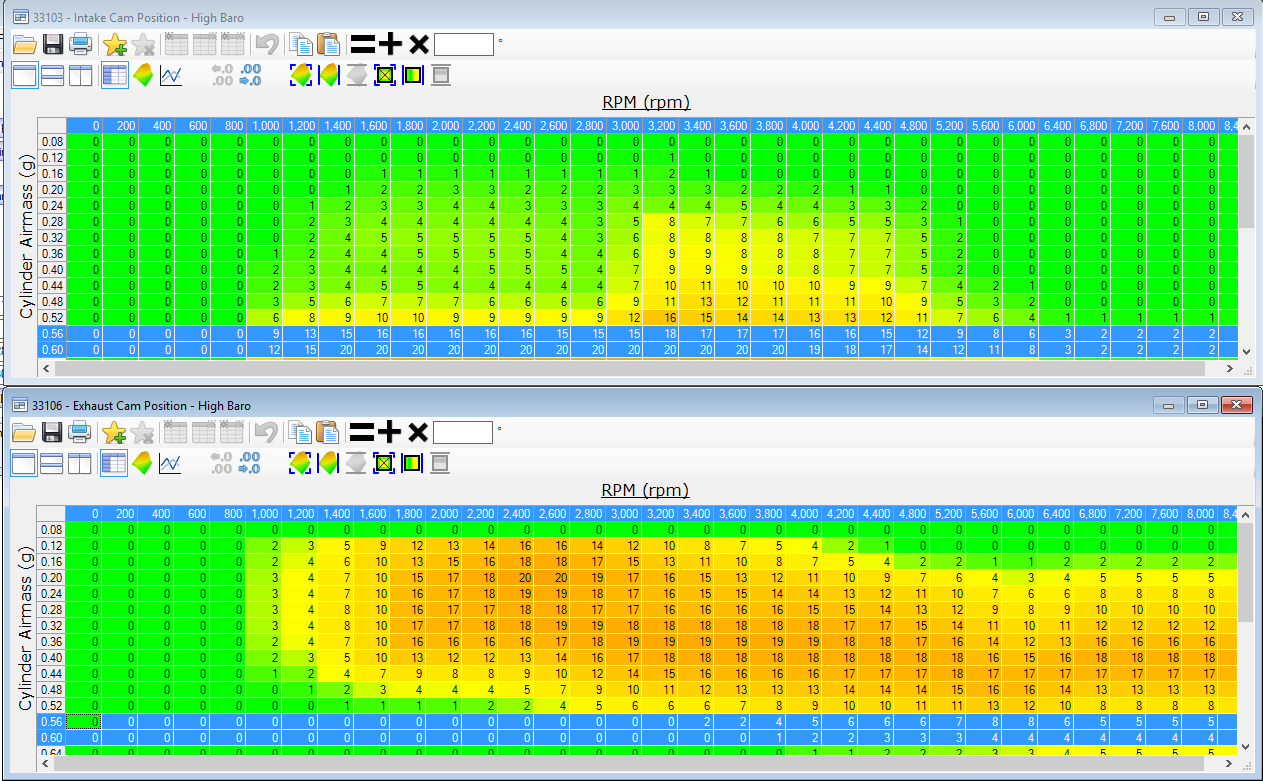
Here is the OEM calibration for the intake and exhaust cams at high baro.  During WOT my LH2 operated around .57 g/cyl airmass so I have blue-lighted the .56-.60 areas: [click to zoom in, back to return]

lh2 vvt intake and exhaust cams

What we see is that the intake cam goes from 16-19 degrees at 4400 rpm down to 2 degrees at 6800 rpm.  The exhaust cam goes from 3-6 degrees at 4400 rpm to 4-5 degrees at 6800 rpm.

The values for the intake cam should be degrees of advance, and the values for the exhaust cam degrees of retard.   For the LH2 it appears 0 degrees of either are Top Dead Center (TDC) [ref: Helms manual pg 9-340].   If that is the case, as the engine moves to high RPM the intake cam gets less advanced (retards), and the exhaust cam gets more retard (retards).

camactuatoroperation

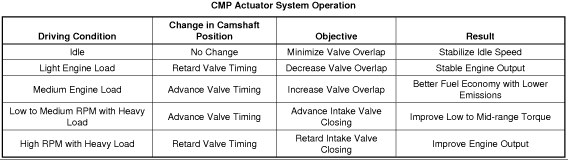
Simple cam tuning rules for Naturally Aspirated engines like my LH2: [ref]

  • Advancing both cams => more low-RPM power, less high-RPM power
  • Retarding both cams => more high-RPM power, less low-RPM power
  • Less overlap => more low-RPM power, less high-RPM power
  • More overlap => more high-RPM power, less low-RPM power

So as the engine moves to higher RPM we want to see both cams retarding, and that is what we appear to see.  We would also like to see more overlap, and that is not what we see — the net change between the two cams appears to introduce more overlap not less.

I am interested in the changes over cylinder air mass within the table.  At lower cylinder airmass the changes have the same basic shape, but to different degrees.

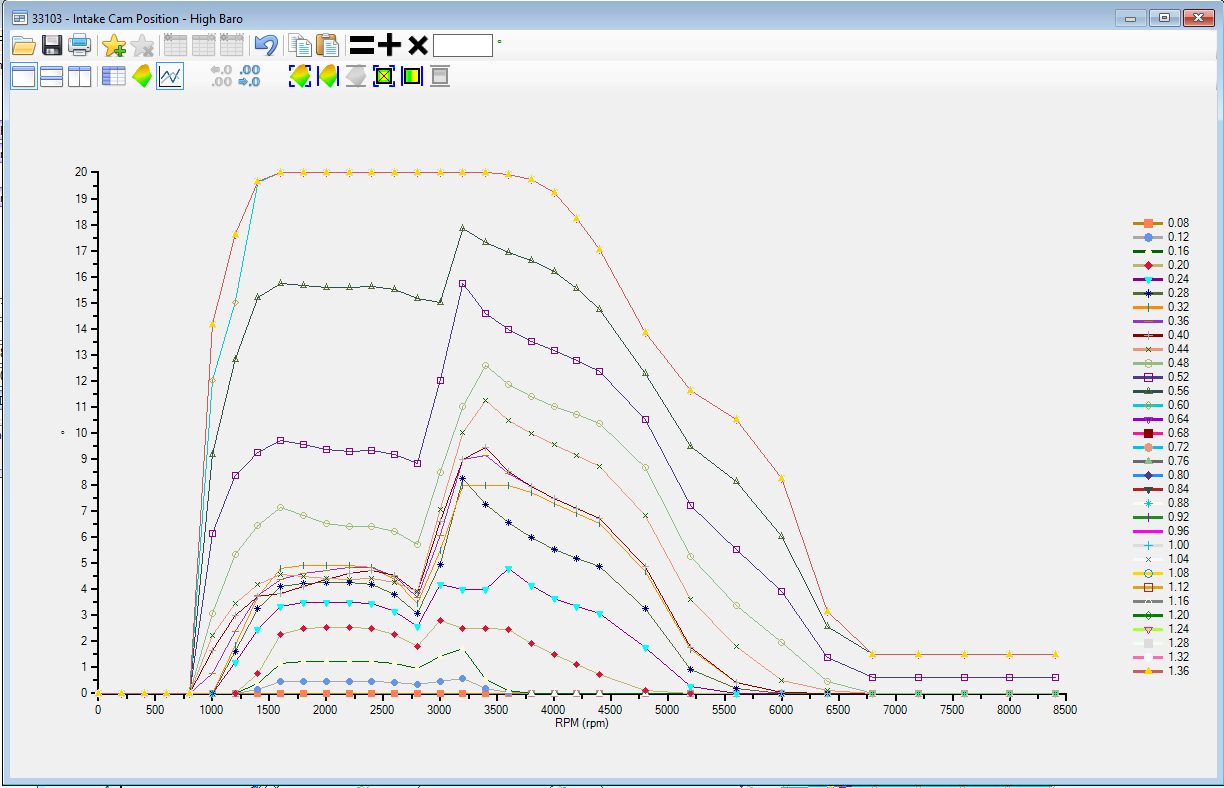
LH2 Intake Cam Graph

This graph shows the degrees of intake cam (left axis) vs rpm (bottom axis) at various gram/cyl air pressures.  The top two lines are our lines of interest, which seems odd, but because the graph maxes out at that point every other range over-writes the top line.

I think our first step will be to begin logging the intake and exhaust cam positions in order to verify that there are not other tables having an impact on these values.

What do you see in the data?  How would you tune these values for low-end torque and high end power?

Cadillac XLR Volant Cold Air Intake Install and Test

Today I installed and tested a Volant Cold Air Intake p/n 25846150 for the Cadillac XLR.

Install

The install is pretty easy.  A screwdriver is needed for the clamps, and a bit of WD40 or similar for the hose fittings.

IMG_2646

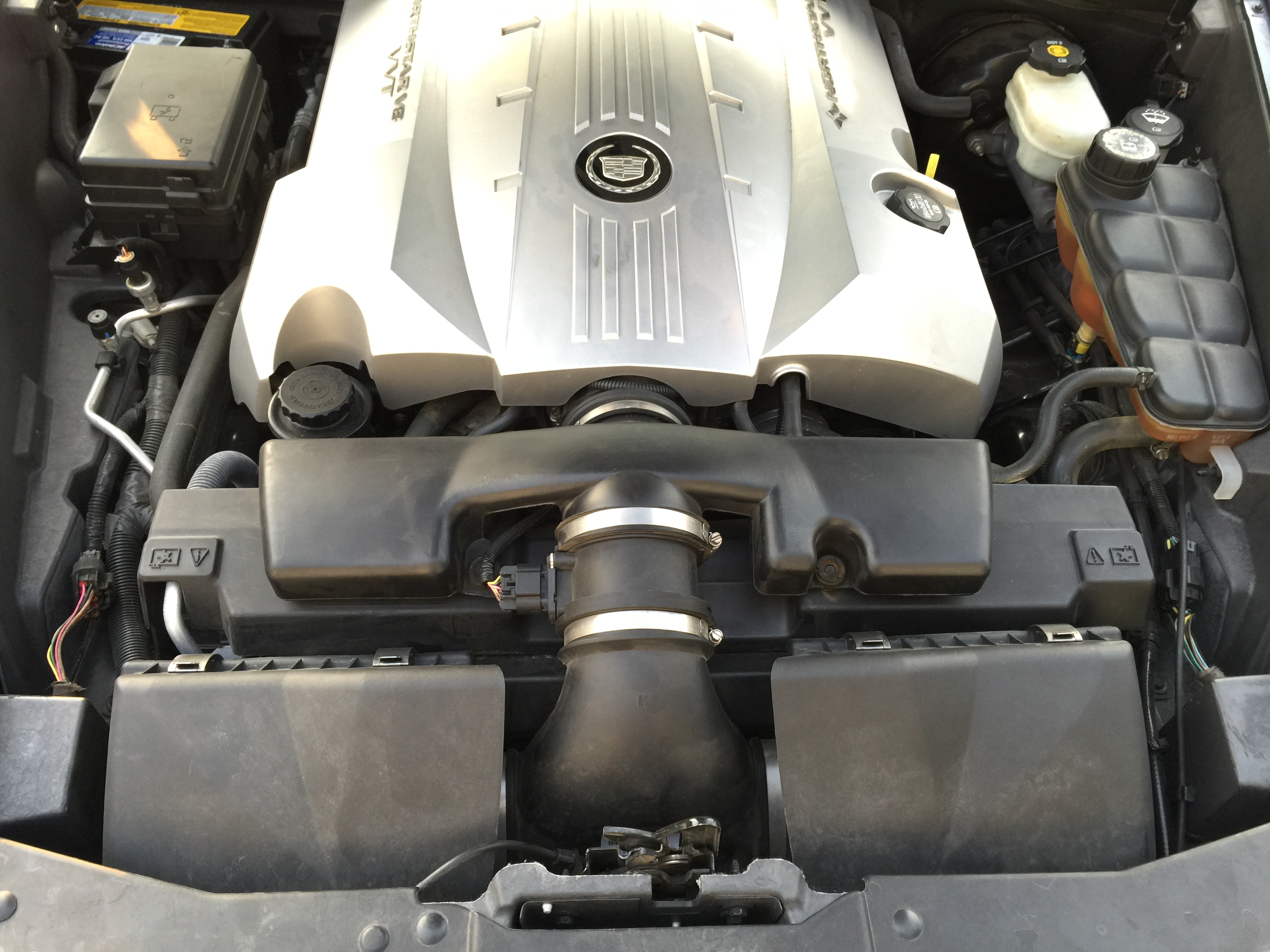
This is the intake setup on the stock XLR.  The air comes into the middle then flows down through openings facing the middle to dual filters and back to the middle and through the MAF into the intake.  There are resonance tubes along the way to quiet the intake.

IMG_2648

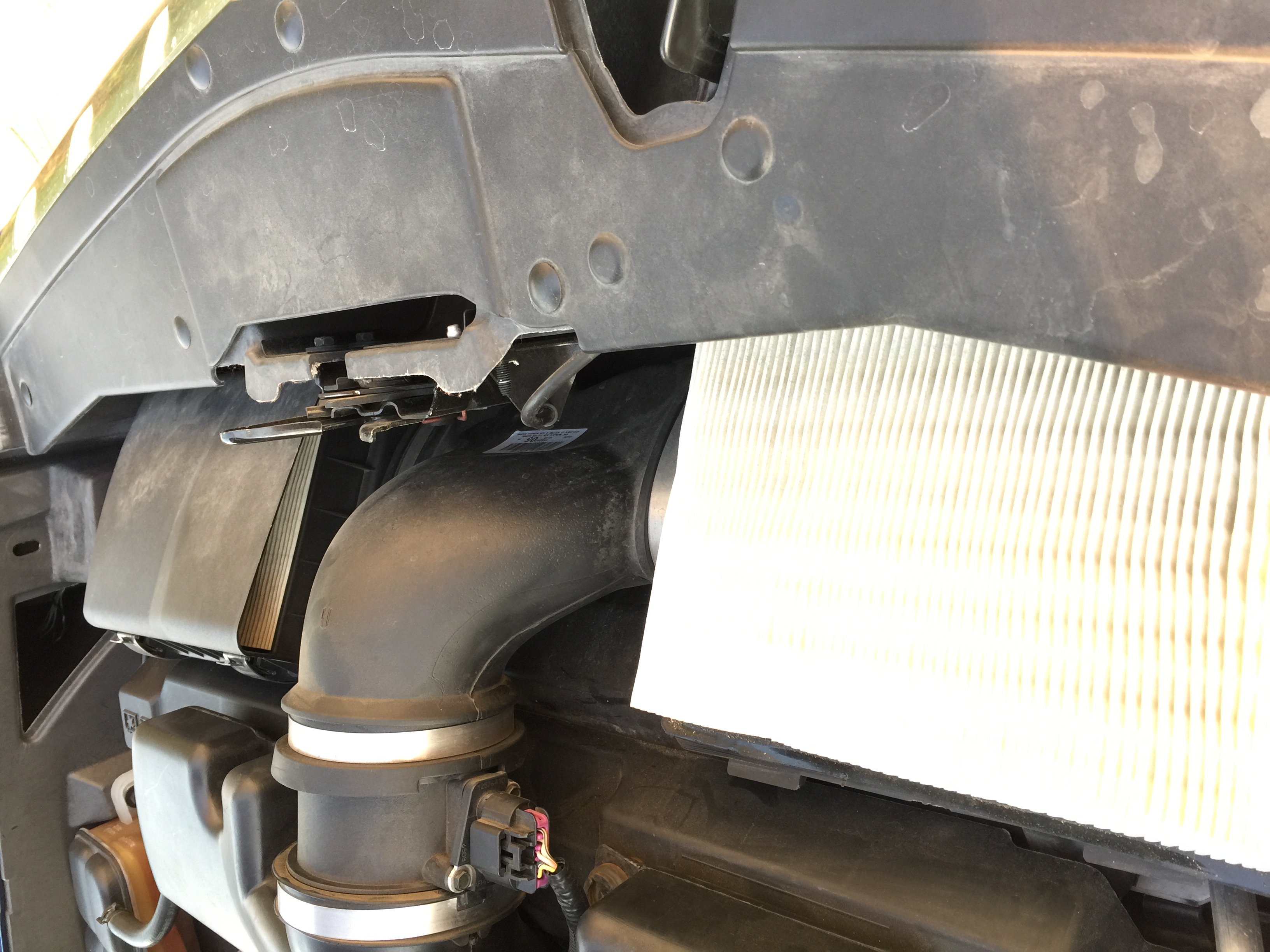
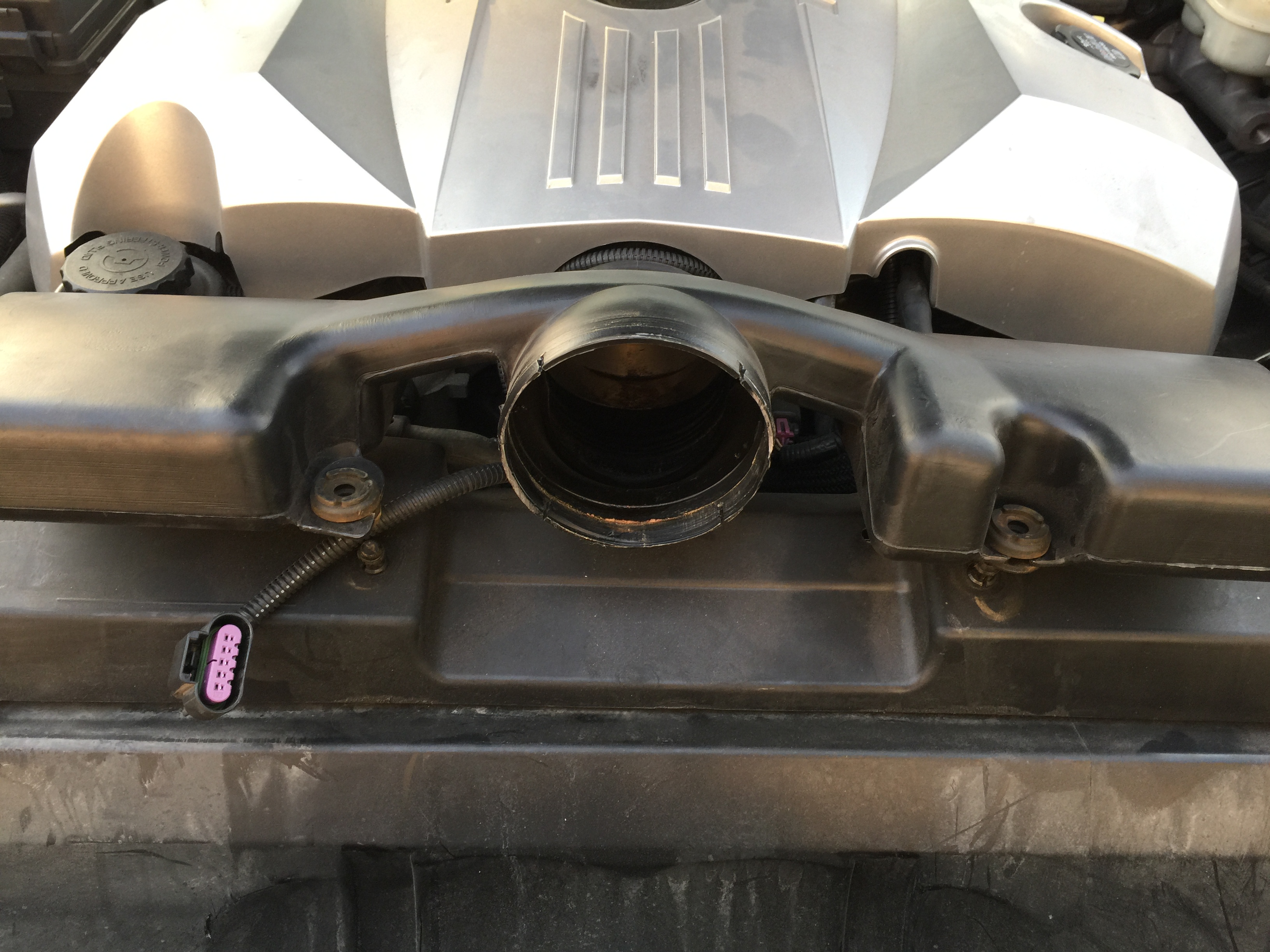
So the engine has to breath through that opening just above the filter on the left, then down through the filters 90 degrees, 90 degrees back to the center, where they turn 90 degrees to get to the MAF.  Good filter area.  The twists and turns the air takes are to prevent hydrolock in a heavy rain?

IMG_2653

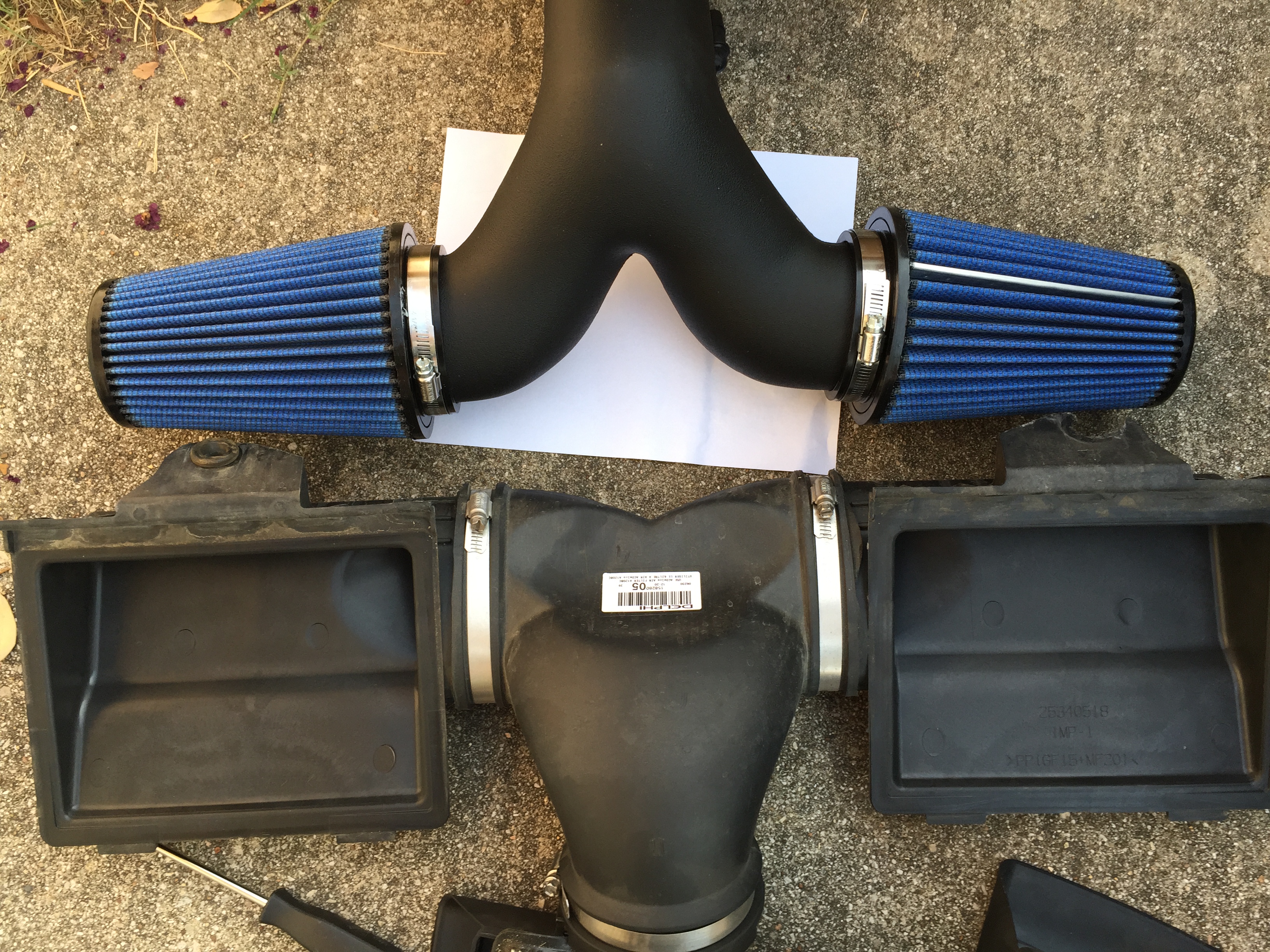
Stock intake vs the Volant Intake.  The Volant has cones and large tubes for flow vs the elliptical pinched approach the OEM took.

IMG_2656

Behind the MAF was this resonator tube.  This probably captures and eliminates certain intake frequencies?

IMG_2658

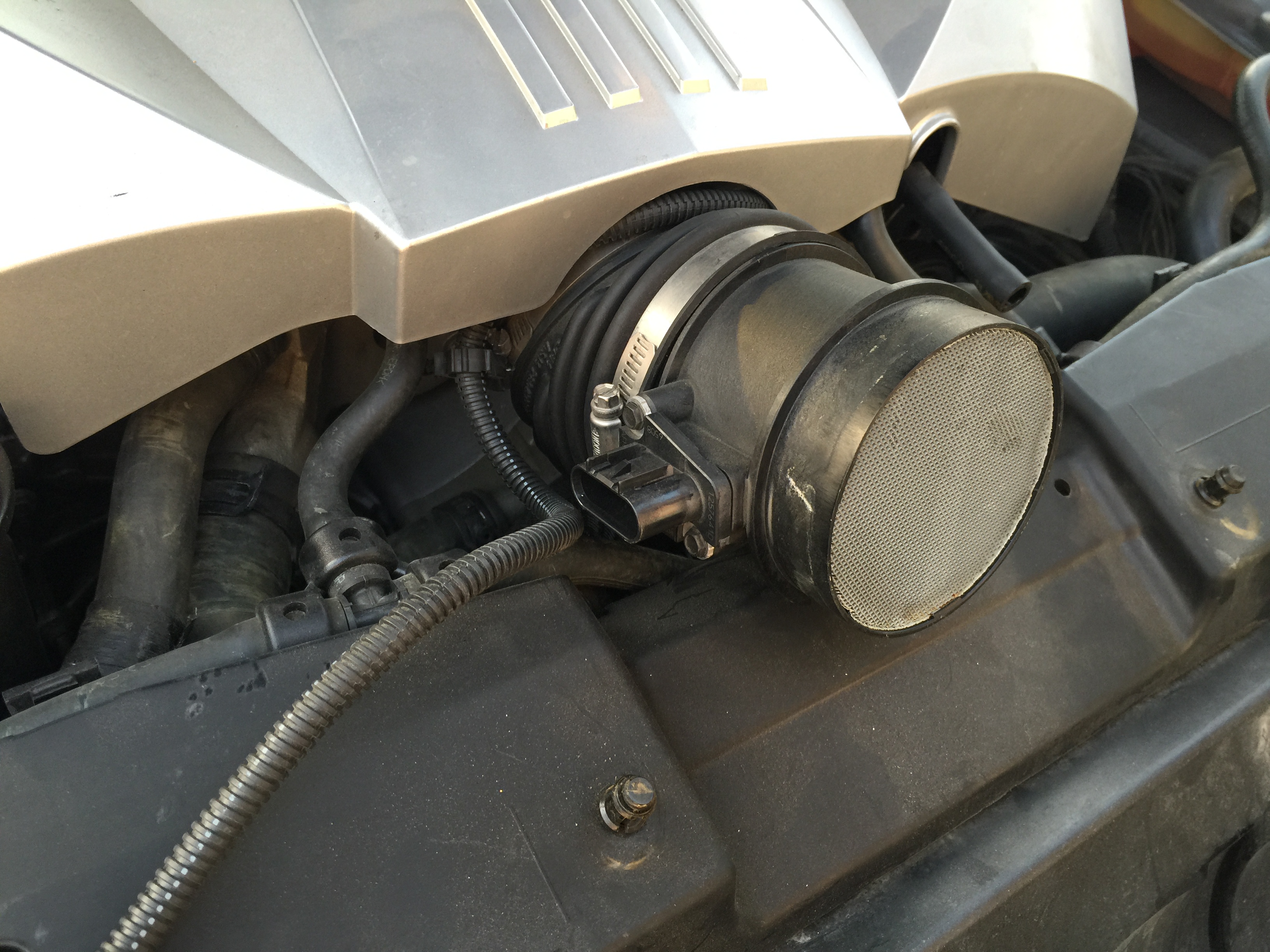
The XLR MAF is a switchblade style, and has a MAF screen to smooth air flow.  I left that in place, but removed the resonator setup and air now flows directly from the MAF to the throttle.

IMG_2659

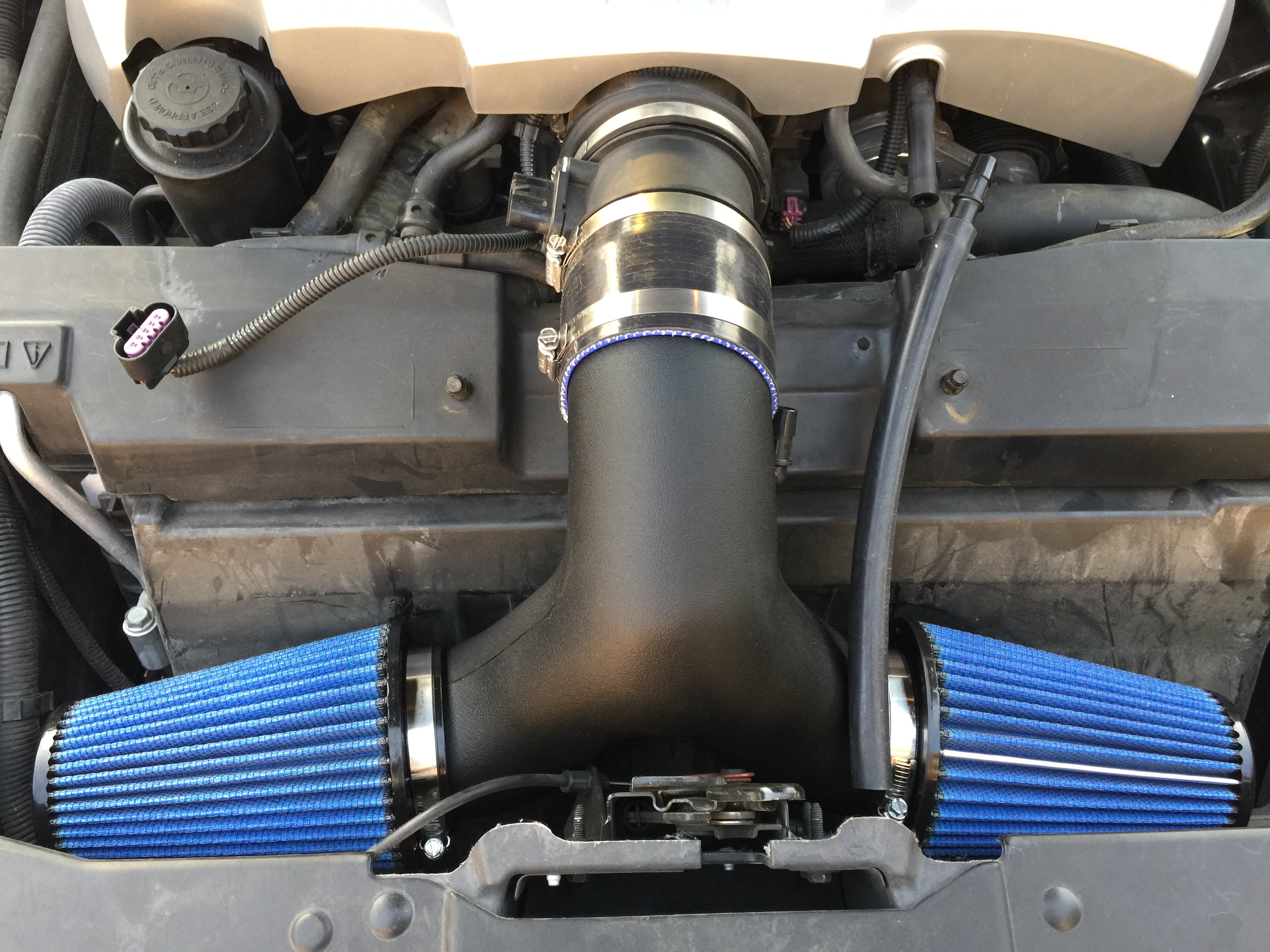
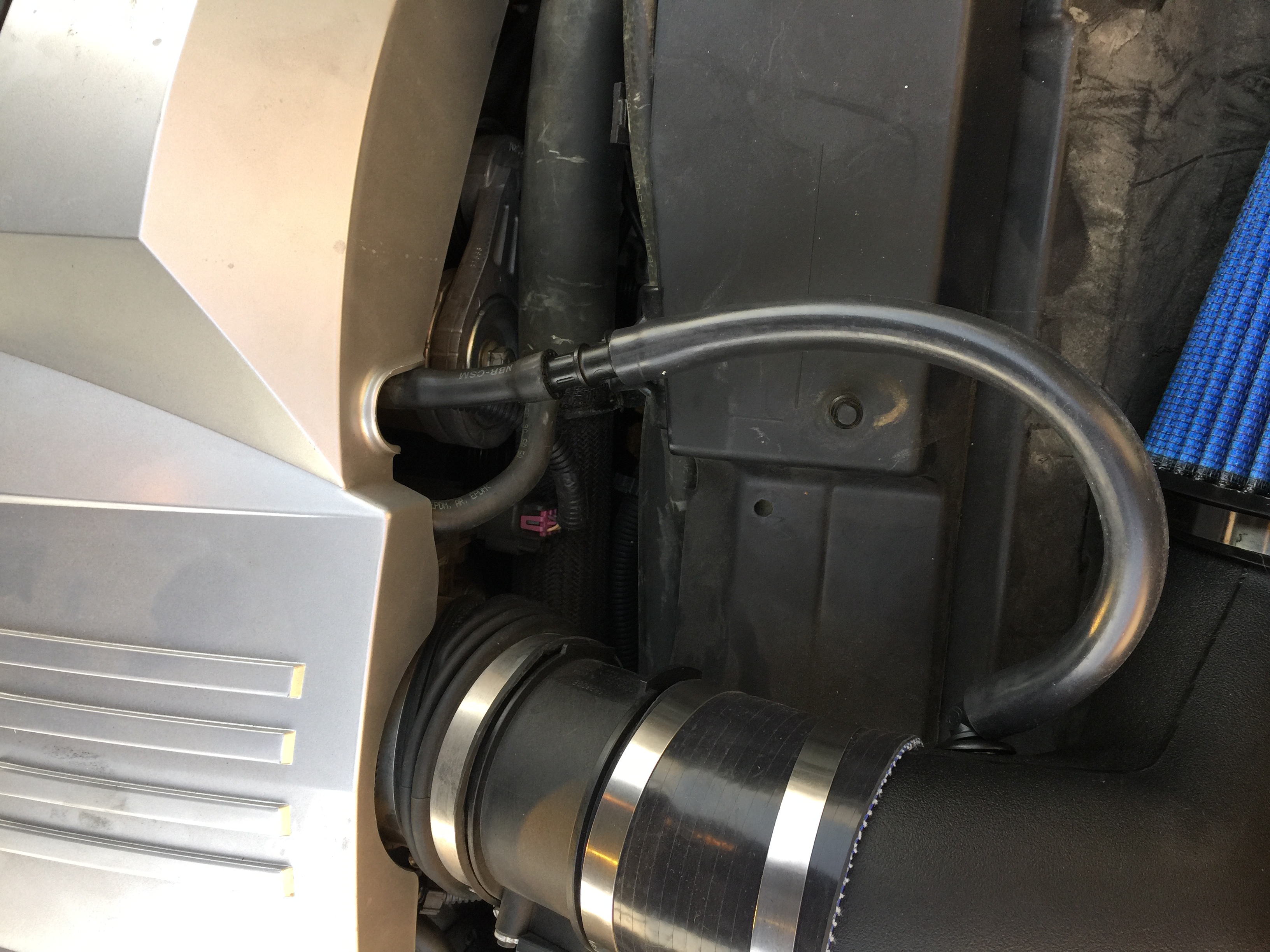
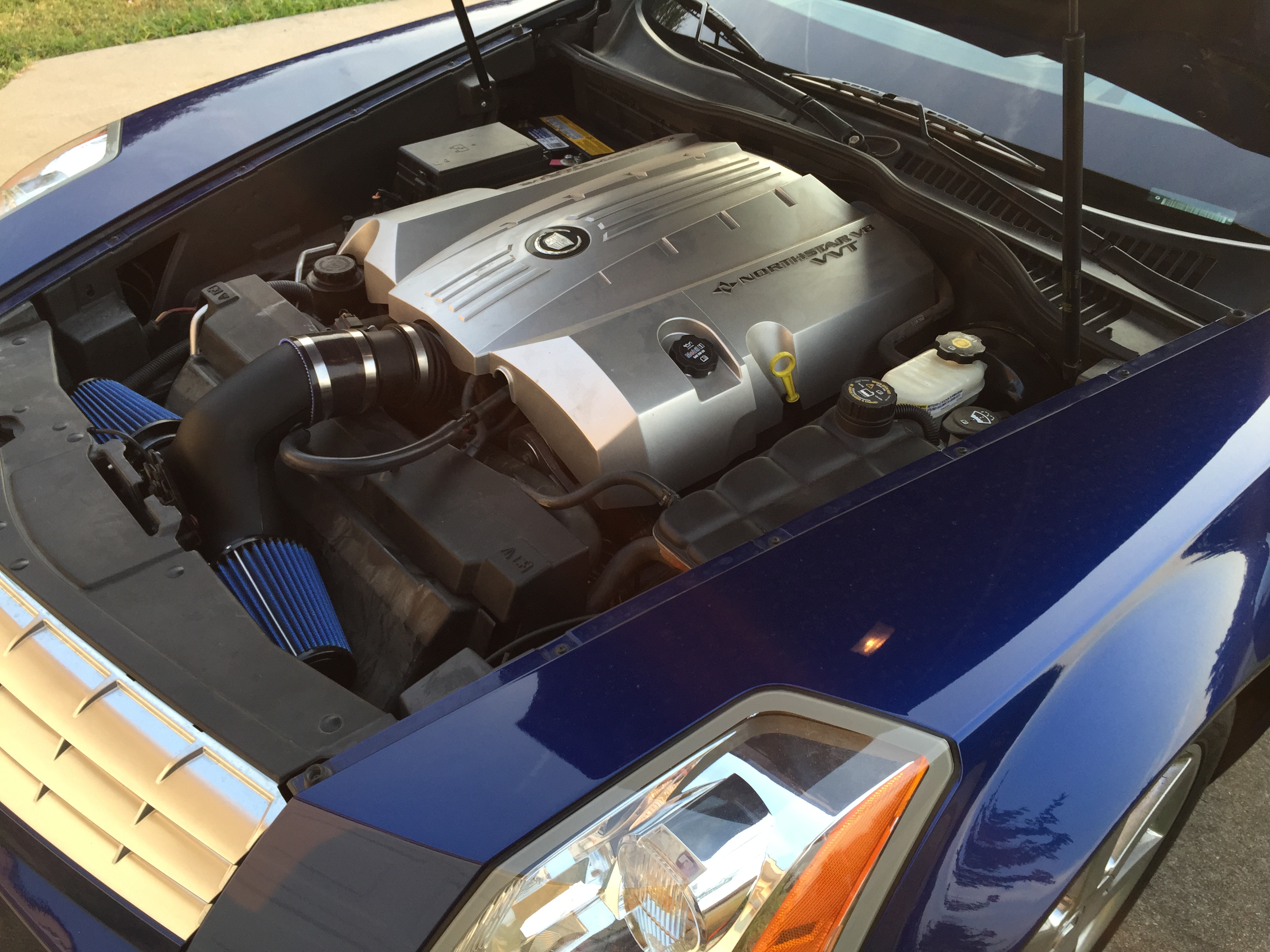
This shows the Volant in position.  The hose to the right is not attached yet, but goes from the breather hose to the intake.  It took a bit of muscle and a drop of wd40 to get the hose barb properly inserted on the engine end.

IMG_2662

Close-up on hose attachment and placement.

IMG_2665

One of the two Volant cone filters up close.

IMG_2667

The blue filter matches the blue XLR.  The hood closed fine.

IMG_2668

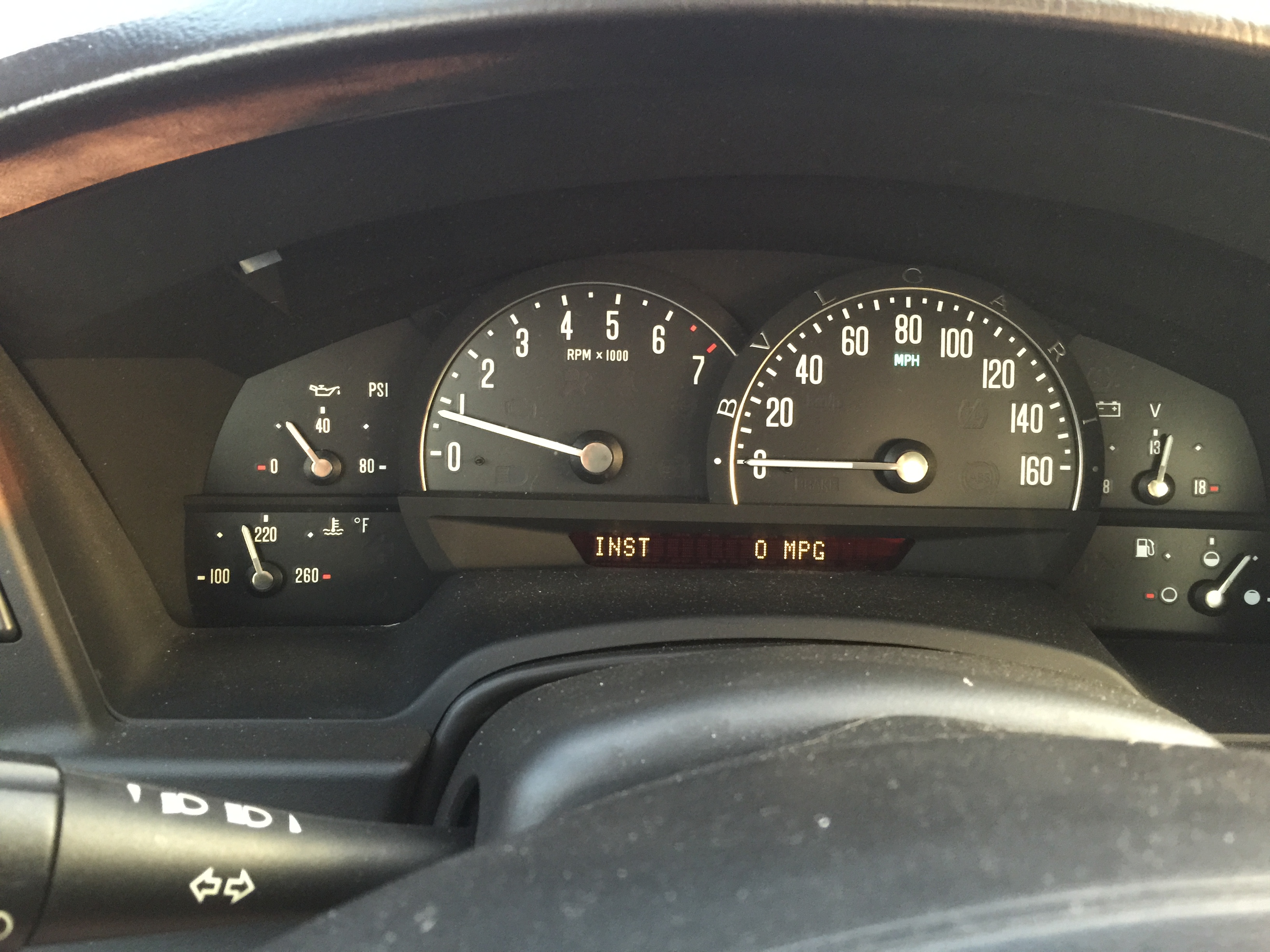
No trouble lights.

Results?

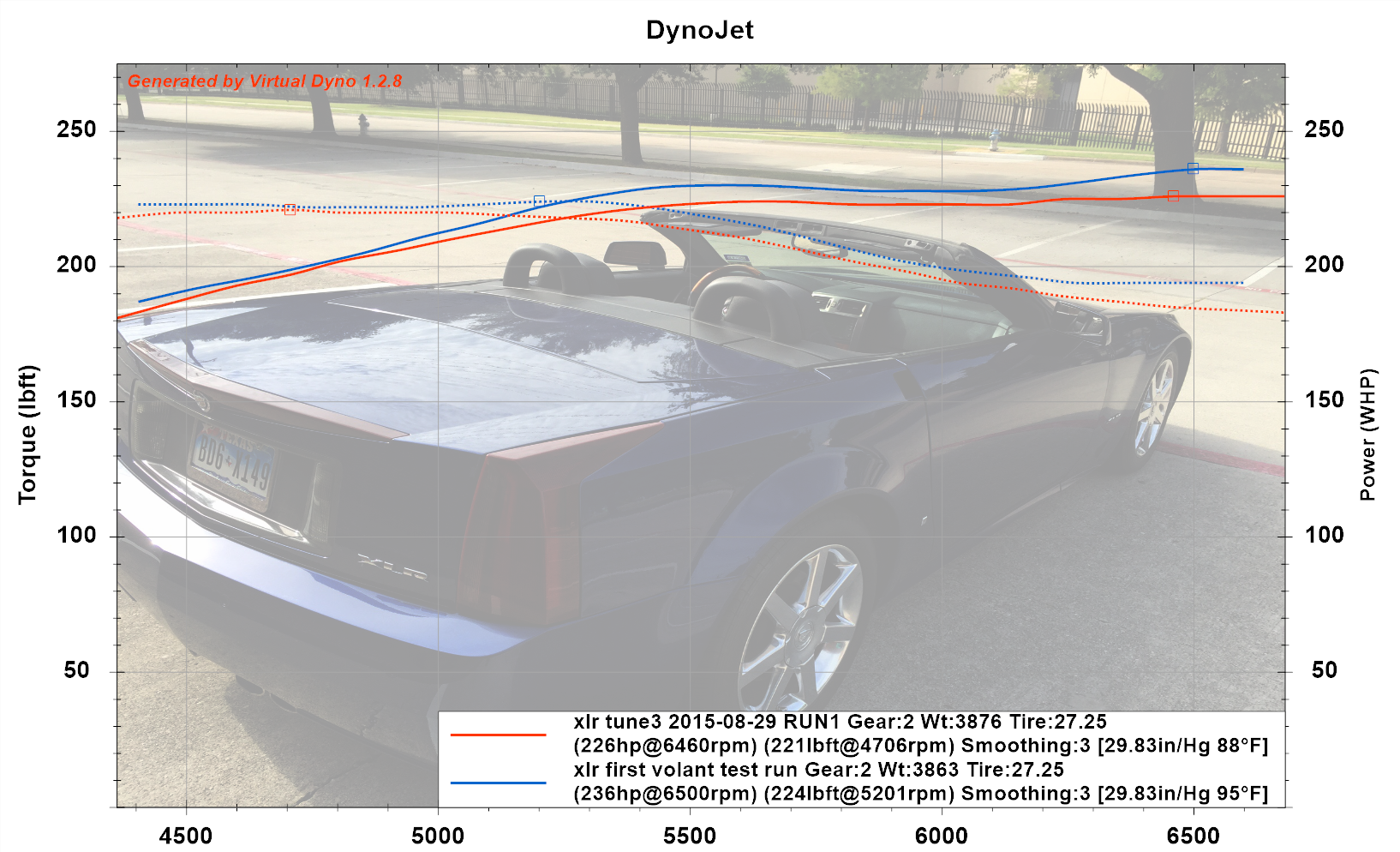
I have been using Virtual Dyno to measure results.  These are 2nd gear pulls so they vary from a chassis dyno which would be done in the gear closest to 1:1 which for the XLR is 3 or 4.

XLR Volant First Test 236 whp 224 lbft baro corr

[click to zoom in, back to return]

This graph shows tonight’s run in Blue, and the prior run with current tune in Red.  The runs are on different days.  Today was hotter at 95F vs 88F yesterday.  What this appears to show is that the Volant added 10 whp and 3 lbft of torque.  The blue line is clearly above the red line from around 4700 RPM up.  This would mean the 320 hp LH2 now puts out about 320 + 10/.8 = 332 hp at the crank.

The intake also had an effect on the intake sound, and the exhaust sound.  The fuel trims kicked up to around 10% each, which is another indication the MAF is now getting more air in than it expected.  I will want to adjust for that in the tune or have the MAF dialed in on a dyno.

The XLR did not show any trouble lights, and the idle is smooth as always.   The calculated hp and torque were lower than expected, so that seems to suggest that these are not predictive of real-world performance?