
Test Gear: ContourHD Camera

I received a ContourHD helmet camera for Christmas. We shopped these and discovered that the latest 1080p version was out, and the previous 720p version was on sale at Amazon with a gift card deal, so we got the previous version, the ContourHD, and my Wife kept the gift card.  Win-win.

After a quick setup and experimentation, here is a test video along a tree-lined road.  Not dramatic video, but the video angle, lens, and video quality seem good:

The VHoldR ContourHD is a video camera in the shape of a small cylinder with attachment points.  It records video to a micro-SD card.  It runs off a battery so is self-contained.  Because it is very light (4 oz) it is also easy to mount on a helmet, or in my case in the Cadillac CTS on the rear view mirror.

The camera came with a 2GB microSD card, although additional cards (extended recording by swapping cards) and larger capacity cards can be used, up to 16 GB.  The battery recharges when you attach the camera via a cable to the USB port on the PC; easy.

ContourHD

The ContourHD like the one I have records in either HD (1280×720 pixels), 720p, or in SD (848×480 pixels), 480p. The latest model, the Contour HD 1080p, records in:

Video Choices for the 1080p:

Video Resolutions
Window Size Frame Rate Record
Full HD – 1080p 1920×1080 pixels 30fps 15min/GB
Tall HD – 960p 1280×960 pixels 30fps 15min/GB
Action HD – 720p 1280×720 pixels 60fps 15min/GB
Contour HD – 720p 1280×720 pixels 30fps 30min/GB
Fast SD – WVGA 848×480 pixels 60fps 30min/GB

a variety of resolutions.

The ContourHD does not have a video display for realtime video review.  To understand and test the best mounting points for the camera in the Cadillac CTS I would try it at different points, then connect it to my netbook, download the video, and review it.  I decided that attaching the ContourHD to the rearview mirror with a clear view out the front of the CTS was best.

The Rearview mirror in the CTS is a large one, with the OnStar access built in to the mirror.  One advantage is that the bottom of the mirror is a flat surface, so it made it easier to attach the camera.  I shopped Walmart in Georgetown, SC where we are vacationing this week and found a Velcro strap to use to attach the camera to the mirror.
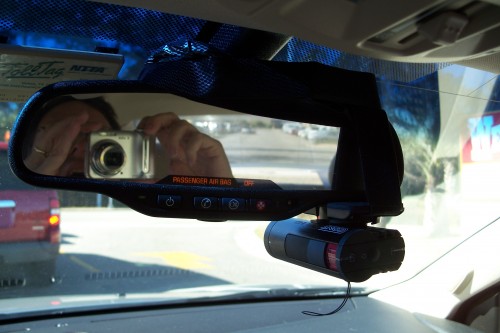
camera mounted on mirror

Mirror Mount with Velcro One-wrap

I used a Velcro One-wrap 3ft x 1 in to attach the ContourHD. A more permanent and repeatable mounting would be more desirable, but this worked for my test drive.

The ContourHD captures video in Quicktime format. It comes with an editing program that can be used to crop the video, but does not offer options to resize. VHoldR does offer online storage of captured video; the video above is on their site.

Overall I am happy with the ContourHD. Because it is light and battery powered, it is easy to mount in interesting places to capture video. It is inexpensive, but appears to be well made. I am not a fan of their side rail mounting system so far, but as I become more familiar with it perhaps it will grow on me.

For inside the Cadillac footage my cruisecam shortbar mount and digital camera really work well.  I think the ContourHD would be more interesting strapped to the exterior mirror or front air scoop.  I plan to keep experimenting with placement and see what works.

Power target for next Cadillac CTS?

The current Cadillac CTS sedan has all the right ingredients to be a very hot dish.  The Performance variant of the CTS Sedan makes a handy 304 hp at 6,400 rpm and 273 lb-ft at 5,200 rpm.  It has a direct injection 3.6L V6, FE3 tuned sport suspension, and performance brakes.  So is it as quick as it should be?

I know, if you want really quick, buy a CTS-V.  Got it.  But is the CTS Sedan putting up the numbers that it should?

Cadillac claims a 0-60 time for the current CTS of under 6.5 seconds.  Magazine tests of the FE3 Performance model have confirmed a 0-60 time of 6.3 seconds.

Let’s compare the CTS Sedan performance to the BMW 335i Sedan.  Yes, I recognize that the CTS is larger than the 335i, more the size of the BMW 5-series.  But I think that BMW 335i performance is really what Cadillac needs to be achieving with the CTS Sedan.  BMW are also masters at magazine numbers / comparison tests, so they are a good benchmark for benchmark racing.

Cadillac CTS BMW 335i
HP: 304 hp at 6400 rpm 300 hp at 5800 rpm*
Torque: 273 lb-ft at 5200 rpm 300 lb-ft at 1500 rpm
Car weight: 4,063 lbs 3,620 lbs
0-60 mph 6.3 sec 5.1 sec
0-100 mph 16.1 sec 12.7 sec
Skidpad 0.87 g 0.89 g
Power/Weight: 13.37 12.07

*Dyno Tests: Automobile Magazine dyno tested a 2007 BMW 335i and found that it was making 340-350 hp and 360 lb-ft of torque, much better results than BMW specs this engine for.  The Cadillac CTS’ LLT engine is SAE certified at 304 hp, so we know that is the true and accurate result.

Weight: weight is a side-effect of larger size. The CTS carries an extra 400 lbs compared to the BMW. Generally 0-60 mph times in this size car are effected at 0.1 sec per 100 lbs, so that is 0.4 seconds of disadvantage.  Given that the CTS Buyers want the CTS to be a fullsize sedan, and want all the luxury and safety features, Cadillac needs to add some power to the 3.6L.

Power: At the current weight, to achieve the same (Mfr claimed) power to weight ratio of the 335i, the LLT 3.6L engine needs to produce around 337 hp.  How can Cadillac achieve this?  The new 3L V6 makes 270 hp; if the 3.6L were tuned to achieve the same hp/liter as the 3L is doing now, or 90 hp/liter, the 3.6L would produce 324 hp instead of 304 hp.  Then for the Sport model of CTS I would specify a performance-tuned exhaust, and a performance-tuned intake.  Together those should put the Performance model above 345 hp normally aspirated.

However, if the BMW is actually making 345 hp, then to overcome the weight difference Cadillac needs a 380 hp powerplant.  Given choices, I would release a Turbo 3.6L as a mid-CTS model.  Such an engine might make 400 hp in production based on GM’s showcars claiming 425hp from that configuration.  That would solve the power/weight issue nicely for the CTS sedan or the upcoming CTS coupe.

Gearing:  I am interested to see how the upcoming CTS Coupe does with a more aggressive final drive ratio

Summary: Is the current Cadillac putting up the proper numbers? With equal power to the BMW claimed HP but at the current weight disadvantage, the CTS should do 0-60 mph in around 5.5 sec.  However, the BMW 3L Twin-turbo, at least the ones presented for comparison testing, is producing around 40 hp more than the Cadillac.  Again, by thumb rule 10 hp makes about 0.2 sec difference in 0-60 times.  So a 40 hp difference can change the 0-60 time by 0.8 sec if all goes well.  Therefore the current CTS if it were as efficient as the BMW at 0-60 mph, but at the current CTS weight, and down 40 hp compared to the BMW test models, should be able to do 0-60 mph in around 6.3 sec.  And it turns out, that is approximately what it does do.

Conclusion — Targets: I suggest that the target for the CTS however should be 0-60 mph in 5.5 sec.  That would put it squarely in the mid-range of what is considered sport sedan territory these days.  That probably means a tune-up to the LLT V6, send in the Supercharged Version, or release a V8 option below the CTS-V that gives the base sedan close to 400 hp.

2009 Cadillac CTS-V Comparison Tests – Car and Driver

Car & Driver tested a Cadillac CTS-V vs a Jaguar XFR vs a Mercedes E63; they pick the Mercedes 1st, the Cadillac 2nd, and the Jaguar 3rd:

All other things being equal, if the CTS-V had been equipped with an [available] automatic transmission like the two other cars here it might have tied the Benz in overall points. How, you ask? A six-speed automatic V we tested in April for CARand DRIVER.com managed the quarter-mile in 12.2 seconds, 0.4 second quicker than both the manual in this comparo and the one from our November 2008 road test. The difference would have tipped the quarter-mile-acceleration score in the Caddy’s favor.

Read more: 2009 Cadillac CTS-V Comparison Tests – Car and Driver.

This probably is the best summary:

Even with the muted soundtrack, our usually home-team-loyal German correspondent quickly deemed the Cadillac to be the sportiest-feeling car of our trio and one that, at $67,345, undercuts the test’s second-priciest Jaguar by more than $12,500. It will cost you about $8000 more than the Jag to start looking at the Mercedes…

Despite the disparate window stickers, everything else—horsepower, weight, terrible fuel economy, even tire width—is nearly identical in this group. Even the acceleration to 100 mph ended up in a three-way tie.

The three cars are very close in mission, performance, and luxury.  The Cadillac manages to achieve it all for $12K – 20K less cash.