
CTS Seat Experiment — The Loaner CTS

Took my 2005 Cadillac CTS over to Crest Cadillac in Plano, Texas today to see about the Service Air Bag light on from The Great Cadillac CTS Seat Experiment. I had emailed and called ahead to make an appointment, and my Service Adviser was waiting for me when I arrived.  We briefly discussed the situation, and then I worked with the Loaner Car desk to get the Loaner car setup and I was off.  In and out around 20 minutes total.  Everyone was very nice and helpful, especially since I arrived at the extended hours opening time of 7 am.  Crest’s service hours make it super easy to drop off your Cadillac for service and still get to work on time.

The Loaner CTS appears to be a 2010? Cadillac CTS 3L with 9k miles or so.  Light platinum exterior, neutral leather (now called cashmere?) interior.

UPDATE:  the loaner car is a 2010 CTS 1SD 3.0L Luxury Model.  So it has Luxury Level One Package, including (ARH) heavy-duty pet guard cargo net, (RYJ) retractable cargo area shade, (UA6) theft-deterrent alarm system, (U2R) audio system, and (TSQ) accent lighting, 6 disc CD player, leather upgraded seats, and bluetooth.  The wood trim accents are also part of this package.
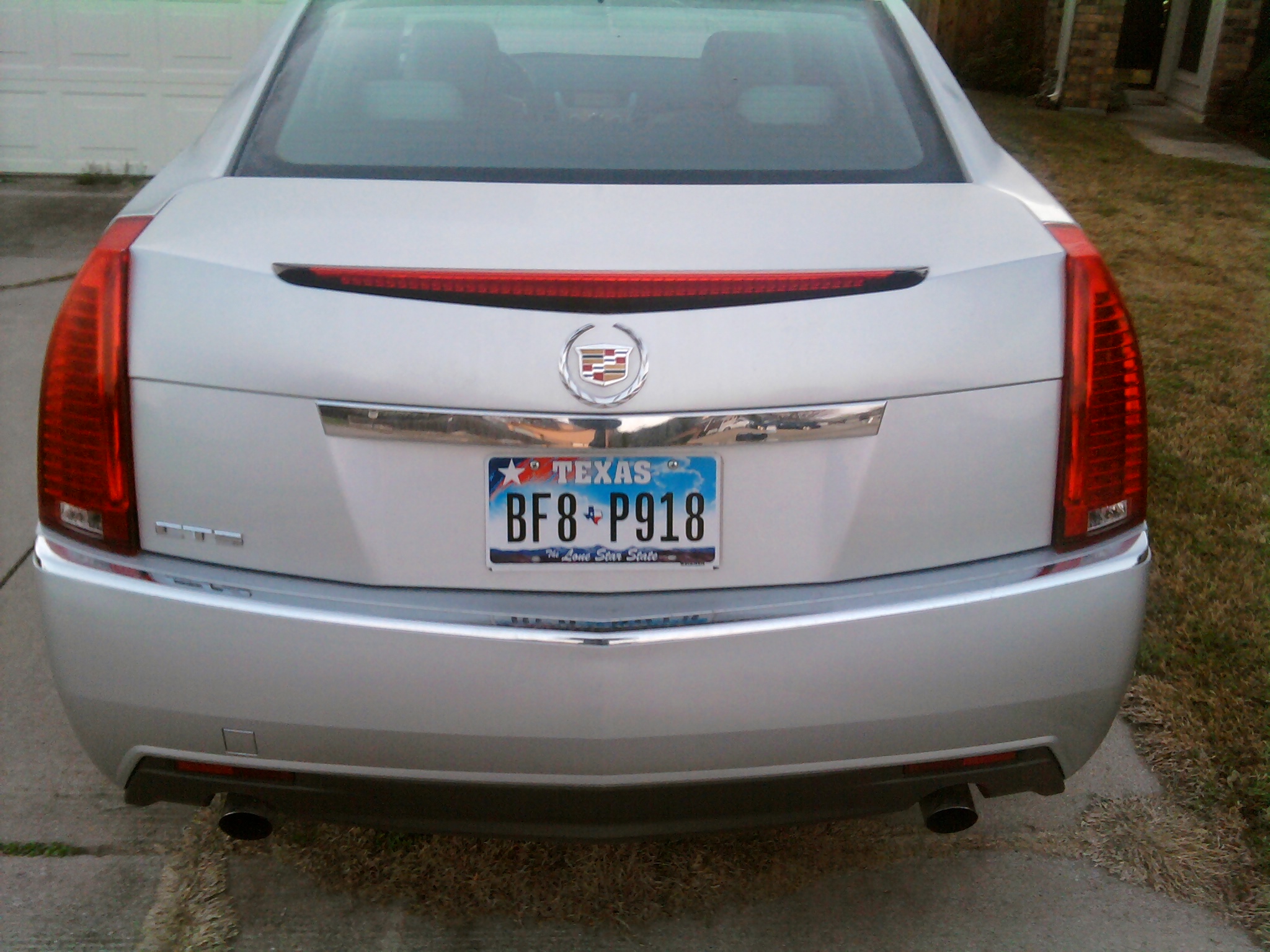

No insignia on the rear left which I think indicates this is the 3.0L model and not the 3.6L model.
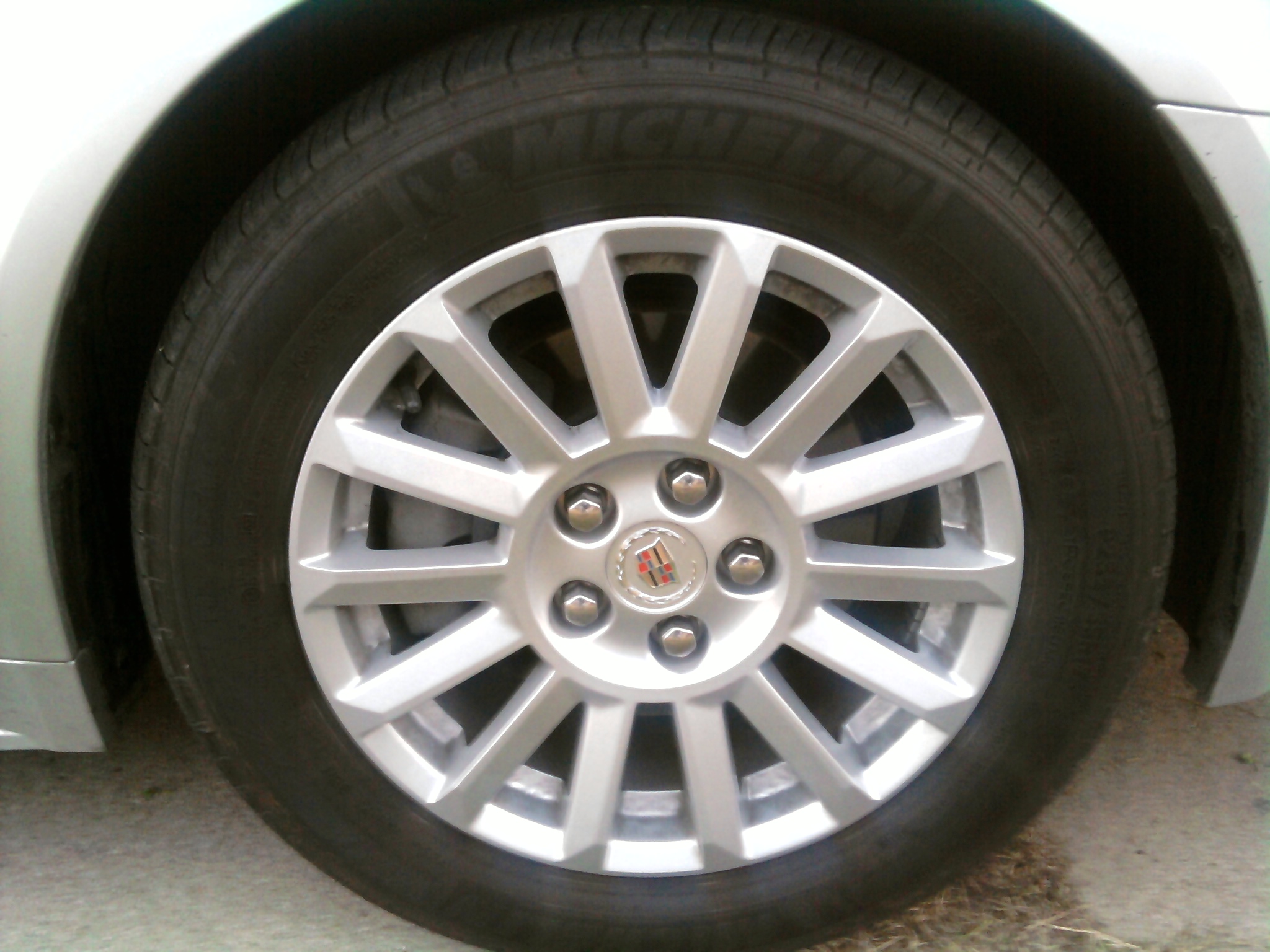

These wheels are a 1000% improvement over the 08-09 base model wheels. I love these, although I suppose they are difficult to clean. Certainly worth the trouble though.
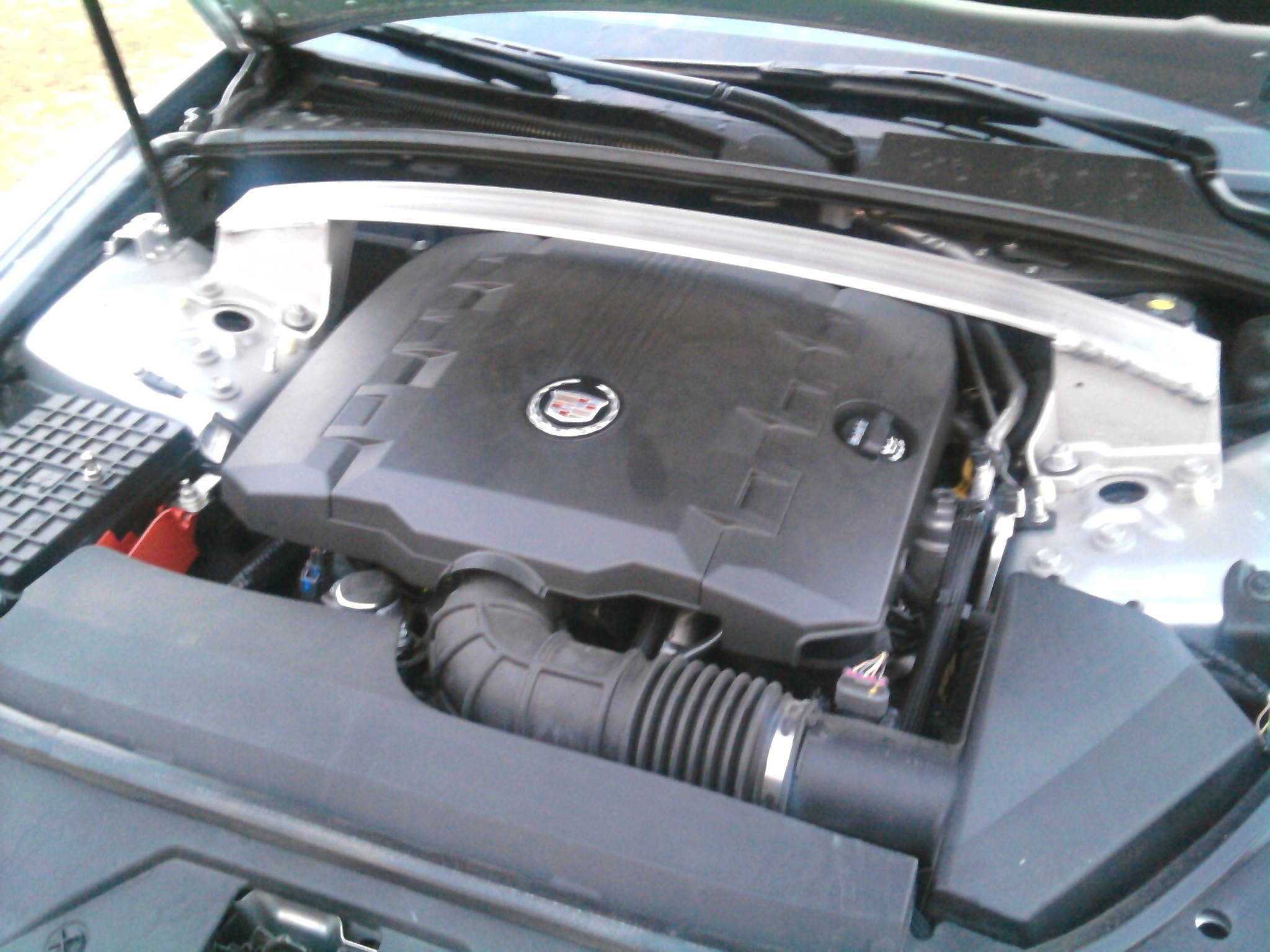

Engine compartment shot. No markings on the engine cover, which seems uncharacteristic. I would have expected the cover to say VVT, DI, 3L etc. Look at that strut brace! Here is a closeup:
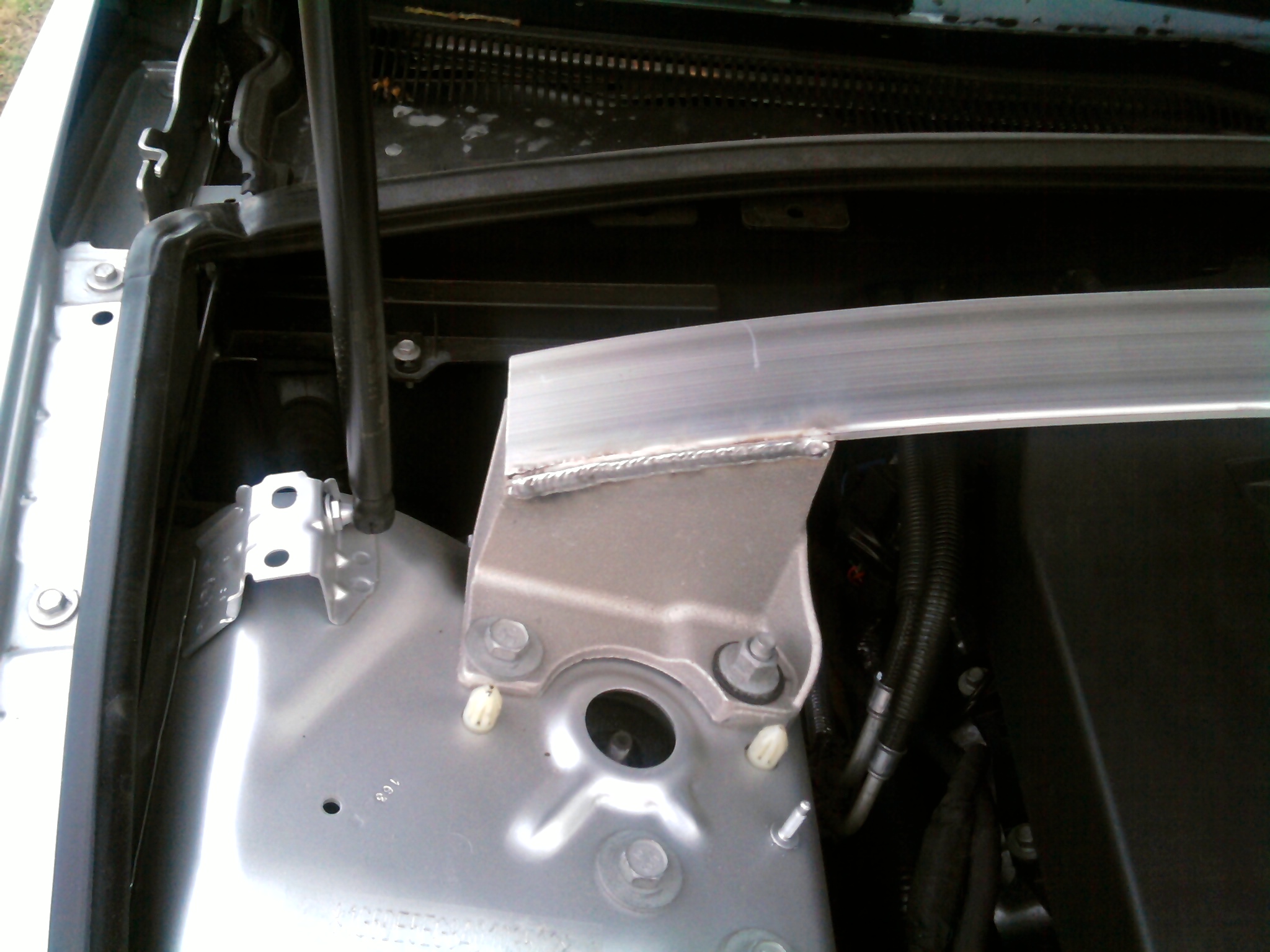

This has a very ‘aftermarket’, serious look to me with the exposed weld. I like it, but surprised to see it as the ‘stock’ piece.
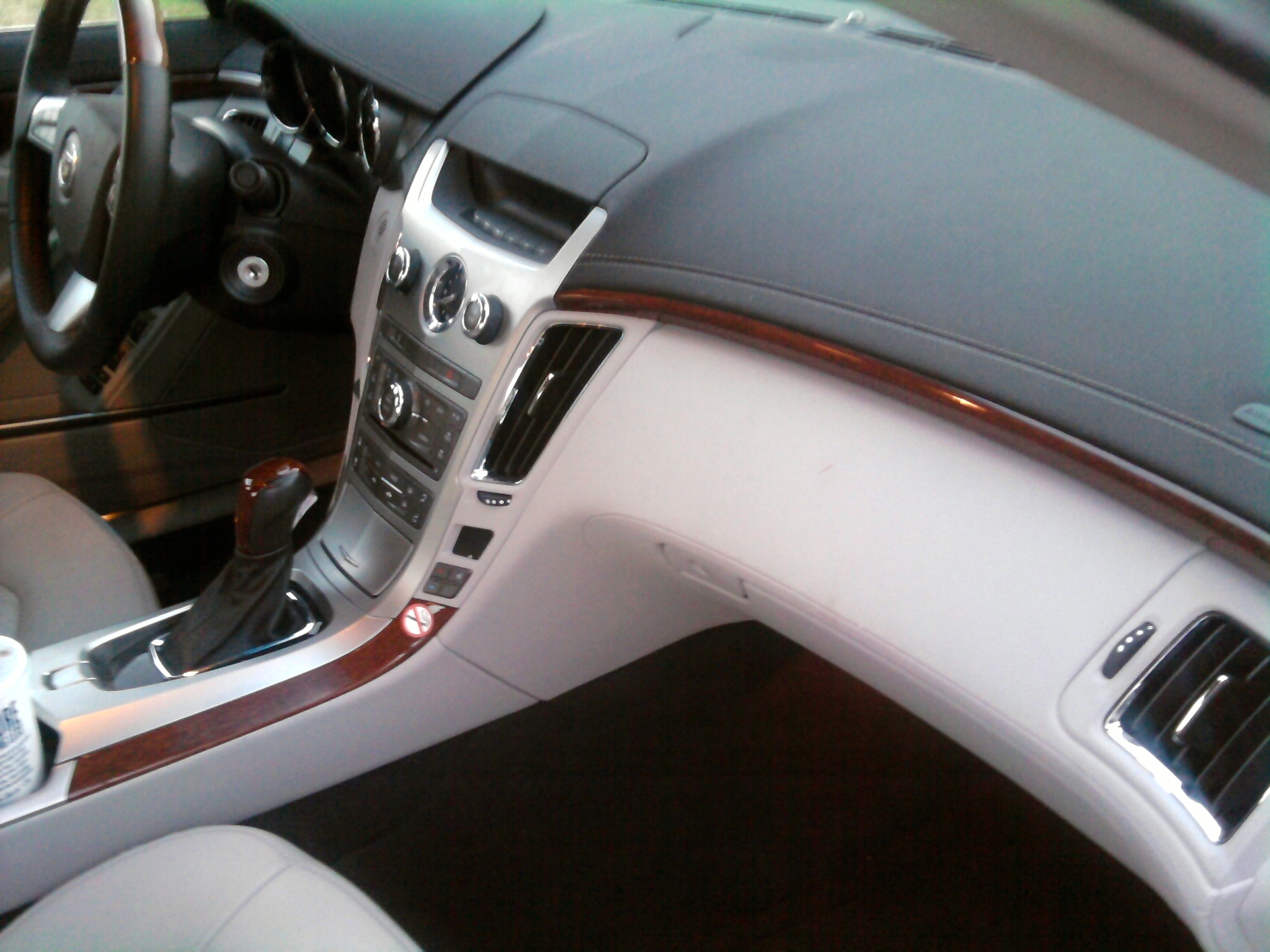

I am a sucker for the wood trim steering wheel and shifter.

Overall this CTS drives very well. I am jealous of the manual-shift option on the 6-speed automatic transmission, and it holds selected gears which is perfect.  The 3L seems to have plenty of power for the CTS.  This combination has gotten a lot of mixed reviews from the buff books, but I am not sure why.  The 3L and 6-speed automatic seem to work very well together to me.

Hopefully I’ll get my 2005 CTS back today; God willing and the creek don’t rise they just need to run a diagnostic to correct the airbag issue.  I have ordered a new control panel for the driver’s door to address the new discovery that the new driver’s seat is a memory seat.  In other words, it wants to move to the position that I select when I open the door with my remote so it is ready for driver 1 or driver 2.  Unfortunately, my CTS does not have the position selector switch, so I have ordered one.
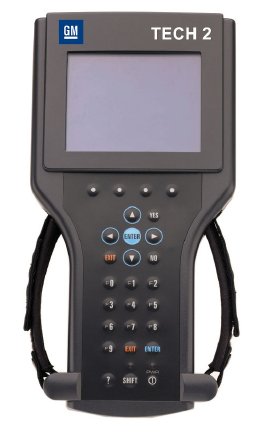
GM Bosch Vetronix HP Tech 2 with CANDI

General Motors Repair Technicians use a hand-held computer called the “Tech 2” to diagnose and tune modern vehicles.   It is called the Tech 2 because there was originally a Tech 1, and this is the update.

GM Tech 2

Tech 2

The Tech 2 is like a scan tool on steroids, with some additional tuning options thrown in.  As a scanning tool, the Tech 2 excels.  While an off the shelf scanner will read the Engine Diagnostic Trouble Codes (DTCs), the Tech 2 will read and report information from all the car’s systems, including ABS, Air Conditioning, Air Bags, and other systems a standard scanner will not read.  For example, in my CTS Seat experiment after the seat was replaced the Tech 2 must be used to run a Passenger Presence System relearn.  There is no other way to run this tuning step other than with the Tech 2.  Similarly some vehicle customizations or radio resets require a Tech 2 to perform.

Bosch has this informative video on the Tech 2: Bosch Tech 2 Video

Vetronix made the Tech 1.  The original GM Tech 2 was made by Hewlett Packard and used Vetronix software.  Vetronix purchased the Tech 2 manufacturing rights from HP.  In 2003, Vetronix was acquired by ETAS, a supplier of standardized development and diagnostic tools for electronic control units. In 2006, the Vetronix Aftermarket division merged with Bosch Automotive Aftermarket, responsible for supply, sales and logistics of automotive parts for service of the vehicle.  So today the Tech 2 is ‘made’ by Bosch.

The Tech 2 is used for GM Vehicles from 1992-present.  It is kept up to date by updating the 32  MB Pcmcia memory card with the latest diagnostic software.  Current cars with the CAN bus require the CANDI interface for the Tech II to communicate with the vehicle.

A Tech 2 costs — pick a number.  New models appear to cost as much as $4K, and the retail price is shown as even higher — as much as $8K or $9K depending on the site.  Discount new units are available for as low as $2300 on ebay for example, and used units run a bit less.  There appears to be a market in Chinese clones for the Tech 2 and software, although I am opposed to piracy of intellectual property.  My impression from shopping is that you should budget around $2K for an authentic Tech 2 in good condition with all accessories, 32 MB card, and CANDI module.

In the future GM appears to be moving to a laptop based scanning and diagnostic tool using the GM Multiple Diagnostic Interface (MDI) EL-47955.  The GM MDI will replace the Tech 2 for diagnostics in the future, but will not replace the Tech 2 for 1992-2009 vehicles.

The GM MDI is a compact communication module that manages the transfer of data between a vehicles onboard ECU network and a PC.  The GM MDI offers faster programming speed at a lower cost. Depending on the vehicle architecture, the MDI can be 20%-70% faster than the Tech2.  The GM MDI allows the user to perform Pass-Thru programming procedures using software running on a laptop or desktop PC.   Any PC can be used.

G/1kMi? Making MPG more understandable

I suggest we mirror the Europeans and turn our mpg upside down, and start tabulating gallons per mile.  More specifically, gallons per thousand miles.

The problem with MPG is that it is not really very good for comparison.  As MPG goes up, the difference between changes is progressively less important.    For example improve a 20 mpg car by 5 mpg and it saves 10 gallons in 1000 miles.  Improve a 50 mpg car by 5 mpg and it saves 2 gallons in 1000 miles.  Sounds like the same gain, but is a very different improvement.  Flip it upside down though, and it becomes more clear.  Improve a 35 Gallons / 1K Miles (G/1kMi) car by 5 G/ 1kMi and has a similar effect to improving a  50 G/1kMi by 5 G/1kMi.  Both save 5 gallons in 1K Miles.

The Cadillac CTS is rated at 27 mpg highway.  So over a course of 1,000 miles it would require 1,000 miles / 28 mpg = 35.7 gallons of fuel, or 35.7 G/1kMi

The latest Chevrolet Cruze may be rated at up to 44 mpg, or 22.7 G/1kMi.  Clearly by comparison with the CTS, the Cruze will require around 13 G/1kMi less, and I know that gas costs around $2.50 this week, so I can surmise that the Cruze would cost around $32 less to drive 1K miles.  For my annual 15K miles the Cruze would save me 15 x $32 = $480 per year.

On the other hand, a Cadillac Escalade gets around 20 mpg highway, or 50 G/1kMi.  So it would require 24 gallons more than the CTS to go 1,000 miles, at $2.50 around $60 more per 1K.

Why choose 1K miles instead of 100 miles?  So that the variance between models is very clear.  Also it makes it even easier to consider total monthly usage.  If you drive your vehicle 15K miles a year, multiple by 15, etc.

We would still want to measure City G/1kMi and Highway G/1kMi perhaps, and Mixed G/1kMi.

Adoption of G/1kMi as our fuel efficiency standard would help people understand and strive for better fuel economy.