Cadillac STS-V Intercooler Flow GPM Bucket Test 3

Today I conducted a new flow test on the intercooler cooling system for my Cadillac STS-V.  Previously I ran a bucket test to determine the actual flow through the intercooler cooling system.  Since that test, the system has been modified to add an inline intercooler tank.  I plan to change the pump from the OEM Bosch pump to a Jabsco 80540-12 pump soon, so today’s test confirms the flow rate prior to the next mod.

The overall purpose of this series of tests and changes is to improve intercooler cooling, which will result in lower intake air temperatures after the supercharger, and let the engine make more power.
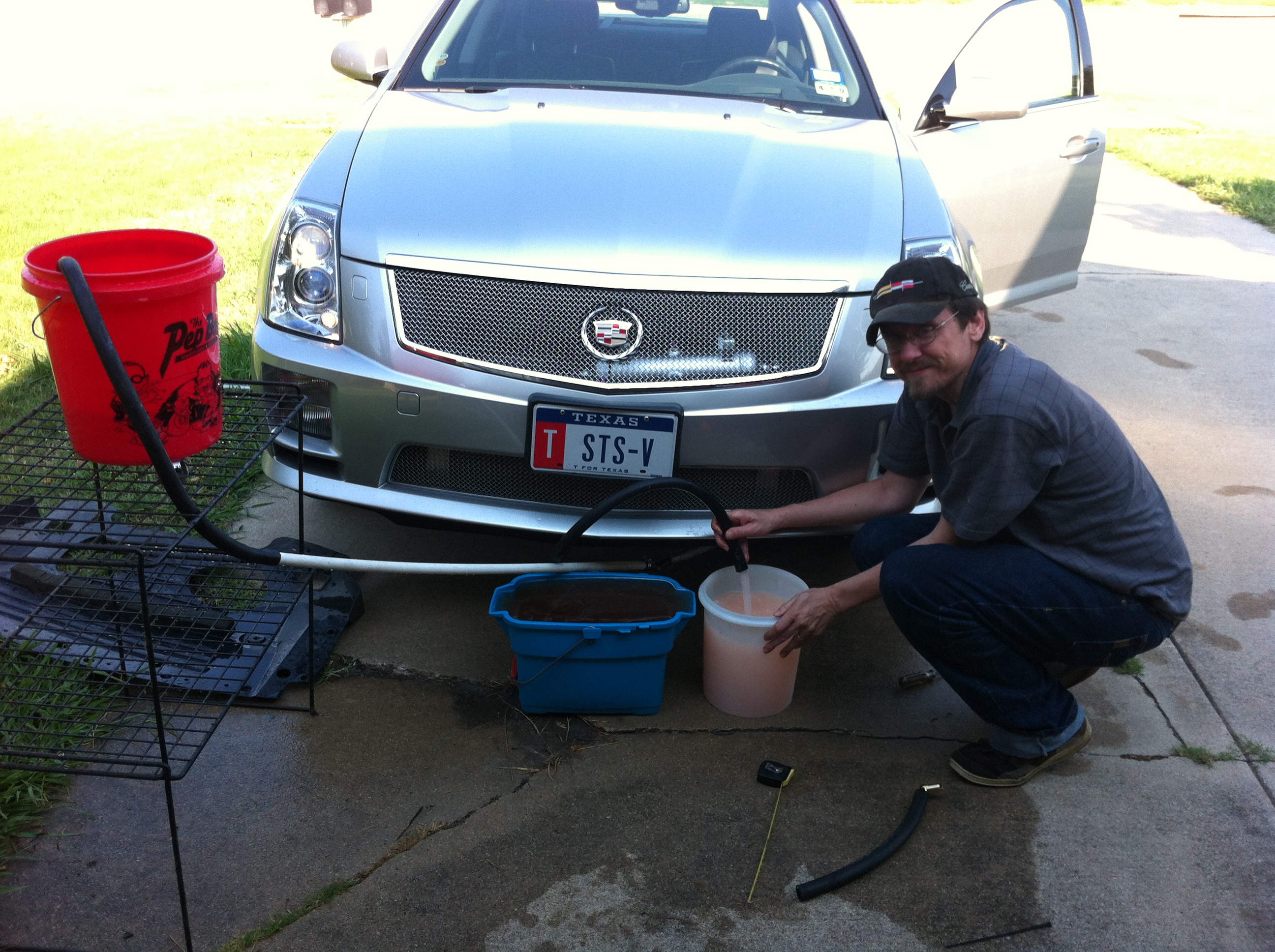
To run the test I place a ‘from’ bucket on a table, which has replaced my earlier box due to box degradation.  The From bucket flows into the first heat exchanger.  The To bucket is flowing out of the intercooler.  The goal of the test method is to measure the flow as if the test were not going on — to not impact the flow.  This is why the From bucket is in a raised place.

Today my Son assisted me with timing and checking the test setup.  We ran the test with the car engine on, to simulate working conditions for voltage.
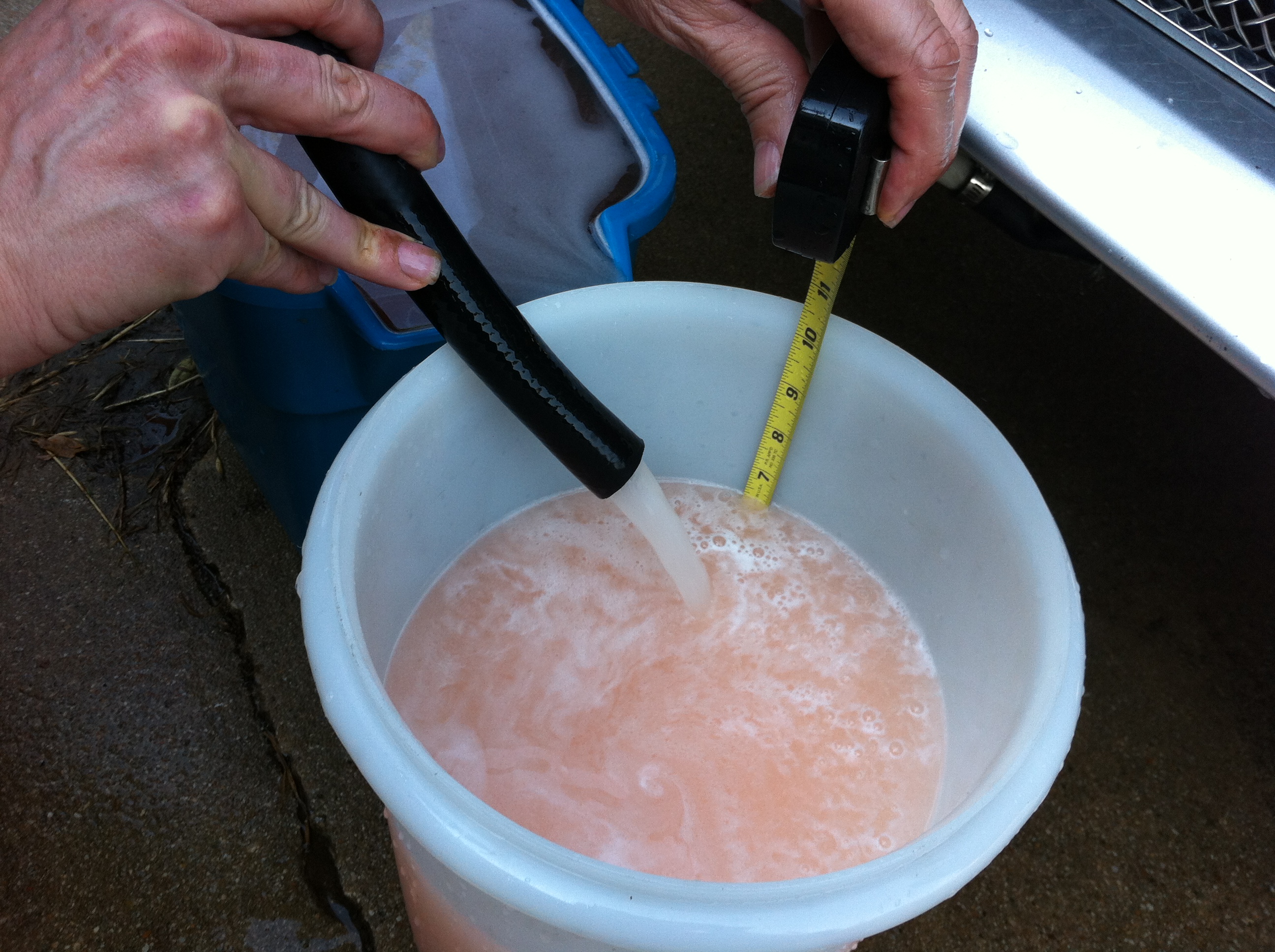
Intercooler cooling flow Result:

We measured a flow of  1 & 3/4 gallon per 30 seconds, or 3.5 gallons per minute (GPM).  This is identical to the flow measured in the earlier test without the inline tank.  I conclude that the inline tank presents no more resistance to flow, or that the changes in hose routing during the tank install improved flow sufficiently to offset the resistance of the tank.

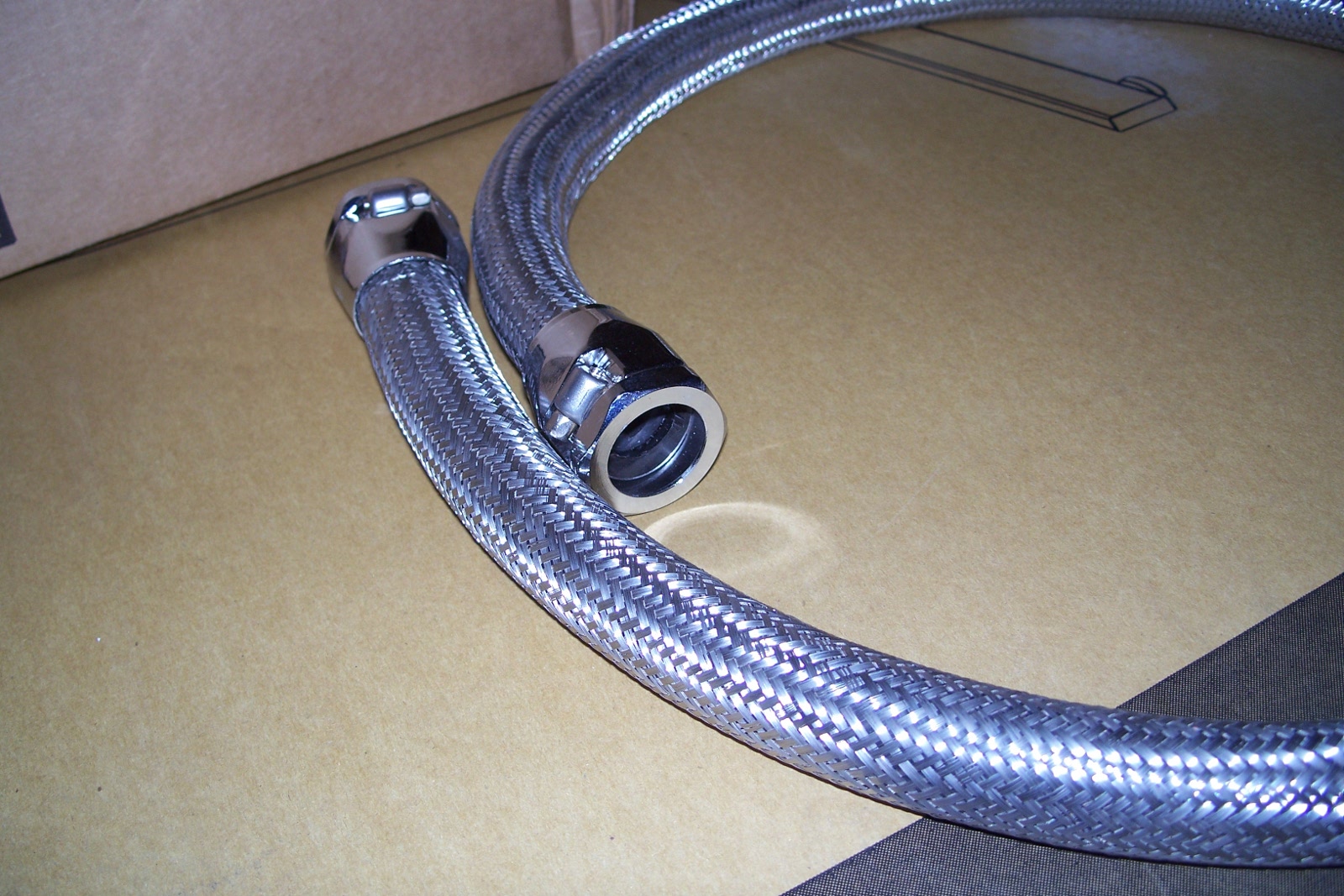
 

Spectre stainless steel sheathed intercooler hoses

One of the great things about OEM heater systems is that they have hoses exactly bent and shaped the way needed, so that the hose is perfectly formed for the job.  Good advice for aftermarket installations like my intercooler cooling mods is to measure out exactly what type of hose you need, then go look at the big books of existing OEM hoses at an auto parts store and find the one snowflake that is similar to your needs.

Another option is the Spectre stainless steel sheathed heater hose, 39798, which is designed to allow a variety of hose turns without kinking or crimping.

Spectre hoses in their packaging

The hoses I need are 3/4″ inner diameter. These Spectre hoses are rubber hoses with a stainless steel braided sheath around the rubber.  For Spectre 39798 the hoses are 4 ft (48 inches) long.
Here is a shot out of the packaging:

Vanity shot of the hose out of the packaging

The sheathing helps prevent hose crimping. After playing with one of the hoses in various bends I would say it is helpful in resisting but does not eliminate crimping. So I will still need to ensure that the hose routing helps as much as possible to avoid crimping the hoses.

Initial IAT2 times with New HX – woops

Initial IAT2 trends with the new Intercooler Heat Exchanger appear to be somewhat worse than the OEM intercooler heat exchanger.

This is disappointing since tuners have reported improvements with similar heat exchangers.  There may be more variables at play here, but my first tests suggest the new HX as installed is not performing better than the OEM HX.

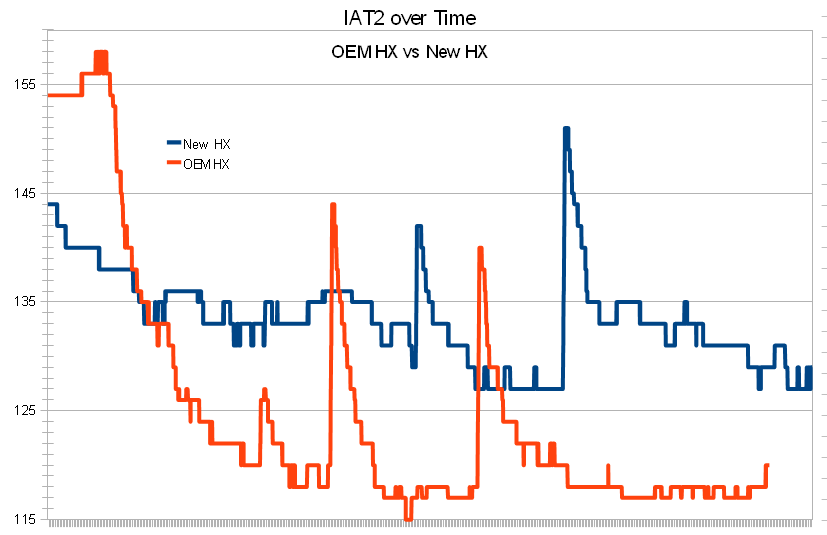
To compare the two I considered HP Tuners VCM Scanner data captures for the OEM heat exchanger on a hot day (heat soaked) to a similar run with my replacement heat exchanger (a flexalite 45321).  IAT1 temps, which is air at the MAF, were similar for each run, but the runs were certainly on different days etc.  Thanks to HP Tuners for updating their comma delimited export capability to make this easier!

The first chart shows overall trend over time for my normal data capture run.  The spikes are acceleration runs.  The X axis is actually the sample time for the scan, which runs from 0-65K so I simply left it off for clarity.  The Y axis is IAT2 temps in degrees F.


The new HX appears to reach constant IAT2 around 127F.  The OEM HX reached constant IAT2 around 117F.

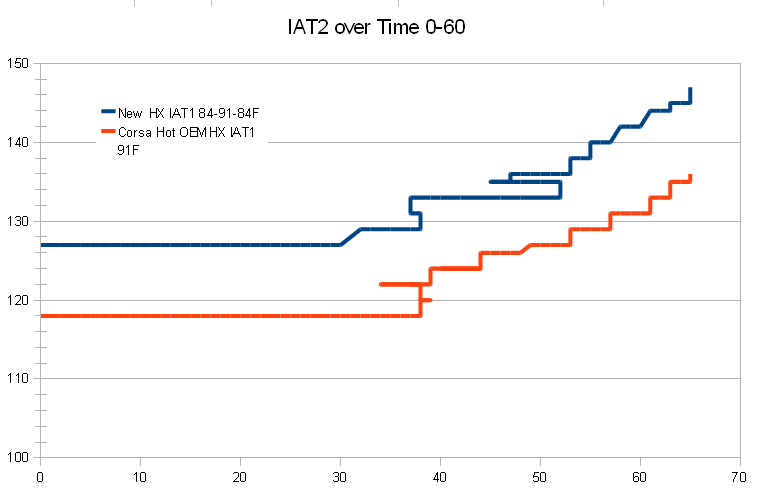
This is a comparison side by side over time during a 0-60 mph run with each:

The OEM HX starts at a lower temp, but the two HX’s appear to show similar trends for the expected increase in IAT2’s during hard acceleration.

It is possible that the system is still not air-free, and I will retest after a week of continued monitoring.