Tune it and lose warranty coverage?

GM has taken a fairly agressive stance on engine modifications:

DocumentID: 2365177 #09-06-04-026A: Identifying Non-GM (Aftermarket) Engine and Transmission Calibrations for V8 Gas
Engines – (Oct 28, 2009)

General Motors is identifying an increasing number of engine, transmission and catalytic converter part failures that are the result of non-GM (aftermarket) engine and transmission control calibrations being used.
When alteration to the GM-released engine or transmission control calibrations occurs, it subjects powertrain and driveline components (engine, transmission, transfer case, driveshaft and rear axle) to stresses that were not tested by General Motors. It is because of these unknown stresses, and the potential to alter reliability, durability and emissions performance, that GM has adopted a policy to cancel any remaining warranty coverage to the powertrain and driveline components whenever the presence of a non-GM (aftermarket) calibration is confirmed – even if the non-GM control module calibration is subsequently removed.
Warranty coverage is based on the equipment and calibrations that were released on the vehicle at time of sale, or subsequently updated by GM. That’s because GM testing and validation matches the calibration to a host of criteria that is essential to assure reliability, durability and emissions performance over the life of the warranty coverage and beyond. Stresses resulting
from calibrations different from those tested and released by GM can damage or weaken components, leading to poor performance and or shortened life.
Additionally, non-GM (aftermarket) issued engine control modifications often do not meet the same emissions performance standards as GM issued calibrations. Dependinq on state statutes, individuals who install engine control module calibrations that put the vehicle outside the parameters of emissions certification standards may be subject to fines and/or penalties.
This bulletin outlines a procedure to identify the presence of non-GM (aftermarket) calibrations. GM recommends performing this check whenever a hard part failure is seen on internal engine or transmission components, or before an engine assembly or transmission assembly is being replaced under warranty. It is also recommended that the engine calibration verification procedure be performed whenever diagnostics indicate that catalytic converter replacement is indicated.
In May 2009, the PQCwill begin piloting a process to confirm the ECM/PCM calibration is GM issued. Beginning on May 18, 2009, the PQC will require a picture of the engine calibration verification screen, as outlined in this bulletin, before authorizing any V8 gas powered engine replacement.
If a non-GM calibration is found and verification has taken place through GM, the remaining powertrain and driveline warranty will be cancelled and notated in GMVIS and the dealership will be notified.

The Magnuson–Moss Warranty Act gives US buyers certain protections with regard to warranties.  In order to flatly deny warranty coverage, GM must prove that the Consumer has done something to cause the problem.  It is not clear to me that GM is correct to argue that because they don’t know if an aftermarket calibration might have caused the problem, they then can deny coverage.  That does not seem to be in keeping with the Magnuson-Moss Warranty case law.

I am all for everyone taking responsibility for their actions.  If you get an aftermarket tune that takes the engine lean and end up blowing the engine, then that’s on you and not a warranty covered item.  On the other hand, if you happen to have an aftermarket tune and the engine fails due to an unrelated defect, that should continue to be covered under the powertrain warranty.  I understand GM’s argument that if you have an aftermarket tune, there is no way to determine if it was a causal factor or not.  But I don’t think that is a strong enough argument — it does not constitute proof that the user installed modification caused the problem, which is the requirement.

I think the right thing to do here is to document that if the failure can be clearly established as a result of the aftermarket tune and not as a result of an unrelated failure, then warranty coverage would be denied.
HiPer Strut — removing the disadvantages of FWD?

Good news that the Cadillac XTS has made it through the next gate and been approved for production in 2011 as a 2012 model.  Perhaps it will also benefit from this innovative suspension approach implemented on the Buick Lacrosse: Hiper Strut Suspension, which removes the disadvantages of Front Wheel Drive (FWD) of torque steer, cornering ability, and road feel while maintaining the efficiency advantages.  The XTS is expected to arrive with All-wheel drive either standard or as an option, along with a plug-in hybrid power plant.

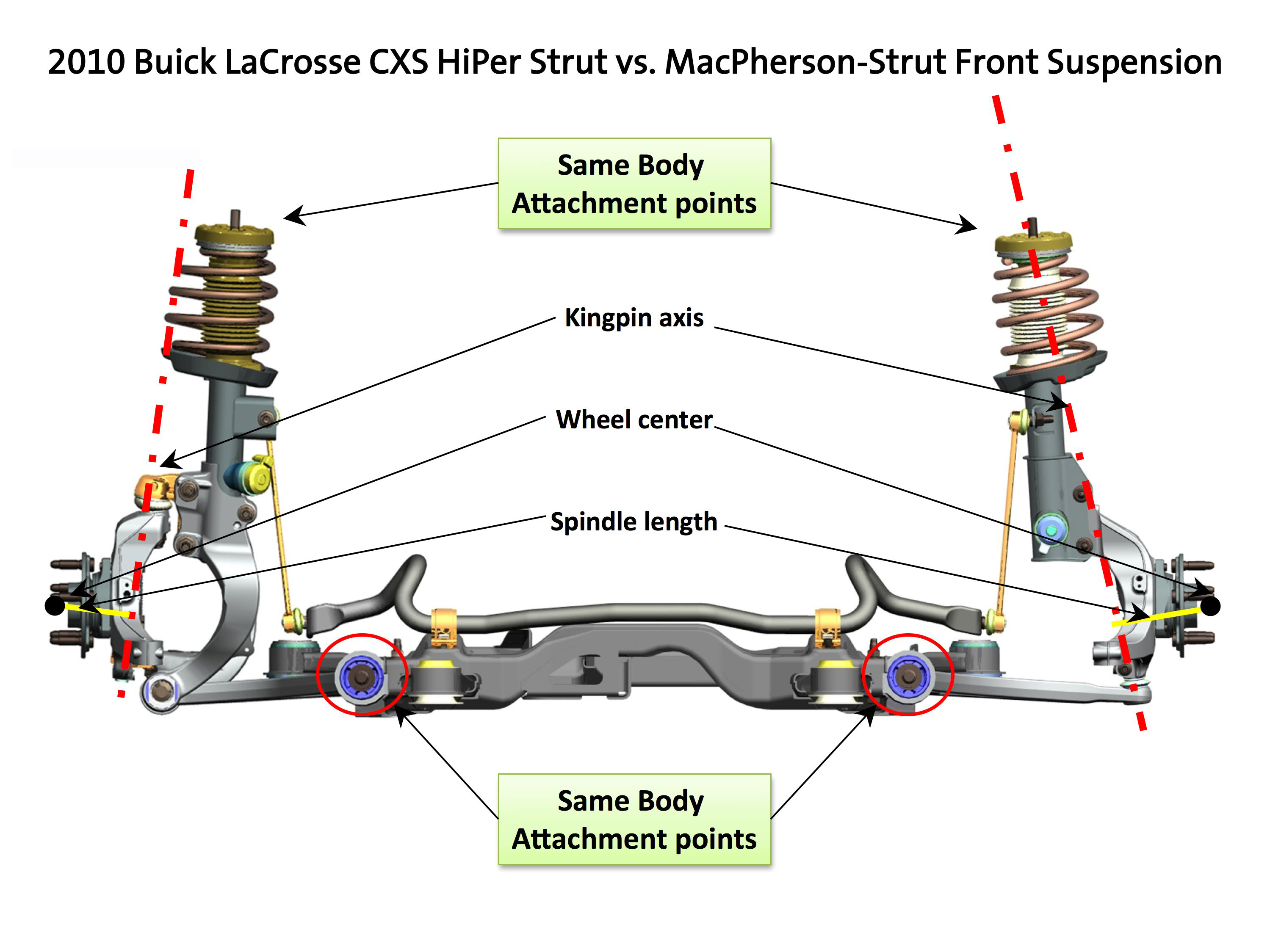
HiPer Strut vs. MacPherson-Strut

Buick Lacrosse’s Innovative Hiper Strut Suspension Delivers Improved Ride And Handling

DETROIT – The 2010 Buick LaCrosse CXS incorporates North America’s first use of a unique front suspension design called HiPer Strut. It is a premium, technologically advanced suspension design that improves ride and handling characteristics in four significant ways:

  • Reduces torque steer
  • Improves vehicle sensitivity to tire irregularities and wheel imbalance
  • Provides more linear and communicative steering through improved camber control
  • Improves impact isolation on bumps and rough surfaces.

Derived from “High Performance Strut,” the LaCrosse CXS’ HiPer Strut suspension is partnered with conventional dampers when used with the standard 18-inch wheels and an advanced electronically controlled damping system with the available 19-inch wheels.

“HiPer Strut helps reduce torque steer and maintain negative camber during cornering,” said Jim Federico, chief engineer for Buick LaCrosse. “That improves ultimate grip levels in dry and wet conditions, as well as improves the direct feel of the road, while isolating undesirable feedback. Behind the wheel the driver experiences reduced torque steer, improved grip and increased cornering power, along with crisper handling, steering precision and feedback.”

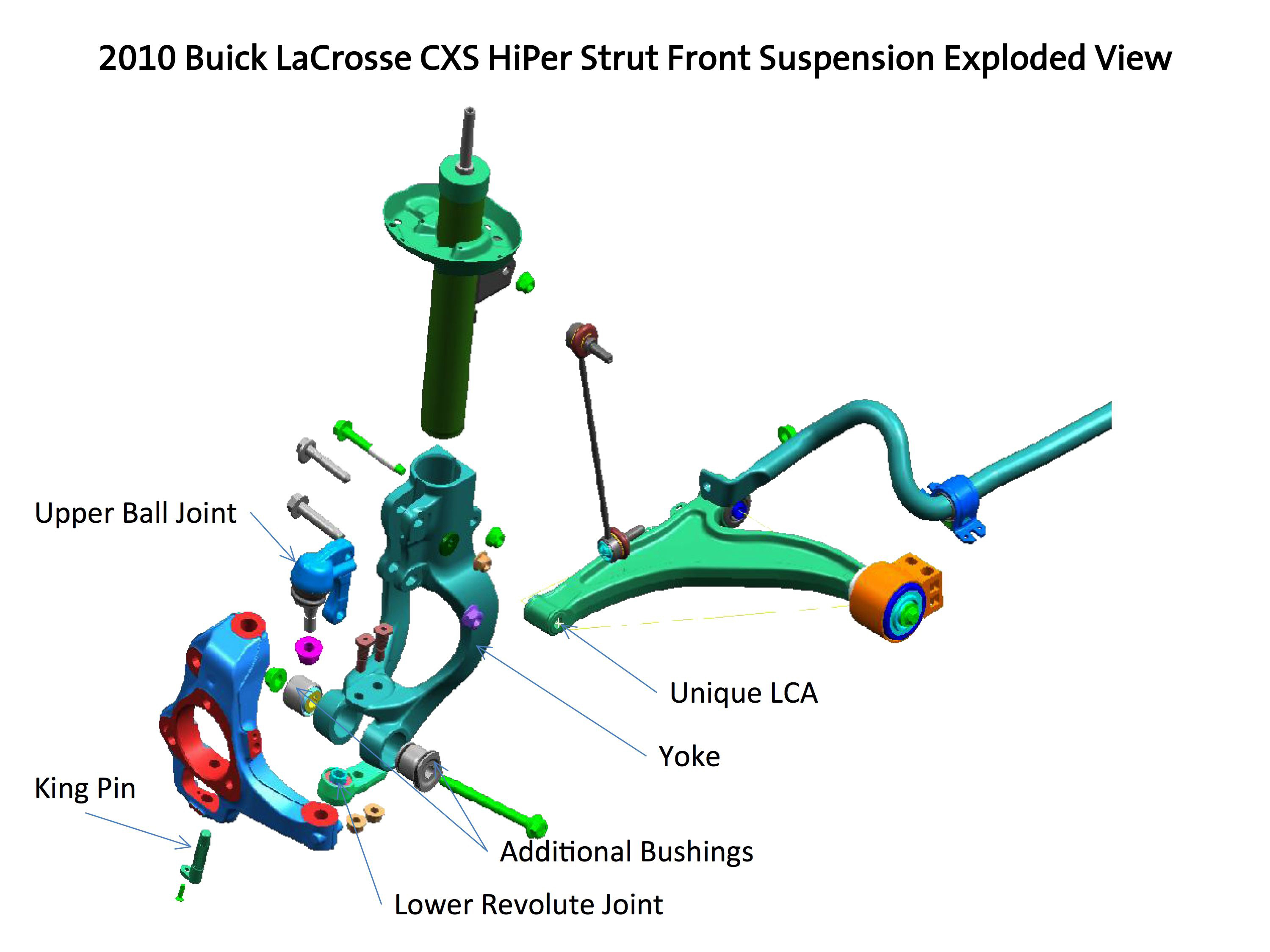
HiPer Strut Front Suspension Exploded View

HiPer Strut is based on the MacPherson strut front suspension design and features dual-path top mountings that separate the transfer of spring and damper loads to the body structure. A combined steering knuckle/strut carrier is unique to the design. The lower control arms are attached to a rigid sub-frame that is bolted to the body structure with four isolators that reduce the transmission of noise and vibrations to the interior.

The design is also an enabler for a limited-slip differential, for even greater traction, and supports better ride quality with larger-diameter wheels – including LaCrosse CXS’ available 19-inch wheels.

“Perhaps the most significant attribute of HiPer Strut’s effectiveness is what you don’t feel,” said Federico. “You don’t feel torque steer; you don’t feel tugging or vibrations through the steering wheel; you don’t feel sharp reactions to bumps and pot holes. You simply experience a smoother, more controlled and more linear driving experience.”

The foundation

The LaCrosse’s stiff body structure is the foundation for more precise suspension tuning and the CXS’ HiPer Strut design. It is constructed with ultra high-strength steel strategically placed to enhance strength, as well as crash protection. LaCrosse CX and CXL models use a conventional MacPherson strut front suspension.

At the rear suspension, the CX, CXL and the CXS model with 18-inch wheels feature a four-link design that is mounted to the body at four points. CXS with optional 19-inch wheels and Touring Package feature a more sophisticated H-arm design that uses the same attachment points as the four-link system but with the cross member attached via isolated mounts. The lower H-arm replaces the basic trailing link, delivering a greater ride quality and lower noise.

The Touring Package also includes real-time damping and Sport Mode Selectivity, which uses four electronically controlled dampers to constantly “read” the road and make adjustments within milliseconds.

Vehicle control

Along with HiPer Strut suspension in the CXS, all LaCrosse models employ a variety of state-of-the-art systems that enable exceptional vehicle control through the steering system, brakes and more. GM’s StabiliTrak electronic stability control system is standard on all models. Additional highlights include:

  • Variable effort power steering that delivers greater assistance at low speeds, such as parking maneuvers, and reduced effort at higher speeds for a greater feeling of control. The steering system has a quick, 15.2:1 ratio, requiring only 2.75 turns lock to lock.
  • Four-wheel disc brakes with four-channel ABS, including large, 12.6-inch-wide (321 mm) front discs and 12.4-inch-wide (315 mm) solid rear discs. Lightweight, aluminum-body calipers are used at each corner.
  • Electronic Brake force Distribution that ensures optimum braking force is applied simultaneously at both axles, for maximum stability under heavy braking; and a Brake Assist System that senses the severity of a braking situation and applies additional braking pressure when needed.

Performance cost in MPG

My current 2005 Cadillac CTS has a 3.6L V6 and is EPA rated for 16 city and 25 highway MPG using their current measure.  For argument sake this yields a mixed-driving target of 19 MPG.

I drive 15,000 miles a year, more or less.  So with my 2005 Cadillac CTS I might expect to need 15,000 miles / 19 MPG = 790 gallons of fuel in the next year.  The 3.6L CTS uses regular unleaded fuel, so let’s say $2.50 / gallon for a total of $2.50 x 790 gallons = $1,975 in fuel costs.

Here are the replacement performance V-Series cars I am considering:  the 469 hp 2008 Cadillac STS-V, or the 400 hp 2007 Cadillac CTS-V.

2008 Cadillac STS-V:  EPA rated 13 city 19 highway, 15 MPG combined.  With my expected annual mileage of 15,000 miles per year that would mean 15,000 miles / 15 MPG = 1,000 gallons of fuel.  Noting that the STS-V however requires premium fuel, which might cost $3.00 / gallon, that makes a total of 1,000 gallons x $3.00 / gallon = $3,000 in fuel costs.   So the Cadillac STS-V would cost an extra $1K/year, or $85/month in gas compared to my 2005 Cadillac CTS.

2007 Cadillac CTS-V: EPA rated 14 city 22 highway, 16 MPG combined. It also requires premium fuel.  15,000 miles x 16 MPG = 937 Gallons.  937 Gallons x $3.00/gallon = $2,811 in fuel costs.  So that CTS-V would cost an extra $836/year in fuel, or $70/month compared to my 2005 Cadillac CTS.

I plan to keep the next Cadillac for 5 years.  Comparing the new cars, STS-V will cost $200/year more than the CTS-V, or $1,000 over the 5 years.

On the other end of the spectrum, the current 2010 Cadillac CTS 3.6L DI V6 engine is rated at 18 city 27 highway for combined 21 mpg.  The current 2010 Cadillac CTS 3.0L DI V6 engine is rated at 18 city 28 highway for combined 22 mpg.  Either engine can use regular unleaded.  So replacing my CTS with the new 2010 Cadillac CTS 3.6L would yield a projected fuel cost of 15,000 miles / 21 MPG x $2.50/gallon = $1,785/year.  Although the new 3.6L has more power at 304 hp than the 2005 non-DI 3.6L at 255 hp in my car, the DI engine also gets better MPG, and is boosted by the 6-speed automatic vs 5-speed automatic.

Replacing my CTS with a 6-speed DI 3.6L instead of a 2007 CTS-V or 2008 STS-V model would save $1,026-$1,215/year.   However, the CTS DI 3.6L has respectable performance of 0-60 in 6.5 sec, while the 08 STS-V or 07 CTS-V will both accelerate 0-60 in under 5 seconds, out-brake, out-corner, generally out-perform the CTS 3.6L.  What cost performance?  Besides the initial price of entry, about $100/month in my case.  Is that worth the thrill of the added performance potential?  Would you pay another $1200 a year to drive a Super car versus a ‘normal’ sport sedan?