About bwnunnally

Bruce Nunnally is an independent Blogger who writes Cadillac Conversations on all things Cadillac. Connect with Bruce on Google+

Monitoring IAT, IAT2 Cadillac STS-V

This morning I did some data-logging with HPTuners up and down the highway.  I am still learning the software, so feel free to make suggestions.

I grabbed these screen shots of a couple of points: (click on the image for a zoom-in version, then hit back to come back):

HPTuners datalog screenshot 1

What the first screenshot shows is that at 69 mph and 6651 RPM the supercharger was making 10.7 psi.  During this portion of the run, ambient air temperature was 90F, IAT air coming into the MAF temperature sensor was 108F, and IAT2 air leaving the intercooler was at 151F.

Actually I would have expected the car to shift at 6500 rpm, but 6651 is close enough I suppose.

In the chart display at the bottom however, you can see that the IAT2 was already elevated before the higher-RPM event occurs.

The question for today though is how the IAT2 151F compares with ambient air 90F.  The Supercharger adds heat to the intake air in the process of compressing it.  At maximum RPM as here, the Supercharger is spinning at 2.1:1 and so 13,967 rpm.   This can add up to 200F to the air coming into the intercooler.   Today the air coming in to the supercharger was already 108F, so heating it by a couple hundred degrees puts some very hot air across the Laminova intercooler tubes. The goal for the Intercooler is to reduce the heated air back as close to ambient air as possible, pulling the air back from 200F+ down to 151F in this example.  The unachievable ideal is that the intercooler get the air down to the intercooler heat exchanger’s own cooling source, which is the ambient air coming into the front grill at 90F.
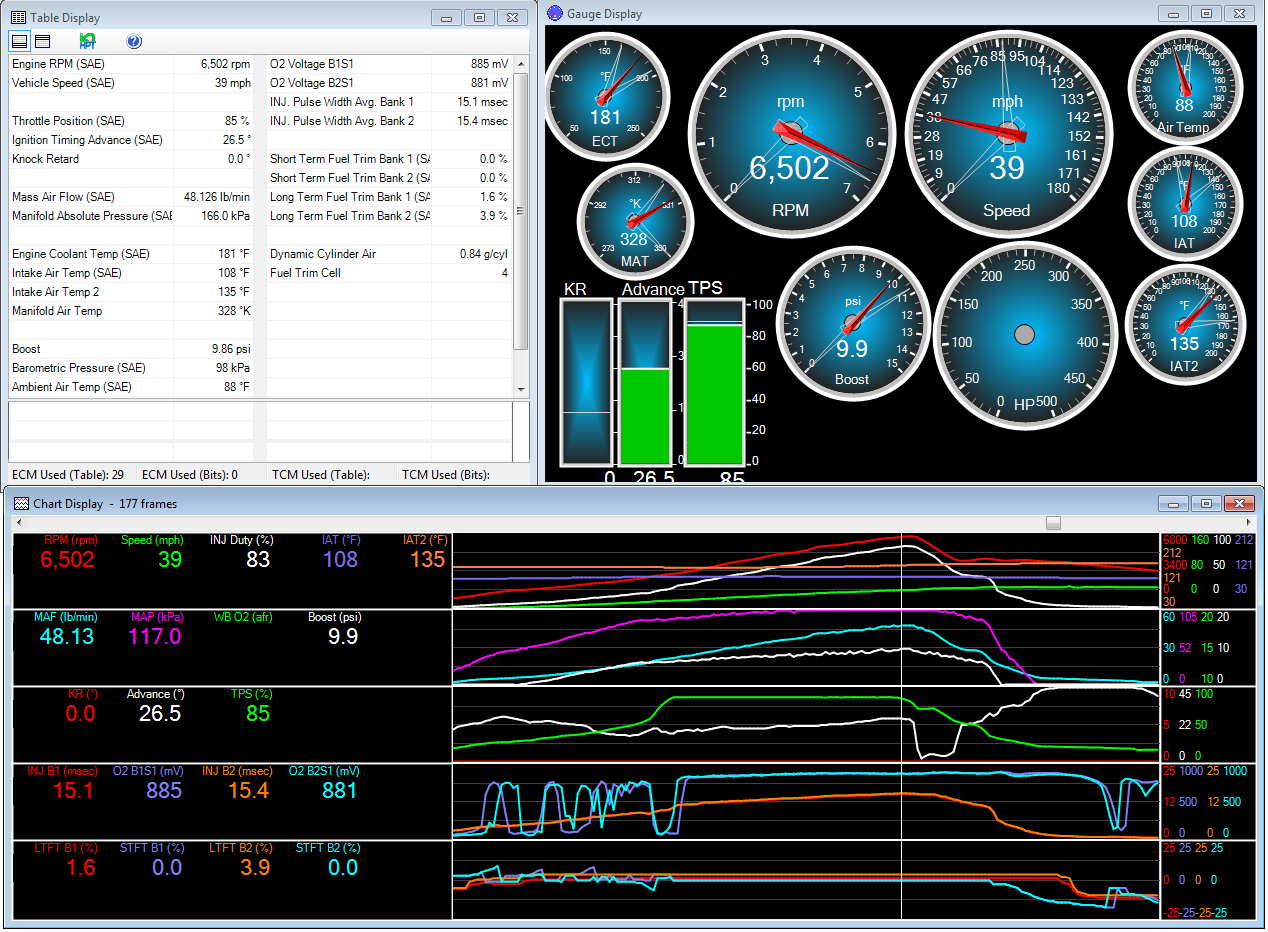
HP Tuners datalog screen shot 2

In the second screen shot, at 39 mph and 6502 rpm, ambient air was 88F, MAF intake air 108F, and IAT2 after the supercharger was 135F.

On a separate topic, long term fuel trims appear to be small, which I think is good.

Points to ponder:

How to reduce the IAT2 temperatures from 151F when accelerating at highway speeds

Why the max pressure seen was 10.7 psi instead of 12 psi?  Is this also temperature related?

How will these readings change in cool air?
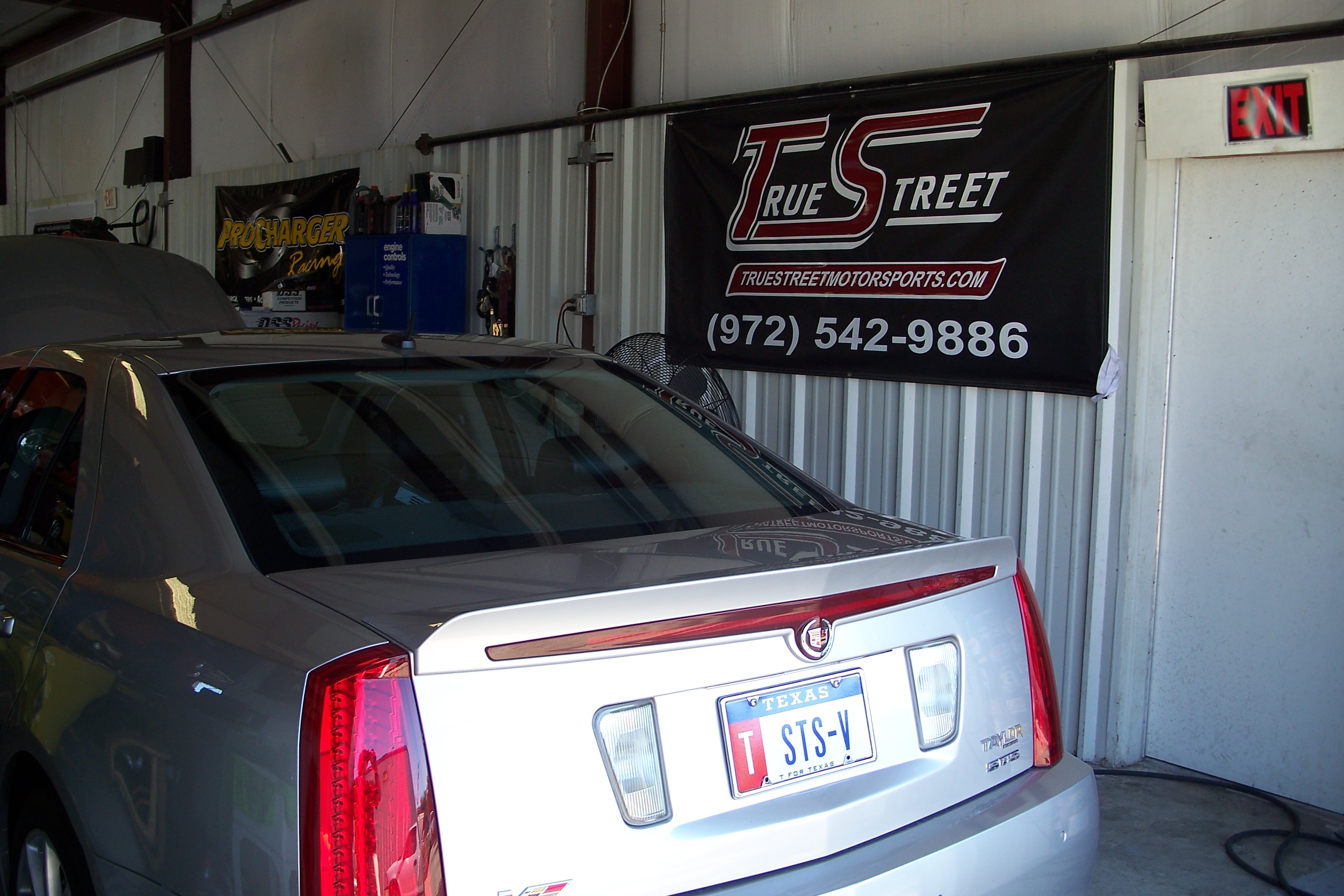
 

Cadillac STS-V Spectre Intake dyno test

I had a great time with my Cadillac STS-V this morning at True Street Motorsports in McKinney.  We did a baseline dyno run on my 2008 Cadillac STS-V, then installed a Spectre custom intake for the STS-V, and ran a new dyno for before/after tests.   The Spectre intake was custom ordered through Streetsideauto.

Cadillac STS-V on the Dynojet dyno

As soon as I arrived the True Street Motorsports crew got the Cadillac on the dyno and off we went.

A first casualty of the day were the batteries in my flip camera, so I switched my kodak to video mode and captured videos of the dyno runs:

True Street  Motorsports uses an in-ground Dynojet dyno.  A dyno reads horsepower at the wheels, after losses through the transmission and rolling losses.

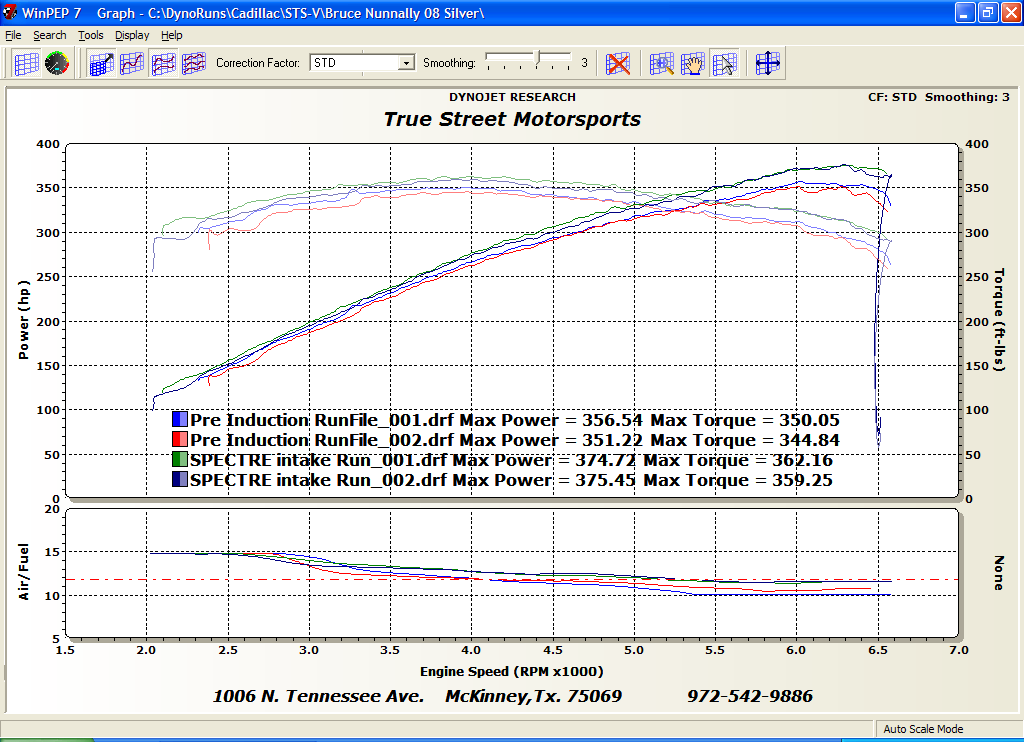
One might expect an STS-V to put 360-370 hp to the wheels based on other results I have seen; my STS-V today did 356.8 whp and 350.2 ft-lb of torque, so a bit below average.

Once we had a baseline, the team started removing the intake and replacing it with the Spectre custom STS-V intake.

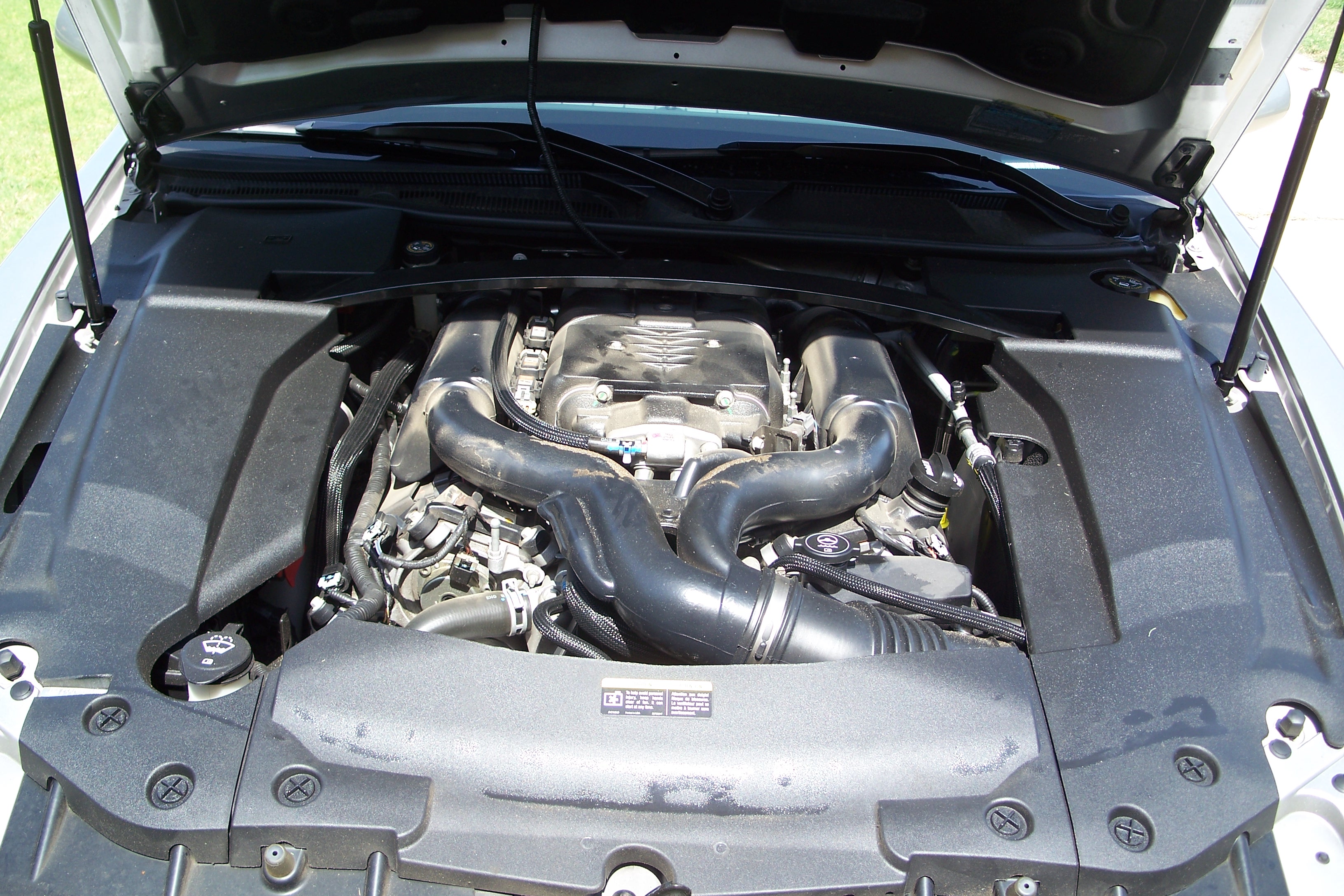
STS-V LC3 Engine Compartment with side covers and front cover on

This was the dirty picture from after I first removed the beauty cover to give an idea of the original intake tubing in place.

For the first run it was 92.9F 29.64 in Hg Baro, humidity 15%.  By the ‘after’ runs it was 99.4F.

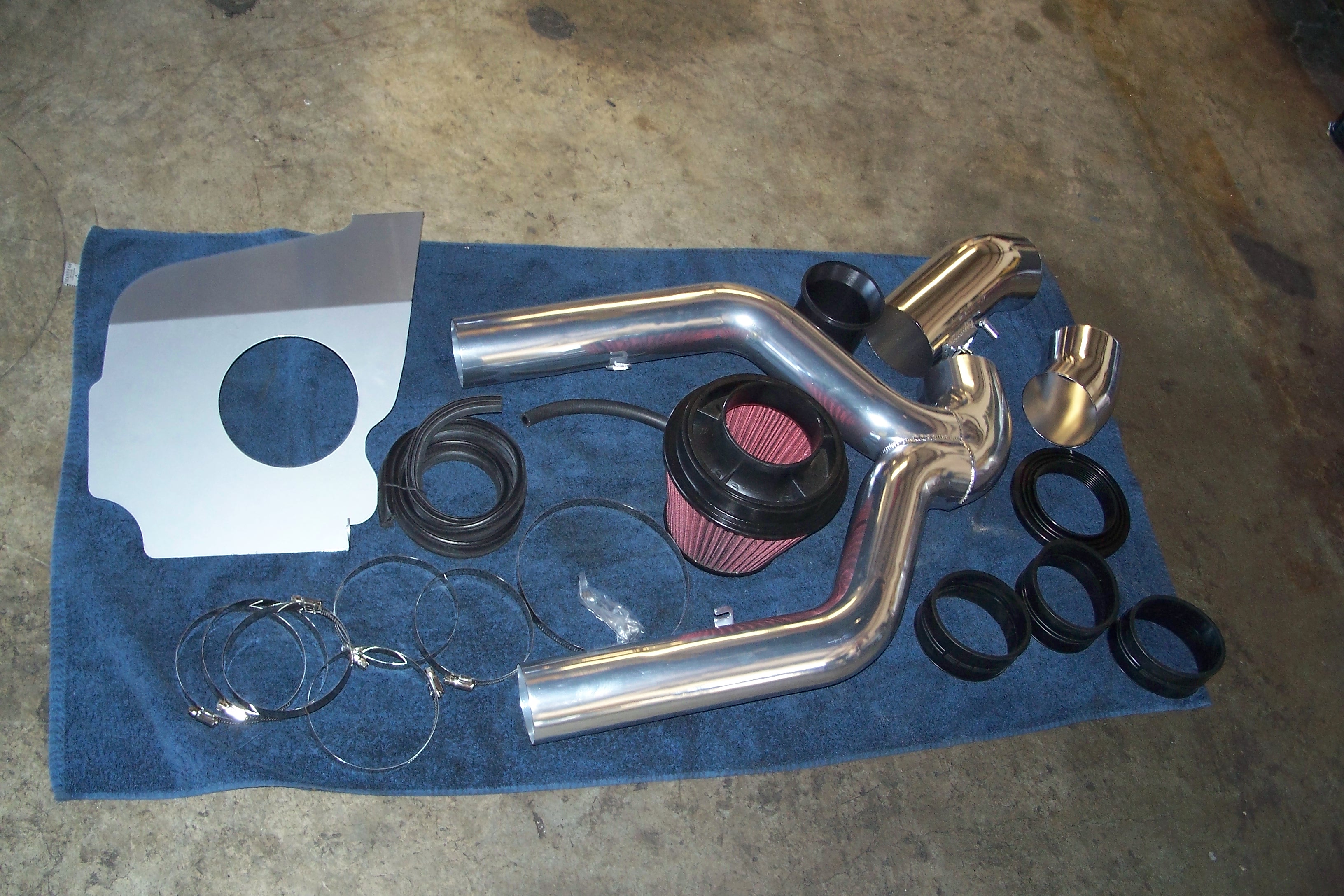
Spectre intake parts ready to go in

Spectre intake parts ready to go in

The new intake parts replaced all the factory intake from the box to the intake pipes leading around the engine.

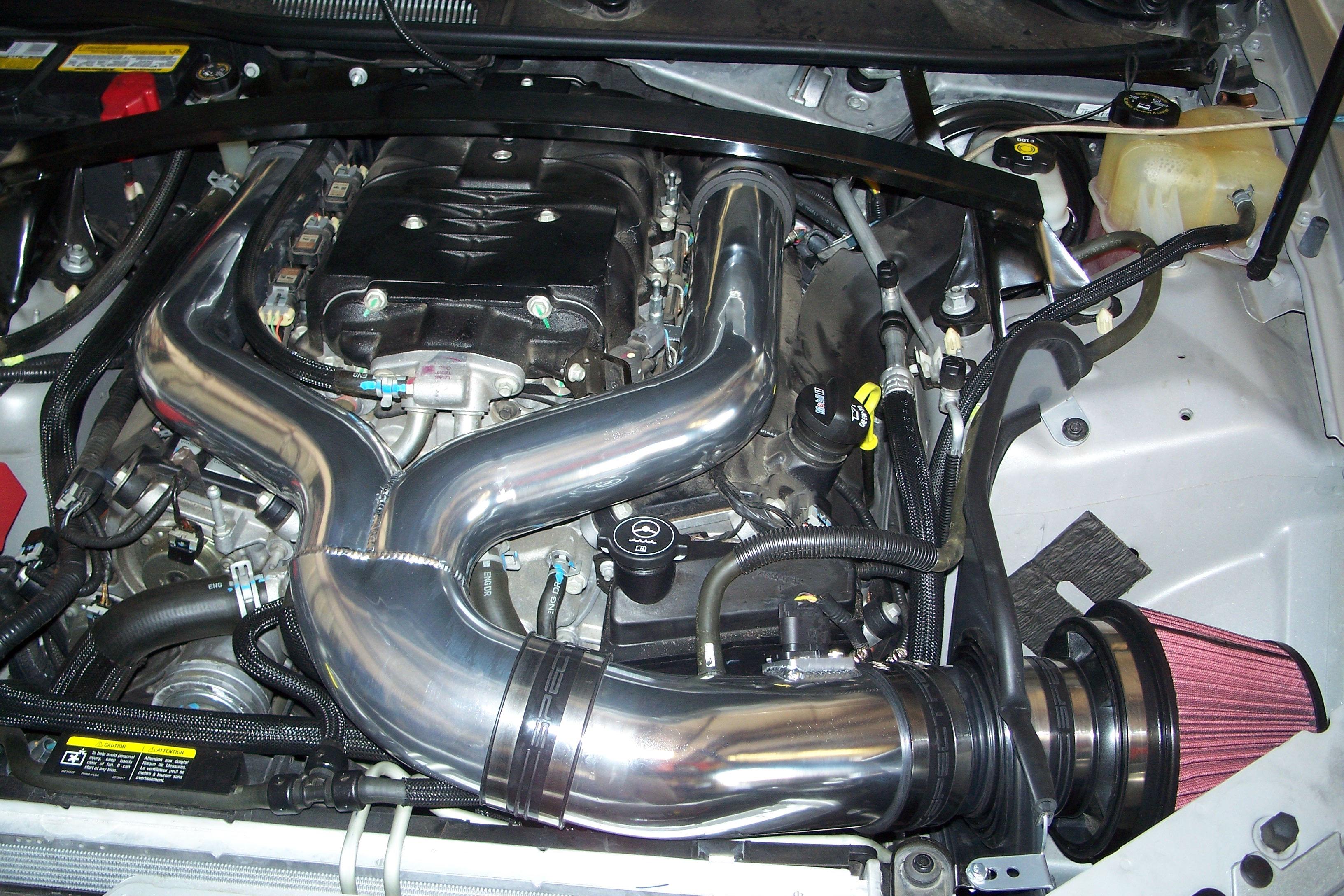
Spectre Intake installed STS-V

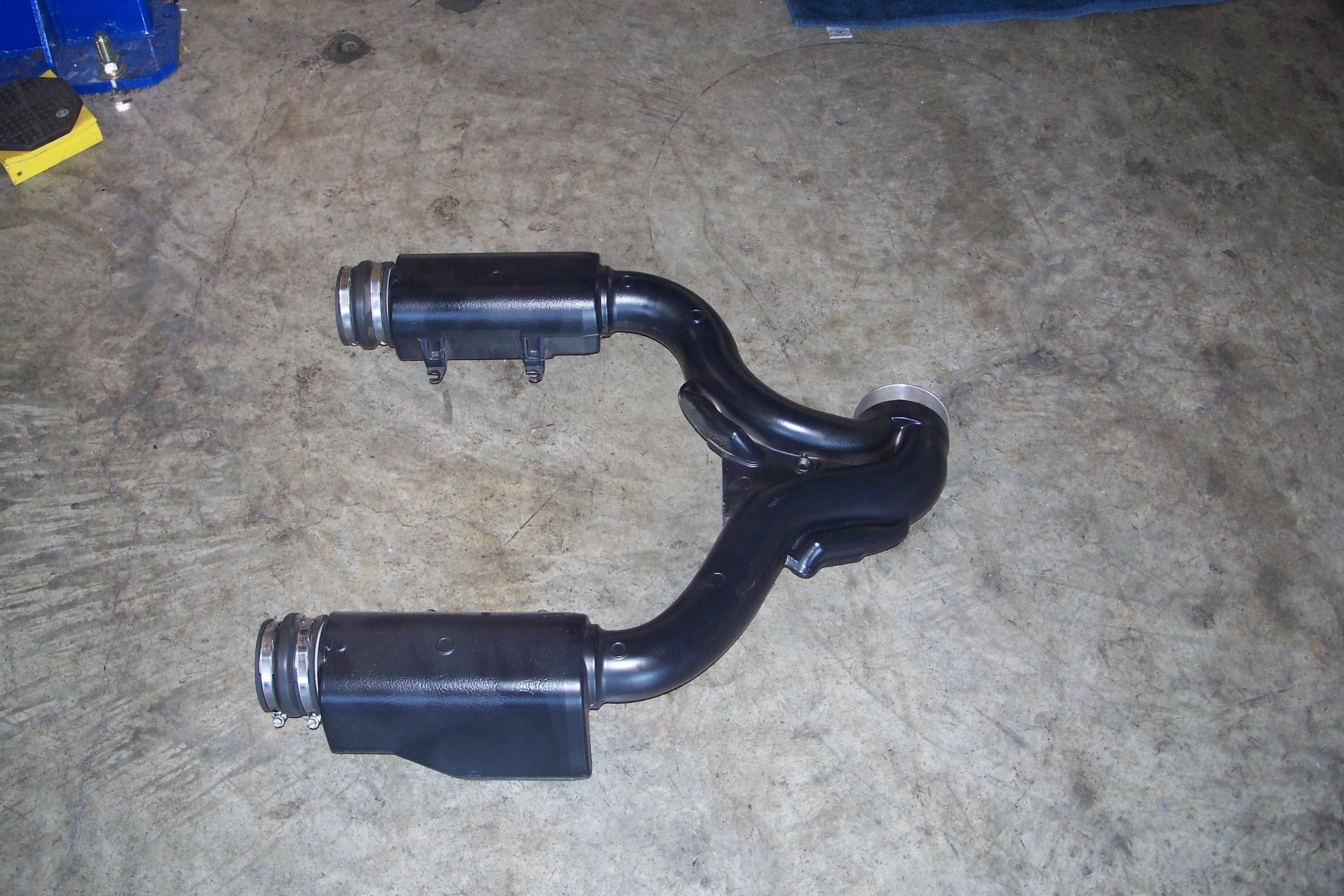
The OEM intake has baffles to reduce the supercharger characteristic whine; the new intake is lighter and has no sound baffles.

OEM intake piping with baffles

With the intake installed, coolant hosing routed appropriately, and fuel trims reset, we were ready for the AFTER dyno pulls

UPDATE: replaced the ‘after’ video with higher rez combination of the two video files.

This chart shows the before/after dyno runs on a single comparison chart:

2008 STS-V Before/After dyno runs

Lots of things to consider in these results.  First, I am happy with the Spectre Intake and the support from StreetSideAuto, and I had a blast at TrueStreet Motorsports, so thanks all around to everyone.  I’ll be doing more dyno runs at True Street Motorsports in the future.

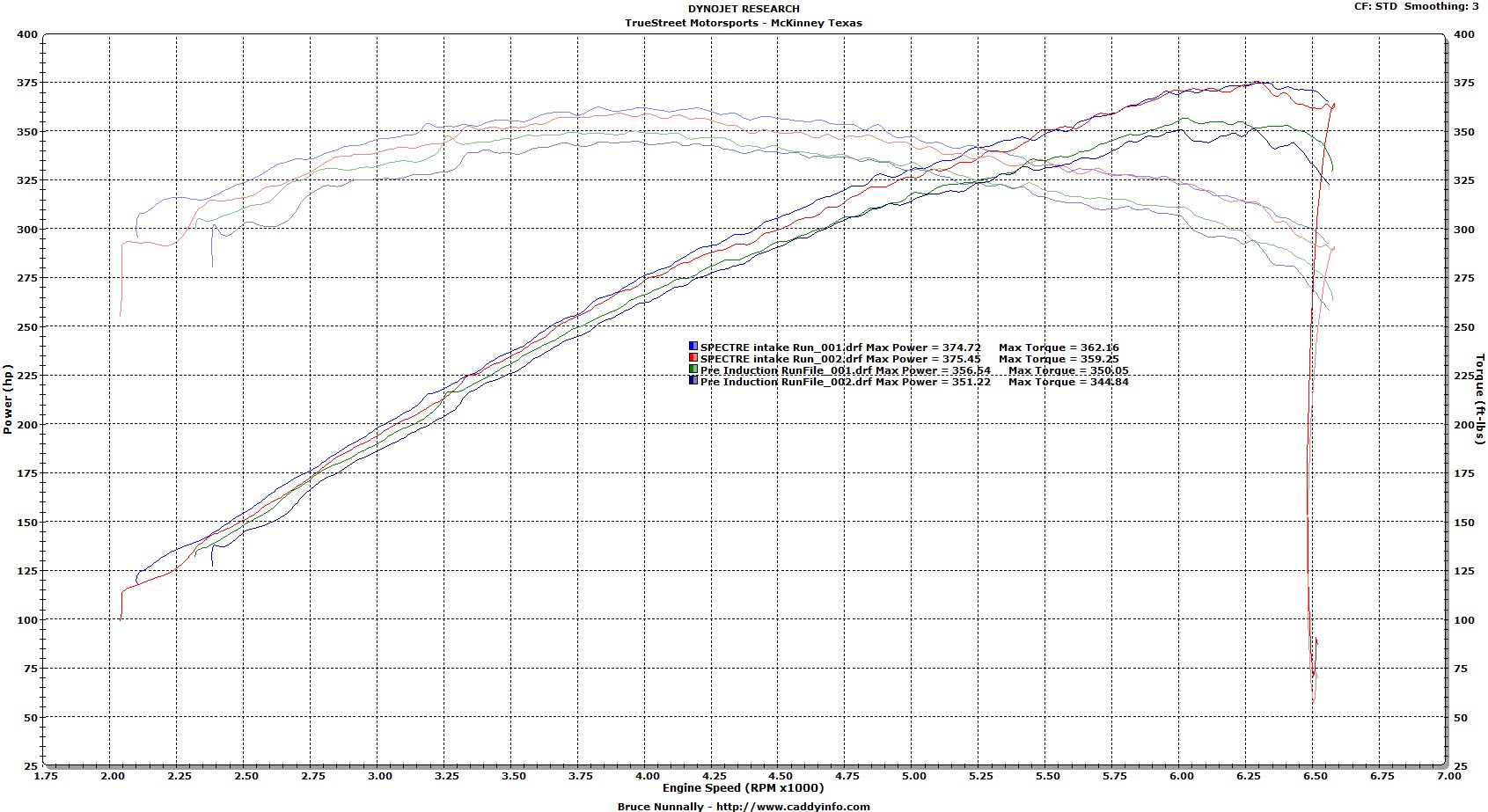
The results were somewhat worse than hoped — I was hoping to see +40 whp before/after and we saw +19 whp.  If the 356.5 whp was 469 hp at the crank “before” (24% losses) under perfect conditions, then the after reading of 375.4 whp might equate to 493 hp at the crank “after” with only the Spectre Intake mod, or +24hp.

It was very hot here in Texas, and although the dynojet uses a correction factor to ‘standard’ conditions, that may or may not compensate adequately for the actual hp lost due to the hot air for a supercharged Cadillac.

HP vs Torque across all 4 runs exported Run Viewer

This chart is the same data done using the raw files and the dynojet viewer.   Click on the image for a larger copy, then hit back to return.

Next I want to wait a couple of weeks, then rerun a ‘check’ dyno, and swap the MAF to a different lot of the same p/n MAF and retest.

Summary

Good day, parts works, good times were had.

CTS, SRX continued to lead Cadillac Sales in July 2011

Cadillac Sales: 

A 25% bottom line sales decrease might suggest a disappointing July year over year for Cadillac, but continuing good sales for CTS and SRX are reassuring.   July 2010 was a ‘banner’ month with over 5.5K of each model sold, so while it would be great to repeat at those levels, this month’s sales of over 4K for each model are nothing to sneeze at.  It would be interesting to compare incentives in July 2010 vs July 2011 but those figures are not given here.

DTS continues to fade as the last models are sold.  Escalade sales continue to reflect higher fuel prices.


July
(Calendar Year-to-Date)

January – July

2011 2010 % Chg Volume %Chg per S/D
2011 2010 %Chg Volume
Selling Days (S/D) 26 27


CTS 4,449 5,516 -19.3 -16.2
31,454 24,601 27.9
DTS 715 1,207 -40.8 -38.5
9,453 10,221 -7.5
Escalade 914 1,252 -27.0 -24.2
7,859 8,766 -10.3
Escalade ESV 605 762 -20.6 -17.5
4,402 4,150 6.1
Escalade EXT 171 195 -12.3 -8.9
1,067 1,008 5.9
SRX 4,133 5,723 -27.8 -25.0
30,333 28,378 6.9
STS 132 259 -49.0 -47.1
2,661 2,404 10.7
XLR 0 5 ***.* ***.*
12 176 -93.2
Cadillac Total 11,119 14,919 -25.5 -22.6
87,241 79,704 9.5

Summary

XTS and ATS are missing from the equation here and can’t arrive soon enough.

Press Release Summary:

Cadillac: Cadillac reported total sales of 11,119 for July, a 26-percent decrease versus last July which included a significant reduction in sales to fleets. For the month, retail sales decreased 26 percent. For the year-to-date, Cadillac total sales are up 9 percent while retail sales have increased 17 percent.