About bwnunnally

Bruce Nunnally is an independent Blogger who writes Cadillac Conversations on all things Cadillac. Connect with Bruce on Google+

Updated Baseline Cadillac STS-V 0-60 time

This morning it was a fresh 91F out, so I ran some new baselines for the STS-V.  Just tickling the 5 sec line at 91F.

Weather: 91.4F; Baro 29.12 Hg. (14.3 psi); Humidity 10%.  Fuel: half-tank.  Altitude: 600 feet above sea level.

My Cadillac is a 2008 STS-V with a Spectre Intake.  This is a 4,233 lb sports luxury V-Series sedan with a 4.4L supercharged & intercooled V8.

Today in hot weather it ran a 0-60 time of 5.42 sec (0 feet-5,280 feet), or 4.98 sec including 1 foot of rollout as at a dragstrip, (1 foot-5280 feet).

The 60′ time for this run was 2.3 sec.

Previous measured times for my STS-V with me driving were 5.39 sec w/rollout and 5.29 sec w/rollout, so today’s time of 4.98 sec w/rollout is an improvement of 0.3 sec.  Between the runs I have changed the tires, added the Spectre intake, and changed the MAF.  Side by side, today’s run would have been 17 feet ahead of the previous run at 60 mph.

w/rollout
Speed(mph) Time 0.44 Dist(f)
10 1.01 0.57 6
20 1.75 1.31 23
30 2.46 2.02 49
40 3.31 2.87 93
50 4.30 3.86 159
60 5.42 4.98 248

Here is the graph:

Here is a view from HPTuners of the peak near 60 mph for this run showing that I am getting -3.2 degrees of advance due to the ambient and IAT2 / MAT temps at this point; it heads as low as -4 degrees.
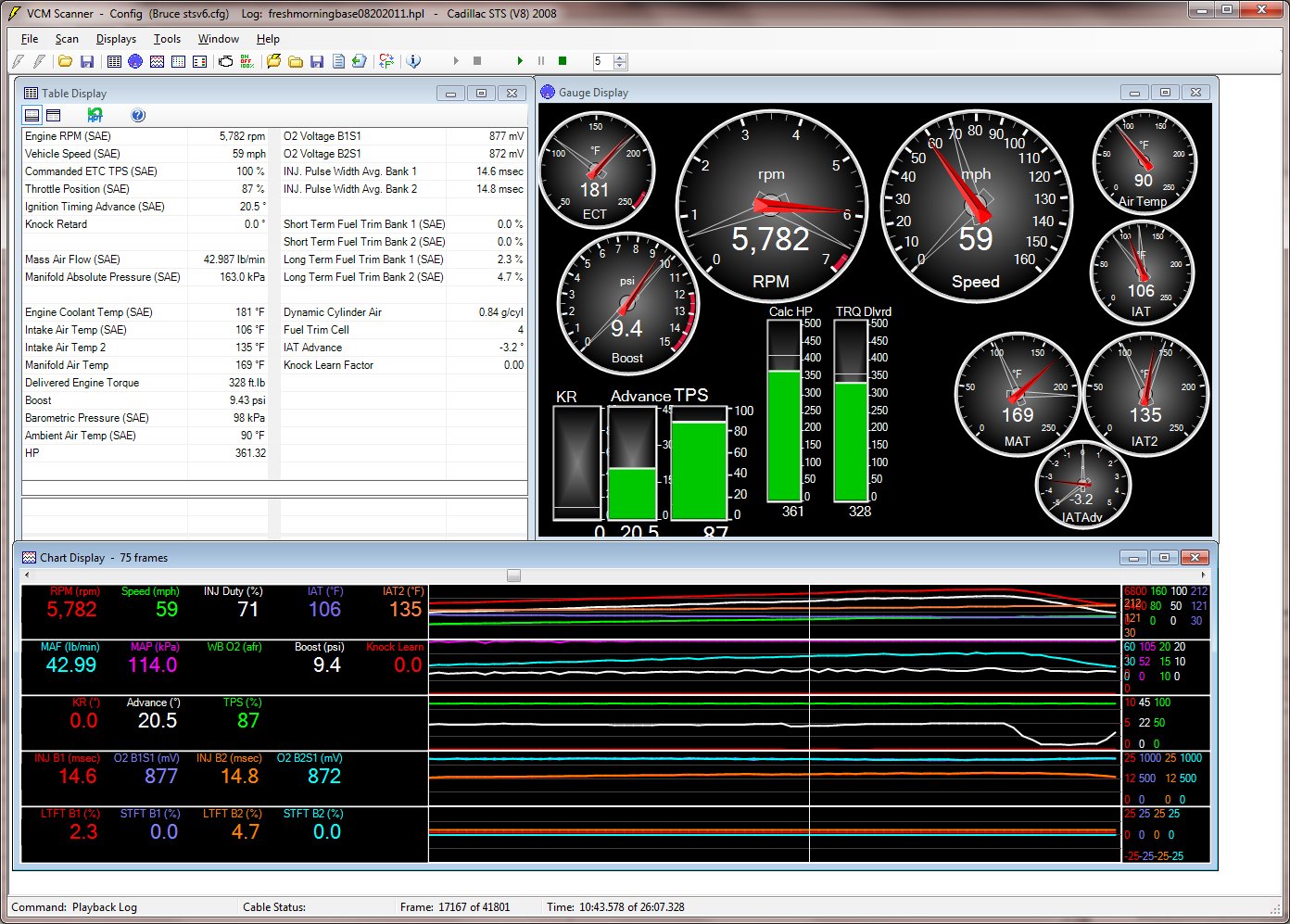
IAT Advance at -3.6 degrees

I believe that because the boost is calculated from Manifold pressure and barometric pressure, that it reflects boost after the pressure drop across the Laminova intercooler tubes.  So some pressure going in, 9.4 psi getting to the engine in this snapshot.

Here was a video of the HP Tuner scan of the 0-60 run:

I captured a second run at 5.45 sec w/o rollout or 5.08 sec from 1 foot.

w/rollout
Speed(mph) Time 0.37 Dist(f)
10 1.06 0.69 6.2
20 1.87 1.50 22.58
30 2.61 2.24 48.61
40 3.41 3.04 92.88
50 4.38 4.01 158.55
60 5.45 5.08 248.34

My rollout is still a bit high — taking too long to get from 0-1 foot.  I would like to see rollout around 0.3 sec.

Summary

Today’s run shows a clear improvement from the previous mark.  I would like to see under 5 sec without rollout considered.

The IAT Advance is pulling timing from the engine based on the incoming air temp out of the supercharger.  Either running the car in cooler weather (!) or improving the intercooler cooling perhaps would help.  This is with the stock calibration; it may be possible to simply adjust the tune to be somewhat less aggressive on IAT Advance.  Adjusting shift times and possibly RPM may also reduce 0-60 times.
I’m sure we’ll MAF about it later…

On my quest for tuning my 2008 Cadillac STS-V as I have noted the Camaro5 community discovered that not all examples of the same Hitachi MAF have the same response characteristics.  MAFs with a single letter are less responsive than MAFs with a letter-number combo.    I believe that this indicator is a ‘lot’ indicator and perhaps relates to the individual components used in the sensor.  The STS-V uses the same card-type MAF sensor.

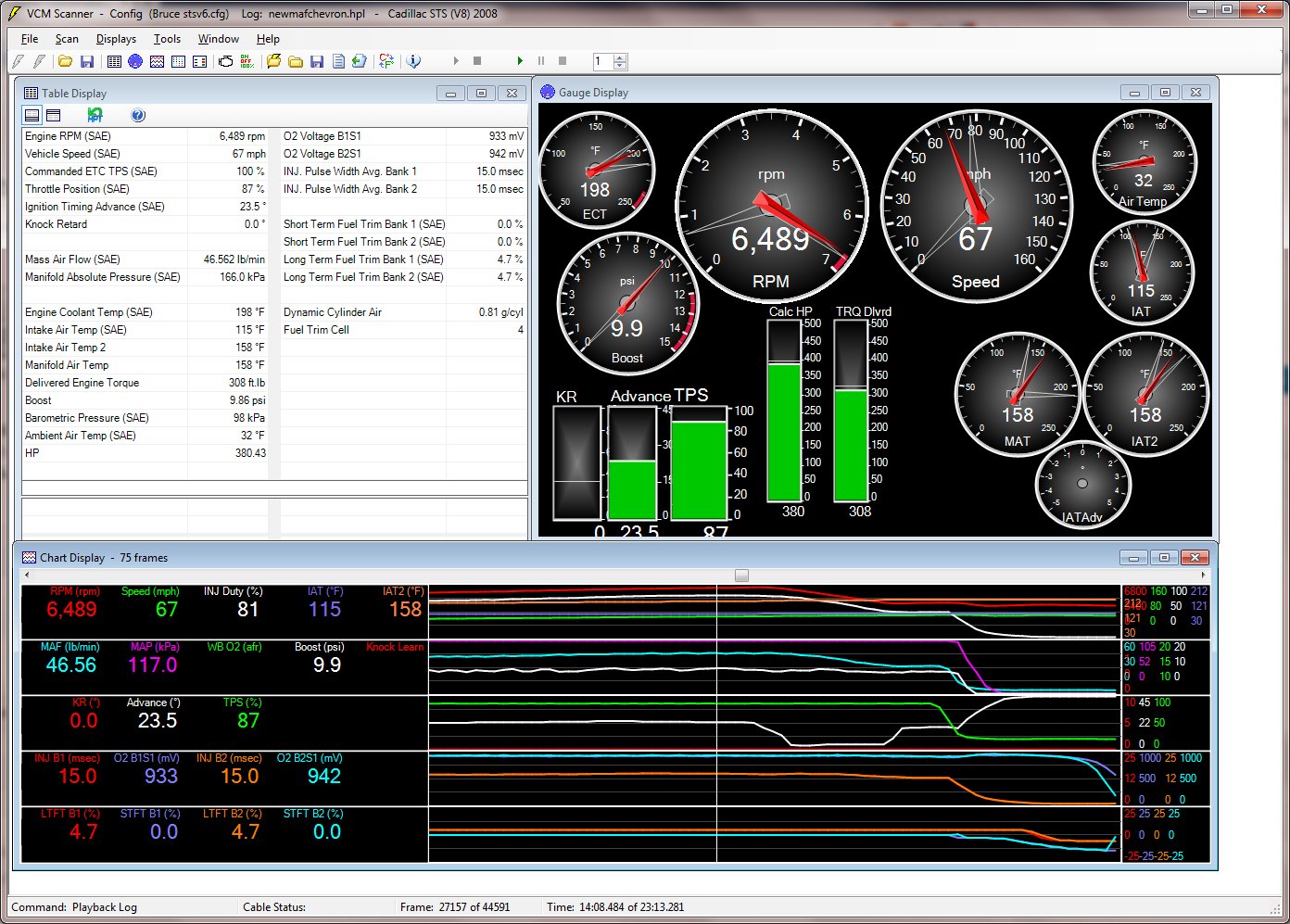
After MAF run snapshot near redline 2nd gear

Regardless, I got a ‘better’ MAF in the mail today from Apex Motorsports, and installed it in the STS-V.  Unfortunately, the V was heavily heat soaked so it is hard to do much useful testing at the moment.  Hopefully I will be able to run some new tests soon.

I did take the V out for a test drive and was able to confirm that the MAF is working properly and no codes shown, etc. with the new MAF in place.  I disconnected the battery for the new MAF install, so it has been ‘reset’ again.  Ambient temperature will read 32F until it slowly catches up again.  The IAT2 temps of 158F show the heavy heat soak, and the IAT1 would rapidly go up when stopped.  Local baro from weather underground today was 29.09 in (14.3 psi).

I was able to verify that although the physical throttle angle is 87% the Electronic throttle control system is treating this angle as 100%.

I have been playing with the delivered torque and calculated horsepower on my HP Tuners dashboard.  Because these both depend on delivered torque they are not considered useful for absolute value but are debatable to be useful for relative testing.  I would say treat them as info the ECM is using for load indication & for fun.


Cadillac STS-V: MAT vs IAT2 vs IAT Advance

I am continuing to study the effects and behavior trends for intake air temperatures (IAT) versus after the intercooler air temps (IAT2), versus Manifold Air Temps (MAT).

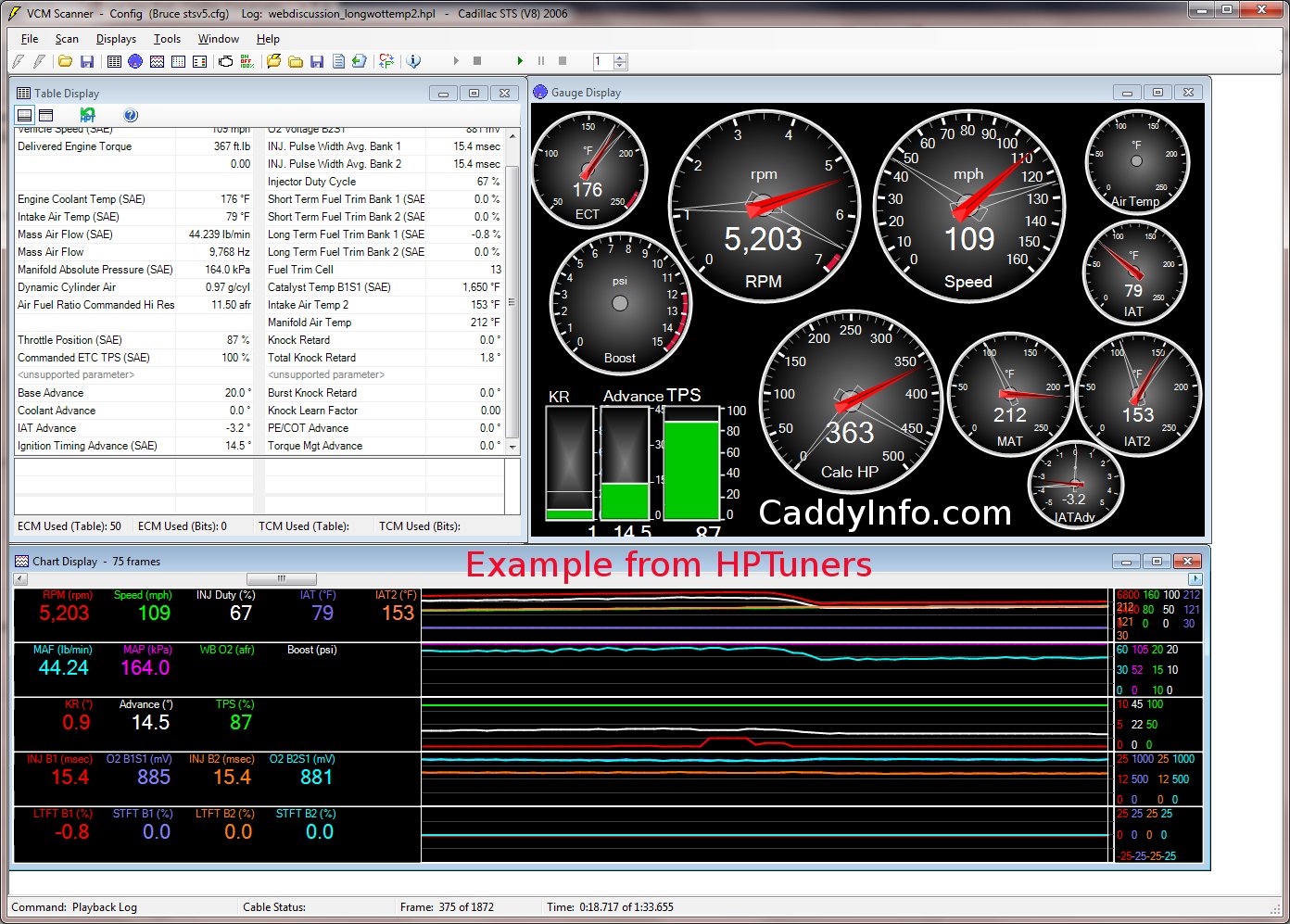
This graph is a tuner discussion taken from an .hpl download in this thread.  It is not my STS-V, just interesting to see the data from this run.  In the run the author was studying the relationship between MAT, IAT2, and the effect of IAT on timing advance (IAT Advance).

HPTuner Dashboard from a web example

What this dash shows is a moment in time as the STS-V is about to shift from 2nd to 3rd gear at 6188 RPM and 64 mph.  The IAT incoming air temperature is 79F, so a mild day.

The IAT2 is 117F, taken off the sensor.  The MAT is a predicted value for the actual manifold temperature as follows:

ok there is some hidden logic here you cannot see, the IAT2 PID displays the raw IAT2 sensor reading. The IAT Spark table uses a prediction from the IAT2 reading that is meant to compensate for the slow moving IAT2 sensor. To predict IAT2 temperatures faster than the IAT2 sensor can actually measure them. Now for the happy coincidence: The MAT value is calculated from this predicted IAT2 value (using the usual Bias and Filter tables) and for your application the bias tables are all 0. Meaning MAT = Predicted IAT2.

So in other words, the IAT2 is useful, but the MAT perhaps reflects the value that the IAT Advance will use.  What we see here is that the MAT temp of 109F the IAT Advance is 0 degrees.

Later in the run as the MAT goes up to 212F the IAT Advance falls as low as -3.2 degrees.

Hp Tuners test drive snapshot example2

Summary:

MAT is perhaps as important as IAT2 in understanding the LC3 Supercharged V8’s responses to temperature over time.  After adding MAT to the Table display in HP Tuners one can select F instead of the default of K degrees, and same for the gauges so that MAT shows apples to apples with the IATs.

Generally the MAT changes much more rapidly than the IAT2 value, which as described is the purpose of its use.  It swings higher than the IAT2 max, but also recovers faster to lower temps.