Gen1 CTS-V: Supercharger?

In my previous article about performance mods for Cadillacs I mentioned the great gains possible in the LS2 with a Cam/head package, and I argued that if you intended to add a Supercharger you might do that up front instead of doing a cam/head modification.  One advantage of a supercharger add is that it leaves no question as to the drive-ability of the car, and maintains a smooth idle.

Let’s look at the current situation for supercharger modification options.  The Cadillac solution of course, as used on the 2009+ CTS-V with LSA supercharged V8 is a TVS1900 supercharger.

The Corvette LS9 engine uses the larger 6th generation TVS2300 supercharger, and some CTS-V owners have found that if they upgrade from the TVS1900 to the TVS2300 they gain significant horsepower.  Based on my reading, it appears that the TVS1900 is good on a 6.2L engine up to around 800 crank horsepower; you would want the TVS2300 if you are targeting above this number.

For the 6L LS2 engine in the 2006/2007 for most applications the TVS 1900 Seems a better fit than the TVS 2300.

The previous Magnuson supercharger kit for the 2004-2007 CTS-V used the 5th generation MP112 1.84L unit.  That setup for LS6 engines made 6 psi of boost, and added on average 130 whp according to Magnuson.

Interestingly, the STS-V and XLR-V 4.4L engines used a modified version of the MP122 unit.  It adds 10 cubic inches to the M112, so rounds up to a full 2L of displaced air.

The size indicates the amount of air displaced with each revolution of the blower.  So at the same RPM and gearing the MP112 will pump 1.84L of air, the TVS 1900 will pump 1.9L of air, and the TVS 2300 will pump 2.3L of air.  The new TVS units are also more efficient, will make more power at the same boost due to lower heat added to the air charge, and are quieter.  The simple amount of air pumped per revolution does not tell the whole story.

TVS means Twin Vortices Series.  The new TVS series superchargers are 4-lobe Eaton units with 160 degrees of twist along the rotor.  This simulates twin vortices of air rushing into the intake system.  The 5th generation units like the M112 or M122 used 3 lobes with 60 degrees of twist along each rotor.  All TVS superchargers have a 2.4 pressure ratio capability and a thermal efficiency that exceeds 70 percent, which enables more compact packaging and greater output.  The M112 1.84L unit was replaced effectively by the TVS1320 (1.3L) unit due to the greater efficiency of the new series.

The LSA engine in the 2009+ Cadillac CTS-V is basically a supercharged LS3.  So it differs from the LS2 engine in the 2006/2007 CTS-V not only by the fact that it is supercharged but also because it has different heads, among other differences.

So how would a TVS2300 do when added to a ‘stock’ LS2 engine?  Try 130+ RWHP added, which seems oddly similar to the Magnuson number for the MP112 on a CTS-V.  My impression is that the TVS models have more head-room and can provide more air at lower temperature, and be spun faster with less loss of efficiency.  It is not clear to me from the raw numbers in kit claims that one system has more output in a near-stock setup than the other.

A supercharged 2007 CTS-V that pulled 350whp (wheel hp) stock, with a supercharger it might then make 480 whp.  Not surprisingly approximately what you might expect of a 2009+ CTS-V at the wheels.

Superchargers costs start around $7,500 plus installation, but reach beyond $10K depending on the kit and options.

With a Supercharger, premium fuel will be required.
The great Cadillac CTS seat experiment

Hmm, one day I noted that a pair of my slacks had a scraped spot on the rear pocket.  That seemed odd.  Must have gotten up against a brick wall, or perhaps brushed against something sharp?

Uh oh — a second pair came out of the wash with a similar marking.  And a third. Hmm.  So next I began attempting to note what in my day might be causing a pre-mature death of my wardrobe.  Some of the slacks had scrapes, and some were developing full rips or tears.  This was rapidly becoming an expensive problem.

Finally found what I decided must be the culprit — over time the plastic panel along the side of the seat in my Cadillac CTS had become cracked.  The panel is not designed to be a load bearing structure, but in the process of sliding in or out of the car it can end up being one.  Mine had cracked in the middle, leaving a sharp prong pointing toward the driver’s seat.  So each time I got out of the daily driver Cadillac, there was some likelihood of snagging my slacks on the plastic.  Problem solved — sort of.

To test my theory, first I took a microfiber towel I keep in the CTS and carefully used it to form a second ‘skin’ over the plastic piece.  This had the advantage of being a quick and easy fix, but is a temporary solution at best.  It did help, but the towel would move out of place, re-exposing the pronged plastic, and it looked unsatisfactory.

Next I planned to get my dremel tool out and modify the plastic part to remove any sharp edges.  While examining it further to prepare for this step, I was able to simply snap off the ‘prong’ sharply pointed portion of the plastic.  This seemed to be a good solution for the pants problem, but still left the Cadillac looking worse than I would want.

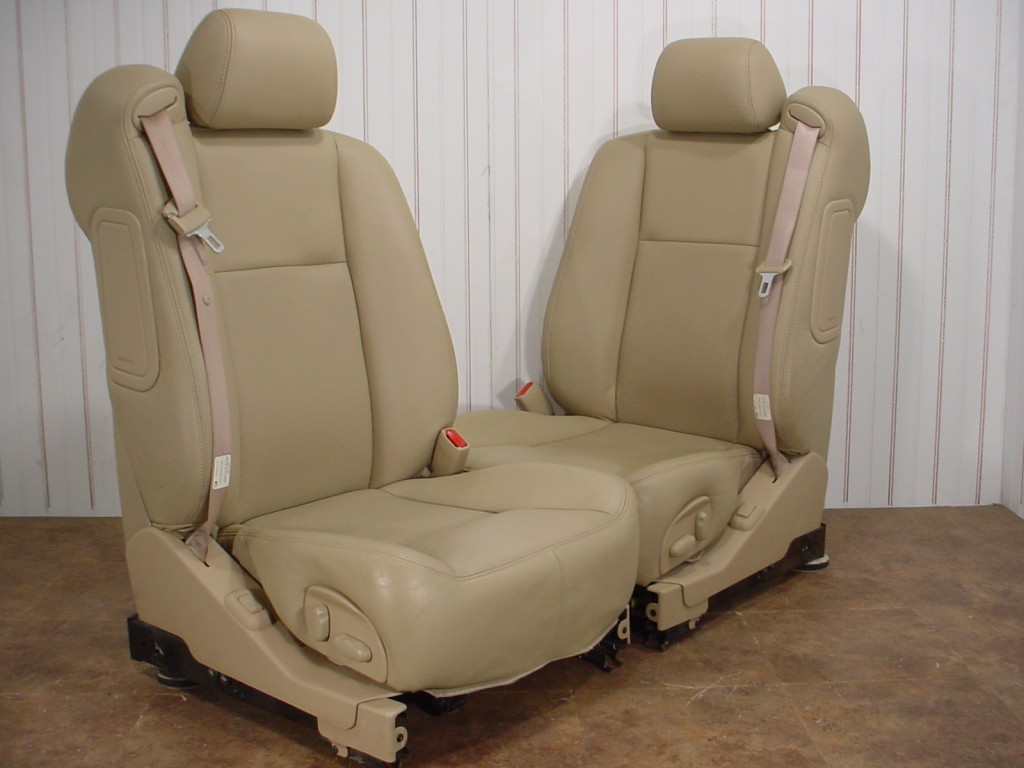
The plastic part is possibly a replaceable item, but I suspect that it is a part of the Cadillac seat assembly.  Turning to ebay, I located a replacement seat assembly.

Now this seems overkill — one because my seats are otherwise in good condition, and two because there is nothing wrong on my passenger side.

Hold that thought — when I purchased my 2005 Cadillac CTS 3.6L new, the only options I selected were the 3.6L engine and the automatic transmission.  So my car has the ‘base’ seating package, which meant that year a power driver’s seat and a manual passenger seat.  My passenger seat ‘lean back’ lever has broken, and I have a replacement in hand.  But if I can replace the whole thing with a power passenger seat I would be a happier owner.  It has always been a point of irritation to me that ANY Cadillac would come with a manual seat; that is not what I expect of a Cadillac.

The power seat combo should bolt right in to my 2005 Cadillac CTS, plug right in to the waiting harness, and step up my seating accommodations to a) not broken b) all power and c) trouser safe.

Wish me luck that: the seats are as described, they are functional, they arrive safely, they bolt right in, and they work in my CTS.    Should be fun, and I am sure I will find out new things in the process.

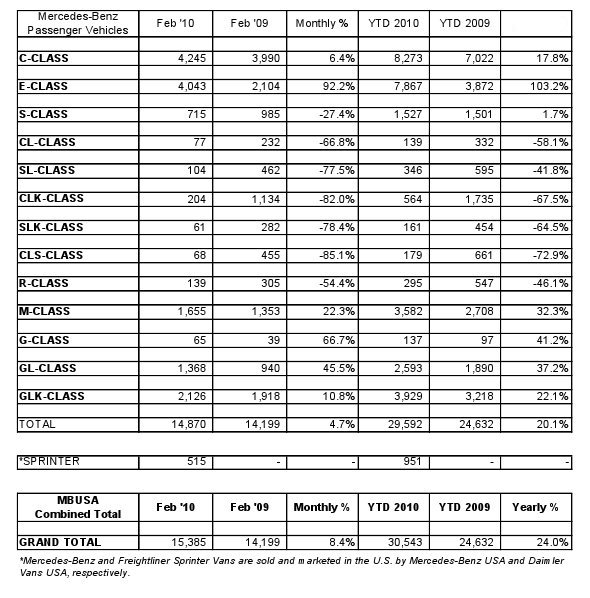
Daimler AG reports Feb 2010 US Sales up 4.7%

Daimler AG, the mother company for the Mercedes Benz, reported Feb 2010 Sales up 4.7% from Feb 2009.  The really interesting thing is that MB is making the numbers selling sedans as opposed to SUVs.  Mercedes Benz (MB) sales also seems consistent — they make high content, high value cars that are focused on their market and sell well to Buyers who know what they are getting.

C-Class Sales held steady at 4,245 cars sold.  The C-Class ranges from a starting price of $33K for the C300 Sport Sedan up to $39,750 for the C350 Sport sedan.  This is similar to the range of pricing I would prefer for the CTS Sedan — start in the low $30s and maintain a $10K increase across the range.

The C-class also includes the C63 AMG for $57K, which is similar to the more expensive CTS-V at $62K.

I believe that the C-Class was the original target for the CTS, and the CTS can be translated as C-Class Touring Sedan.  By comparison the CTS sold 2,690 cars in February.

The new E-Class sales were very good at 4,043 cars sold.  The E-Class starts at $43,600 for the E350 and rises through $56,300 for the E550 to $85,750 for the E63 AMG.  This is the market in which the DTS and the STS should be competing, or that the upcoming XTS would compete.  With the ATS arriving to re-challenge the BMW 3-Series and the MB C-Series, I suppose now the CTS will move further upmarket to compete with the E-Class.

M-Class SUV sales, R-Class tall station wagon, and the traditional GLK class SUV sales were up statistically but still low for all models compared to BMW or Cadillac SUV sales.  Cadillac SRX and Escalade sales have continued to overshadow any MB SUV sales.

And here was our Feb 2010 Cadillac chart for comparison:

February (Calendar Year-to-Date)
January – February
2010 2009 % Chg Volume %Chg per S/D 2010 2009 %Chg Volume
Selling Days (S/D) 24 24
CTS 2,690 3,259 -17.5 -17.5 5,255 6,677 -21.3
DTS 611 982 -37.8 -37.8 1,229 2,344 -47.6
Escalade 1,418 1,238 14.5 14.5 2,655 2,591 2.5
Escalade ESV 552 416 32.7 32.7 948 1,088 -12.9
Escalade EXT 102 166 -38.6 -38.6 223 501 -55.5
SRX 3,542 552 541.7 541.7 6,776 1,440 370.6
STS 332 357 -7.0 -7.0 565 770 -26.6
XLR 26 68 -61.8 -61.8 62 126 -50.8
Cadillac Total 9,273 7,038 31.8 31.8 17,713 15,537 14.0

February 2010 US Sales: MB 15,385 BMW 15,100 Cadillac 9,273