HiPer Strut — removing the disadvantages of FWD?

Good news that the Cadillac XTS has made it through the next gate and been approved for production in 2011 as a 2012 model.  Perhaps it will also benefit from this innovative suspension approach implemented on the Buick Lacrosse: Hiper Strut Suspension, which removes the disadvantages of Front Wheel Drive (FWD) of torque steer, cornering ability, and road feel while maintaining the efficiency advantages.  The XTS is expected to arrive with All-wheel drive either standard or as an option, along with a plug-in hybrid power plant.
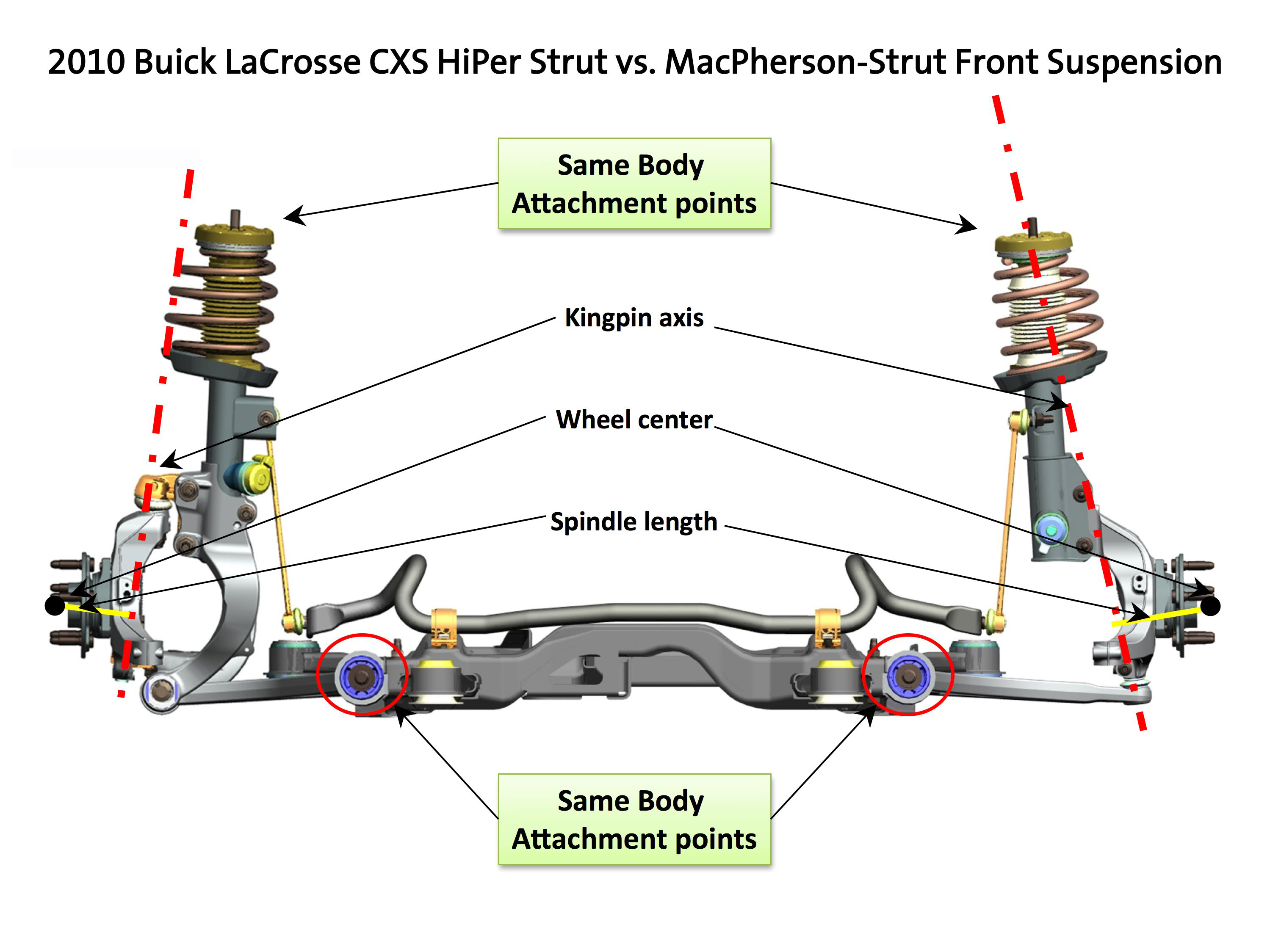
HiPer Strut vs. MacPherson-Strut

Buick Lacrosse’s Innovative Hiper Strut Suspension Delivers Improved Ride And Handling

DETROIT – The 2010 Buick LaCrosse CXS incorporates North America’s first use of a unique front suspension design called HiPer Strut. It is a premium, technologically advanced suspension design that improves ride and handling characteristics in four significant ways:

  • Reduces torque steer
  • Improves vehicle sensitivity to tire irregularities and wheel imbalance
  • Provides more linear and communicative steering through improved camber control
  • Improves impact isolation on bumps and rough surfaces.

Derived from “High Performance Strut,” the LaCrosse CXS’ HiPer Strut suspension is partnered with conventional dampers when used with the standard 18-inch wheels and an advanced electronically controlled damping system with the available 19-inch wheels.

“HiPer Strut helps reduce torque steer and maintain negative camber during cornering,” said Jim Federico, chief engineer for Buick LaCrosse. “That improves ultimate grip levels in dry and wet conditions, as well as improves the direct feel of the road, while isolating undesirable feedback. Behind the wheel the driver experiences reduced torque steer, improved grip and increased cornering power, along with crisper handling, steering precision and feedback.”
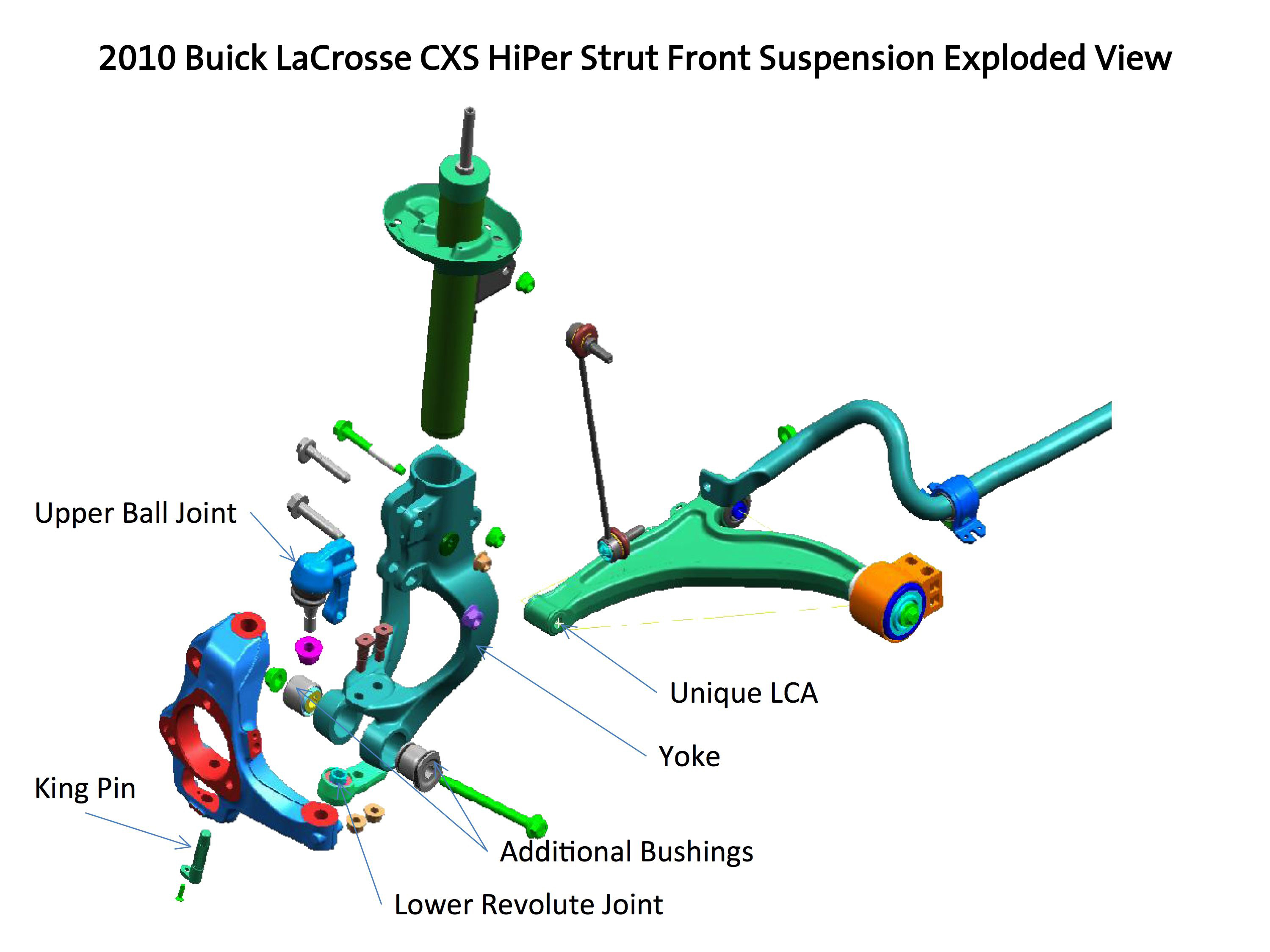
HiPer Strut Front Suspension Exploded View

HiPer Strut is based on the MacPherson strut front suspension design and features dual-path top mountings that separate the transfer of spring and damper loads to the body structure. A combined steering knuckle/strut carrier is unique to the design. The lower control arms are attached to a rigid sub-frame that is bolted to the body structure with four isolators that reduce the transmission of noise and vibrations to the interior.

The design is also an enabler for a limited-slip differential, for even greater traction, and supports better ride quality with larger-diameter wheels – including LaCrosse CXS’ available 19-inch wheels.

“Perhaps the most significant attribute of HiPer Strut’s effectiveness is what you don’t feel,” said Federico. “You don’t feel torque steer; you don’t feel tugging or vibrations through the steering wheel; you don’t feel sharp reactions to bumps and pot holes. You simply experience a smoother, more controlled and more linear driving experience.”

The foundation

The LaCrosse’s stiff body structure is the foundation for more precise suspension tuning and the CXS’ HiPer Strut design. It is constructed with ultra high-strength steel strategically placed to enhance strength, as well as crash protection. LaCrosse CX and CXL models use a conventional MacPherson strut front suspension.

At the rear suspension, the CX, CXL and the CXS model with 18-inch wheels feature a four-link design that is mounted to the body at four points. CXS with optional 19-inch wheels and Touring Package feature a more sophisticated H-arm design that uses the same attachment points as the four-link system but with the cross member attached via isolated mounts. The lower H-arm replaces the basic trailing link, delivering a greater ride quality and lower noise.

The Touring Package also includes real-time damping and Sport Mode Selectivity, which uses four electronically controlled dampers to constantly “read” the road and make adjustments within milliseconds.

Vehicle control

Along with HiPer Strut suspension in the CXS, all LaCrosse models employ a variety of state-of-the-art systems that enable exceptional vehicle control through the steering system, brakes and more. GM’s StabiliTrak electronic stability control system is standard on all models. Additional highlights include:

  • Variable effort power steering that delivers greater assistance at low speeds, such as parking maneuvers, and reduced effort at higher speeds for a greater feeling of control. The steering system has a quick, 15.2:1 ratio, requiring only 2.75 turns lock to lock.
  • Four-wheel disc brakes with four-channel ABS, including large, 12.6-inch-wide (321 mm) front discs and 12.4-inch-wide (315 mm) solid rear discs. Lightweight, aluminum-body calipers are used at each corner.
  • Electronic Brake force Distribution that ensures optimum braking force is applied simultaneously at both axles, for maximum stability under heavy braking; and a Brake Assist System that senses the severity of a braking situation and applies additional braking pressure when needed.
Performance cost in MPG

My current 2005 Cadillac CTS has a 3.6L V6 and is EPA rated for 16 city and 25 highway MPG using their current measure.  For argument sake this yields a mixed-driving target of 19 MPG.

I drive 15,000 miles a year, more or less.  So with my 2005 Cadillac CTS I might expect to need 15,000 miles / 19 MPG = 790 gallons of fuel in the next year.  The 3.6L CTS uses regular unleaded fuel, so let’s say $2.50 / gallon for a total of $2.50 x 790 gallons = $1,975 in fuel costs.

Here are the replacement performance V-Series cars I am considering:  the 469 hp 2008 Cadillac STS-V, or the 400 hp 2007 Cadillac CTS-V.

2008 Cadillac STS-V:  EPA rated 13 city 19 highway, 15 MPG combined.  With my expected annual mileage of 15,000 miles per year that would mean 15,000 miles / 15 MPG = 1,000 gallons of fuel.  Noting that the STS-V however requires premium fuel, which might cost $3.00 / gallon, that makes a total of 1,000 gallons x $3.00 / gallon = $3,000 in fuel costs.   So the Cadillac STS-V would cost an extra $1K/year, or $85/month in gas compared to my 2005 Cadillac CTS.

2007 Cadillac CTS-V: EPA rated 14 city 22 highway, 16 MPG combined. It also requires premium fuel.  15,000 miles x 16 MPG = 937 Gallons.  937 Gallons x $3.00/gallon = $2,811 in fuel costs.  So that CTS-V would cost an extra $836/year in fuel, or $70/month compared to my 2005 Cadillac CTS.

I plan to keep the next Cadillac for 5 years.  Comparing the new cars, STS-V will cost $200/year more than the CTS-V, or $1,000 over the 5 years.

On the other end of the spectrum, the current 2010 Cadillac CTS 3.6L DI V6 engine is rated at 18 city 27 highway for combined 21 mpg.  The current 2010 Cadillac CTS 3.0L DI V6 engine is rated at 18 city 28 highway for combined 22 mpg.  Either engine can use regular unleaded.  So replacing my CTS with the new 2010 Cadillac CTS 3.6L would yield a projected fuel cost of 15,000 miles / 21 MPG x $2.50/gallon = $1,785/year.  Although the new 3.6L has more power at 304 hp than the 2005 non-DI 3.6L at 255 hp in my car, the DI engine also gets better MPG, and is boosted by the 6-speed automatic vs 5-speed automatic.

Replacing my CTS with a 6-speed DI 3.6L instead of a 2007 CTS-V or 2008 STS-V model would save $1,026-$1,215/year.   However, the CTS DI 3.6L has respectable performance of 0-60 in 6.5 sec, while the 08 STS-V or 07 CTS-V will both accelerate 0-60 in under 5 seconds, out-brake, out-corner, generally out-perform the CTS 3.6L.  What cost performance?  Besides the initial price of entry, about $100/month in my case.  Is that worth the thrill of the added performance potential?  Would you pay another $1200 a year to drive a Super car versus a ‘normal’ sport sedan?

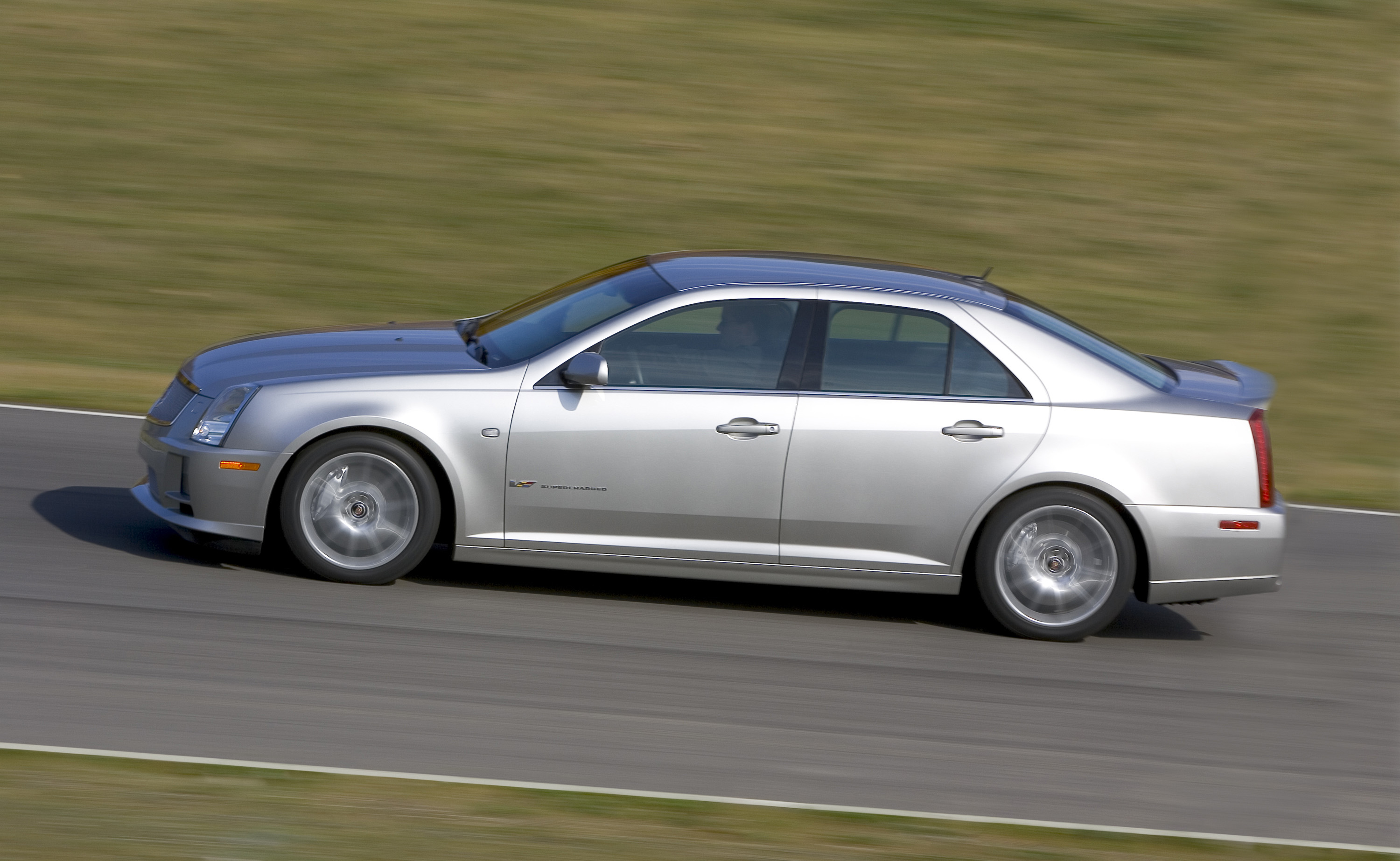
Cadillac STS-V a Cadillac made by Craftsmen

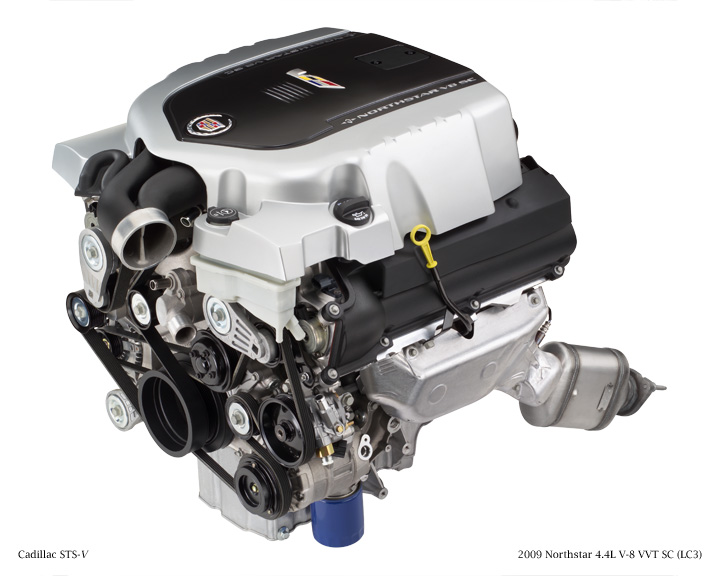
In 2006 Cadillac introduced the STS-V, an all-out, no holds barred assault on the world’s luxury performance cars.  Sporting a hand-made, supercharged 4.4L Northstar V8 engine, and hand-cut and sewn interior leathers, the STS-V exceeded initial estimates of 440 hp and with tuning achieved 469 hp.  This made the STS-V the most powerful Cadillac made up to that time; the emergence of the 556 hp 2nd Generation CTS-V in 2009 has since grabbed the most powerful crown.

Supercharged Northstar

Press info:

STS-V

The supercharged 2007 Cadillac STS-V is GM’s most intense expression of Cadillac power and performance. It carries all the sophistication of its STS sibling, yet elevates the performance and luxury attributes of the brand’s V-Series lineup to their fullest extent. The STS-V represents an historic combination of performance technology and hand-crafted elegance.

The 469-horsepower (350 kW)* STS-V is the most powerful Cadillac ever, and is capable of exceptional performance for an automobile of its size. Each 4.4L Supercharged Northstar V-8 engine is hand assembled to exacting standards at GM’s Performance Build Center in Wixom, Mich., and is built from start to finish by a single expert craftsman. Production is limited to ensure exclusivity in the marketplace.

The engine is paired with the GM Hydra-Matic 6L80 six-speed automatic transmission with driver shift control. This powerful combination enables 0-to-60 (mph) acceleration in less than five seconds. The STS-V includes numerous chassis enhancements, including massive Brembo brakes with air cooling, larger wheels and tires for better grip and larger front and rear stabilizer bars for better performance.

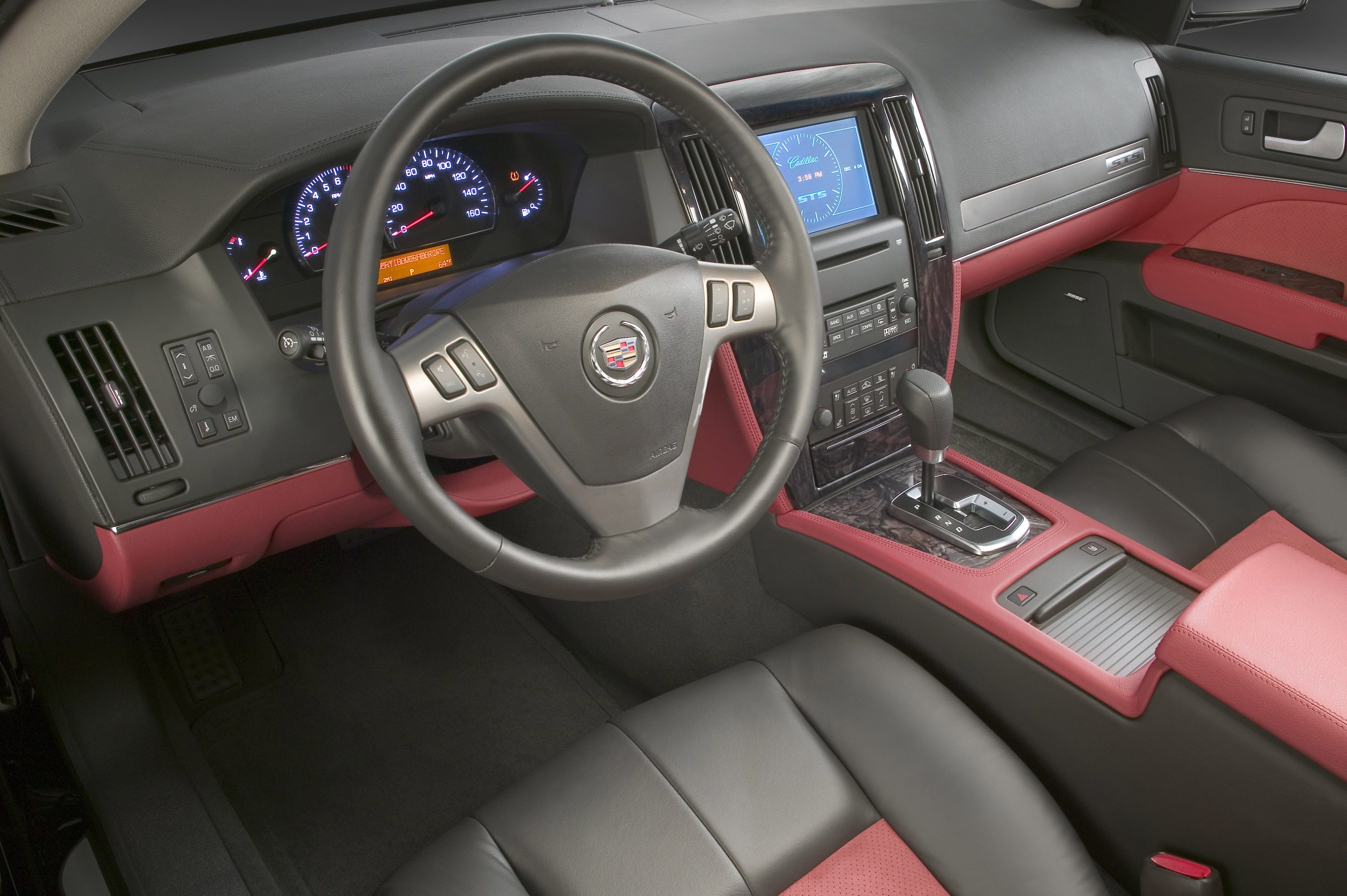
The interior features extensive use of leather wrapped surfaces, created by craftsmen who cut, wrap and sew leather around components individually. Kinetic aluminum accents adorn the steering wheel and instrument panel. STS-V features deep-tinted Olive Ash Burl wood accenting the center stack and door trim.

All STS models are built at GM’s state-of-the-art Lansing Grand River assembly center in Lansing , Mich.

2006 Cadillac STS-V

STS-V Interior Tango Red option shown

What makes the STS-V Special?  It is after all on the Sigma platform, similar to the CTS.  Besides the great engine, it also has Brembo brakes front and rear for high performance, fade free braking.  It has tuned Sachs performance struts/shocks front and rear FE4 suspension as well as high precision ZF Steering gear and limited slip differential.  So from a performance view, it is a complete package.  But what the STS-V also brings is luxury features not found on other V-series models.

Lane Departure Warning senses if the STS-V has crossed over a lane border line and alerts the driver.

Memory Package, recalls 2 driver “presets” for 8-way power driver seat with easy exit, outside mirrors, power tilt and telescoping steering wheel with easy exit and audio system/climate control settings

Head-Up Display, (2008-2009) 4-color, reconfigurable, with digital readouts for vehicle speed, selected gear, Adaptive Cruise Control indicator, audio system information, high-beam indicator, fuel level and 5 language capability (English, French, German, Italian and Spanish)

Heated driver and front passenger seats, as well as heated outboard rear passenger seats. Seat trim, Nuance full-leather with perforated Preferred sueded fabric material inserts.

Steering wheel, heated and leather-wrapped with kinetic aluminum trim.

Wood trim, Olive Ash burl on doors, shifter knob and center console with Kinetic aluminum accents

Compared to the 2009+ CTS-V, the STS-V lacks the newly tuned MR suspension.  MR suspension was available in 2006, but it did not give the performance level at the time that the Sachs adjustable shocks offered.  That has since been corrected for the CTS-V, but the STS-V was not updated.  The CTS-V receives the Supercharged OHV 6.2L LSA engine for 556 hp vs the LC3 32V DOHC Supercharged 4.4L Northstar engine in the STS-V; each engine is specific to that model.  Both cars are approximately the same weight due to all of the high performance equipment.  The CTS-V has more raw performance, the STS-V has more luxury features and is a bit larger.

The STS-V was phased out of production in 2010, so it ran from 2006-2009, with very few 2009 models produced.