Initial Tuning Steps Cadillac LH2 V8 Engine

First, I wanted to adjust the tune to recognize that we have E10, or gas with up to 10% ethanol.  This gas has a lower stoichemic makeup, and an ideal ratio is 14.2:1 air:fuel instead of non-alcoholic gas at 14.7:1 air:fuel.  The Cadillac factory tune assumes 14.7:1 fuel.  I set the tune to 14.4:1 since we have an uncertain mix of alcohol in the fuel.

Second & Third, in our Texas heat the Cadillac is just on the border of heat retard from engine coolant temperature and intake air temp.  I addressed each of those to move the ‘border” a few degrees higher and get that retard out.  We’ll look for any sense of knock or knock retard on these runs just to be careful.
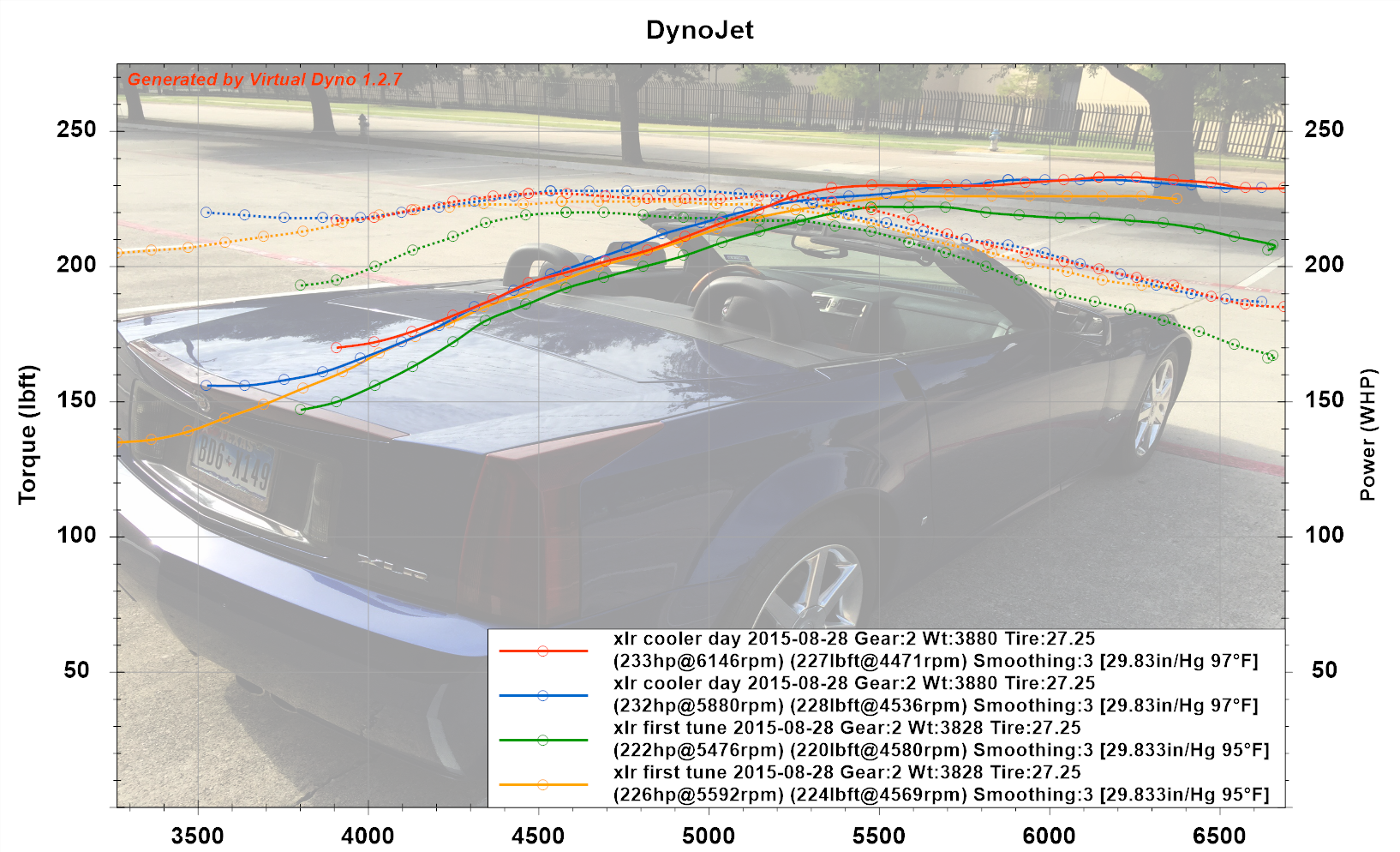
XLR First Tune Stoic IAT ECT 4 Comparison

The two test runs with those changes appear to have lost 8 hp and 5 lb ft of torque.  Not what I hoped.  In this graph the red/blue runs are from earlier today, the green/yellow runs are from after the tuning changes.

The stoichemic setting change had the effect of moving the XLR 0.3 richer on in AFR, which is not what it appears to want.  The other changes allow it run a bit more timing.  My sense is we need to keep the AFR, but I am uncertain if the Wideband O2 sensors in the XLR are auto-magically compensating for fuel quality and driving to lambda for the current fuel, then reporting that as 14.7 AFR?
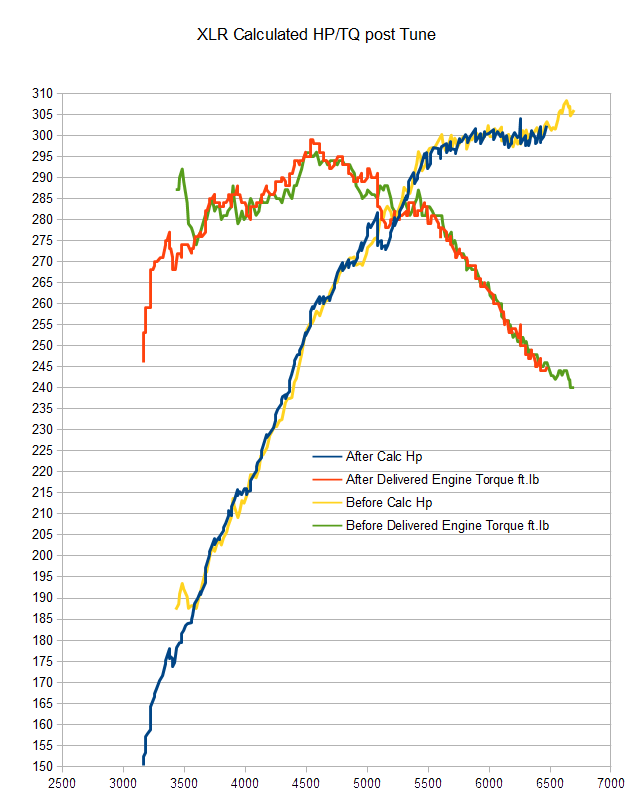
XLR First Tune Calc Before After

The calculated hp before/after is not as dramatic as the Virtual Dyno.

For the next tune I plan to replace Stoich at 14.7, and move PE from 1.176 to 1.148 (12.8:1).  This will have the net effect of going the other way from baseline — taking the overall fueling 0.3 AFR leaner than factory tune from 12.5:1 to 12.8:1 in AFR terms.
Cadillac XLR Virtual Dyno Testing 2015-08-28 #Motorama

I have been testing my 2007 Cadillac XLR with the LH2 4.6L DOHC V8 engine to establish a baseline prior to any mods or tuning.

Today the air was a bit cooler, although not as much as I had hoped.  HPTuners VCM Scanner recorded a 97F intake air temp, and 29.83 barometer during the test.  For safety, testing is done in 2nd gear which is not optimal — it should be done in a 1:1 ratio or as close as possible.  I am using Virtual Dyno to convert captured export data from hptuners to a on-road dyno result.

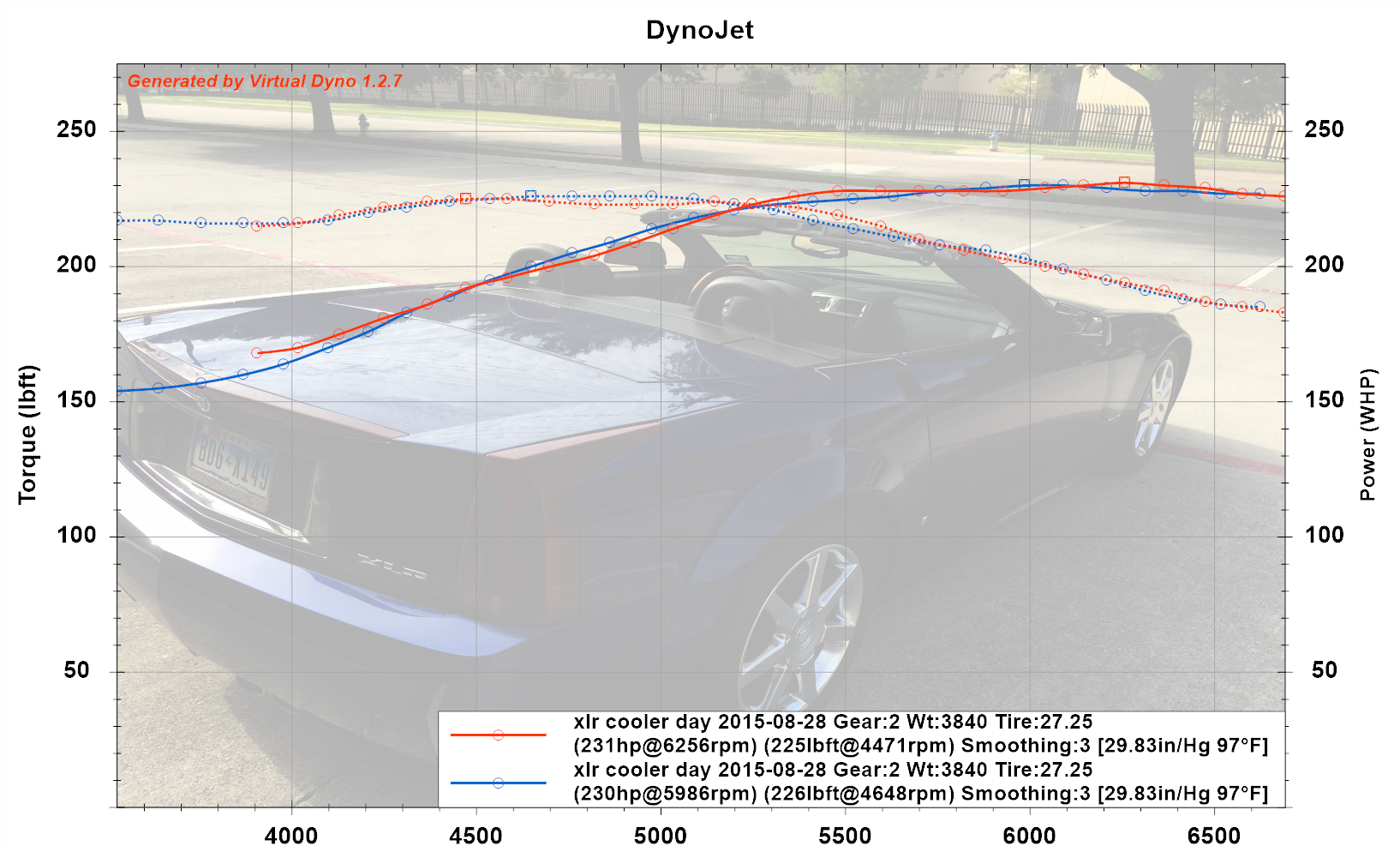
XLR cooler day 2015-08-28 2 run comparison

[click to zoom in, back to return]

The red and blue runs are both from today, and run within 6 minutes of one another on our 2-test area cycle.  I was hoping to see a bit more whp in the cooler air, but I suppose 97F not all that cooler than 104F from the prior tests.

XLR cooler day 2015-08-28 4 run comparison

This second chart shows today’s 2 runs in yellow and green vs prior runs in red and blue.  Corrected for temp and gas, the results seem fairly consistent at least.

All runs are using current method, which is drive to a known point with transmission manually selected to 2nd gear, then wide open throttle until fuel stop at redline.  Rinse, repeat.

Info Video about this type of testing

xlr cooler day 2015-08-28

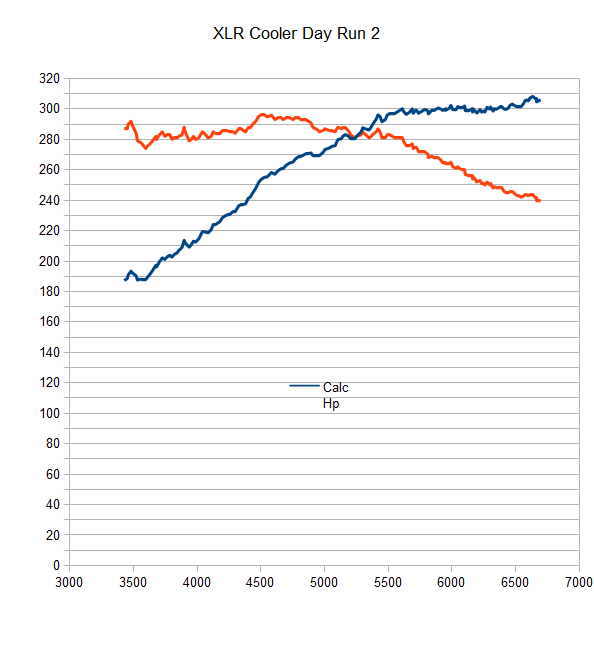
Calculated hp/torque for the LH2 in this test peaks 308 hp @ 6635 rpm, and 296 lb ft at 4503 rpm.

Today’s tests appear to be consistent with prior tests.


Cadillac XLR validating frontal area calculation

2009 Cadillac XLR

2009 Cadillac XLR

I did a bit more work on frontal area, which appears to support the short-cut we took earlier.

From a thread on Virtual Dyno on HpTuners, The quick way to calculate frontal area is (((w*h)(0.85))/12)/12 = Frontal Area.

For the 2007 base XLR, W=72.3in,  H=50.4in so for a first approximation (((72.3*50.4)*.85)/12/12)= 21.5 ft2.

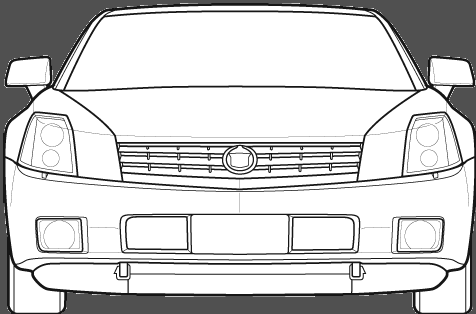
The question then is the 0.85 factor.  To test that, I downloaded a diagram of the 2007 Cadillac XLR from the-blueprints.com and pulled just the frontal area into a photo editor.

cadillac-xlr-2007 frontal

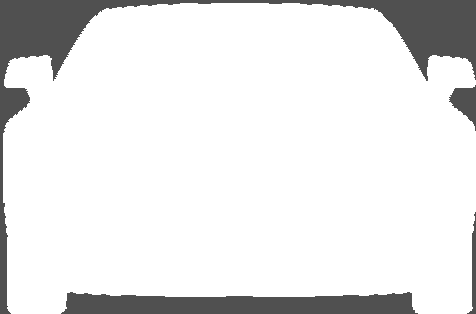
Next, I selected the parts of the diagram that were NOT XLR

xlr outline of not xlr

Then I used the photo editor (GIMP) to tell me how many pixels were shaded (20,668) of the total pixels size (149,464) which resolves to 20668/149464 = 13.8%, or 86.2% for the XLR.

That makes the frontal area for the 2007 base XLR, (((72.3*50.4)*.862)/12/12)= 21.8 ft2.  In this case the approximation was good, but I will update my Virtual Dyno XLR profile to 21.8 ft2.