Cadillac XLR Virtual Dyno calibration

Using my initial and second (premium) run data captured from HPTuners, I did some Virtual Dyno Analysis (see my initial Virtual Dyno article here).  First I needed a new custom file for the XLR:
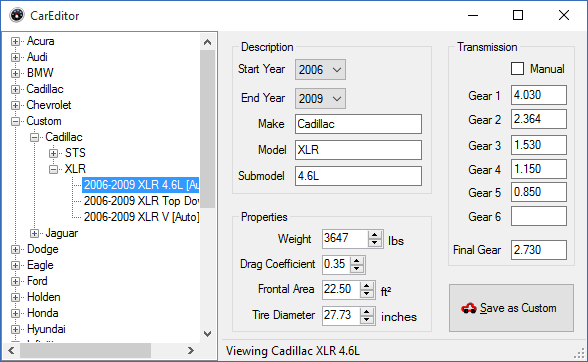
Virtual Dyno XLR data

I had run the test data with the top down (worse aerodynamics), and I used a back-to-back wind tunnel test of a different car (Miata) to model the degradation of top down as .06 CD.  I will want to run virtual dyno tests with top up in the future?

I created a 2nd custom file to model the XLR with top down:
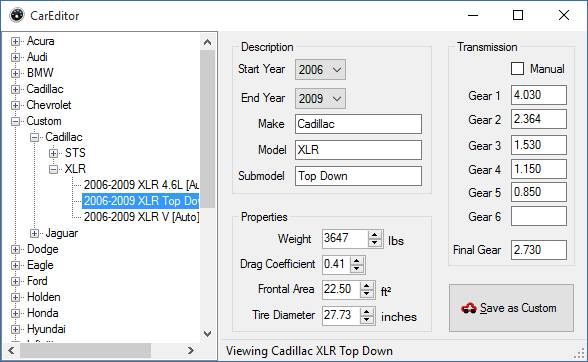
Virtual Dyno XLR Tops Down

I edited the .csv saves from Hptuners to only include the acceleration range desired, and loaded both runs.
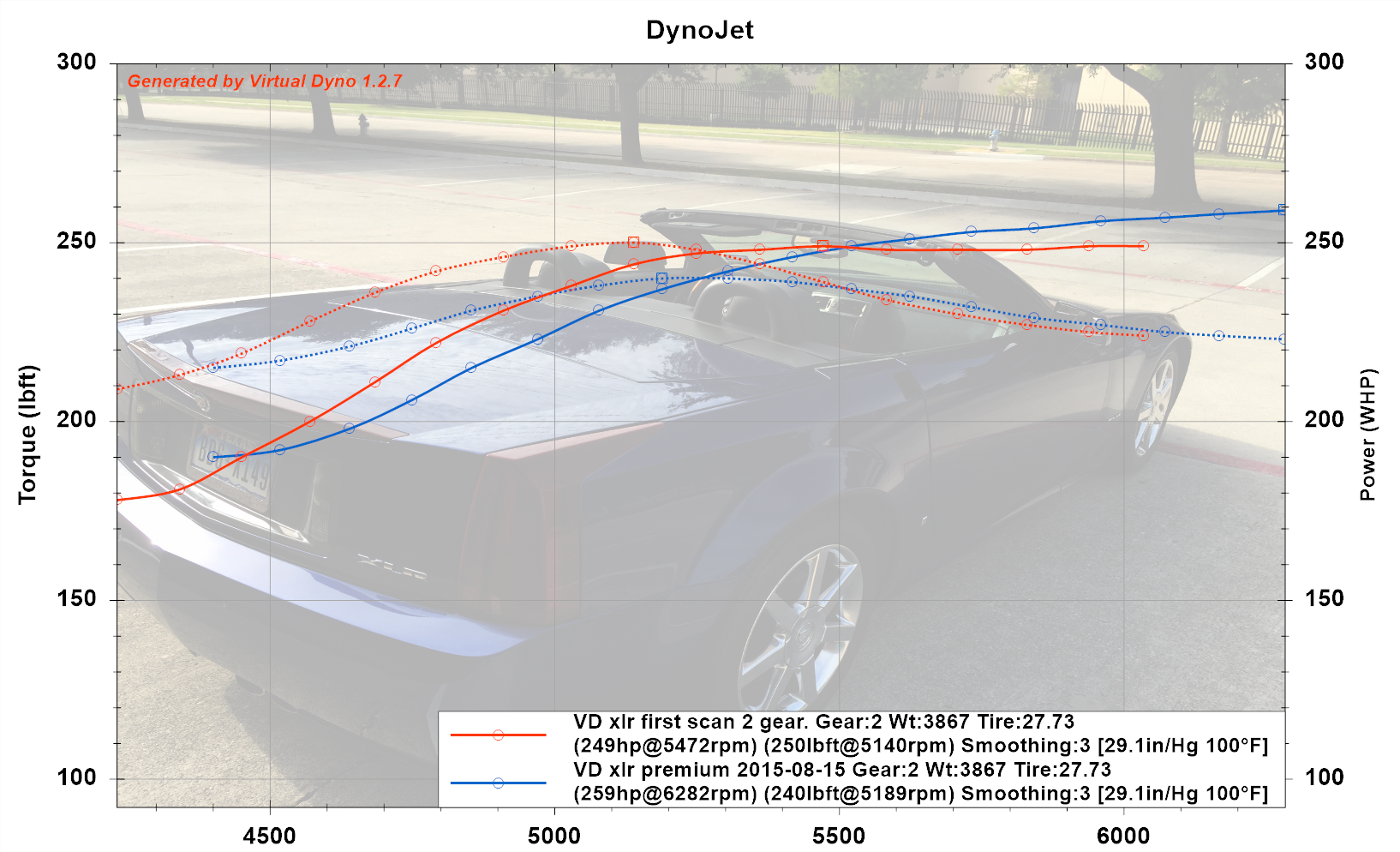
VD XLR Setup initial Comparison - CD adjusted +.06 for Top down

[click on image to zoom in, back to return]

I adjusted the SAE conditions for the pressure and temps during the test, 29.1 in/hg baro and 100F.  The car intake air was actually a bit higher.  I am not sure this adjustment is quite right — the reference site suggests a dyno adjustment of 4.5% for test conditions.  The Virtual Dyno not-SAE – to SAE goes from 251 to 259 or a 3.2% increase.  A 4.5% increase would be 262 whp, so not much difference really.

The results, 249 whp for the initial test, and 259 whp for the known-quality premium fuel test, seem consistent with expectations.  259 whp / 0.8 transmission losses = 324 hp.  Cadillac rated the stock XLR LH2 V8 engine at 320 hp.

One might conclude the difference between believed-regular unleaded and known premium unleaded in this test case was 10 whp (13 hp).  This is similar (9 hp) to what the calculated hp values showed.

The calculated engine hp vs virtual dyno:

Initial:  2nd gear 293 calc hp x 1.045 conditions adj = 306 hp
Virtual Dyno 249 whp / .8 trans loss = 311 hp

Premium: 2nd gear 302.3 calc hp x 1.045 conditions adj = 315 hp;
Virtual Dyno 259 whp / .8 trans loss = 324 hp

Or told in the other order:

Initial: 306 adj hp x .8 trans loss = 244 whp
Virtual Dyno: 249 whp

Premium: 315 adj hp x .8 trans loss = 252 whp
Virtual Dyno: 259 whp

Note in both tests 1st gear calculated hp was higher, and for comparison with Virtual Dyno analysis of the same runs I am using 2nd gear hp data.

Virtual Dyno depends on consistent, level test area, weights (with/without fuel for example), and conditions for comparable results.  It has however been tested over and over to be consistent with dynojet results when done with proper care.

My conclusion is that I need to do a few more captures of consistent test data for Virtual Dyno use, but the configuration files I have predict results consistent with my other indicators.
 

Tuning VVT — Establishing a Baseline

Variable valve timing allows tuning of the camshaft timing across the RPM range.  In my 2008 Cadillac STS-V, the DOHC engine allows individual tuning for exhaust and intake cams.

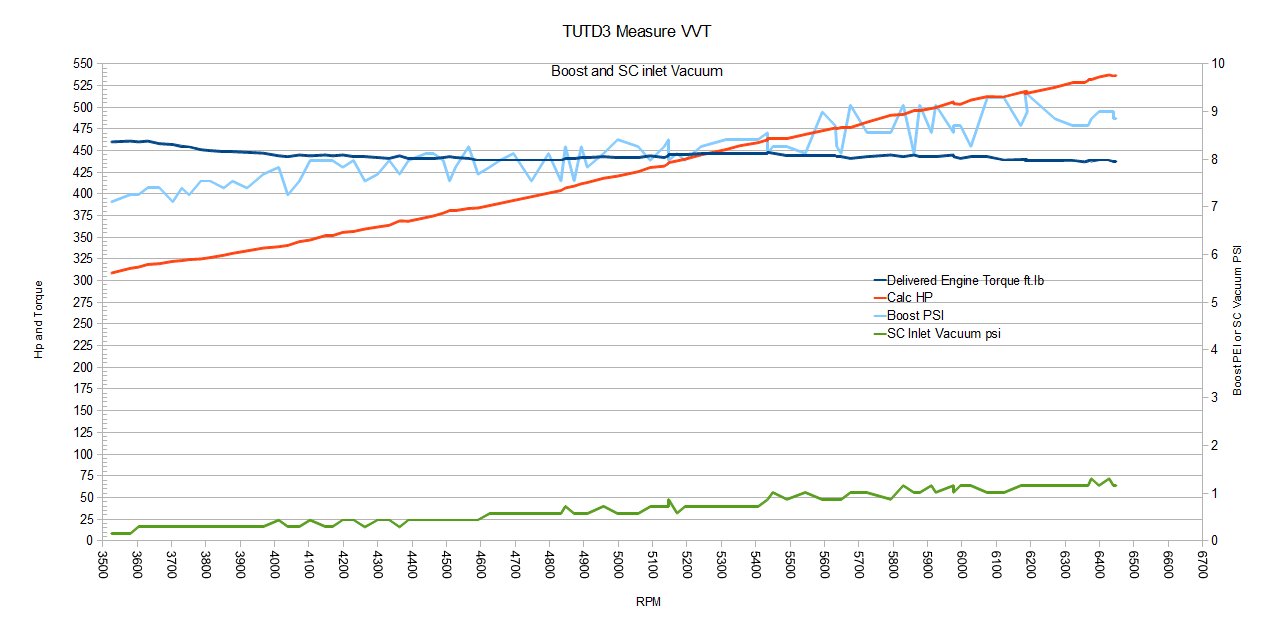
TUTD3  baseline hp torque vs boost sc vac

This graph shows today’s run delivered torque and calc hp vs supercharger boost and supercharger inlet vacuum in psi.  It is provided as a baseline comparison for how the engine performed today.

tutd 3 hptuners peak

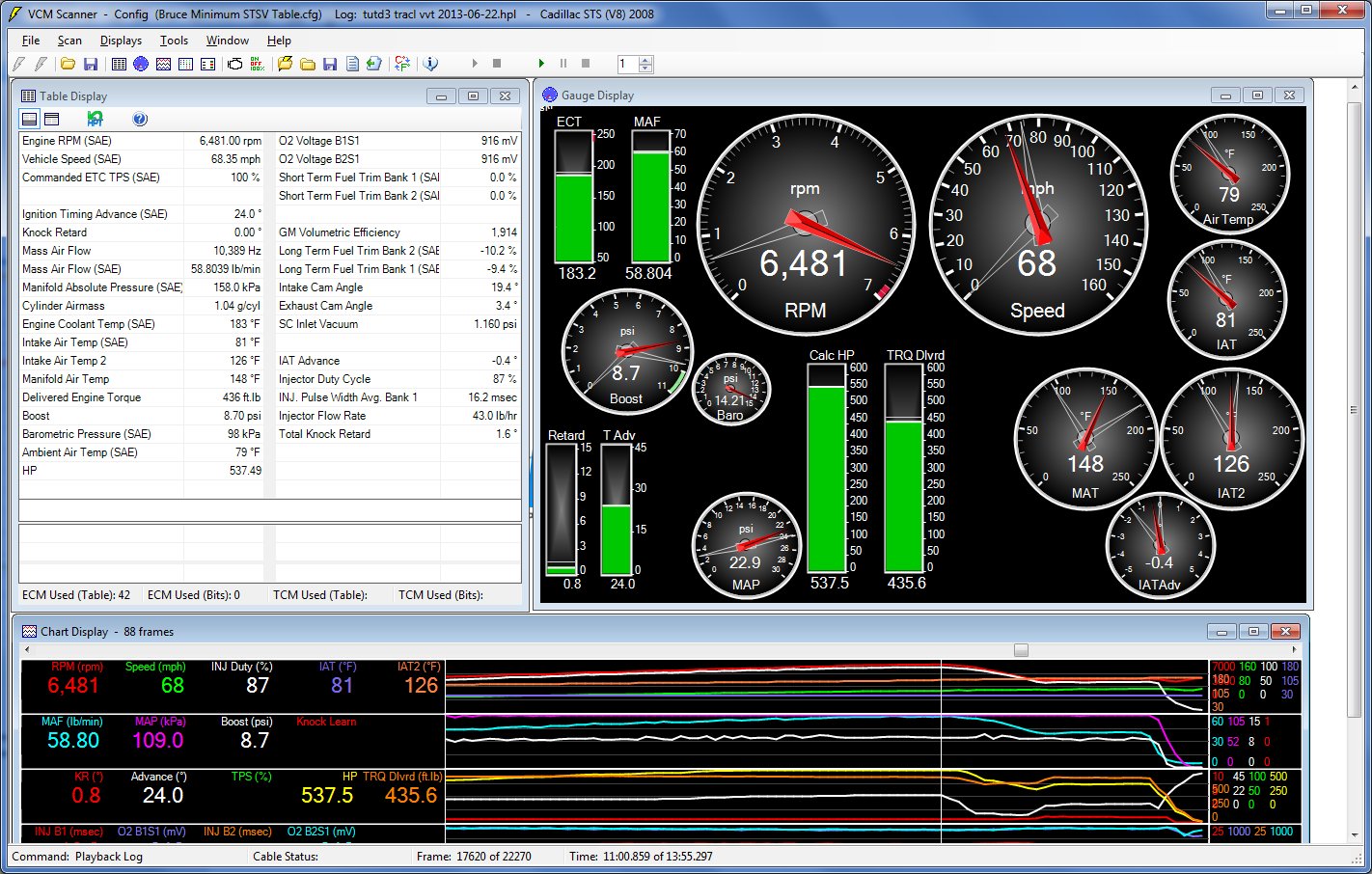
Hptuners capture at peak in 2nd gear.  This run shifted in custom TUTD mode at top of 2nd to allow selection of 2nd gear but smooth transition to 3rd.

TUTD3 KR vs total KR

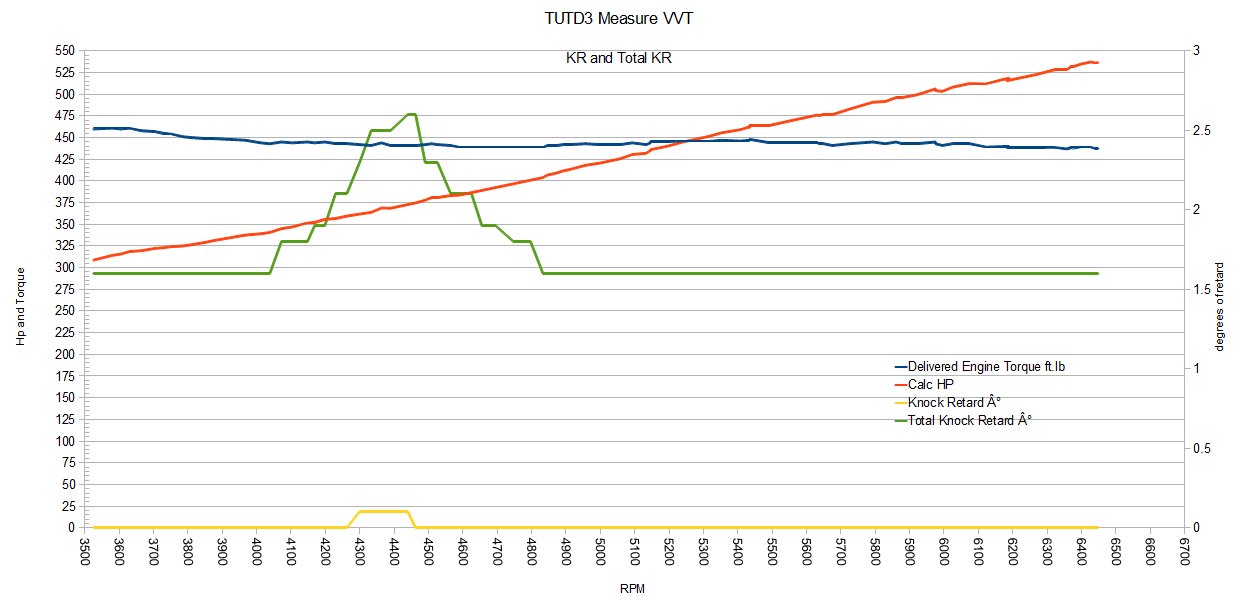
I have previously been charting KR, or knock retard.  I added tracking for Total KR, which includes burst, or pre-emptive knock retard.  The KR is shown in yellow, and the Total KR in green on this chart.  I think you can see the Total KR anticipate and over-shadow the KR, as well as the fact that the Total KR runs a degree of KR all the time, which was a surprise to me.  More thought and study needed here.

I also should note that my gauge for KR tracks the Timing Retard sensor, which seems to be different from just KR or Total KR.  Again, more study.

TUTD3 cam position

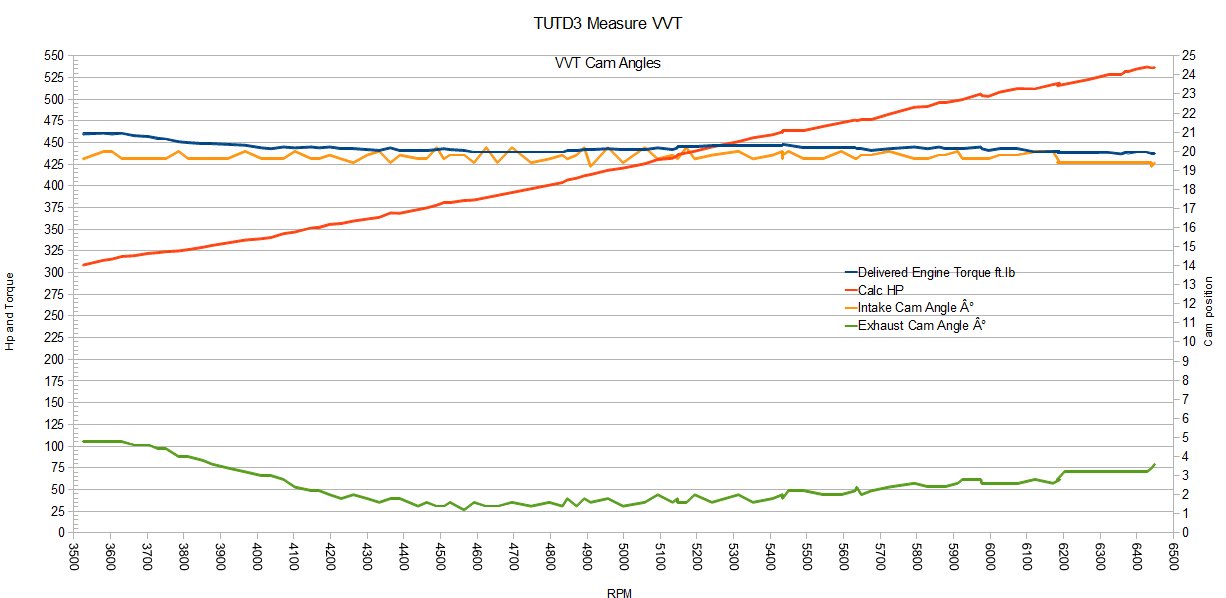
Finally, this graphic shows the VVT operation — the gold line is the intake cam position, and the green line is the exhaust cam position.  Basically, in the pressure range the V is running, the intake cam is commanded to 20 degrees, while the exhaust cam goes from 5 degrees at low RPM to 2 degrees midrange to 4 degrees at high RPM.

In our previous experiment, I changed the exhaust cam to show a more expected pattern similar to lower pressure settings by adding 1 degree at 4800 and 2 degrees of cam position from 5200 on.  We did not see a improvement or degradation, so it was reset it to OEM for this run.

It surprises me that the VVT cam position is not constant (waivers).  I am not sure if this is an effect of the variance in the boost, or if this is a cause of the variance in the boost.

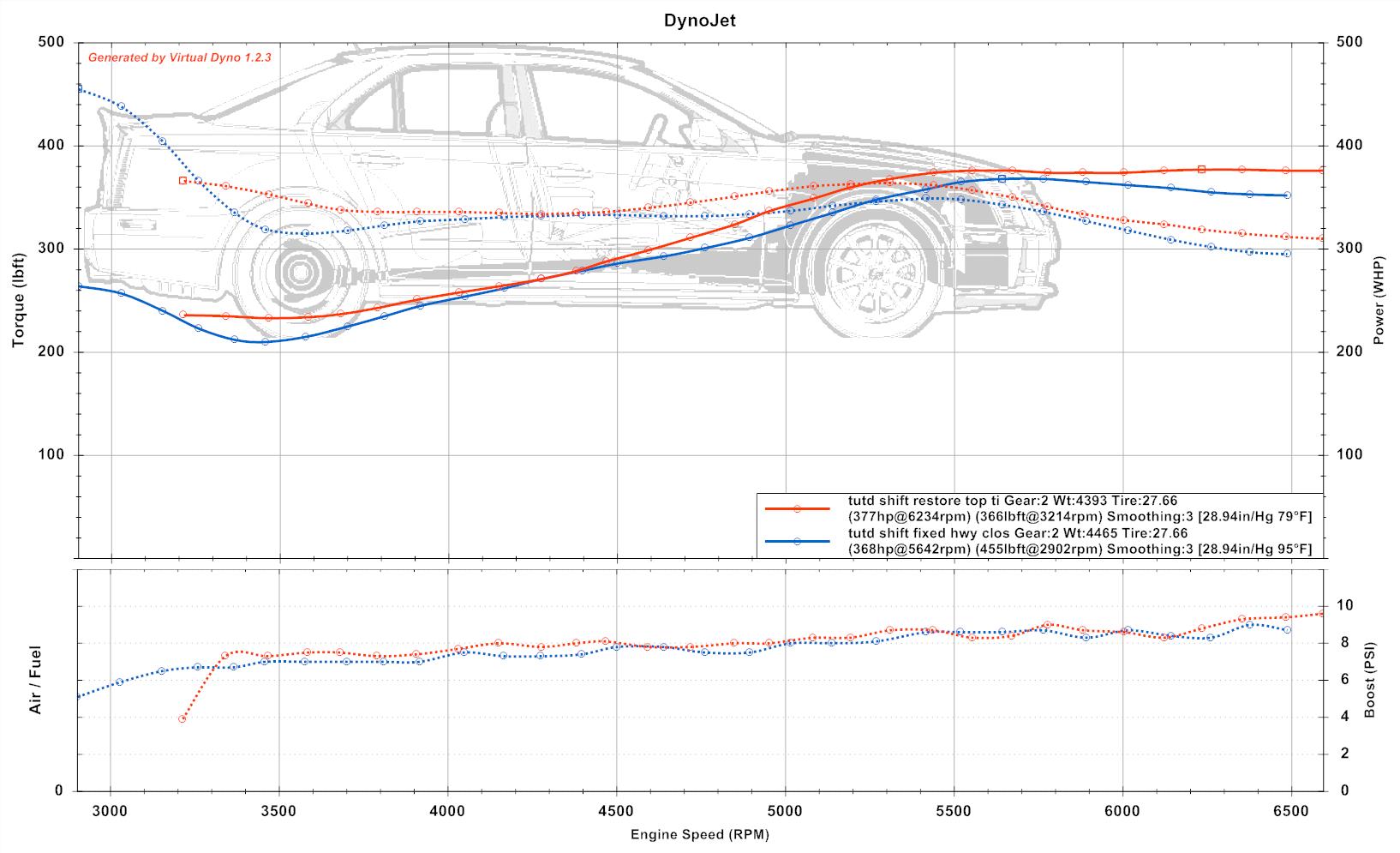
TUTD3 2013-06-22 low virtual dyno result

I included a Virtual Dyno run.  Other than it is hotter now I am unclear why this run was markedly lower than prior.  Both are ‘cold’ runs at operating temp but without heat soak.  The MAF also shows less air in lb/min so I don’t think it is just test variance, but I am uncertain what caused.

TUTD3 RPM vs Time comparison

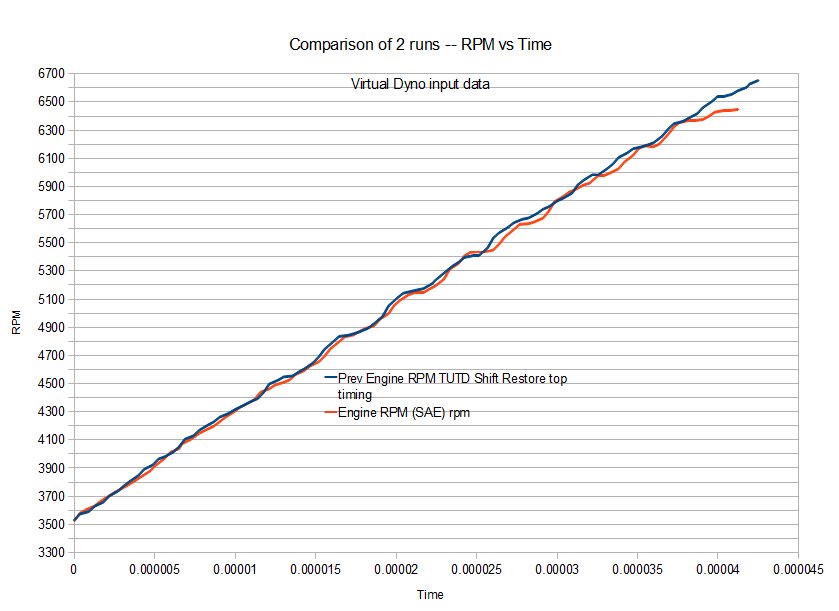
This graphic shows the raw data that Virtual Dyno uses — time deltas and RPM for the two runs shown.   The runs appear equivalent until 6300+ rpm, where today’s run tapers off.  This may be an effect of the TUTD shift for today’s run vs the hold to redline of previous run?

I will note that I got gas from an unusual location on last trip, not my normal source, but was marketed as 93 octane.

The boost psi looks similar between the two.  The good news is programming the TUTD to shift automatically avoids pulling the V back in to normal then back to sport, which appears to have been causing the RPM pattern that disrupted the virtual dyno readings.  The last few charts have not shown that issue.

 Summary

The purpose of today’s test was to select and record VVT cam positions over RPM to characterize current state with OEM tune.  Next I plan to study changes to the intake cam position.

Testing VVT Exhaust cam retard at high RPM

Today’s test was not a normal test.  First, I was dispatched for a breakfast run to Starbucks, which adds intercooler heat.  Second, the highway was jam packed with some problem, and the run was captured in an alternate location.  All that noted, I feel we can reach some conclusions.

TUTD 2013-06-21 exhaust cam test

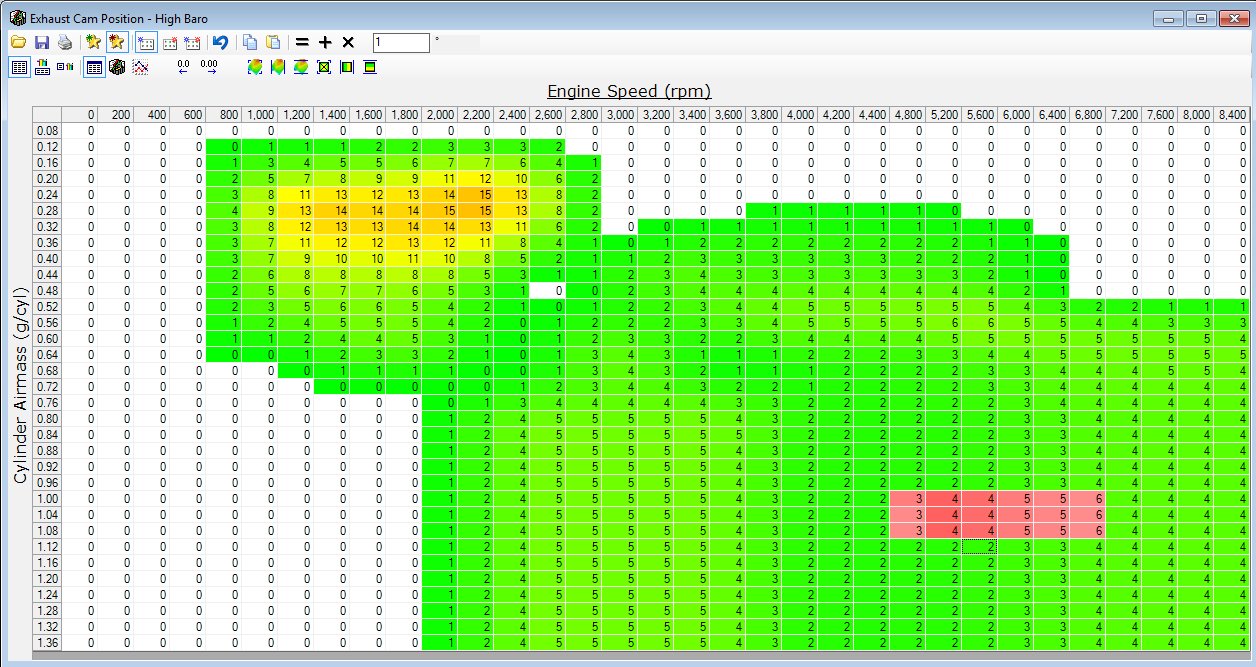
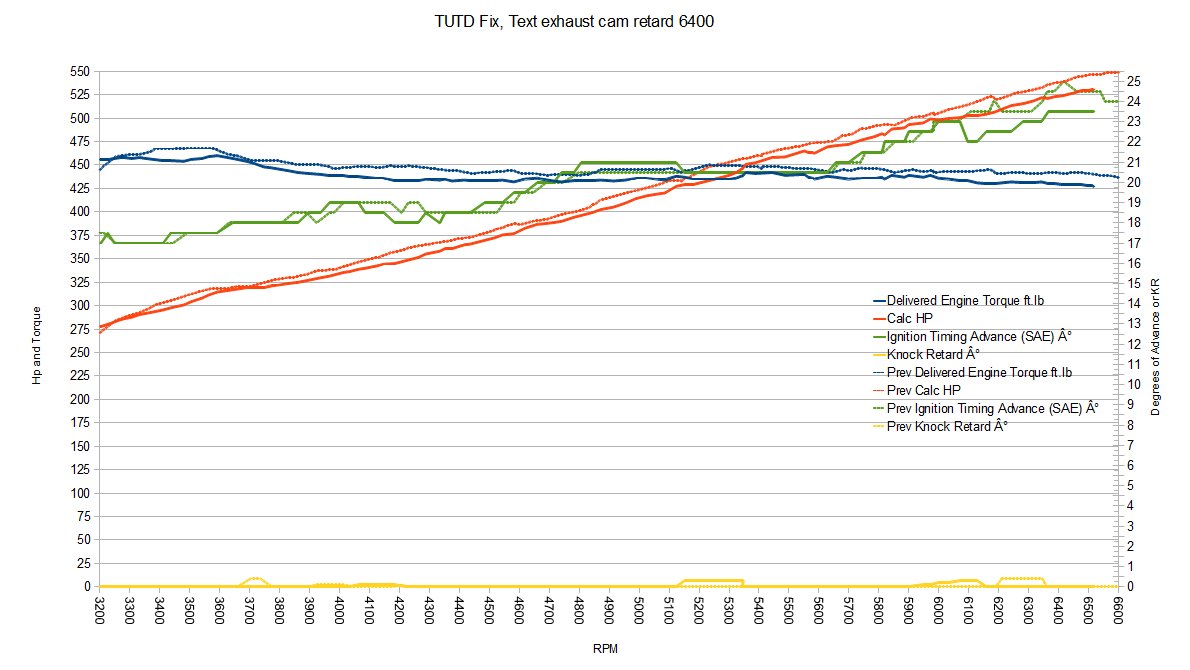
This chart shows exhaust cam position for the VVT timing.  The cells in red are our test settings — adding 1 degree of retard at 4800 rpm, and 2 degrees of retard from 5200-6800.  What we hope to see is a change in the slope of the HP and Torque curves as a result.

tutd 2 2013-06-21 add exhaust cam retard

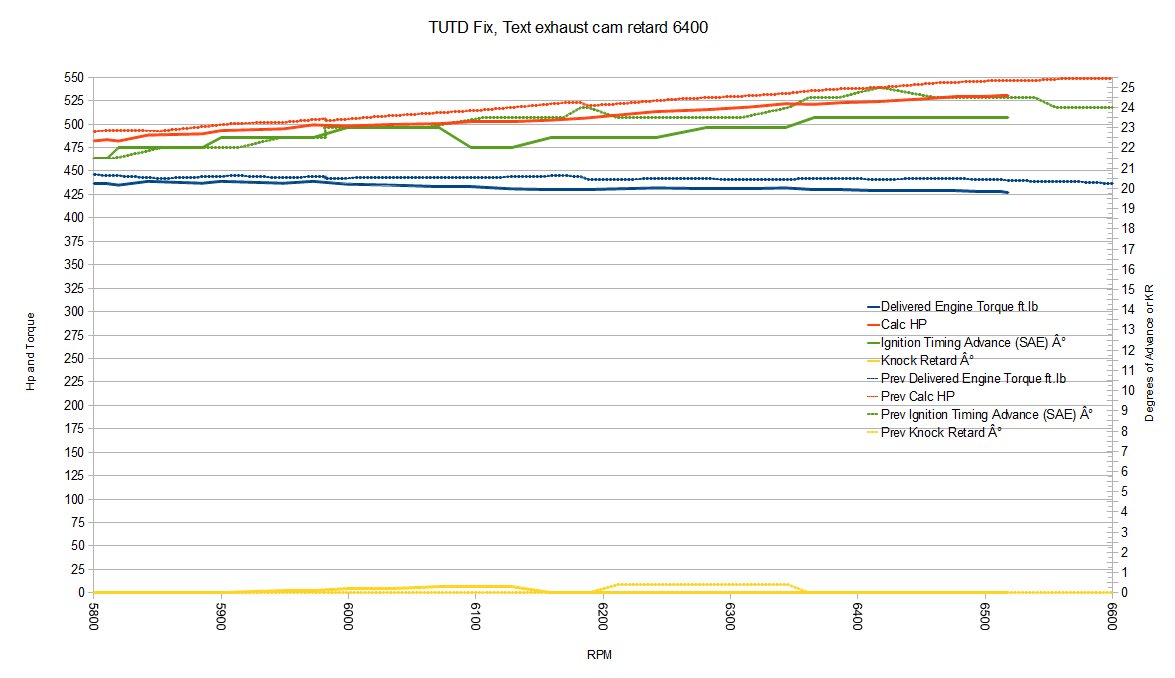
This chart shows today’s hotter run vs previous cooler run.   I am not focused on the absolute values so much as the slopes for today’s study.  Here is a zoom in from 5800-6600:

TUTD 2 2013-06-21 zoom in to study slope

What this appears to show is that the change in the exhaust cam timing didn’t cause a huge improvement or loss in power and torque at 4800-6800.  However, the slow of the blue torque curves appears to suggest that the addition is overall not an improvement, since the current curve decreases over time in this range at a faster rate than the previous.

The TUTD shift point did work correctly for this test, so that change will help with future testing.

TUTD 2 2013-06-21 exhaust cam retard

Next I will restore the exhaust cam VVT timing, and test an adjustment of the intake cam vvt timing.