Cadillac STS-V Intercooler cooling – gathering more parts

Tim C keeps working on his STS-V — he has done a turbo kit then returned it to stock at this point.  His product offerings include a front mounted heat exchanger, an upper supercharger pulley service, and a new product on the way, a cold air intake.  He has a new website coming for sales and info; stay tuned.

As the next experiment in my intercooler cooling quest I have decided to try the ZZP S3 front mounted heat exchanger.
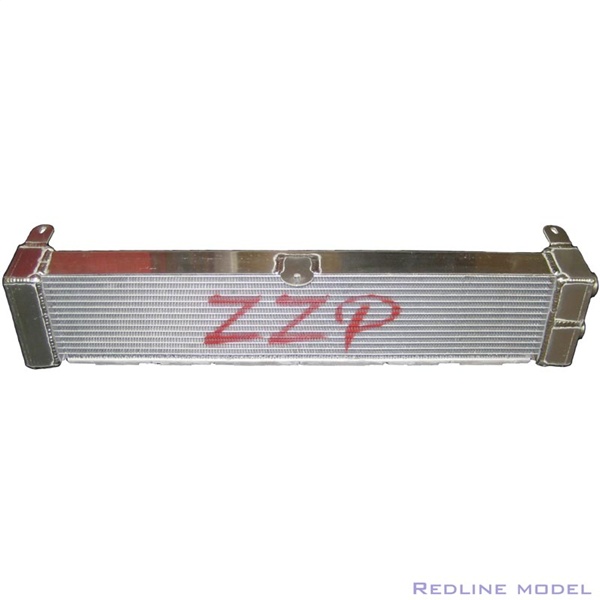
ZZP S3 Intercooler Front-Mounted Heat Exchanger

Here is the ZZP info on this part:

Intercooler heat exchanger (radiator) for your liquid to air intercooler system. This HE is the largest most well thought out radiator we’ve produced to date. With a 1.8 liter fluid capacity, it holds more liquid than any HE in the Redline/Cobalt market and with 4000 sqare inches of fin area it cools better than anything currently available!

  • All aluminum construction
  • Drill 4 holes into existing bumper support
  • Overall measurements of 32.5×6.5×2.25
  • Core measurements of 28×6.5×2.25
  • 2 row, dual pass
  • Maximum cooling, minimum weight, fully tig welded and pressure tested
  • 2 stainless bolts and nuts
  • Includes 2 fittings and 4 hose clamps
  • 49″ of 3/4″ hose
  • 6.4 pounds

Here is a link to a tech article ZZP did on the S3 comparing to OEM and a competitor.  Their conclusion was that almost any 2nd HX works about the same, but it is a nice write-up nonetheless.

A different popular choice would be the Frozen Boost 101, but I really like the ZZP info and research, and I like that Tim is doing so much experimentation on what works for these cars, so I would like to test out the S3 on my STS-V.

I’ll have to decide whether to put the OEM HX back in and then use the S3, or stay with the 45321 and S3.  Best would be to test each set, but I am not sure I am up for those installs; we’ll see.

My current tests suggested the system is at a higher equilibrium temperature with the 45321 than it was with the OEM HX.  This week I am continuing to monitor the fluid level and then hope to retest after it has burped air for the week.
Initial IAT2 times with New HX – woops

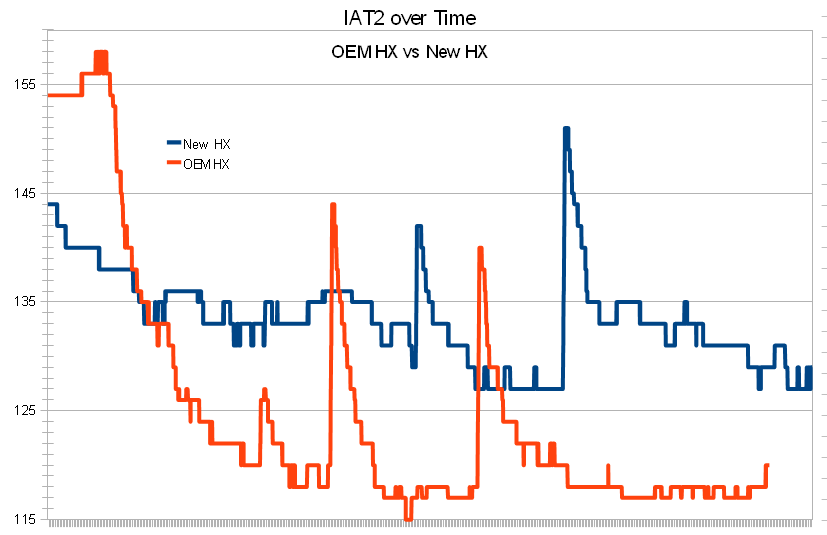
Initial IAT2 trends with the new Intercooler Heat Exchanger appear to be somewhat worse than the OEM intercooler heat exchanger.

This is disappointing since tuners have reported improvements with similar heat exchangers.  There may be more variables at play here, but my first tests suggest the new HX as installed is not performing better than the OEM HX.

To compare the two I considered HP Tuners VCM Scanner data captures for the OEM heat exchanger on a hot day (heat soaked) to a similar run with my replacement heat exchanger (a flexalite 45321).  IAT1 temps, which is air at the MAF, were similar for each run, but the runs were certainly on different days etc.  Thanks to HP Tuners for updating their comma delimited export capability to make this easier!

The first chart shows overall trend over time for my normal data capture run.  The spikes are acceleration runs.  The X axis is actually the sample time for the scan, which runs from 0-65K so I simply left it off for clarity.  The Y axis is IAT2 temps in degrees F.


The new HX appears to reach constant IAT2 around 127F.  The OEM HX reached constant IAT2 around 117F.

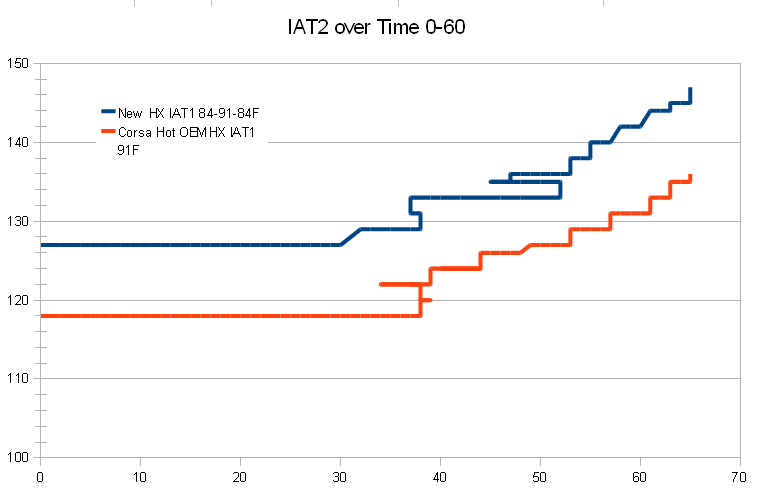
This is a comparison side by side over time during a 0-60 mph run with each:

The OEM HX starts at a lower temp, but the two HX’s appear to show similar trends for the expected increase in IAT2’s during hard acceleration.

It is possible that the system is still not air-free, and I will retest after a week of continued monitoring.


Cadillac STS-V understanding test result diversity

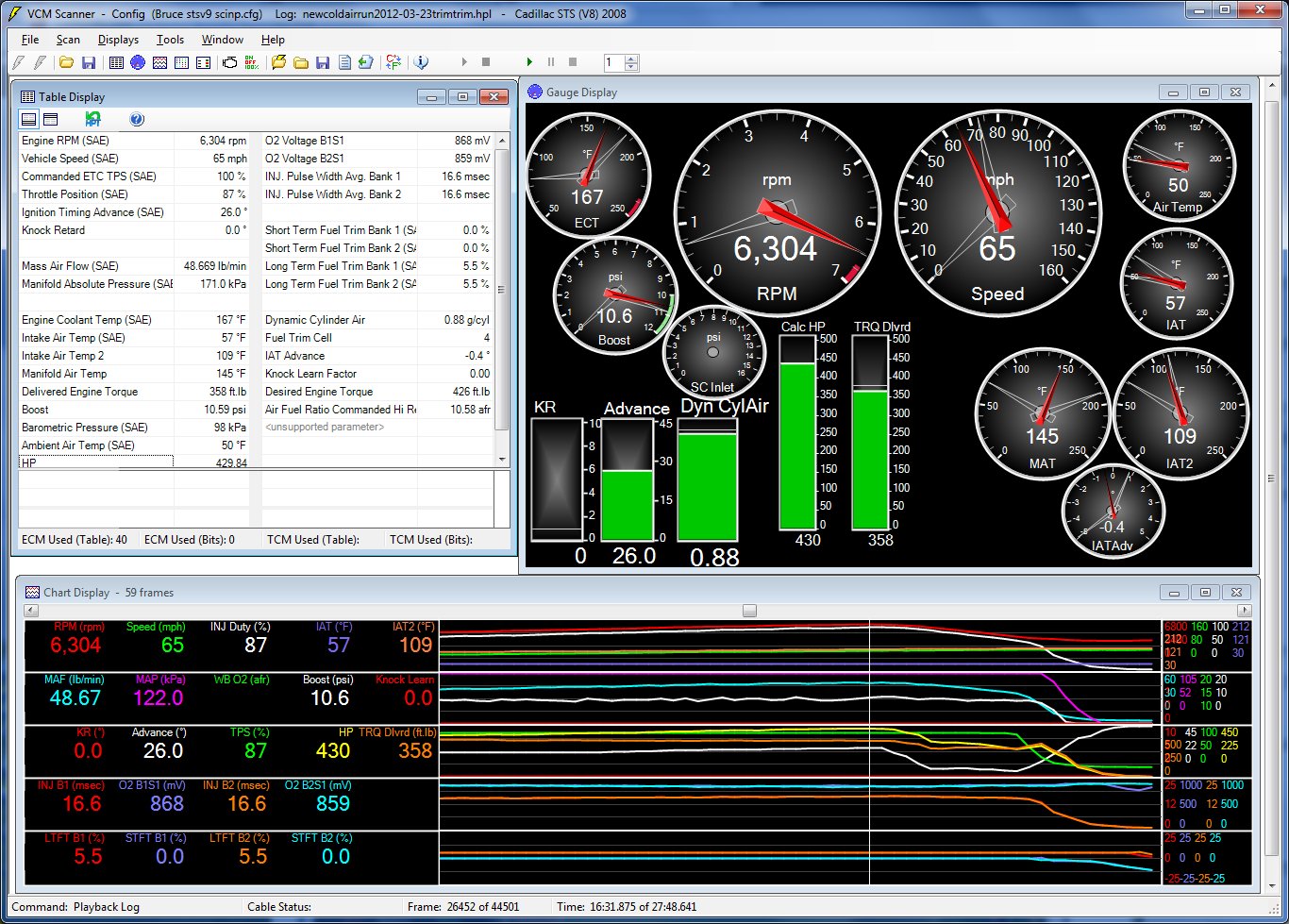
As a part of understanding the HPTuners data I am seeing I captured these snapshots from two different 0-60 test runs:

Time 11:

Time 11:01.531

Time 16:


Time 16:31.875

Summary:  Same Cadillac STS-V, same day, same driver, one run later than the other run.  Different locations.

On the 2nd run the car is able to maintain a lot more timing — 26 degrees of advance vs 18.5 degrees on the first run.  The MAT temp on the 2nd run is at 145F while it hits 171F on the first — for the identical 109F IAT2!  The boost is 0.4 psi higher on the 2nd run — the boost varies pulse to pulse so that could be noise.  Lots of variables — again, 2 runs from the same car same day same gas 5 minutes apart.

These two runs resulted in very similar 0-60 mph times — 4.9 sec on the first one and 4.8 sec on the 2nd one.  This sort of rich diversity in the results certainly is intriguing; let me know if you see something obvious that I am missing on why!