Intercooler Cooling – gathering parts

I ordered a Flex-a-lite 45321 heat exchanger to help with intercooler cooling on my 2008 Cadillac STS-V
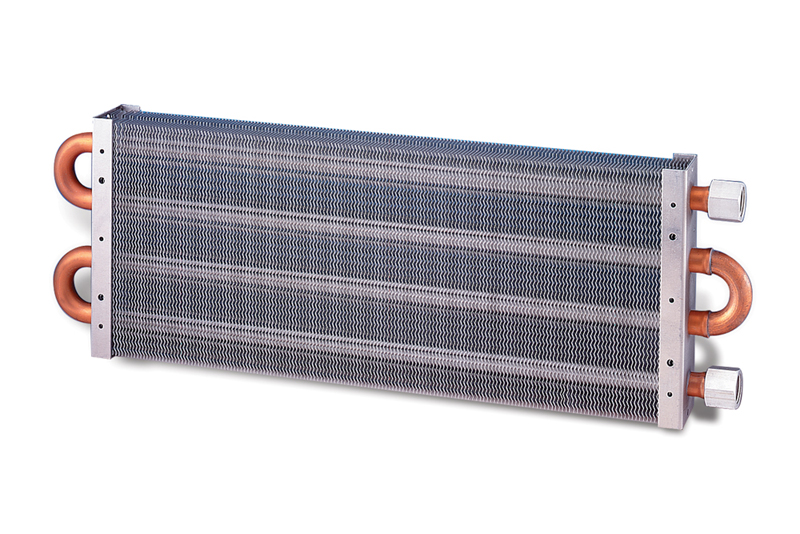
Flex-a-lite heat exchanger

This is the heat exchanger that one Tuner uses alone in place of the factory intercooler heat exchanger on the STS-V  — except that they use one with a 10″ puller fan on it.  On the dyno and on the street we have plenty of air flow so I am going without the fan.

The OEM heat exchanger is  a small radiator, 24x14x.5 that is single pass with many water routes.  The Flex-a-lite has a single tube with 6 passes (the picture shown is a 4 pass version but the one ordered, 45321,  is 6) and is 10 1/2″x21″x1 1/2″

I am thinking though the best ways to test this versus the OEM config.  I am tempted to put this cooler in series with the OEM cooler, although no one is doing that so far.

What some V owners have done is replace the OEM heat exchanger with this unit, then place a Frozen Boost 101 heat exchanger in front below the front bumper, and use both heat exchangers in serial.  Other installs have just replaced the factory heat exchanger, then added a tank for extra coolant capacity.

I like the coolant tank from the LS9 install, and it would be ‘factory’, but not sure that I want to do there yet.

What do you think?   How would you setup the intercooler cooling on my V?
Commanding the Intercooler pump key on engine off

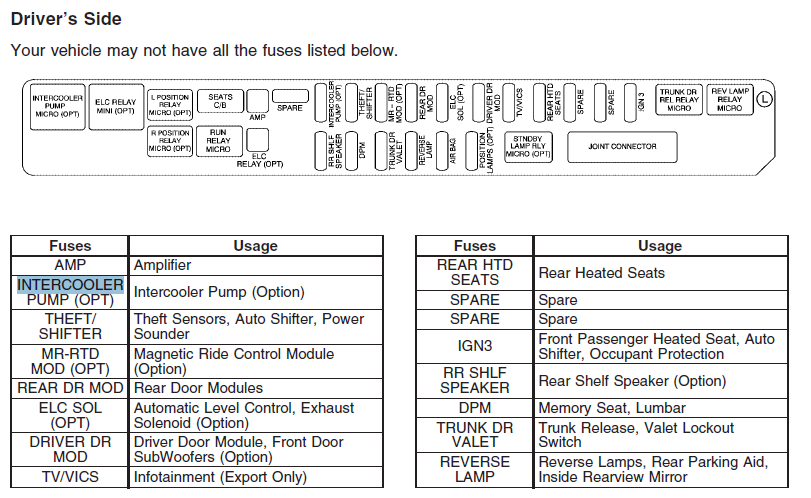
The intercooler pump relay on the Cadillac STS-V is on the driver’s side fuse box.   It would be useful to be able to command the intercooler pump on when the key is on but the engine is off (KOEO) — example on the dyno under a fan — to cool the intercooler and intake manifold off.

Now, the Driver’s side fuse box they mention is under the rear seat on the Driver’s side.

On some vehicles the owners simply short across the relay when desired and manage to turn the pump on.

Hmm…

On some vehicles HPTuners VCM Scanner can also do this sort of thing under VCM Controls.  Mine appears to give that option, and will let me press the ‘On’ button, and it goes green, but the pump does not appear to come on.

I have also tried setting the intercooler pump delay after engine turn on from 10 sec to 0 sec but that didn’t appear to do it either.

If you have some experience with turning on the intercooler pump with the Accessories on, engine off on the STS-V or similar, please comment and point out what I’m not doing.

2008 Cadillac STS-V Spectre CAI + Corsa 394.3 whp 380.4 lb ft

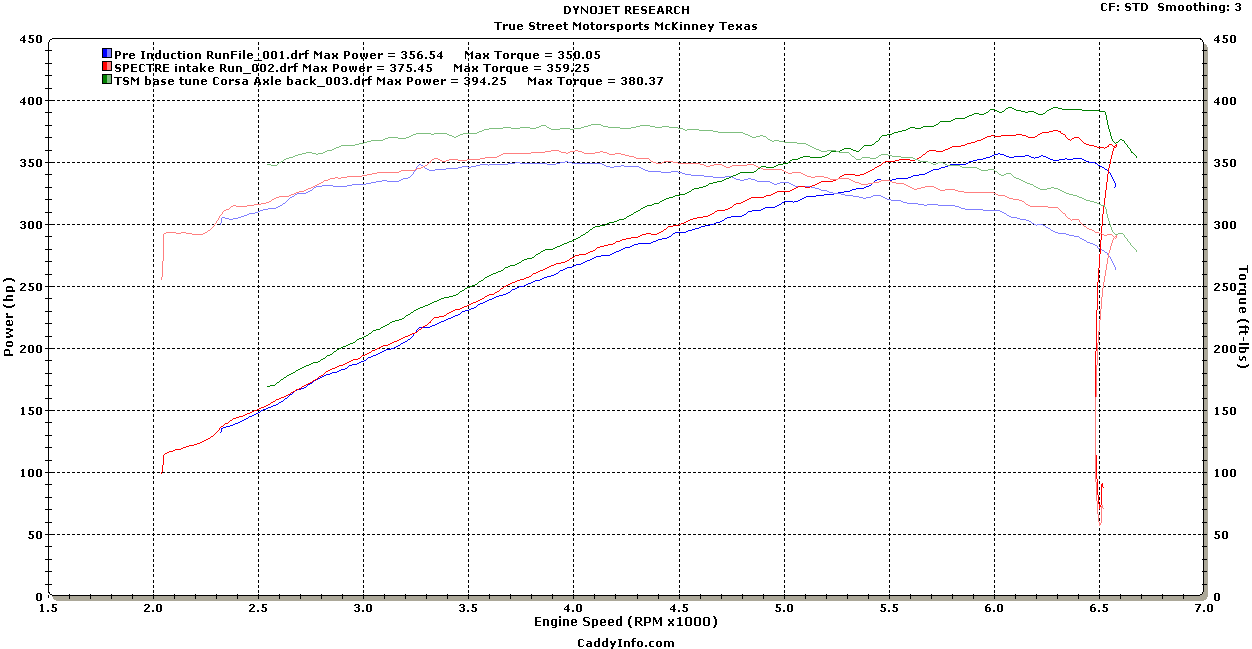
Today I headed back to True Street Motorsports in McKinney Texas to get some dyno time in and check my air fuel ratios after the addition of the Corsa axle back exhaust.  Click on the graph to zoom in, then hit back on your browser to get back.

STS-V WHP and Torque vs Engine RPM

Coincidentally, the Spectre Cold Air Intake (CAI) added 19 wheel horsepower (whp) over the baseline pre-Spectre CAI, and the Cora axle-back with the Spectre added another 19 whp for a total of 38 whp.  The Corsa addition opened up a nice 20 ft lb of torque.

A dyno measures horsepower at the wheels, or whp.  This is always less than the manufacturer’s advertised engine horsepower, or hp at the crank of the engine.  WHP is hp after losses through the transmission and drivetrain.  A reasonable figure for these losses on the STS-V’s 6L80e transmission is 20-24%.  On my STS-V, the stock car was rated for 469 crank hp and made 356 whp on the dyno, or  a 24% loss.  if we use 22% as an average then the V originally made 456 hp stock.  The addition of the Spectre got the car to 375 whp or +24 crank hp, and the addition of the Corsa with the Spectre CAI got the STS-V to 394 whp or +49 crank hp.  Overall a nice gain for two easy bolt-ons, and the STS-V is now making 394 whp which at 20-24% losses equates to 492-518 hp at the crank.

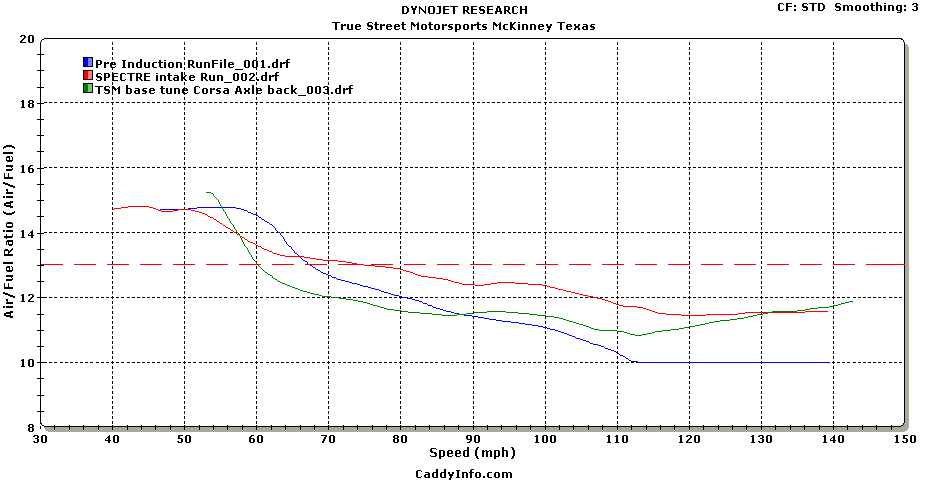
Air Fuel Ratios

Part of the point of the visit was to ensure the Air Fuel ratio was in the right range and stayed there throughout the Wide Open Throttle dyno run.    The resulting fuel levels are safe and consistent with commanded.

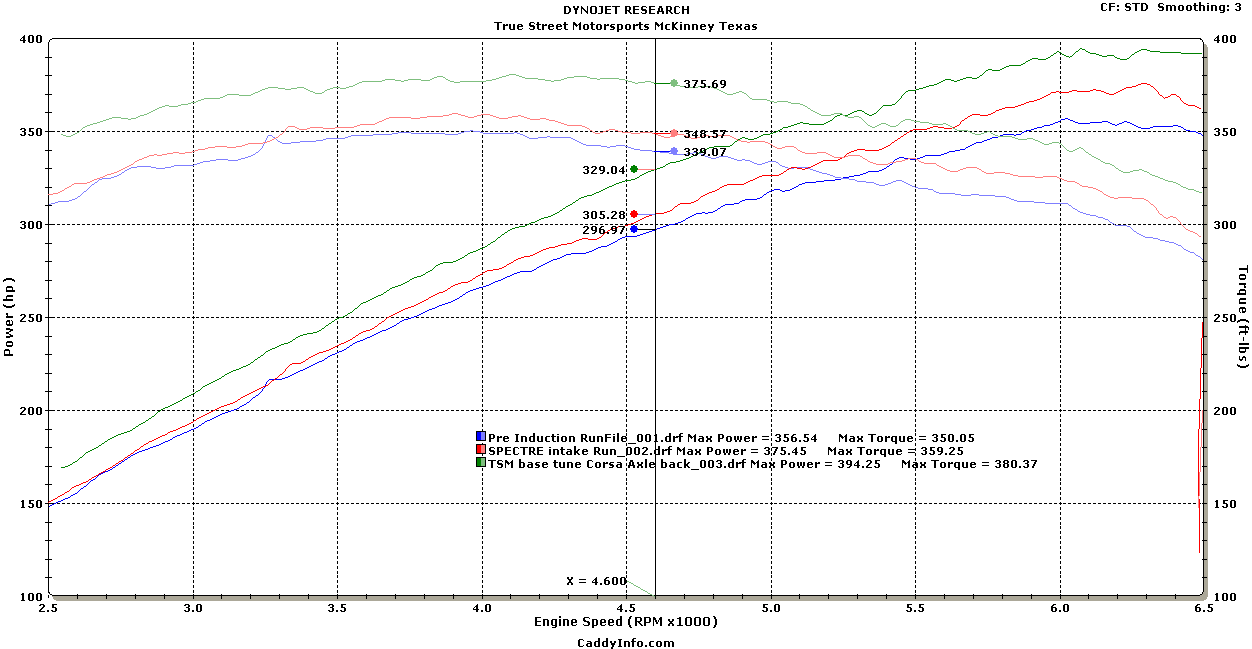
This graph shows the same info zoomed in a bit and with a detail point showing that the new exhaust at key points actually adds +27 lb ft of torque:

I am close to my power goal of over 400 whp on the dyno at 394 whp.   I want to run a new baseline on the dyno with the car cool and not heat-soaked for comparison.  In fact, our 3rd run was at the same whp as the initial run today, but with the intercooler Intake Air Temp 2s (IAT2) hitting 150F+ due to the stress of repeat dyno runs on the original,  stock intercooler cooling system.    That suggests that the V may put down 400 whp when not heat soaked.

Fun day, and as always the True Street Motorsports team is easy to work with and helpful.