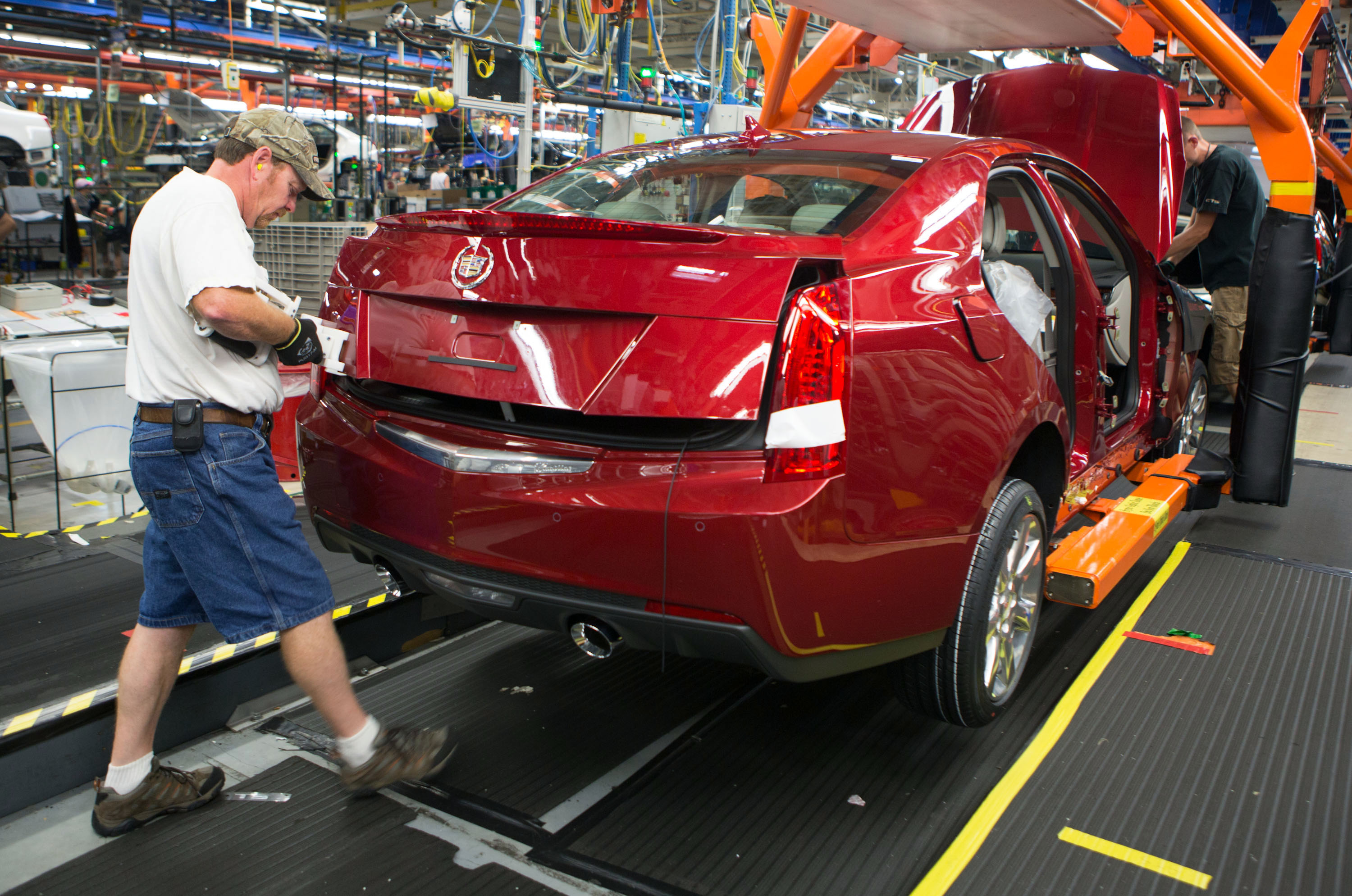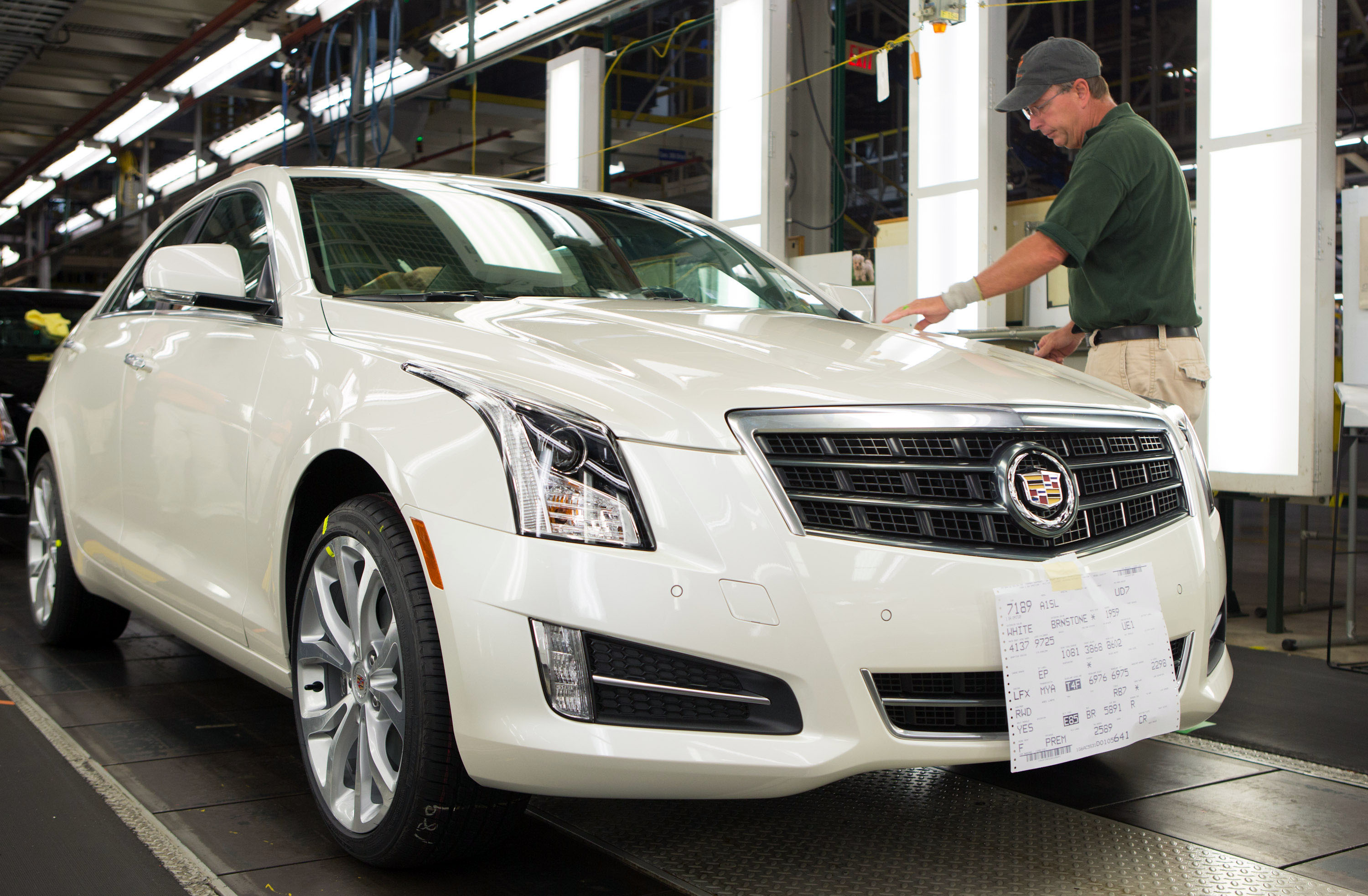
Cadillac ATS in production at LGR

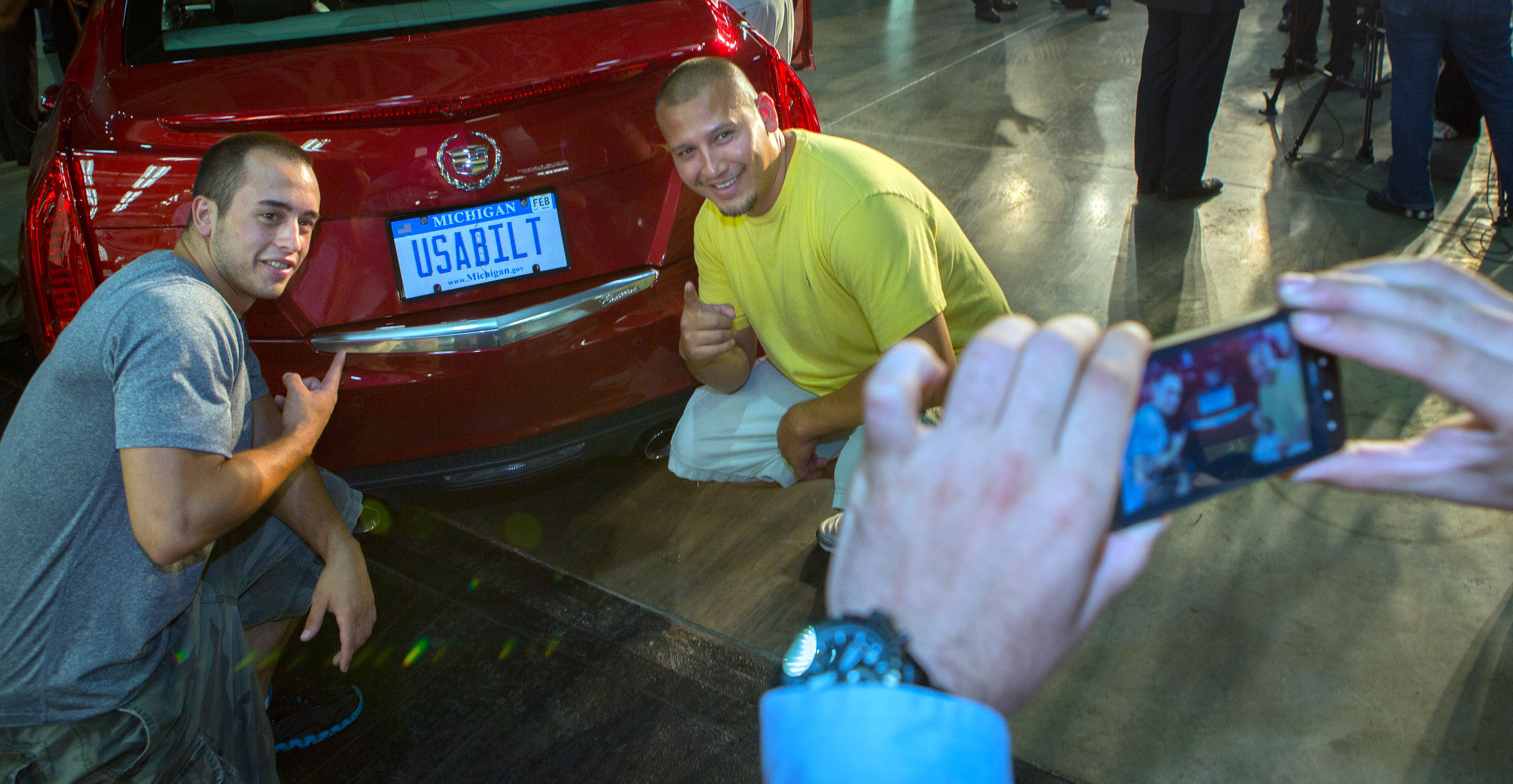
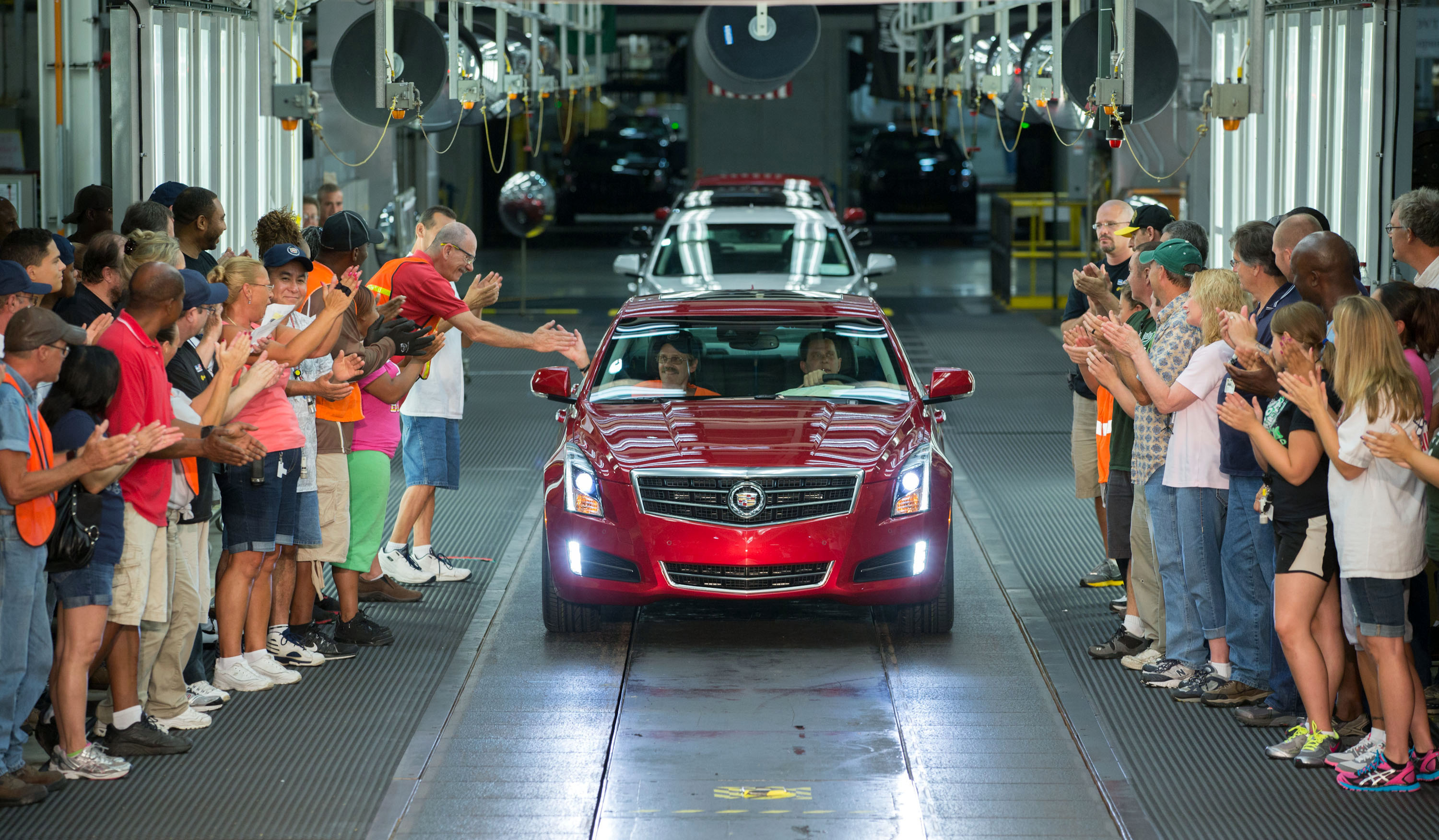
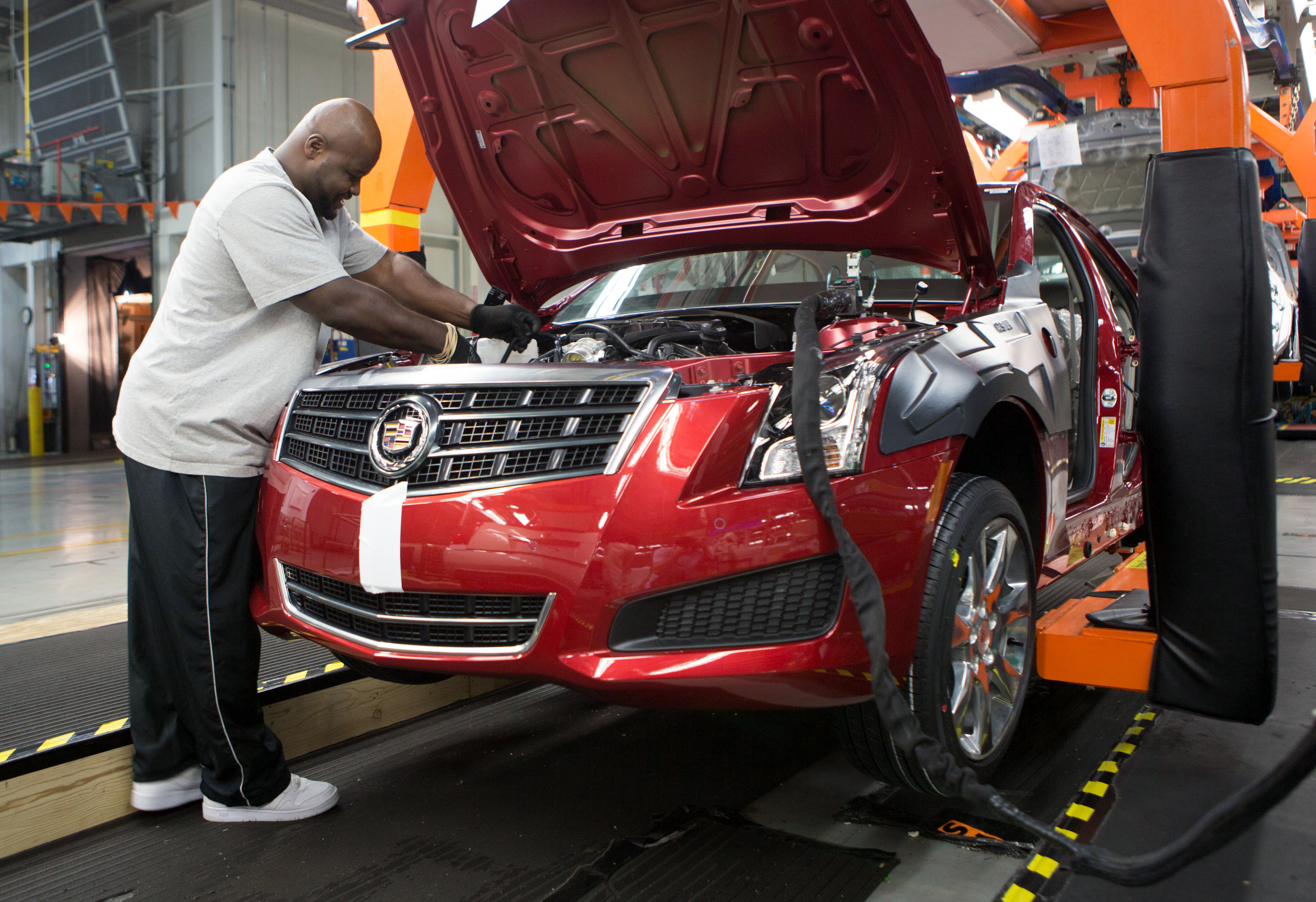
The Cadillac ATS is rolling out of Cadillac’s home factory at Lansing Grand River.  Here is a gallery of first-day baby shots for the new Cadillac ATS.

[click on any image to go into slide show mode]

The Cadillac ATS is in production and is arriving at a Cadillac dealer near you soon.

Full Release:

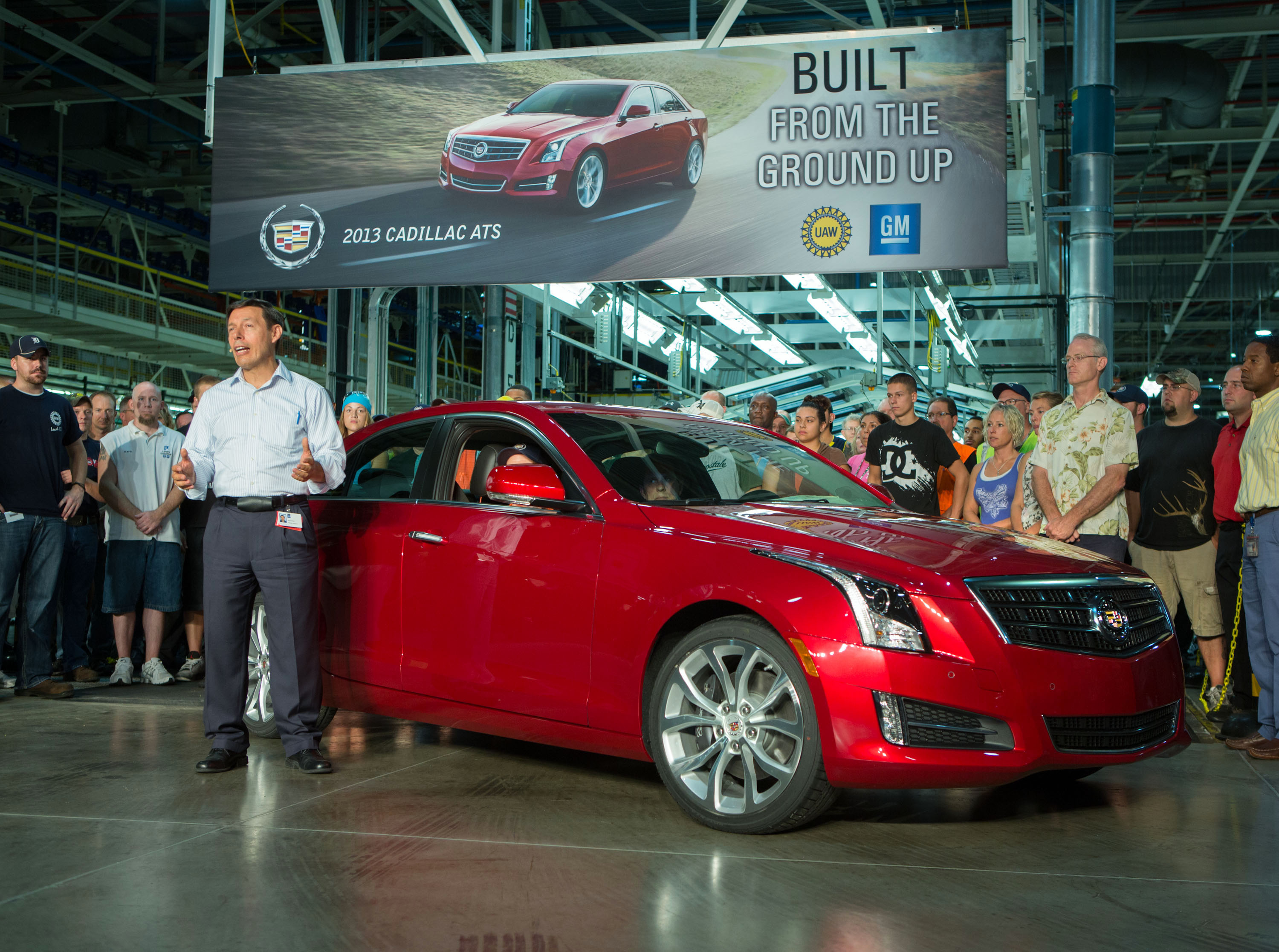
DETROIT – The first 2013 Cadillac ATS compact luxury sport sedan intended for public sale was built today at the Lansing Grand River assembly plant in Michigan, culminating a massive design and development project.

Arriving in U.S. dealerships in August, ATS is Cadillac’s all-new entry into the most significant global luxury segment, featuring a new rear wheel drive-based architecture targeting nimble, quick and fun driving performance.

Cadillac’s Lansing Grand River plant, also the production site for the CTS Sedan, Wagon and Coupe and V-Series performance models of each, underwent a $190 million upgrade for ATS production. A second shift was added, creating or retaining 600 jobs.

In total, the award-winning plant that opened in 2001 now has 1,643 salaried and hourly employees.

“The new Cadillac ATS represents an investment in Lansing and our workforce,” said Tony Francavilla, Lansing regional plant manager. “A successful launch needs a great process and a great product, but at the heart of it all are the people, and the care they put into each and every vehicle.”
The ATS expands Cadillac into the highest volume category in the luxury automotive industry. Following the initial start of production in Lansing, distribution to U.S. dealerships will begin in August. Exports to international markets will begin later this year.

“This is a car with a big mission, and it’s been comprehensively prepared for that mission,” said Don Butler, vice president of Cadillac Marketing. “The new-from-the-ground-up ATS creates a new entryway into the Cadillac brand for luxury car drivers, and a compelling new challenger to the status quo among the top luxury sport sedans.”

The all-new ATS was custom-built using a new lightweight vehicle architecture featuring advanced materials and techniques to ensure precise driving dynamics.  ATS includes a host of exclusive advanced-tech features, including Magnetic Ride Control, the Safety Alert Seat, and CUE, a new in-car user experience for connectivity and control using industry-first capacitive touch and natural voice recognition systems.

The ATS hits the airwaves during the television broadcast of the Opening Ceremonies of the Summer Olympics on Friday.

Cadillac has been a leading luxury auto brand since 1902. In recent years, Cadillac has engineered a historic renaissance led by artful engineering and advanced technology. More information on Cadillac can be found at media.cadillac.com.

Cadillac ATS-V Turbo V6 or Supercharged V8

The Cadillac ATS-V needs to bring the power to put the BMW M3 away.  The Cadillac ATS-V will bring an exciting engine for the new Cadillac track star — we just don’t know which one yet.

Cadillac ATS Exterior

Cadillac ATS Exterior

The Cadillac CTS-V uses the LSA supercharged 6.2L V8.  This engine makes 556 hp in the CTS-V.  The Camaro ZL1 uses a modified version of the LSA engine, tuned to 580 hp.  We may reasonably see this modified variant in next year’s redesigned CTS-V as well, at 580 hp.

2010 6.2L V8 SC LSA LoR


The Camaro ZL1 is down on power compared to its arch rival the GT500, which makes 662 hp.  The ZL1 is a better overall package, but I am hoping GM Powertrain brings the power for the next iteration of the LSA and hits 700 hp.  A powered up CTS-V also gives more head-room for a powered up ATS-V.

Cadillac ATS-V – Turbo V6?

The ‘missing’ engine is the Turbo 3.6L coming as an engine for the 2014 CTS.  We don’t know the exact output for this engine yet, and it will likely arrive in several states of tune.  Rumors have been all over the place — 450 hp for an initial show car, down to 425 hp for production, and up to 475 hp.

A maximum effort ATS-V version of a turbo V6 engine could be tuned for 480 hp and still leave room for a slightly heavier CTS-V  with a 580 hp V8.  But besides avoiding  sibling rivalry, will that be enough for the Cadillac ATS-V?

Sizing the Competition

How much power does the Cadillac ATS-V really need?  The 2014 BMW M3 is the logical target.  The current M3 uses a 414 hp V8.  The next M3 is rumored to equip a tuned turbo V6, for 430-450 hp.  BMW manages to under-rate their engines; so when matching it is best to plan for an extra 25-35 hp for equivalent.  A good target for the Cadillac ATS-V powerplant then is BMW 450 +30 equivalent + 50 better or 530 hp.

And ding ding we have a 556 hp LSA engine available that can be slotted for the ATS-V.  Give the CTS-V a power-up to a 650-700 hp version that the Camaro ZL1 needs, and there is head room to give the ATS-V the current LSA.

If GM Powertrain can bring the same power range (500-530 hp) in the Turbo V6 of course, all the better…


Cadillac STS-V Performance Modeling

Cadillac STS-V performance can be modeled, as with any other vehicle, using software similar to the CarTest 2000.  Simulators don’t always give perfect exact real-world predictions of exact performance, but they offer a ready way to test our assumptions and to model and understand the results we do find.

The 2006-2009 Cadillac STS-V has a supercharged DOHC, VVT Northstar rated at 469 hp and 439 lb ft of torque.  Originally GM estimated that the engine would produce 440 hp, but in the final SAE certification some assumptions changed — such as normal supercharger coolant temps instead of worst case — and the final rating was 469 hp.

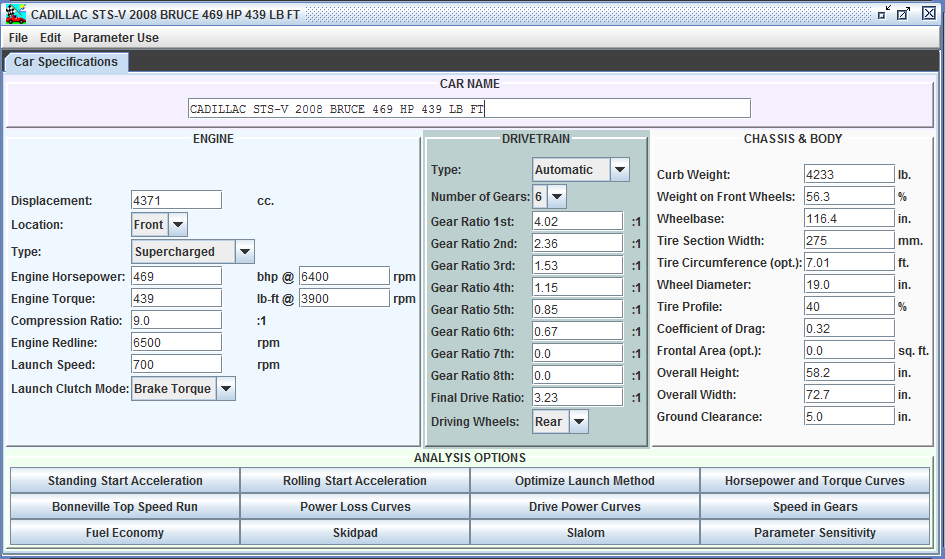
2008 Cadillac STS-V Cartest Stats

2008 Cadillac STS-V Cartest Stats [click to zoom, back to return]

This screen shows Cartest stats for the car.  With peak hp and torque at their RPMs the software can make assumptions on the power curves.  Knowing the other stats — weight, gearing, tires — the software can estimate vehicle performance.

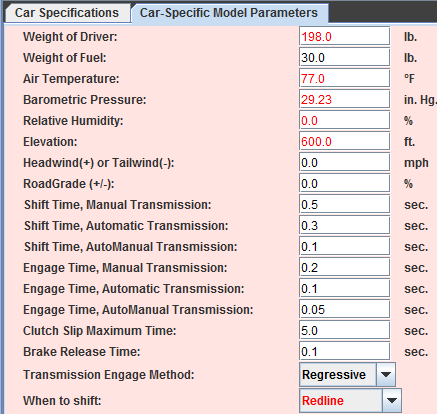
Cartest Car Specific Parameters

Cartest Car Specific Parameters

Cartest also allows the user to specify car specific parameters.  This is helpful in matching real-world conditions.  For example, driver weight, altitude, and atmospheric conditions all change the expected acceleration result.

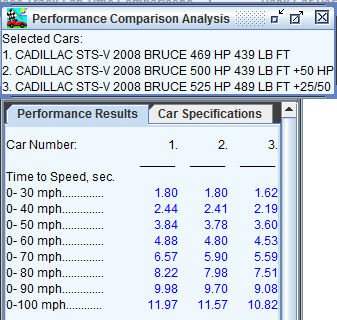
STS-V Comparison Analysis

STS-V Comparison Analysis

Cartest allows the user to run a variety of tests; this shot shows some portions of a side by side comparison test of a stock STS-V, a car modified to 500 hp with no change in torque similar to my current mods, and a car with a 10% supercharger pulley — modeled here as an increase of +25 hp / +50 torque.  Tim Coeling offers a 2.55″ modified upper pulley for the STS-V.

What we see is that opening up the top end breathing from car 1 to car 2 added +30 hp, as my intake and exhaust mods have, it makes little difference in the estimated performance, 0.1 sec by 60 mph and 0.4 sec by 100 mph.  On the other hand, increasing the torque by over driving the supercharger makes more difference to the acceleration.  Not surprising since acceleration depends on torque and not hp.

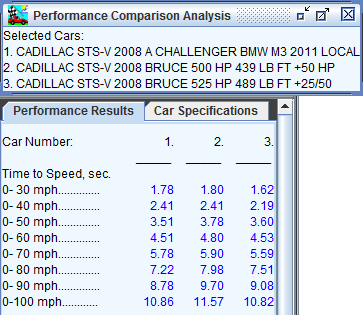
A beauty of the software is that it allows side by side comparison with target models.  For example, how does the Cadillac STS-V performance compare to a 2011 BMW M3 track car with 4L, 414 hp V8 screaming at 8300 rpm redline?  For this test I have renamed the M3 as “Cadillac STS-V 2008 A Challenger …” for ease of selecting it from the car list:

2011 BMW M3 vs 2008 STS-V

2011 BMW M3 vs 2008 STS-V

What we see here is the 3600 lb M3 makes use of its 7 speed sequential gear box and 600 lb weight advantage to stay ahead of a modified 500 hp STS-V, and match a pulleyed 525 hp STS-V.

When can more power be slower?

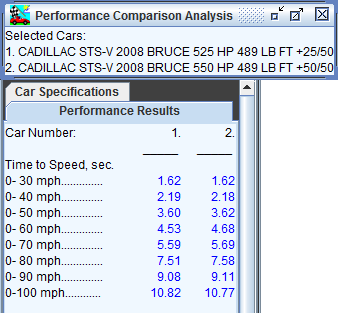
It is good to mention that in cases, more power can actually slow a car down.  For example, in our analysis above if we take the same STS-V but increase the power to 550 hp with the same torque, it is slower in 0-60 mph, but faster in 0-100 mph.

More Power, slower 0-60

More Power, slower 0-60

I believe that the simulator in this case is anticipating more wheel spin at the 1-2 gear shift due to the increased power.  To take advantage of the new power curve the shift points would need to be altered.

Cadillac STS-V Performance

The Cadillac STS-V Performance sedan uses a custom Eaton M122 supercharger.  It uses a 2.1:1 ratio, so that the blower as it arrives is spinning x2.1 engine rpm, or 14K+ RPM for the supercharger at 6700 rpm for the engine.  [More discussion in my post – Adding Boost Pressure to the LC3] That is also the top range of efficiency for the M122 — past that speed the supercharger starts to make more heat than pressure.

However, because a smaller pulley increases the boost pressure at lower RPMs, and thus the torque, it can have a larger impact on the acceleration of the STS-V than on the peak HP.   I will also need to address adding more fuel; the model assumes that I am taking care of how to make the power.