Tuning the Cadillac XLR – MBT #Motorama @hptuners

Torque and horsepower are related, and if we increase torque everywhere across the RPM band, horsepower will go up as well.   What we want to know is what timing or advance will give us the most power?  But also, knowing that more timing can mean more heat and more detonation, what is the minimum timing for the maximum torque from the engine (MBT)?

I recently purchased a 2007 Cadillac XLR with the 4.6L LH2 V8 DOHC VVT engine. I will be tuning this platform and publishing my experiences.
XLR MBT

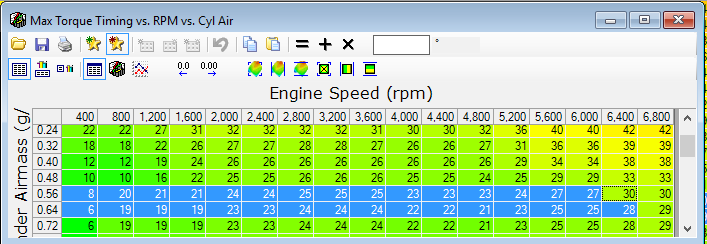
GM helpfully includes a reference table used by the PCM which shows the Max Torque Timing vs RPM vs Cyl Air based on their experiments with the engine design.  This table is shown above for the XLR from the factory calibration file for my 2007 XLR 4.6L.

I highlighted the two rows 0.56 and 0.64 cylinder airmass because at WOT the engine flows from 0.61 to 0.58 cyl airmass.  So those are the rows of interest.  If we get the timing to the values shown along those rows at various RPM values (without detonation), we will maximize the output of the engine.
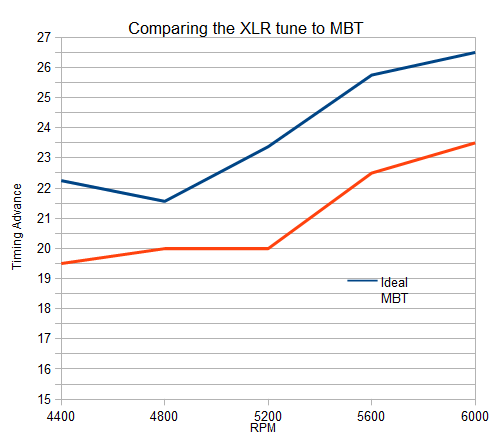
XLR compare XLR tune to MBT

For this sample I captured the actual advance from the engine, the actual measured cylinder airmass, and then calculated the ideal advance from the MBT table to compare to the actual advance from the engine result.  What we see is that with the heat and other factors the engine is 3 degrees retarded from MBT.  In this range for this engine I believe that is a 15 hp difference.

Now, since some of the gap is CAUSED by intake air temperature (IAT) retard, and some is caused by engine coolant temperature (ECT) retard, we may not be able to get to MBT in the summer heat here in Texas.  But during tuning that is the spark advance I will be shooting for.

Separately, I will be looking at the fueling the engine prefers, the transmission tuning, and transitions.  If you have other ideas or recommendations please reply below.  There is not a lot published on the RWD LH2 Northstar V8, so if you have experience with what worked for you please share.
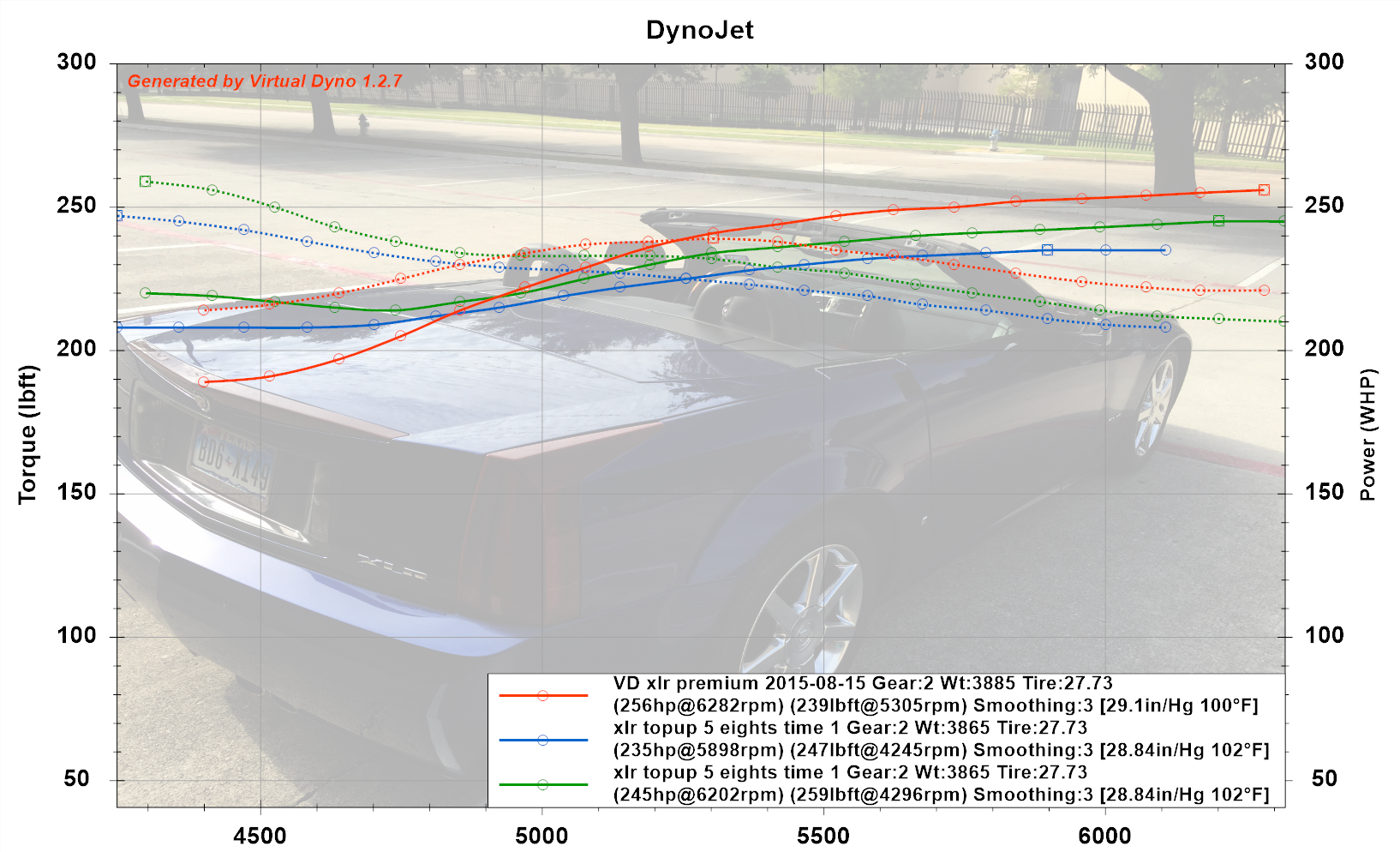
 

Cadillac XLR Top-up Testing

This evening I ran some top-up comparison tests to help calibrate and establish a baseline.  Previously I had tested with the XLR top down, enjoying the convertible.  I was focused on monitoring calculated hp/torque, so aero wasn’t a factor.  However, as I am comparing using Virtual Dyno, then aero is a factor and I wanted to know exactly how much of a factor, and to establish a top-up value.

VD XLR Comparison Premium Top Up

[click to zoom in, back to return here] [This chart was based on incorrect tire diameter — see replacement chart below]

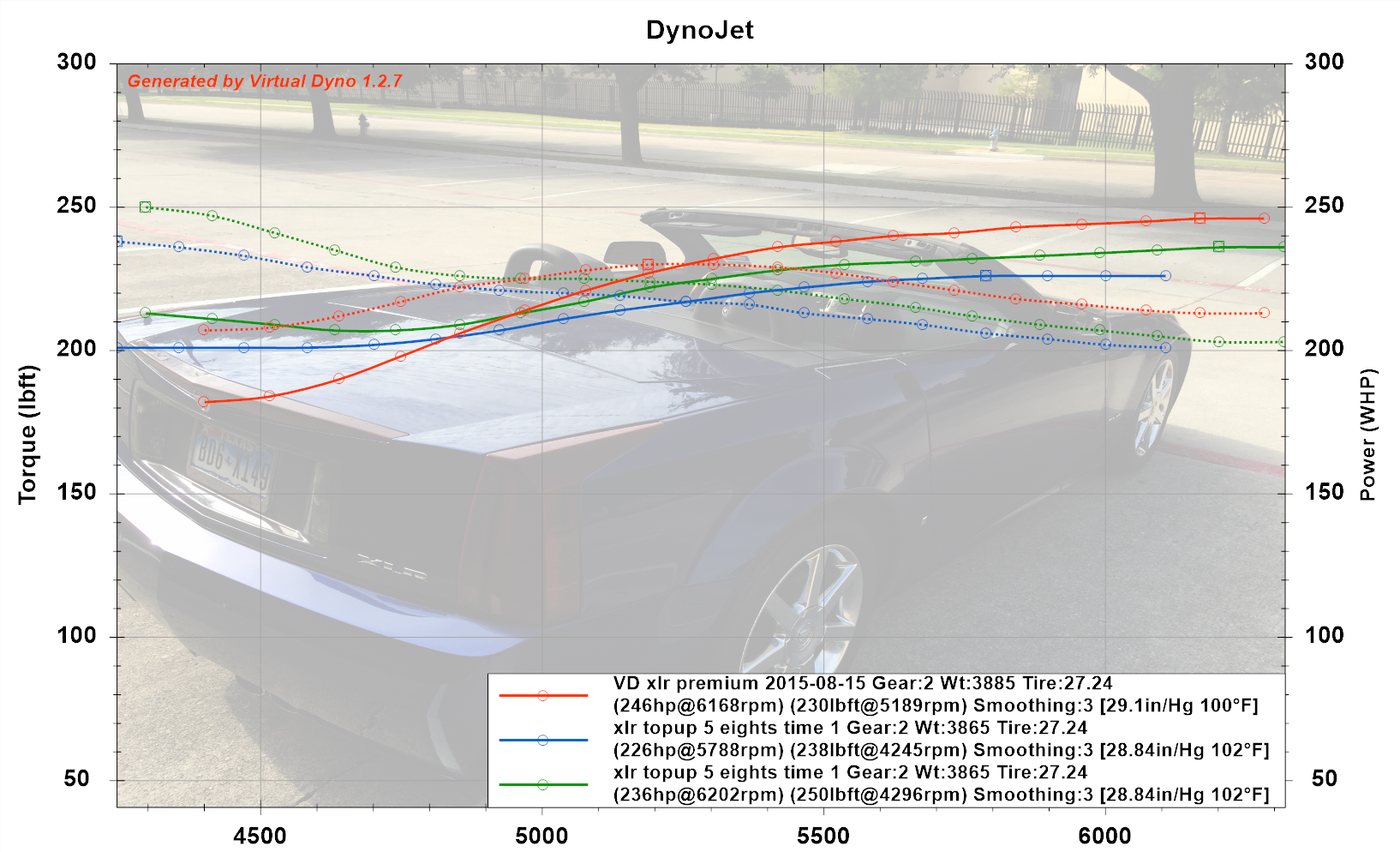
The Red line is the previous, Top-down test at 256/239 whp/lb-ft.  Tonight’s comparable run from the exact same location is the Green line at 245/259 whp/lb-ft.  The Blue line is another run tonight at a separate test location at 235/247 whp/lb-ft.  Tonight’s runs were lower HP, higher Torque.

With the top up or down, the variance is in CD, or coefficient of drag.  In my previous setup I wrote that I modeled the top-down impairment as a 0.05 CD adder.  For today’s test I have left that delta alone, but I have revised the base CD to the 0.31 that Cadillac marketing materials said for the XLR, instead of the 0.35 one of the early magazine reports quoted.  So Top-Up CD is modeled at 0.31, and top-down at 0.36.

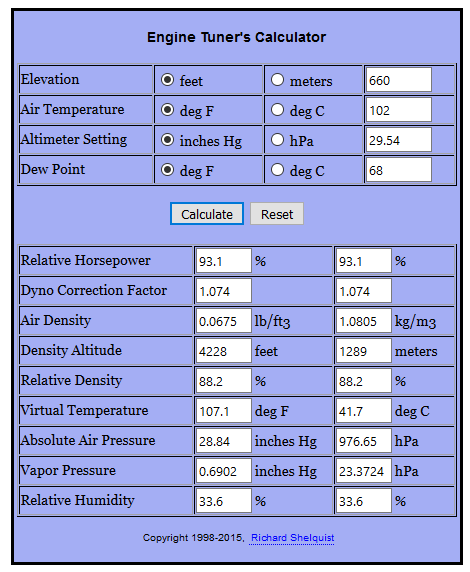
I am using ‘absolute pressure’ from the dew point calculation for baro pressure for the virtual dyno calc.  This takes altitude and local barometric pressure into account.  Thanks to Richard Shelquist!

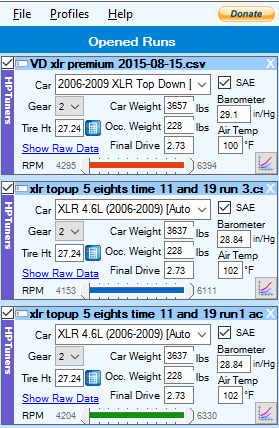
xlr premium comparison tuner calc

My conclusions are that tonight’s runs were lower results than the previous baseline.  This may be normal day-to-day test-to-test variance (unknowns not accounted for), or it may suggest that the top-down drag disadvantage for the XLR is not as great as 0.05.

I enjoyed the XLR all day, and it was out in the sun prior to the tests.  The important thing is to capture sufficient baseline data and to establish a baseline, and eliminate test to test variability.  I may have to either only run tests first thing in the morning to avoid heat soak, or only run tests with the car heat soaked (!)

XLR tire diameter

Update:  the previous Virtual Dyno setup used 27.73 as a tire diameter, and I see from the calibration file it should be 27.24.  This changes the results to following table:

Virtual Dyno XLR Tops Down comparison tires

Which is less than expected.  I am including both charts for now to document my confusion, and to assist in analysis.  Yes, tire size has a significant impact on calculated results.  With SAE adjustments for conditions the 320 hp rated LH2 should make approximately 256 whp; I am uncertain why today’s results are 226-236 whp.