Intercooler pump test 4: Jabsco 29 gpm pump

Update: IAT2 test results added

Today I performed an intercooler pump test on the Jabsco 50840 12v pump as a replacement for the Bosch OEM intercooler pump in my Cadillac STS-V.  The Cadillac STS-V uses the Bosch 00 392 022 006 pump.

My Cadillac has a 2nd heat exchanger, an S3 provided by Timmy C, and uses a 1 gallon AVS inline intercooler tank.  The goal of these tests is to improve intercooler cooling, which will enable the supercharged V8 to make more power.
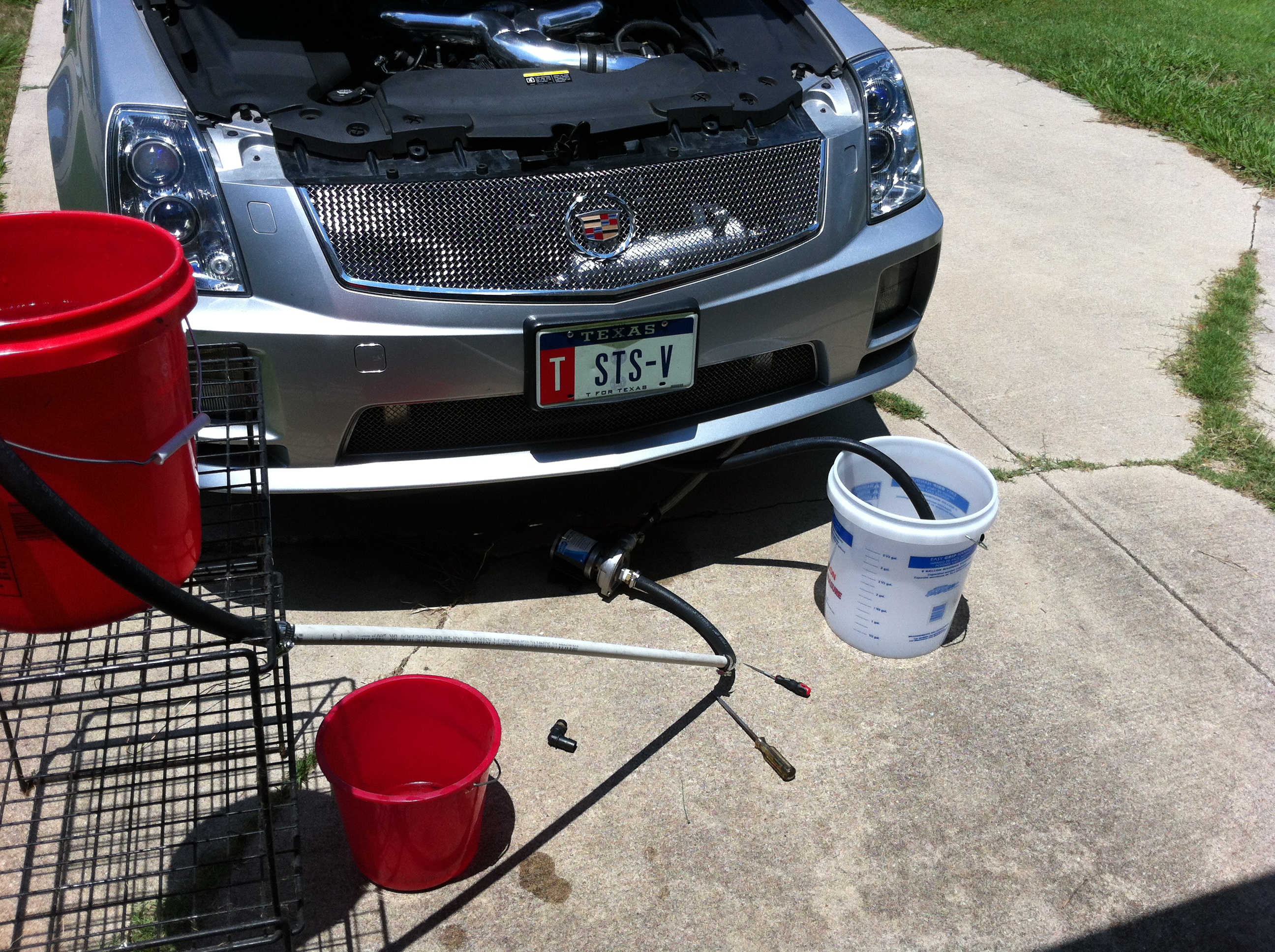
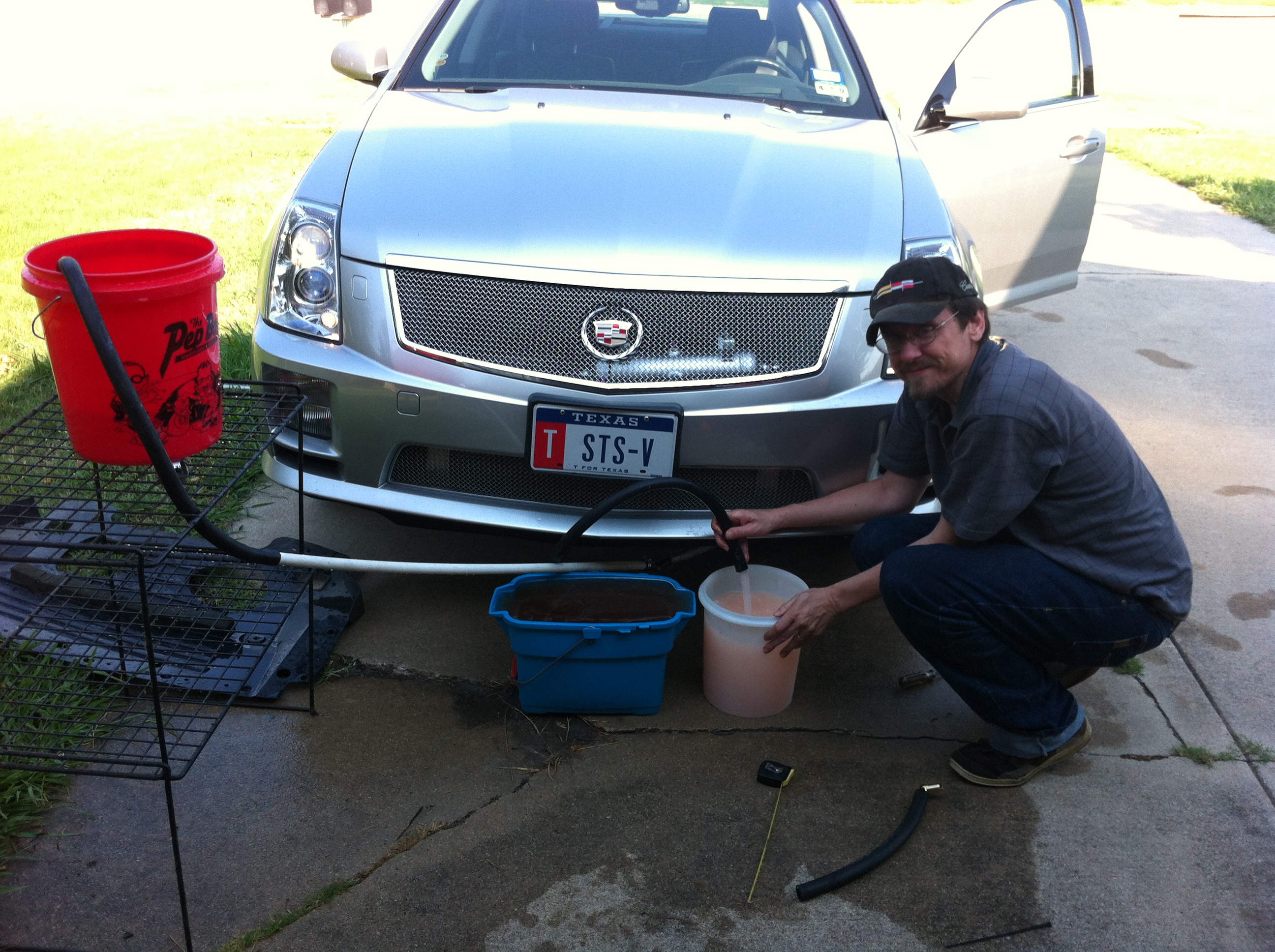
Test setup with Jabsco pump in the loop

Intercooler pump test setup

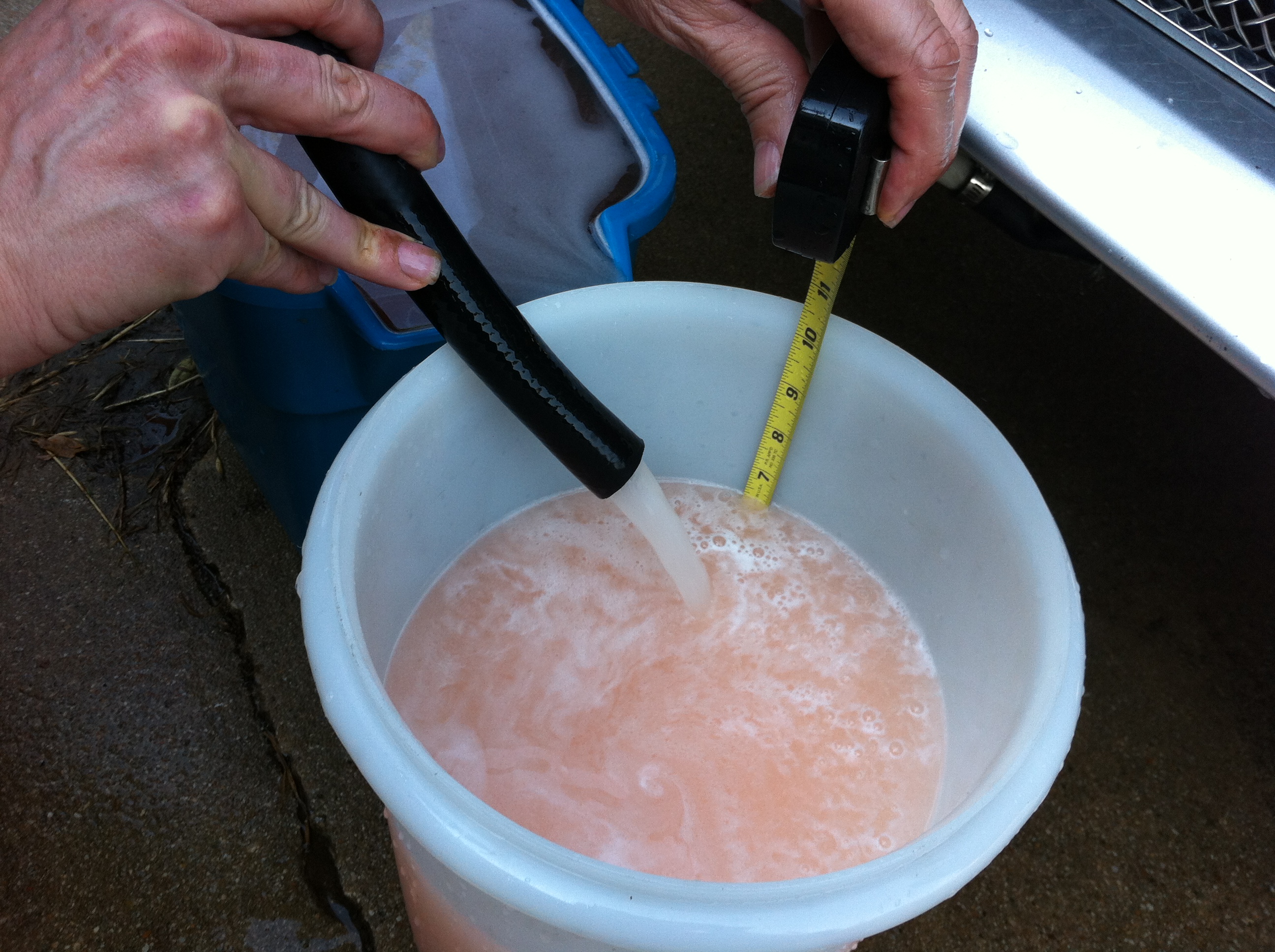
To run a bucket test I put a FROM bucket at intercooler height, flowing into the pump and system, and out from the intercooler to a TO bucket.  This is similar to my previous intercooler pump test setup, for continuity.  I have added a TO bucket that is a mixing bucket which makes it very easy to measure output.

Predicted intercooler pump test flow:
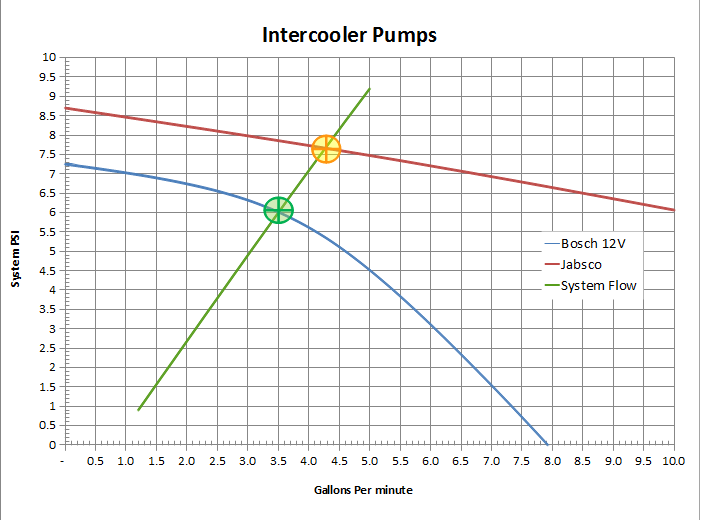
Pump rated flow vs head pressure and system pressure curve

The Jabsco centrifugal pump does 29 gpm against no resistance, and the Bosch pump does 8 gpm against no resistance. In an actual system the pump curves overlaid with the system resistance curve predict where the pump will actually run in that system.

Intercooler Pump Test Results

In today’s test the Jabsco pump measured at a steady 2.25 gallons per 30 seconds, or 4.5 gpm (gallons per minute).  Previously, the Bosch OEM pump ran at 3.5 gpm, which would suggest the system pressure at that flow was 6 psid.  As flow increases, the resistance pressure in the system increases roughly at the square of the flow.  I expected the Jabsco pump to run 4.3 gpm, so the 4.5 gpm is good.  The Jabsco has 1/3.5 = 28.5% more flow than the OEM pump.

I still have more work to do to complete pump installation.  I will retest with the pump in place.  I will follow-up the intercooler pump test with IAT2 tests to see how the new higher flow impacts intercooler cooling.
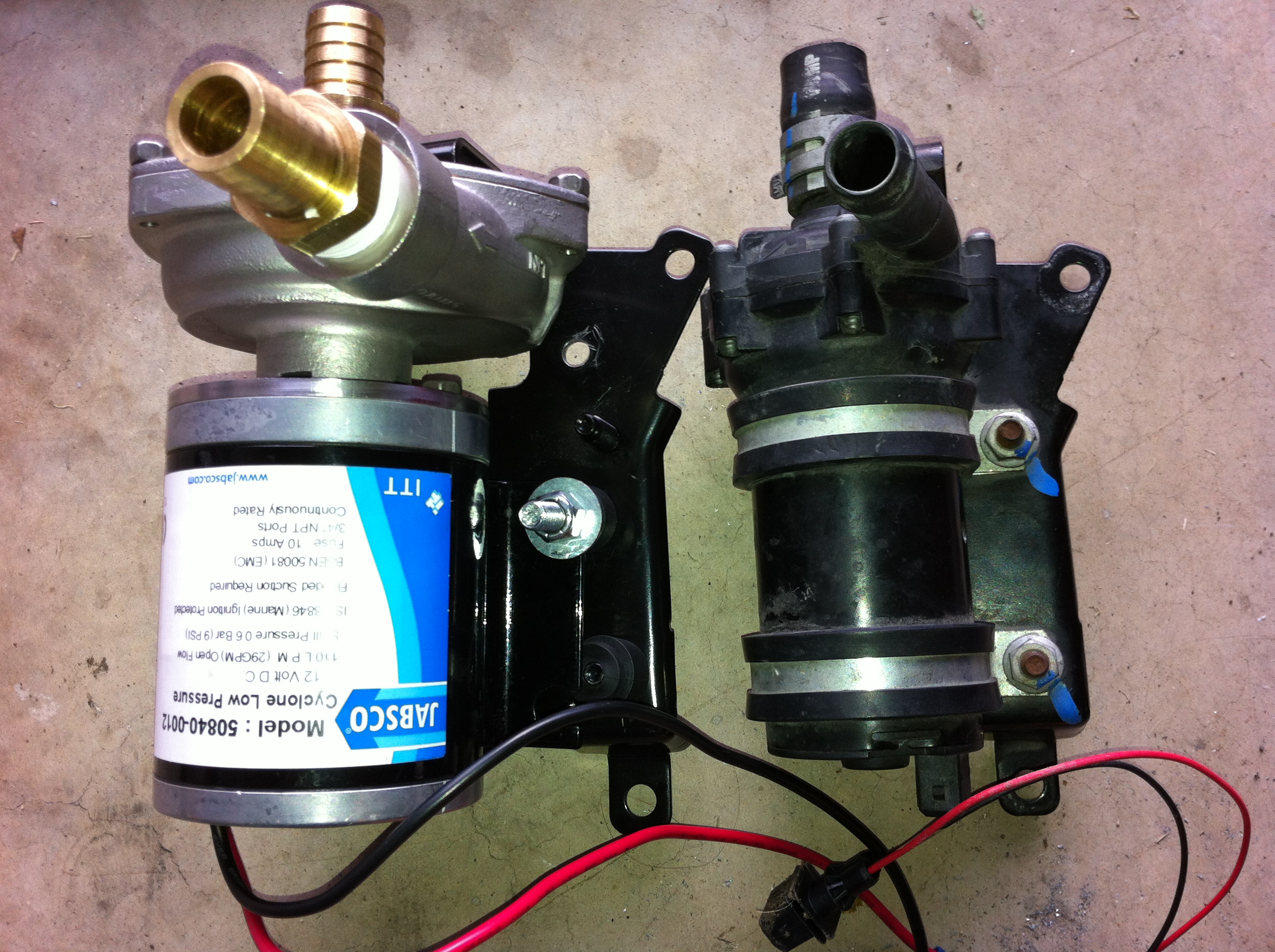
Continuing to modify and fit check the Jabsco pump on the OEM bracket.

Intercooler Pump Test Update

Today I completed the pump install and conducted a test run with the new pump:
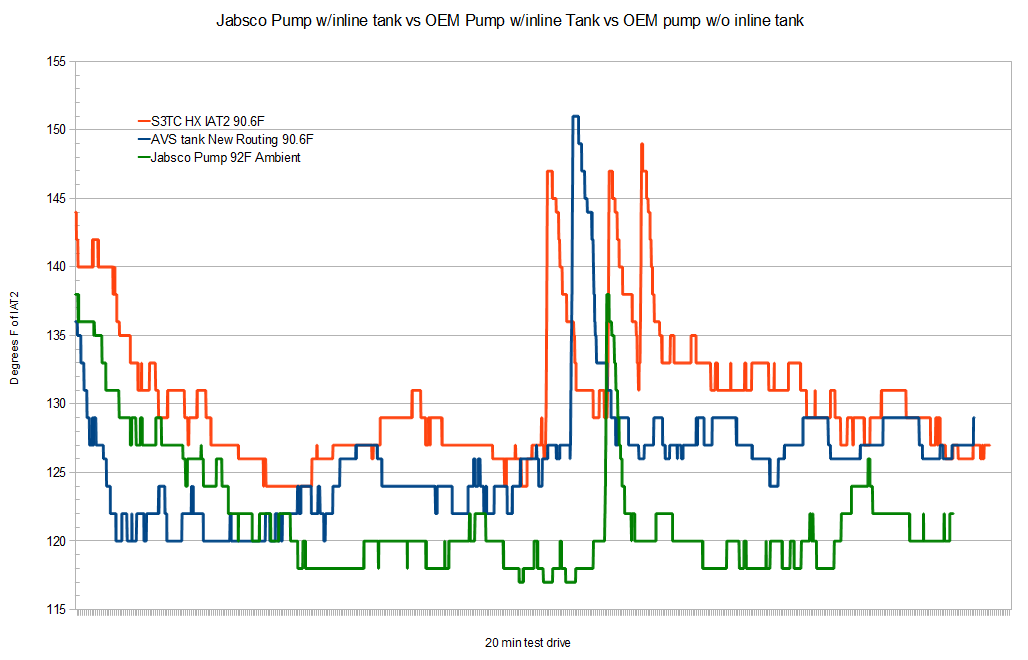
Intercooler pump test showing IAT2 over time during a 20 min drive

Click on the graph for a larger version.

What this graph shows is temperature in degrees F on the Y axis, over a 20 min drive on the X axis.  Spikes in the graph represent acceleration runs.  The red line is the OEM pump without the inline tank; the blue line is the OEM pump with the inline tank; the green line is the Jabsco pump with the inline tank.  Today it is 92F ambient; on the prior test days it was 90F ambient air temperature.

I read this test result to show that the jabsco pump’s greater flow allows the system to reach an IAT2 equilibrium temperature of 118-120F, an improvement of 7F.   The acceleration spike is a 20F increase, an improvement of 5F in addition to the lower equilibrium, so that at peak temps are 12f lower than previous hot day.

Intercooler pump test conclusion:

The Jabsco pump has a 1 gpm higher flow than the OEM Bosch pump.  This 1 gpm greater flow lowers the operating IAT2 temps by 7F

Ambient temp 92F; ambient air temp resets to 32f until the ecm can determine actual temps. Near gear change at top of 2nd gear.  Losing 1 degree of advance to IAT2 retard.
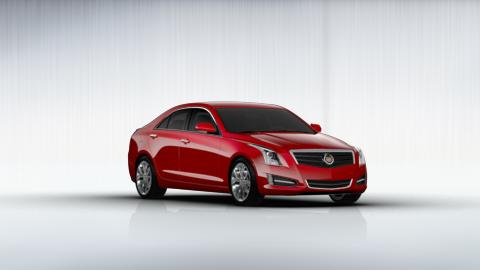
Cadillac ATS Options — Build the best ATS

Cadillac now has a Build your Own planner up on the Cadillac ATS website, so let’ s make some choices for Cadillac ATS options and build the best Cadillac ATS!

Cadillac ATS options

First, I want the 2L Turbo four power train. Although the 3.6L V6 has 321 hp vs the 272 hp rating of the 2L Turbo, I feel the Turbo 4 offers better balance and more opportunities for tuning.

2.0L Turbo I4 DI DOHC Engine with Variable Valve Timing

The all-new 2.0L Turbo makes its Cadillac debut with the ATS. This dynamic engine features Dual Overhead Camshaft design, continuously Variable Valve Timing and Direct Fuel Injection for optimal performance and engine efficiency. The 2.0L Turbo boasts impressive horsepower ratings and provides peak torque through a wide RPM range, delivering immediate, responsive power in any situation. Contributing to this broad power band is a turbocharger that generates up to 20 pounds of boost with virtually no turbo lag. Drivers can choose from a sporty 6-speed automatic with tap-shift control, or the new TREMEC 6-speed manual available on rear-wheel drive models. The 2.0L Turbo powertrain produces:

  • 272 hp @ 5500 rpm
  • 260 lb-ft of torque @1700-5500 rpm

Here in Texas 2 wheel drive is good. If you live where there is more snow you may prefer AWD.

2L Turbo Premium is the all-in selection:

2.0L Turbo Premium Features

The Premium Collection ingeniously melds sophistication with athleticism. The 2.0L Turbo direct-injected four-cylinder 272 HP engine features a 6-speed automatic transmission standard, with a Tremec 6-speed manual available. Rear-Wheel Drive includes a revolutionary Magnetic Ride Control suspension, limited-slip differential, high-capacity engine cooling and performance summer tires.1 Inside, you’ll find a full-color, reconfigurable Head-Up Display (HUD), Cadillac CUE with navigation2 and a Bose® premium surround sound system.

THE 2.0L TURBO PREMIUM COLLECTION INCLUDES OR REPLACES FEATURES INCLUDED ON THE 2.0L TURBO PERFORMANCE TRIM, PLUS:

  1. Full-color, reconfigurable Head-Up Display (HUD)
  2. CUE with navigation2
  3. 60/40 split fold rear seat
  4. Sport suspension with Magnetic Ride Control and limited-slip differential
  5. High-capacity engine cooling
  6. 18” machined-finish aluminum wheels
  7. Performance summer run-flat tires1

Exterior: Crystal Red Tintcoat

Interior: Light Platinum leather seating surfaces, Brownstone accents and Okapi Stripe trim

Next we have a choice of a pair of wheel sets, either 18″ x 8″ front, 18″ x 9″ rear forged aluminum wheels with bright machined-finish (and stretched-V spokes) or polished finish (and straight spokes). I can’t tell which i would prefer so I’ll stick to the machined finish for now.

That would make good Cadillac ATS options for me — although I want to wait and see the ATS-V before I’ll be ready to shop a replacement for my STS-V.

What Cadillac ATS options will you choose? Please hit the comments & share.

;

Cadillac STS-V Intercooler Flow GPM Bucket Test 3

Today I conducted a new flow test on the intercooler cooling system for my Cadillac STS-V.  Previously I ran a bucket test to determine the actual flow through the intercooler cooling system.  Since that test, the system has been modified to add an inline intercooler tank.  I plan to change the pump from the OEM Bosch pump to a Jabsco 80540-12 pump soon, so today’s test confirms the flow rate prior to the next mod.

The overall purpose of this series of tests and changes is to improve intercooler cooling, which will result in lower intake air temperatures after the supercharger, and let the engine make more power.

To run the test I place a ‘from’ bucket on a table, which has replaced my earlier box due to box degradation.  The From bucket flows into the first heat exchanger.  The To bucket is flowing out of the intercooler.  The goal of the test method is to measure the flow as if the test were not going on — to not impact the flow.  This is why the From bucket is in a raised place.

Today my Son assisted me with timing and checking the test setup.  We ran the test with the car engine on, to simulate working conditions for voltage.

Intercooler cooling flow Result:

We measured a flow of  1 & 3/4 gallon per 30 seconds, or 3.5 gallons per minute (GPM).  This is identical to the flow measured in the earlier test without the inline tank.  I conclude that the inline tank presents no more resistance to flow, or that the changes in hose routing during the tank install improved flow sufficiently to offset the resistance of the tank.