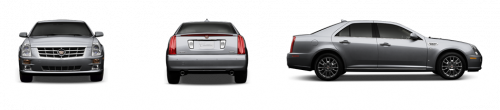
The new 2010 Cadillac SRX is available in front-wheel drive or all-wheel drive. The all-wheel drive is the high tech choice, and makes the SRX a true all-weather, year-around vehicle. The All-wheel drive system used is a 4th Generation version that can not only distribute power front to rear, but also left to right within the front/rear drive.
This system is likely to be a key feature / offering for the upcoming Cadillac XTS. The new AWD system is different from that used on the current Cadillac CTS AWD. The CTS AWD uses the Borg Warner InterActive Torque Management Transfer Case (ITM(R) tc) system. The new Buick Lacrosse uses a similar AWD system to the Cadillac SRX.
Use of this new, light and efficient AWD system in the upcoming Cadillac XTS should enable the type of RWD sports luxury performance one would expect from a Cadillac while maintaining great all-weather performance. In the Buick Lacrosse, the AWD system can send up to 85% of available torque to the rear wheels. The Lacrosse specs show a weight impact of AWD vs RWD of 181 lbs. Because the XTS will be on a similar chassis to the Lacrosse comparisons are apt, although the XTS is likely to have a 115″+ wheelbase vs the Lacrosse’s 112″ wheelbase.
Let’s examine this advanced AWD system used in the Cadillac SRX and Buick Lacrosse, and likely to be used in the upcoming Cadillac XTS. From an article in the Haldex newsletter:
Mechanically, the SRX’s most notable new feature is an active and advanced electronically controlled, all-wheeldrive (AWD) system by Haldex that continuously distributes and transfers torque between the front and rear axles and between the rear wheels. Honed through more than 600,000 miles of tests on roads and test tracks across Europe – including Germany’s famed Nürburgring circuit, where Cadillac engineers have developed and validated new vehicle features for years – the system provides best-inclass levels of driving stability.
The SRX AWD hardware consists of a power take-off unit (PTU) in the front final-drive that transmits engine torque through a prop-shaft to the rear drive module (RDM) that includes a torque transfer device (TTD) and the optional eLSD. Both are wet, multi-plate clutch units from Haldex. Operating seamlessly and programmed to keep the car stable even when cornering (by splitting drive torque to counteract over- or under-steer situations), the AWD system also incorporates an innovative pre-emptive engagement of the rear wheels that eliminates the need to detect front-wheel slip before rear-drive activation, helping to both enhance and exploit the 265 horsepower generated by the SRX’s new standard 3.0-liter DOHC direct-injected V6 engine or the 300 hp delivered by the optional 2.8-litre turbocharged V6, both of which are paired with six-speed automatics. “Performance-wise, you get more horsepower and better economy [18 mpg in the city, 25 on the highway] with a V6,” Reuter says when asked about the change from the V8 in the 2009 model. “Fuel mileage is very important, and the price tag is also a little lower with a V6.”

Haldex internal view

Basic Function
The unique design of the Haldex Gen IV compromises four functional parts:
* Hydraulic power pack with electrical motor and accumulator
* Wet multi-plate clutch
* Controllable pressure reducing valve.
* Electrical control unit (ECU).
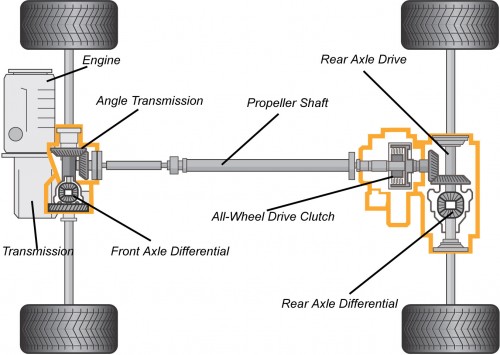
The front and the rear axle of the car is connected via the wet multi-plate clutch which makes it possible to vary the torque distribution between the two axles. As the function of the Haldex Gen IV is independent of the differential speed between the front and the rear axle full lockingtorque, if needed, is available at any given time and speed.
When starting the vehicle the electrical pump in the Haldex Gen IV is started, swiftly providing the system with pressurized oil and thereby making the system ready for operation. The control valve sets the pressure to the piston which in turn compresses the disc package. The level of pressure set depends on the torque level needed which in turn depends on the driving situation. In traction/high slip conditions, a high pressure is delivered: in tight curves (i.e. parking), or at high speeds – a much lower pressure is provided.
Coupling Control Concept
Haldex Gen IV connects to the vehicle’s electrical system and to the data communication bus (i.e. the CAN-system), transmitting information on the driver’s actions, the engine, the transmission, the brakes and other on board systems.
Haldex Gen IV uses this information entirely for its control without the need for additional sensors. The available signals are received by the coupling’s processor and interpreted by the software. Continuous analysis of these data adjusts the characteristics of the coupling according to actual demand, without any active intervention by the driver.
The function of the coupling is automatically adjusted to prevailing conditions. When starting in sand for example, the shafts are coupled together as firmly as possible to obtain the best traction. When close cornering, i.e. parking, the shafts are uncoupled to allow easy maneuvering.
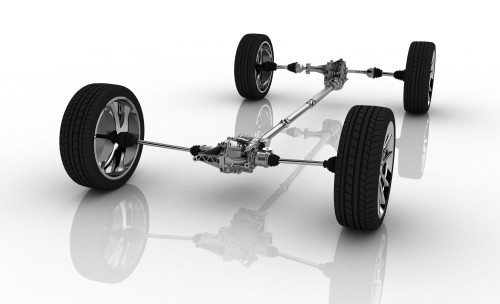
Haldex Drivetrain Model
The controllability of the Haldex Gen IV also makes it possible to use differently worn tires, to tow the vehicle with one axle raised, and to maintain function when using Run-flat-tyres or Mini-Spare.
Haldex Gen IV can use any suitable signal available on CAN. Signals from the ABS and ESP systems and the engine control are vital for performance. For enhanced performance, signals from a steering wheel sensor, yaw sensor, lateral acceleration sensor can be used if available.