
Yeah, but that one’s FWD

The last time my Wife was shopping for a car she was looking at a lot of different brands and models trying to size up exactly what she wanted.   She was thinking one possibility was a red convertible with leather interior, and so we went and test drove a variety of models that offered this combination, or as close to it as we could find.

As we waiting for the Sales Person to grab the keys for one test drive I explained that the vehicle we were about to drive was Front Wheel Drive (FWD).  My Wife asked, “Why are you telling me that; Do I care?”

This gave me pause.

To me, the fact that this car was FWD meant that it would not corner or accelerate as well as a similar Rear-Wheel Drive (RWD) car.  Further, it also meant that the car was not intended for a ‘serious’ car enthusiast / driver, but was being marketed or targeted for the features offered and not as a driver’s car.  On the other hand, a FWD vehicle can be very good in the snow or weather.  So one might choose a FWD performance car if one lived in parts of the country that get a lot of snow or harsh weather.

However, my Wife never plans to drive the car on the track.  If the wheels are screeching around a corner she will likely just slow down.  She probably prefers understeer to oversteer, for the same reason many manufacturers tune their cars to understeer — it gives the driver time to react and slow down, even if at the same time it tends to give up a bit of speed through the corner.  The fact that the car does 0-60 in 0.5 seconds less or more is immaterial in her weighing of the virtues of a car.  A very detailed argument on weight transfer under heavy acceleration being advantageous to a RWD car and disadvantageous to a FWD car would bore her.  And I paused in my response because it occurred to me, weighing these fact, that perhaps she did not care.

I think that BMW and I were very surprised recently to find that 80% of buyers of the rear-wheel drive 1-Series BMW think that the 1-Series incorrectly believe the 1-Series is FWD.  This reminded me of my Wife’s question.  Many buyers may not care that a car is FWD or RWD, only that it has the nameplate and features for the price range they are shopping.  I would have guessed that all BMW drivers were technically oriented, and were buying their BMW because of its driving and handling characteristics, and because it was a RWD performance sedan.  Not so apparently.

I am very glad that Cadillac went to RWD cars for the CTS family.  There is something re-assuring to me about the dynamics of a RWD car when cornering, and about the packaging of the engine longitudinally under the hood, with better associated engine access.  I am interested in how the new XTS does, and I am willing to believe that AWD can be a viable approach given tuning that allows a high percentage of torque to be vectored to the rear wheels when needed.  But I continue to believe that the best performance in acceleration and cornering will be available from a RWD configuration, and I am glad that Cadillac continues to offer RWD luxury performance sedans.
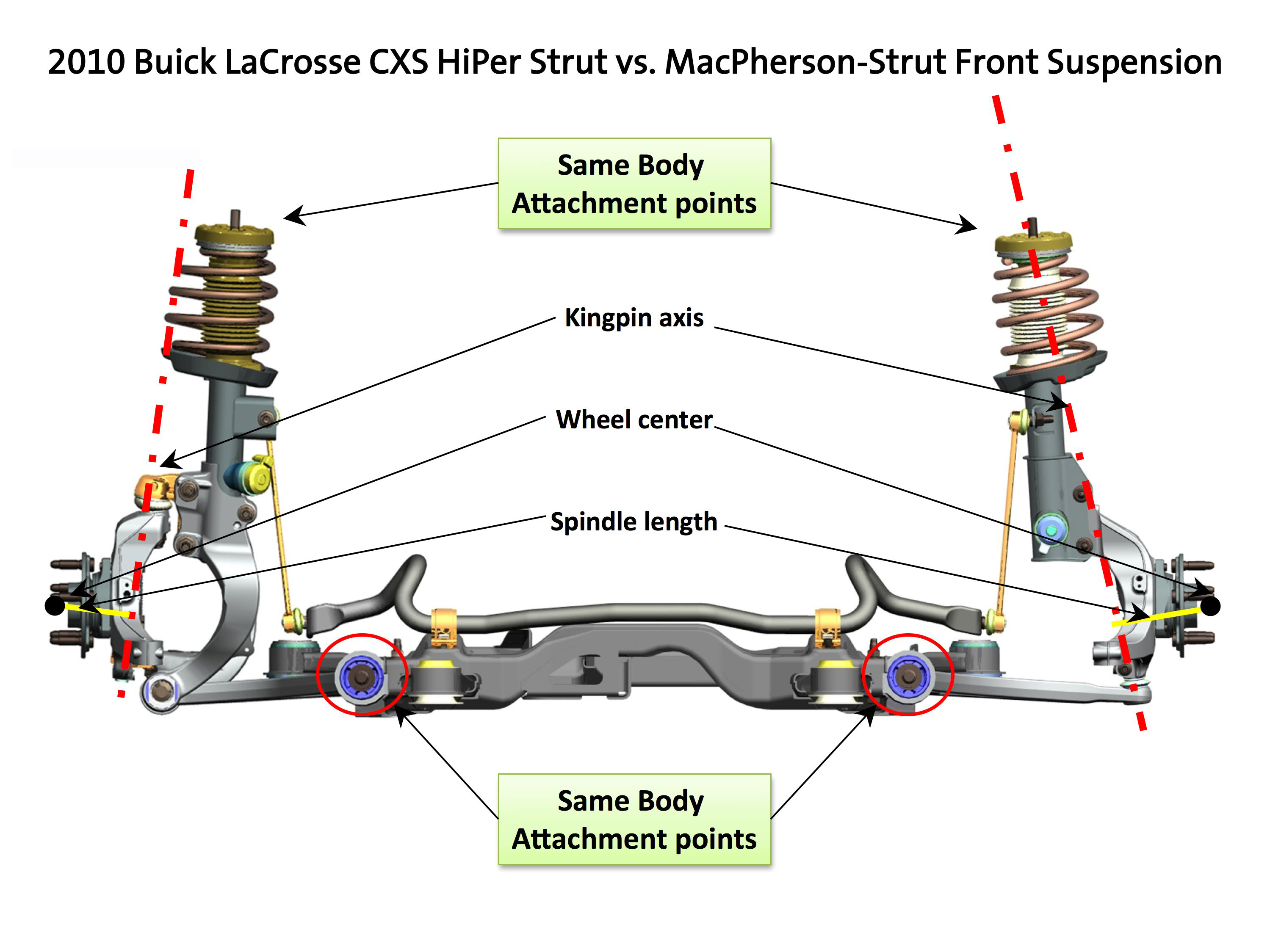
HiPer Strut — removing the disadvantages of FWD?

Good news that the Cadillac XTS has made it through the next gate and been approved for production in 2011 as a 2012 model.  Perhaps it will also benefit from this innovative suspension approach implemented on the Buick Lacrosse: Hiper Strut Suspension, which removes the disadvantages of Front Wheel Drive (FWD) of torque steer, cornering ability, and road feel while maintaining the efficiency advantages.  The XTS is expected to arrive with All-wheel drive either standard or as an option, along with a plug-in hybrid power plant.

HiPer Strut vs. MacPherson-Strut

Buick Lacrosse’s Innovative Hiper Strut Suspension Delivers Improved Ride And Handling

DETROIT – The 2010 Buick LaCrosse CXS incorporates North America’s first use of a unique front suspension design called HiPer Strut. It is a premium, technologically advanced suspension design that improves ride and handling characteristics in four significant ways:

  • Reduces torque steer
  • Improves vehicle sensitivity to tire irregularities and wheel imbalance
  • Provides more linear and communicative steering through improved camber control
  • Improves impact isolation on bumps and rough surfaces.

Derived from “High Performance Strut,” the LaCrosse CXS’ HiPer Strut suspension is partnered with conventional dampers when used with the standard 18-inch wheels and an advanced electronically controlled damping system with the available 19-inch wheels.

“HiPer Strut helps reduce torque steer and maintain negative camber during cornering,” said Jim Federico, chief engineer for Buick LaCrosse. “That improves ultimate grip levels in dry and wet conditions, as well as improves the direct feel of the road, while isolating undesirable feedback. Behind the wheel the driver experiences reduced torque steer, improved grip and increased cornering power, along with crisper handling, steering precision and feedback.”

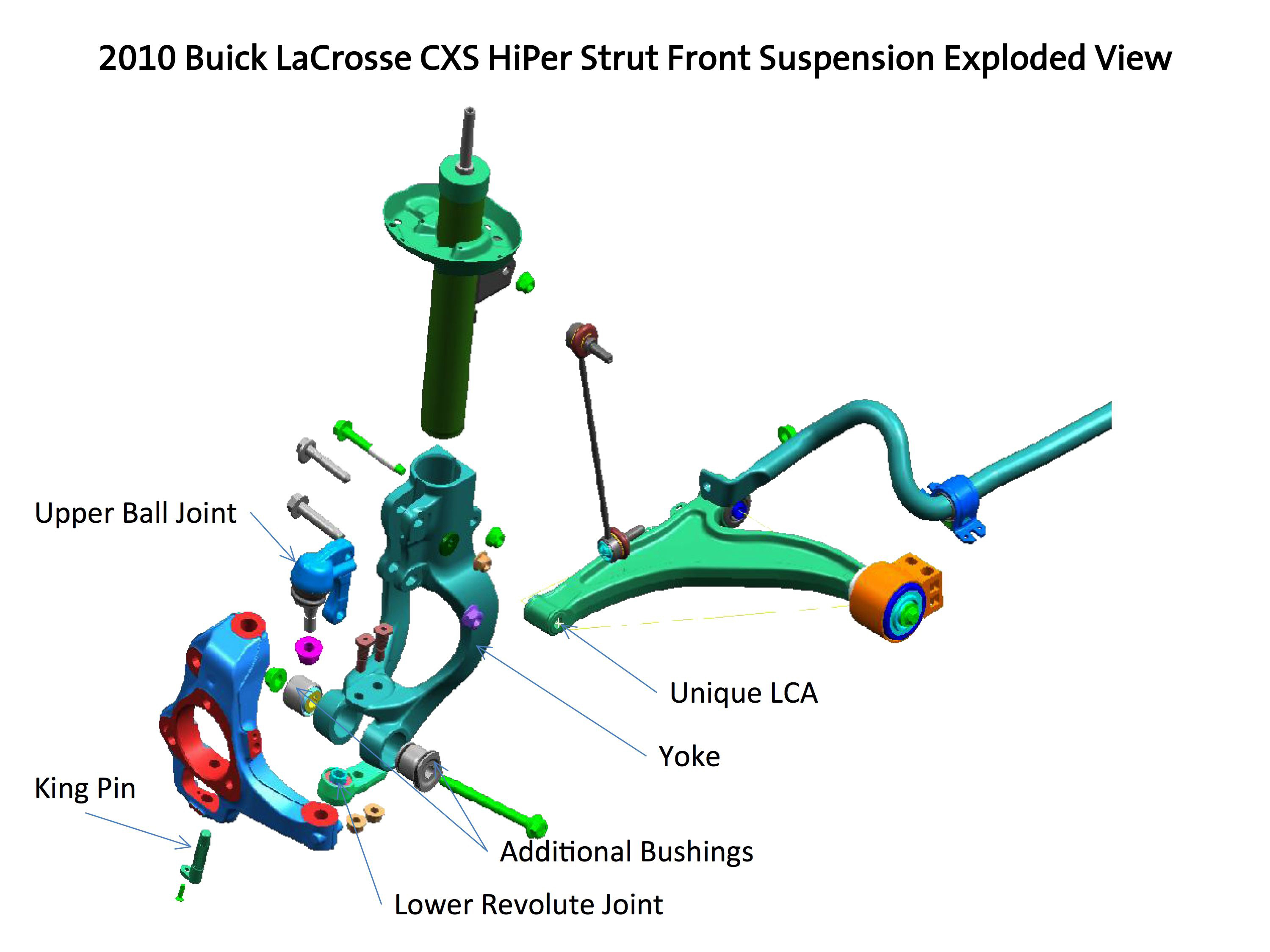
HiPer Strut Front Suspension Exploded View

HiPer Strut is based on the MacPherson strut front suspension design and features dual-path top mountings that separate the transfer of spring and damper loads to the body structure. A combined steering knuckle/strut carrier is unique to the design. The lower control arms are attached to a rigid sub-frame that is bolted to the body structure with four isolators that reduce the transmission of noise and vibrations to the interior.

The design is also an enabler for a limited-slip differential, for even greater traction, and supports better ride quality with larger-diameter wheels – including LaCrosse CXS’ available 19-inch wheels.

“Perhaps the most significant attribute of HiPer Strut’s effectiveness is what you don’t feel,” said Federico. “You don’t feel torque steer; you don’t feel tugging or vibrations through the steering wheel; you don’t feel sharp reactions to bumps and pot holes. You simply experience a smoother, more controlled and more linear driving experience.”

The foundation

The LaCrosse’s stiff body structure is the foundation for more precise suspension tuning and the CXS’ HiPer Strut design. It is constructed with ultra high-strength steel strategically placed to enhance strength, as well as crash protection. LaCrosse CX and CXL models use a conventional MacPherson strut front suspension.

At the rear suspension, the CX, CXL and the CXS model with 18-inch wheels feature a four-link design that is mounted to the body at four points. CXS with optional 19-inch wheels and Touring Package feature a more sophisticated H-arm design that uses the same attachment points as the four-link system but with the cross member attached via isolated mounts. The lower H-arm replaces the basic trailing link, delivering a greater ride quality and lower noise.

The Touring Package also includes real-time damping and Sport Mode Selectivity, which uses four electronically controlled dampers to constantly “read” the road and make adjustments within milliseconds.

Vehicle control

Along with HiPer Strut suspension in the CXS, all LaCrosse models employ a variety of state-of-the-art systems that enable exceptional vehicle control through the steering system, brakes and more. GM’s StabiliTrak electronic stability control system is standard on all models. Additional highlights include:

  • Variable effort power steering that delivers greater assistance at low speeds, such as parking maneuvers, and reduced effort at higher speeds for a greater feeling of control. The steering system has a quick, 15.2:1 ratio, requiring only 2.75 turns lock to lock.
  • Four-wheel disc brakes with four-channel ABS, including large, 12.6-inch-wide (321 mm) front discs and 12.4-inch-wide (315 mm) solid rear discs. Lightweight, aluminum-body calipers are used at each corner.
  • Electronic Brake force Distribution that ensures optimum braking force is applied simultaneously at both axles, for maximum stability under heavy braking; and a Brake Assist System that senses the severity of a braking situation and applies additional braking pressure when needed.

Performance cost in MPG

My current 2005 Cadillac CTS has a 3.6L V6 and is EPA rated for 16 city and 25 highway MPG using their current measure.  For argument sake this yields a mixed-driving target of 19 MPG.

I drive 15,000 miles a year, more or less.  So with my 2005 Cadillac CTS I might expect to need 15,000 miles / 19 MPG = 790 gallons of fuel in the next year.  The 3.6L CTS uses regular unleaded fuel, so let’s say $2.50 / gallon for a total of $2.50 x 790 gallons = $1,975 in fuel costs.

Here are the replacement performance V-Series cars I am considering:  the 469 hp 2008 Cadillac STS-V, or the 400 hp 2007 Cadillac CTS-V.

2008 Cadillac STS-V:  EPA rated 13 city 19 highway, 15 MPG combined.  With my expected annual mileage of 15,000 miles per year that would mean 15,000 miles / 15 MPG = 1,000 gallons of fuel.  Noting that the STS-V however requires premium fuel, which might cost $3.00 / gallon, that makes a total of 1,000 gallons x $3.00 / gallon = $3,000 in fuel costs.   So the Cadillac STS-V would cost an extra $1K/year, or $85/month in gas compared to my 2005 Cadillac CTS.

2007 Cadillac CTS-V: EPA rated 14 city 22 highway, 16 MPG combined. It also requires premium fuel.  15,000 miles x 16 MPG = 937 Gallons.  937 Gallons x $3.00/gallon = $2,811 in fuel costs.  So that CTS-V would cost an extra $836/year in fuel, or $70/month compared to my 2005 Cadillac CTS.

I plan to keep the next Cadillac for 5 years.  Comparing the new cars, STS-V will cost $200/year more than the CTS-V, or $1,000 over the 5 years.

On the other end of the spectrum, the current 2010 Cadillac CTS 3.6L DI V6 engine is rated at 18 city 27 highway for combined 21 mpg.  The current 2010 Cadillac CTS 3.0L DI V6 engine is rated at 18 city 28 highway for combined 22 mpg.  Either engine can use regular unleaded.  So replacing my CTS with the new 2010 Cadillac CTS 3.6L would yield a projected fuel cost of 15,000 miles / 21 MPG x $2.50/gallon = $1,785/year.  Although the new 3.6L has more power at 304 hp than the 2005 non-DI 3.6L at 255 hp in my car, the DI engine also gets better MPG, and is boosted by the 6-speed automatic vs 5-speed automatic.

Replacing my CTS with a 6-speed DI 3.6L instead of a 2007 CTS-V or 2008 STS-V model would save $1,026-$1,215/year.   However, the CTS DI 3.6L has respectable performance of 0-60 in 6.5 sec, while the 08 STS-V or 07 CTS-V will both accelerate 0-60 in under 5 seconds, out-brake, out-corner, generally out-perform the CTS 3.6L.  What cost performance?  Besides the initial price of entry, about $100/month in my case.  Is that worth the thrill of the added performance potential?  Would you pay another $1200 a year to drive a Super car versus a ‘normal’ sport sedan?