Porsche has recently fielded their first 4-door sedan, the Panamera. The new Porsche Panamera is sort of a low-flying variant of the Porsche SUV, the Cayenne. It uses similar nomenclature, and powertrains as the SUV. The Panamera has widely been panned for its visual appeal (or lack thereof), but I am a function over form person. I am also a Porsche fan from way back, so let’s see how the new German compares with Cadillac’s CTS-V Supercar Sedan.
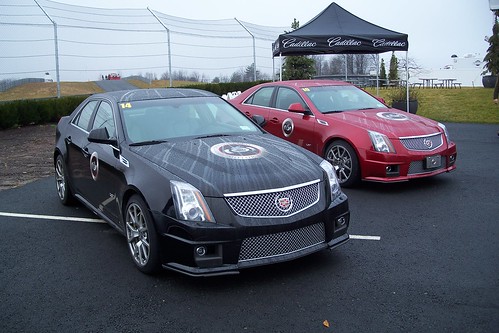
Cadillac CTS-V's at Montecello Motor Club
The Porsche Panamera comes in S, 4S, and Turbo Variants. The Panamera S, which starts at $90.7K, is the Panamera model that is likely to be cross-shopped with the $60.7K Cadillac CTS-V.

Porsche Panamera S
Here are the stats according to Motor Trend for the Porsche Panamera S:
| 2010 Porsche Panamera S |
| Base price range |
$90,775 |
| Price as tested |
$104,805 |
| Vehicle layout |
Front-engine, RWD, 4-pass, 4-door hatchback |
| Engine |
4.8L/400-hp/369-lb-ft DOHC 32-valve V-8 |
| Transmission |
7-speed twin-clutch auto |
| Curb weight (dist f/r) |
4108 lb (53/49) |
| Wheelbase |
115.0 in |
| Length x width x height |
195.6 x 76.0 x 55.8 in |
| 0-60 mph |
5.1 sec |
| Quarter mile |
13.5 sec @ 105.8 mph |
| Braking, 60-0 mph |
108 ft |
| Lateral acceleration |
0.95 g (avg) |
| MT figure eight |
25.7 sec @ 0.72 g (avg) |
| EPA city/hwy fuel econ |
16/24 mpg |
| MT observed fuel econ |
16.8 mpg |
| CO2 emissions |
1.03 lb/mile |
It would be ideal to compare these cars head to head. Lacking that, here’s some similar Motor Trend test data for the Cadillac CTS-V:
|
Motor Trend Data: 2009 Cadillac CTS-V
| |
2009 Cadillac CTS-V |
|
| POWERTRAIN/CHASSIS |
| Drivetrain layout |
Front engine, RWD |
|
| Engine type |
Supercharged 90-deg V-8, alum block and heads |
|
| Valvetrain |
OHV, 2 valves/cyl |
|
| Displacement |
376.1 cu in/6162 cc |
|
| Compression ratio |
9.0:1 |
|
| Power (SAE NET) |
556 hp @ 6100 rpm* |
|
| Torque (SAE NET) |
551 lb-ft @ 3800 rpm* |
|
| Redline |
6200 rpm |
|
| Weight to power |
7.7 lb/hp |
|
| Transmission |
6-speed automatic |
|
| Axle/final-drive ratios |
3.23:1/2.16:1 |
|
| Suspension, front; rear |
Control arms, coil springs, adj shocks, anti-roll bar; multi-link, coil springs, adj shocks, anti-roll bar |
|
| Steering ratio |
16.1:1 |
|
| Turns lock-to-lock |
2.6 |
|
| Brakes, f;r |
14.6-in vented disc; 14.4-in vented disc, ABS |
|
| Wheels, f;r |
9.0 x 19-in; 9.5 x 19-in, forged aluminum |
|
| Tires, f;r |
255/40R19 96Y; 285/35R19 99Y Michelin Pilot Sport PS2 |
|
| DIMENSIONS |
| Wheelbase |
113.4 in |
|
| Track, f/r |
61.8/62.0 in |
|
| Length x width x height |
191.6 x 72.5 x 58.0 in |
|
| Turning circle |
37.9 ft |
|
| Curb weight |
4277 lb |
|
| Weight dist., f/r |
54/46% |
|
| Seating capacity |
5 |
|
| Headroom, f/r |
38.8/37.2 in |
|
| Legroom, f/r |
42.4/35.9 in |
|
| Shoulder room, f/r |
56.7/57.4 in |
|
| Cargo volume |
13.6 cu ft |
|
| TEST DATA |
| Acceleration to mph |
| 0-30 |
1.8 sec |
|
| 0-40 |
2.6 |
|
| 0-50 |
3.3 |
|
| 0-60 |
4.3 |
|
| 0-70 |
5.5 |
|
| 0-80 |
6.8 |
|
| 0-90 |
8.1 |
|
| 0-100 |
9.7 |
|
| Passing, 45-65 mph |
2 |
|
| Quarter mile |
12.6 @ 114.6 mph |
|
| Braking, 60-0 mph |
106 ft |
|
| MT figure eight |
25.1 sec @ 0.75 g (avg) |
|
| Lateral acceleration |
0.94 g |
|
| Top-gear revs @ 60 mph |
1800 rpm |
|
| CONSUMER INFO |
| Base price |
$60,700 |
|
| Price as tested |
$66,835 |
|
| Stability/traction control |
Yes/yes |
|
| Airbags |
Dual front, front side, front/rear curtain |
|
| Basic warranty |
4 yrs/50,000 miles |
|
| Powertrain warranty |
5 yrs/100,000 miles |
|
| Roadside assistance |
5 yrs/100,000 miles |
|
| Fuel capacity |
18.0 gal |
|
| EPA city/hwy econ |
14/19 mpg |
|
| CO2 emissions |
1.22 lb/mi |
|
| Recommended fuel |
Unleaded premium |
|
|
Read more: Motor Trend Test
Conclusions?
- The more expensive, Porsche Panamera Turbo, at 500 hp, comes closer to CTS-V performance than the Panamera S model, but is unlikely to be directly shopped with a CTS-V since it costs roughly twice as much as the Cadillac.
- The CTS-V has more power, at 556 hp/551 lb-ft vs 400-hp/369 lb-ft for the Porsche Panamera S, but weighs slighly more at 4,300 lbs vs 4,137 lbs.
- The CTS-V acceleration numbers are notably stronger, with an advantage of 0.8 sec 0-60, at 4.3 sec for the Cadillac vs 5.1 sec for the Porsche. At the quartermile the difference is still 0.9 sec, placing these two cars in different classes for acceleration. Cadillac CTS-V: 12.6 @ 114.6 mph Porsche Panamera S: 13.5 sec @ 105.8 mph
- Cornering: The Porsche has the advantage here, pulling 0.94 g’s on the skidpad vs 0.93 g’s for the Cadillac. However, the CTS-V powers ahead in the Figure-8: 25.1 sec @ 0.75 g (avg) for the Cadillac vs 25.7 sec @ 0.72 g (avg) for the Porsche.
- The Porsche has the advantage in fuel economy, at 16/24 mpg city/highway vs a thirsty 14/19 mpg city/highway for the Cadillac.
- The CTS-V is almost $30K less expensive than the Porsche, with the Cadillac CTS-V at $60.7K, and the Porsche Panamera S at $90.7K (starting prices).