Aftermarket Cadillac Modifications: Power

Once you purchase a pre-packaged sport tuned V-Series Cadillac, has the Factory pushed the vehicle as far as it can go, or is there some left on the table?  Is there anything else that could be done to these V-Series Cadillacs that would make them faster?

In a word, YES.  Like most tuning however, it is very good to start with a goal usage and power level in mind, and tune to those goals.  A classic hot-rodding question is: How much money do you have, and how fast do you want to go?

First of all, it depends on which V-Series Cadillac you focus on.  The STS-V and XLR-V have more in common with each other than the 2004-2007 CTS-V or the 2009+ CTS-V.

The STS-V and XLR-V are powered by the LC3 Supercharged 4.4L Northstar and make 440-469 hp stock depending on the model.

The 2004-2005 CTS-V was powered by the 5.7L V8 LS6 engine making 400 hp.

The 2006-2007 CTS-V was powered by the 6.0L V8 LS2 engine making 400 hp.

The newest V, the 2009+ CTS-V is powered by the Supercharged and Intercooled 6.2L V8 LSA engine making 556 hp.

LC3 4.4L Supercharged Northstar Tuning

For the STS-V and XLR-V the aftermarket offers re-tuning / re-calibration of the computer, cold air intakes, and performance exhausts.  Together these can net around 40 RWHP, or rear wheel horsepower.

LS6 or LS2 V8 Tuning (~400hp stock)

There is a rich suite of tuning options available for the LS6 or LS2, because they share a great deal of aftermarket development with ongoing LSx performance engine development.

Best bang for the buck items include:

  • Cam shaft — best done along with ported heads.  Cam/heads can add as much as 90 hp at the crankshaft for $2500 plus installation
  • Headers — long tube headers will cost around $1600 and add 20-30 RWHP
  • Supercharger — around 140 RWHP for US$6-7K
  • Dyno Tuning — results vary based on the other modifications on the vehicle, but give the best opportunity for gains from modifications.  Some level of custom tuning will be required with most changes.
  • LS7 Conversion — replace the LS2 or LS6 with a 505hp LS7
  • L92 heads / L76 Intake — To make the LS3 engine GM added the L92 heads to the LS2, so this is a known power combo. The 4.00-inch bore of the LS2 enables it to use LS1/LS6 heads, as well as L92-style heads (including LS3, LS9 and LSA engines).  The L76 intake allows the combo to fit under the hood.  For confusion, the L94 Engine in the current Escalade is an updated variant of the L92.

As an aside, not all adders are additive.  So while you might see 25 hp from adder A and 20 hp from Adder B on a stock setup, you might only reach +30hp from both together.

Second, to some extent a Supercharger works by “forcing” better breathing.  So if you plan to get a Supercharger, I would start with that.  If you want to stay all-motor, go with cam and heads and headers which all act to free up the engine’s breathing.

LSA Supercharged V8 Tuning (556 hp stock)

The LSA engine can be considered a Supercharged LS3 engine, with a steel crankshaft.  The LSA has rectangular port heads like the LS9 or L92 (Escalade engine) instead of Cathedral port heads like the LS2.  The rectangular port heads in the LSA flow a bit better than the cathedral port heads in the LS2.

Although the Supercharged LSA V8 is relatively new, the aftermarket offers include:

  • New supercharger snout to raise boost: with tuning around +74 hp for $2,500.
  • Dyno Tuning
  • Upgrade to the LS9’s Supercharger – Complete packages that include tuning, exhaust quote up to 700 hp, so +150 hp.
  • Upgrade the engine to the LS9:  The LS9 engine makes 638 hp stock.  LS9 Engine around $22K, so pricey
  • Headers with Tuning can produce around 50 RWHP for $2K
  • L92 Heads and Cam package – around 70 RWHP for $2,500 plus installation
  • Cold Air Induction kit

Cadillac Tuner pages:

Understanding BMW sales/profits

I am still fascinated by the quoted statement from BMW in the LA Times that 50% of their profits come from the 5-Series.

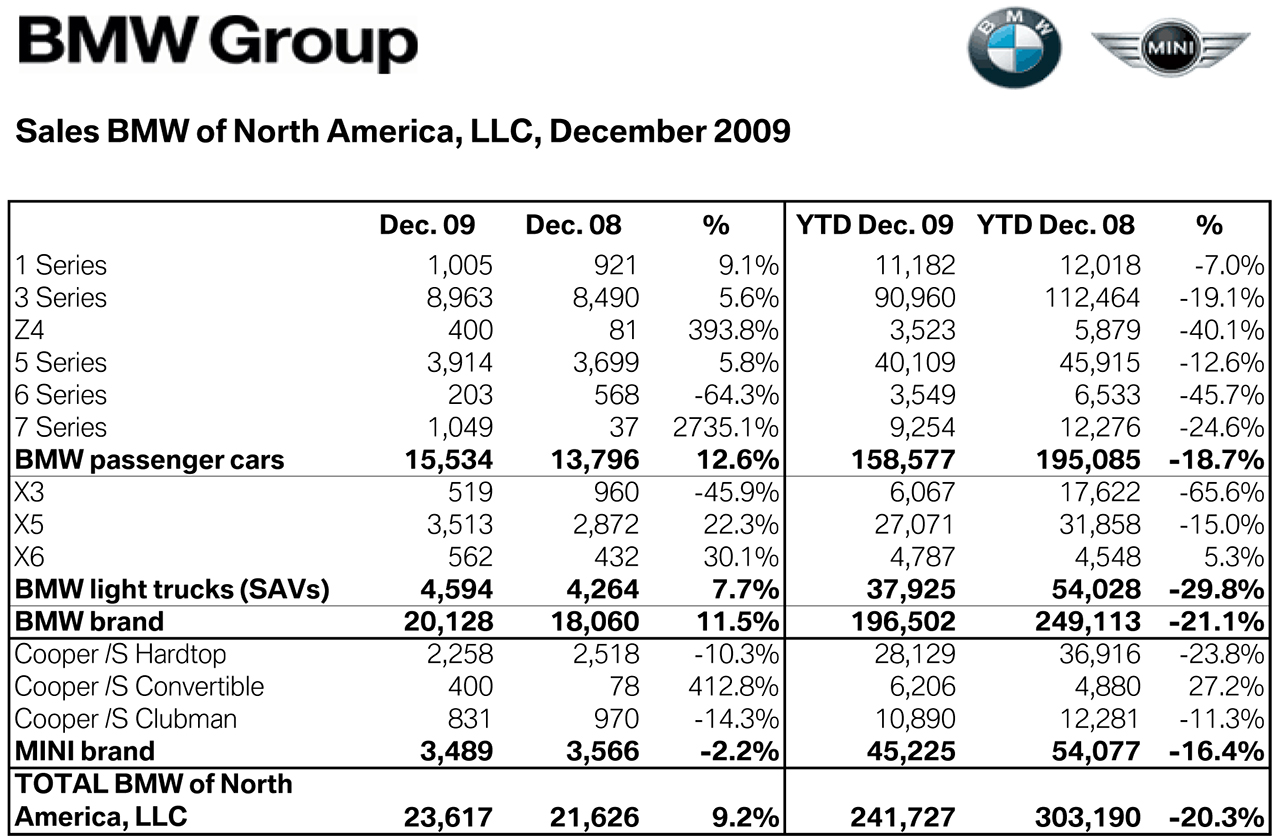
Here is a chart of BMW 2009 Sales from back in January 2010:

BMW sold 40,109 5-Series vehicles, of a total of 196,502 vehicles.  For the moment let’s assume the BMW Marketeers excluded Mini sales from their figures.

Normally I would have expected the profit rate on the SUVs was very high, but BMW sold almost the same number of SUVs as 5-Series sales.  So their profit margin on the SUVs are much lower than the 5-Series?  The profit level on the 3-Series and 1-Series are lower as well?

Certainly because the price tag of the vehicles differs sharply:

3-Series: $33-45K

5-Series: $45K-$63K

SUVs: $39K-$67K

So something seems odd here, if the SUVs have the same price range as the 5-Series but are much less profitable?  It may have to do with pedestrian issues, such as the 5-Series is an older model and so has already paid off its tooling costs (a new model is on the way now).

Or it could simply have been the type of thing Marketing people say to emphasize that BMW 5-Series Buyers don’t mind spending a lot of money on accessories.

One final theory — perhaps BMW’s profits on the 5-Series and the SUV are both healthy, and their profit margin on the 1-Series and 3-Series are near 0?  That would fit the quote, and fit the pricing.  Still is worthwhile to HAVE the 1-Series and 3-Series in the mix, as they drive traffic.  But even at the high (to me) 3-Series prices and healthy sales BMW may not be making much money on them?

Cadillac CTS an American Sports Sedan

In the 90s when Cadillac was marketing the Cadillac Seville STS alongside the Cadillac Eldorado ETC, magazines at the time would often compare/contrast the two.  Besides the obvious fact that the STS had 4 doors and the ETC had 2 doors, they also were targeted at somewhat different audiences.

The ETC was viewed as a classically American personal luxury vehicle.  It had more American touches — more chrome, more color.

The STS was described as a more European luxury vehicle.  Less chrome, more mono-color design cues, more muted styling.

When you look at the Cadillac CTS of today, it uses a variety of chrome accents — on the door handles, the seat back, the trunk — to recall the classic Cadillacs of yesterday. Certainly it has unusual, look at me styling.  The first generation CTS styling was inspired by the Stealth Fighter (F-117 Nighthawk).  That aircraft had sharp creases and angled surfaces as a way to minimize radar cross-section.  The current, second generation CTS is an evolution of the original design, merging in elements of the Cadillac Sixteen look and styling.

I don’t think anyone would claim the Cadillac CTS is not ‘American’ enough.  I think it instantly suggests to most knowledgeable viewers visually that it is an American car.   Certainly in the V-Series you also get the classic American approach to muscle — there is no replacement for displacement.  With the LSA Supercharged 6.2L V8 making 556 hp it is hard to argue with the ‘too much is just enough’ approach to power plants.  In today’s market however, the base 3L V6 with 270 hp and the Performance/Premium CTS with 304 hp seem well heeled, until you consider the competition.  Many of the competitors in this market sport 330 hp – 385 hp powerplants with similar fuel economy to the CTS V6 Sedans.

Clearly it is time for Cadillac to task GM Powertrain to step up their game.  Even a 3.6L with the same tuning and efficiency of the current 3.0L V6 would make 324 hp.   So I don’t think it is a problem that the engines are not capable.  If Cadillac can’t get the power needed from the 3.6L then send in the Supercharged 3.6L, or offer the 6.2L LS3 V8 as an option.  The high feature 3.6L V6 likely costs MORE for Cadillac and GM than the LS3 V8 does to produce due to the higher feature set of the V6.   So my personal favorite best of both worlds would be to offer the LS3 V8 as a $2K SAVINGS off the current base CTS — a CTS V8 for less money lol.

American Luxury cars — Cadillacs — historically bring MORE power than needed.  The current CTS V6 powerplants are adequate.  Adequate is not enough in this class.  Luxury Performance cars need plentiful power, and Cadillacs should have class-leading horsepower.  Bring it, Cadillac!