
Power versus MPG

In selecting my next Cadillac, I am drawn the to highest performance models available within my budget.  More is always better right?

My model for the ‘right’ 0-60 time for a sport sedan is 5.5 to 6  seconds this year.   Performance of cars as a whole changes over time, as automobile performance improves.

The current CTS DI 3.6L will do 0-60 mph in 6.3-6.5 sec.  The CTS should be below 6 seconds with 304 hp, but it also gained a bit of weight with added features, and has fuel economy minded gearing.  Yes I recognize that is kind of in the same range, but let’s assume for this discussion that quicker is important.  So the CTS 3.6L is just on the upper edge of my desired performance envelope, and is right in the right zone for MPG.

Now, the 2006-2009 STS-V with 469 hp will go 0-60 in around 5 sec, or as Cadillac measured in under 5 seconds.  However, this model gets 19 mpg highway compared to the CTS DI 3.6L V6 MPG of 28 MPG highway.

One compromise candidate is the 2005-2009 STS 4.6L V8, with the 320 hp VVT Northstar.  This sedan gets very close to 0-60 mph in 6 sec in most tests, and has fair fuel economy at 24 mpg highway.

The new Gen2 CTS-V with 556 hp supercharged 6.2L V8 will do 0-60 mph in under 4 seconds with a Cadillac test driver, or just over 4 seconds with a magazine writer driving.  The new CTS-V is still outside of my budget however, and also gets 19 mpg highway.

The 2006-2007 Cadillac CTS-V with 6L LS2 V8 engines would do 0-60 in under 5 seconds, and are rated at 24 mpg highway.  So these are interesting, but they will soon be out of warranty.  I like to keep my daily driver under warranty, so if there is an issue I can simply drop it off for service, pick up a loaner car, and be on my way.  These are also only available in manual transmissions.  A manual is okay for me, but is challenging for other members of my household.

So this thought process leaves me wondering if I should change my target from “as quick as possible” to “as quick as possible and still get more than 24 mpg highway”, or similar.

In this range that 5 mpg costs around $1000 per year given my mileage per year and average gas prices.  So would you pay $1000 per year for another 150 hp, or 47% more power?  I suppose over the 5 years I plan to drive the car that is less than the cost of a Supercharger or similar power adder.

How many MPG is more power worth to you?
V8 Speculation

With the GM’s investment in the Tonawanda Engine facility, there is some excitement among enthusiasts about just what product(s) we might expect.

The most likely product is the direct injected 5th Generation 6.2L V8.  The 6.2L L94 engine in the Escalade is a Gen IV engine, and makes 403 hp.  Earlier tests by GM showed that a direct injected variant of the earlier L92 (like the L94 but without Active Fuel Management AFM) made another 50 hp, got 3-6% better fuel economy, and ran cleaner, with no other changes.  So hopefully one output of the new investment at Tonawanda will be a new 6.2L V8 that makes 450+ hp in the Escalade, and 475+ hp in the Camaro or base Corvette.

The ability to make more power gives other nice options — moving to a smaller displacement and keeping the same power.  By increasing power capacity by 10% one can decrease displacement by 10% and maintain the same power output.  So if a 6.2L engine makes 450 hp one could change to a 5.5L engine and still make 400 hp like the current L94.  The smaller displacement engine should gain in fuel economy and emissions from the smaller displacement.    I am always in favor of MORE horsepower, but to meet the new fuel economy and emissions regulations some changes will be required.  Changes that maintain excellent power output while becoming more environmentally friendly are the best changes.

Of course the real gain would be a Gen V version of the LSA Supercharged Direct Injection 6.2L V8 for the CTS-V that made 600+ hp.   One can dream…

Press Release:

    • Five plants receive work: Tonawanda, N.Y.; Defiance, Ohio; Bedford, Ind.; Bay City, Mich. and St. Catharines, Ontario, Canada
    • Investment creates or retains about 1,600 jobs
    • New engines to save more fuel through direct injection technology and advanced combustion system design

DETROIT General Motors will invest more than $890 million which will create or retain more than 1,600 jobs in five North American plants to produce a new generation of fuel efficient small block truck and car engines.  The investment consists of the following:

  • Two plants will support the engine production:
    • Tonawanda, N.Y. – an investment of $400 million resulting in more than 710 jobs
    • St. Catharines, Ontario – an investment of $235 million resulting in approximately 400 jobs
  • Three plants will support engine casting and component production:
    • Defiance, Ohio – an investment of $115 million resulting in up to 189 jobs
    • Bedford, Ind. – an investment of $111 million resulting in about 245 jobs
    • Bay City, Mich. – an investment of $32 million resulting in over 80 jobs

The investments include facility renovation and installation of new, highly flexible engine machining and assembly equipment and special tooling designed for manufacturing efficiency and engine quality.  At the casting facilities, investments include expansion of  semi-permanent mold and precision sand casting technologies that result in a high degree of dimensional accuracy and material strength properties needed to support the newer, more efficient engines in GM’s product portfolio.

“GM is investing in our plants, restoring and creating jobs and making progress toward our vision of designing, building and selling the world’s best vehicles,” said Mark Reuss, president of GM North America.  “These latest investments show our commitment to improving fuel economy for buyers of every GM car, truck and crossover and giving them the best possible driving and ownership experience.”

The next generation small block engine family will have unprecedented fuel efficiency through direct injection and an all-new advanced combustion system design.  The new engine family will rely exclusively on aluminum engine blocks, which are lighter and contribute to the improved fuel efficiency. In addition to being E85 ethanol capable, these engines are being designed with the capability to meet increasingly stringent criteria emissions standards expected throughout this decade.

Specifics about the engine capabilities as well as product applications will be shared at a later date.

Since the launch of the new GM last July, the company has announced investments of more than $2.3 billion at 22 facilities in the U.S. and Canada.  These investments restored or created more than 9,100 jobs, and they demonstrate a strong commitment to GM’s future and to the United States and Canada.

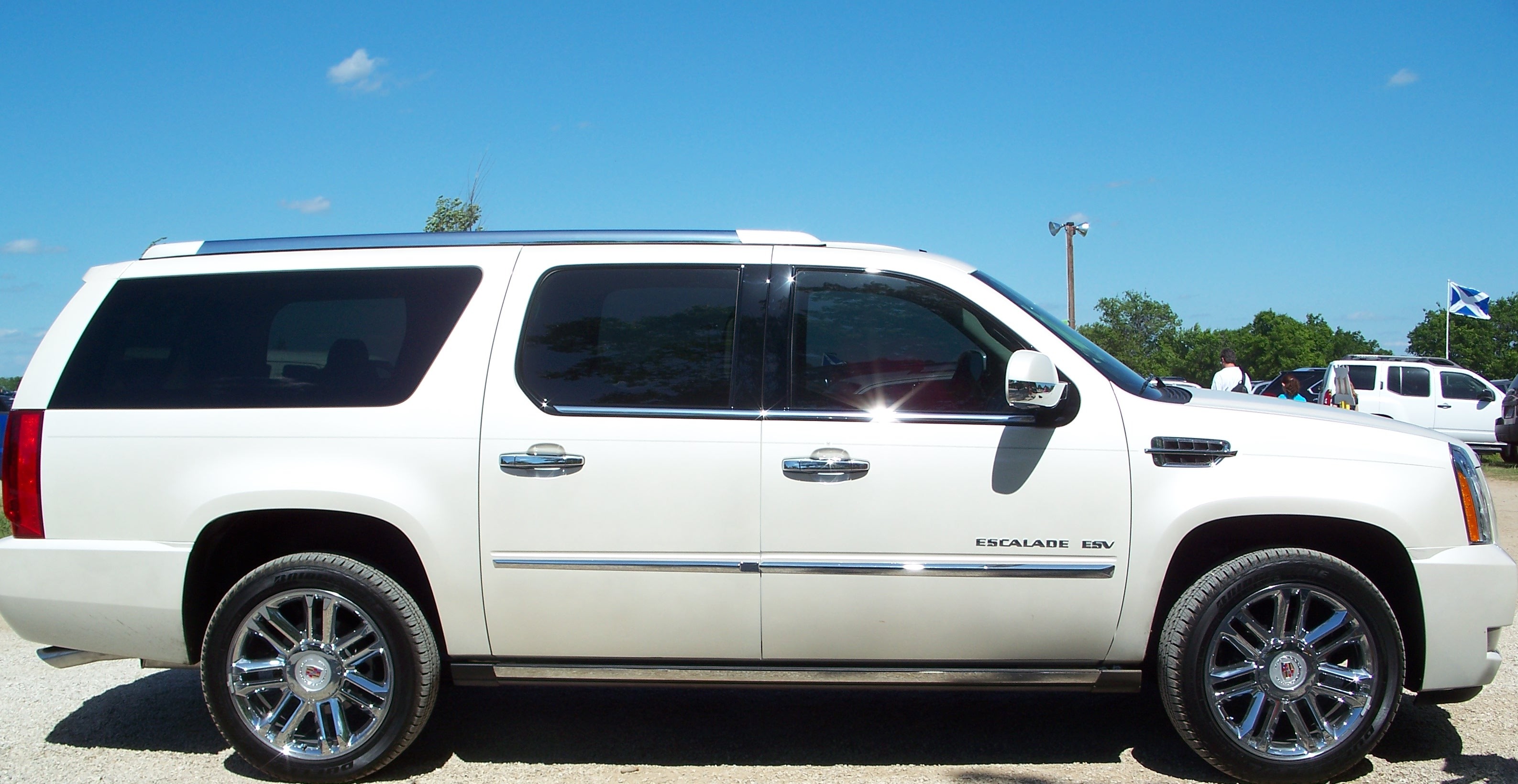
2010 @Cadillac Escalade ESV Platinum Final Thoughts

The story so far: I picked up a 2010 Cadillac Escalade ESV Platinum from Crest Cadillac in Plano to test drive this weekend.  Saturday was Tennis a Escalade, and Night LifeSunday was a trip to Scarborough Faire.

I dropped off the Escalade ESV Platinum at Crest Cadillac this morning after a fun test drive over the weekend.

Summary: The Escalade ESV Platinum is like flying first class.  If you appreciate the additional space, the higher quality accommodations, and the personal service, then it is worth it. For the ESV Platinum the Cadillac Team has carefully and thoughtfully addressed every surface, every feature, every option of the ESV to be of the highest quality and utility.

Final thoughts (no particular order):

  • The Escalade ESV is an excellent vehicle if you need to do the things the ESV can do — haul 7 people and all their stuff in absolute comfort, or tow a horse trailer (or yacht!).
  • The ESV Platinum has absolutely exquisite appointments — everything is top notch
  • Tahama leather seats are very nice
  • In my usage the ESV got a combined 16.5 mpg or so in fuel economy
  • The L94 Engine has a perfectly smooth idle — no occasional cammy pulse like the CTS-V had
  • The ESV says “Premium Fuel Recommended” on the fuel flap; that surprised me — I thought the L94 V8 would use regular unleaded.
  • If I owned the ESV I would also look for an E85 flex fuel station and always use E85; I think alternate fuels are fun
  • With the electric, automatic running boards no problem for me or my Wife to get up into the ESV
  • I am sold on blind zone alert and heated/cooled cup holders after using them.

My Host for this test drive is Crest Cadillac of Plano, Texas.  They are located at 2701 North Central Expressway, Plano, Texas.  You can contact them by phone Toll-free at 1-866-697-9144 or locally at (972)578-7511, or on Twitter or Facebook