2008 Cadillac STS-V Spectre CAI + Corsa 394.3 whp 380.4 lb ft

Today I headed back to True Street Motorsports in McKinney Texas to get some dyno time in and check my air fuel ratios after the addition of the Corsa axle back exhaust.  Click on the graph to zoom in, then hit back on your browser to get back.
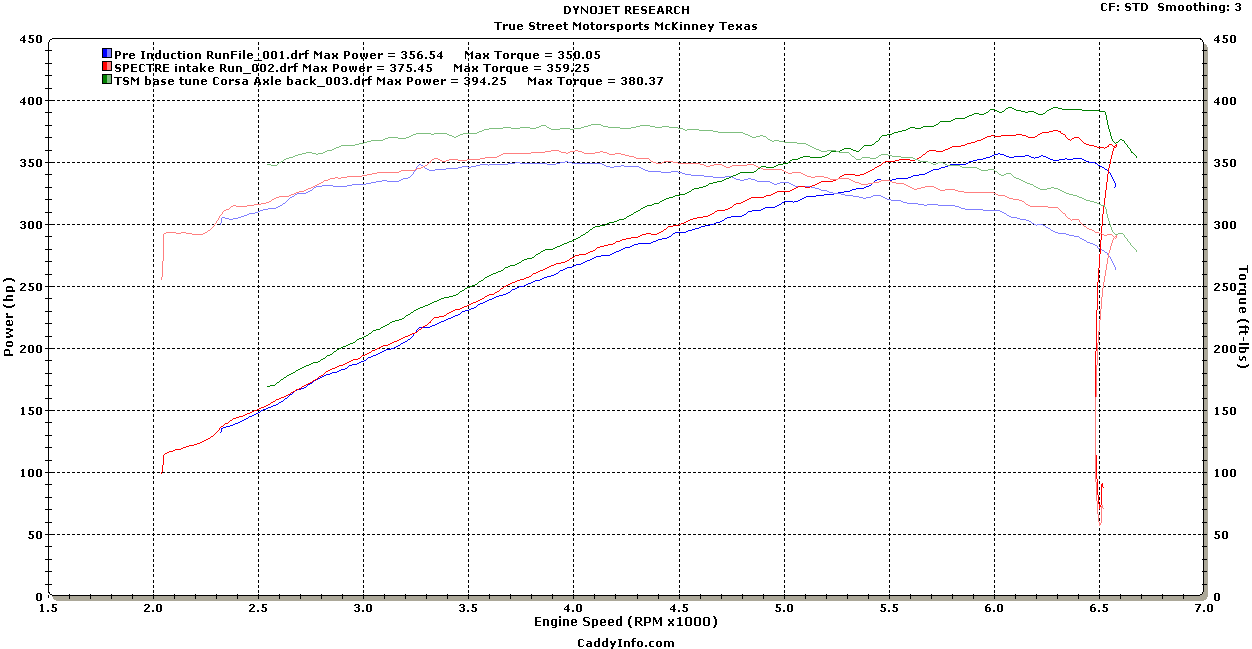
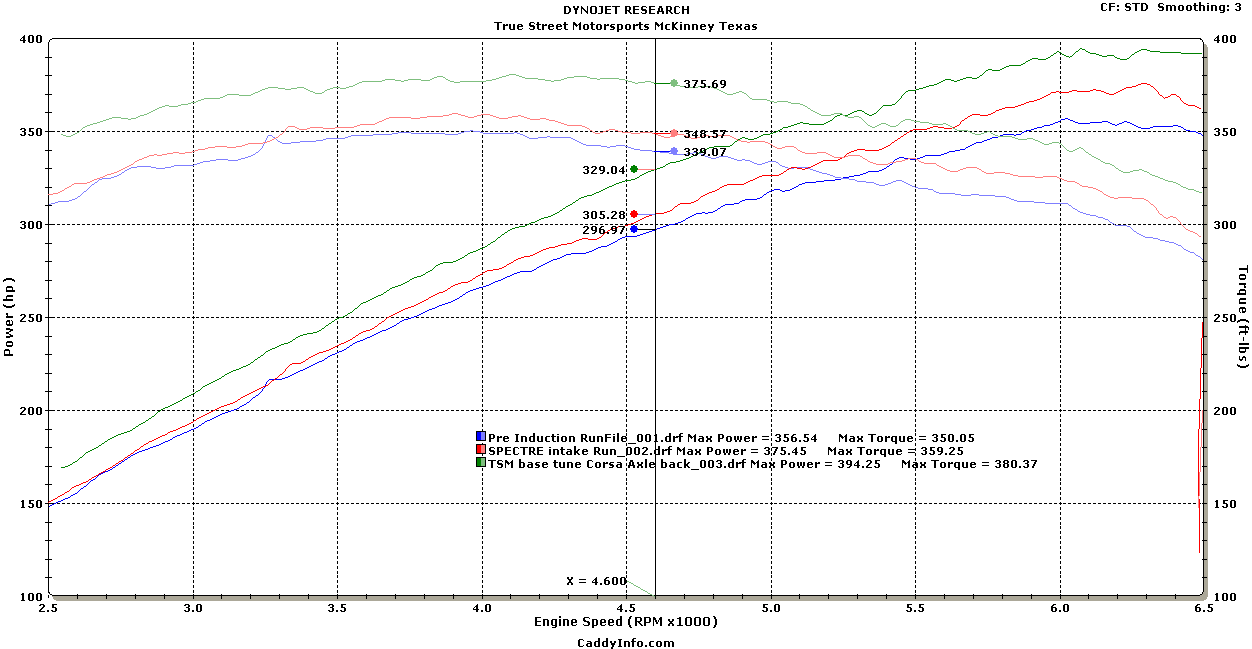
STS-V WHP and Torque vs Engine RPM

Coincidentally, the Spectre Cold Air Intake (CAI) added 19 wheel horsepower (whp) over the baseline pre-Spectre CAI, and the Cora axle-back with the Spectre added another 19 whp for a total of 38 whp.  The Corsa addition opened up a nice 20 ft lb of torque.

A dyno measures horsepower at the wheels, or whp.  This is always less than the manufacturer’s advertised engine horsepower, or hp at the crank of the engine.  WHP is hp after losses through the transmission and drivetrain.  A reasonable figure for these losses on the STS-V’s 6L80e transmission is 20-24%.  On my STS-V, the stock car was rated for 469 crank hp and made 356 whp on the dyno, or  a 24% loss.  if we use 22% as an average then the V originally made 456 hp stock.  The addition of the Spectre got the car to 375 whp or +24 crank hp, and the addition of the Corsa with the Spectre CAI got the STS-V to 394 whp or +49 crank hp.  Overall a nice gain for two easy bolt-ons, and the STS-V is now making 394 whp which at 20-24% losses equates to 492-518 hp at the crank.
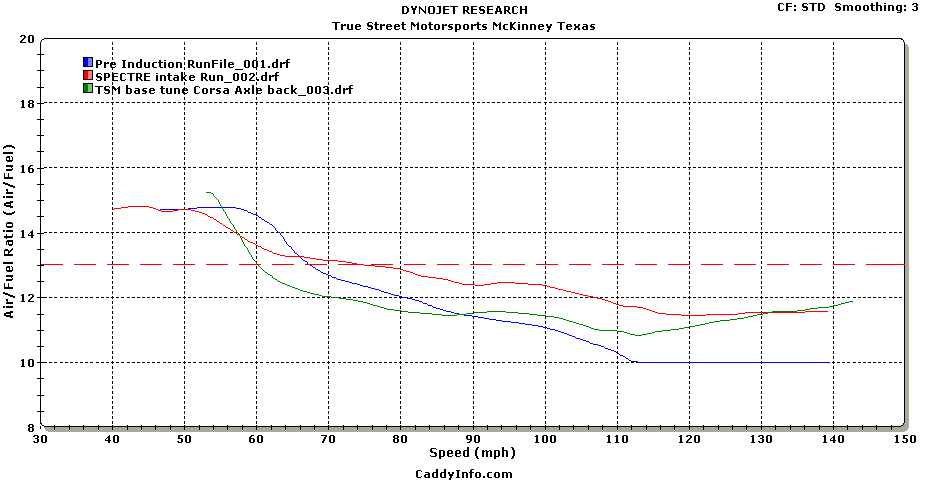
Air Fuel Ratios

Part of the point of the visit was to ensure the Air Fuel ratio was in the right range and stayed there throughout the Wide Open Throttle dyno run.    The resulting fuel levels are safe and consistent with commanded.

This graph shows the same info zoomed in a bit and with a detail point showing that the new exhaust at key points actually adds +27 lb ft of torque:
I am close to my power goal of over 400 whp on the dyno at 394 whp.   I want to run a new baseline on the dyno with the car cool and not heat-soaked for comparison.  In fact, our 3rd run was at the same whp as the initial run today, but with the intercooler Intake Air Temp 2s (IAT2) hitting 150F+ due to the stress of repeat dyno runs on the original,  stock intercooler cooling system.    That suggests that the V may put down 400 whp when not heat soaked.

Fun day, and as always the True Street Motorsports team is easy to work with and helpful.
Cool Air, new Cadillac STS-V times

I have some dyno time scheduled for Saturday, so I wanted to get a current baseline on my 08 Cadillac STS-V.

Racelogic PerformanceBox GPS times:

Speed(mph) Time(s) W/Rollout Dist(f)
10 0.95 0.56 6.34
20 1.64 1.25 21.45
30 2.31 1.92 45.86
40 3.05 2.66 84.29
50 3.94 3.55 143.25
60 4.94 4.55 223.83

New low time today — a 4.55 sec 0-60 mph with rollout, or 4.94 sec w/o rollout.  This was my goal for the V — to get to a solid <5 sec without rollout.  Car had 3/4 tank of fuel and the run not heat soaked.   The STS-V has the Spectre cold air intake and a Corsa axle-back exhaust system.  I weigh 35 lbs more than the standard 160 lbs for the buff magazine journalists who get the great times for car mag tests.    Local fuel is 93 octane E10.  The backup 0-60 run was 4.74/5.13 sec.

The 60′ time was 2.2 sec, which is an improvement from my usual 2.4 sec.  PkAccelG was 0.77G. The 1-2 shift was recorded at 0.4 seconds.

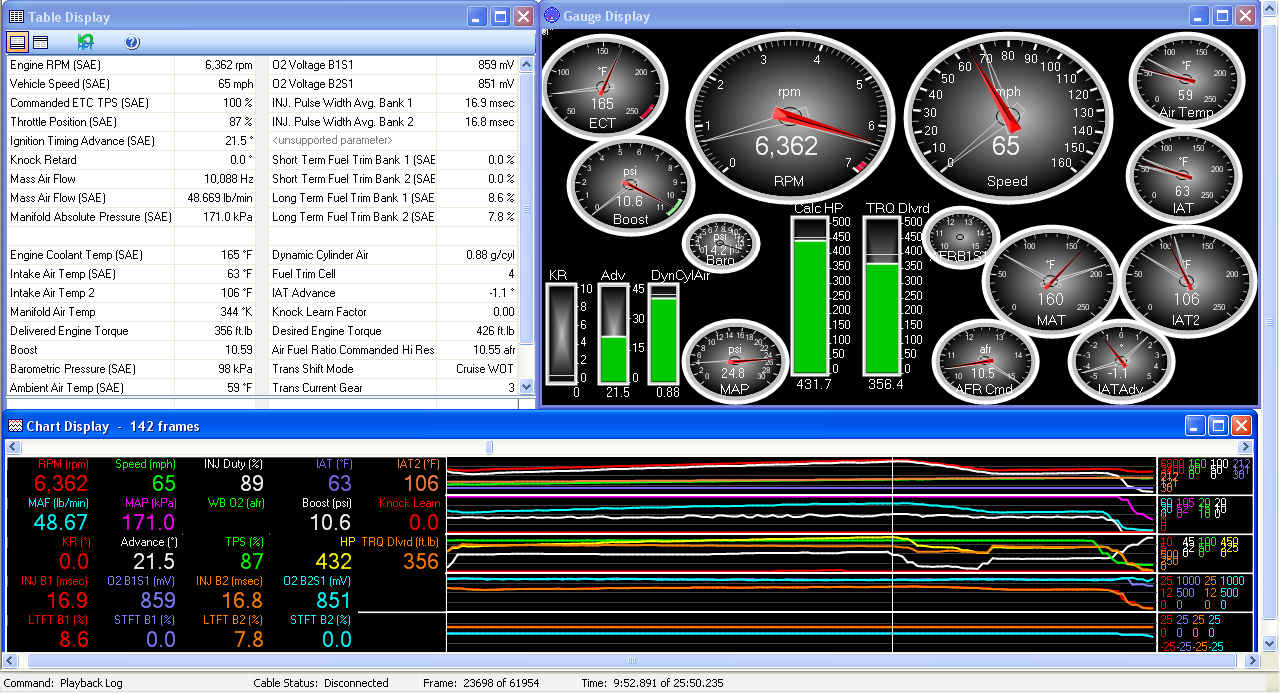
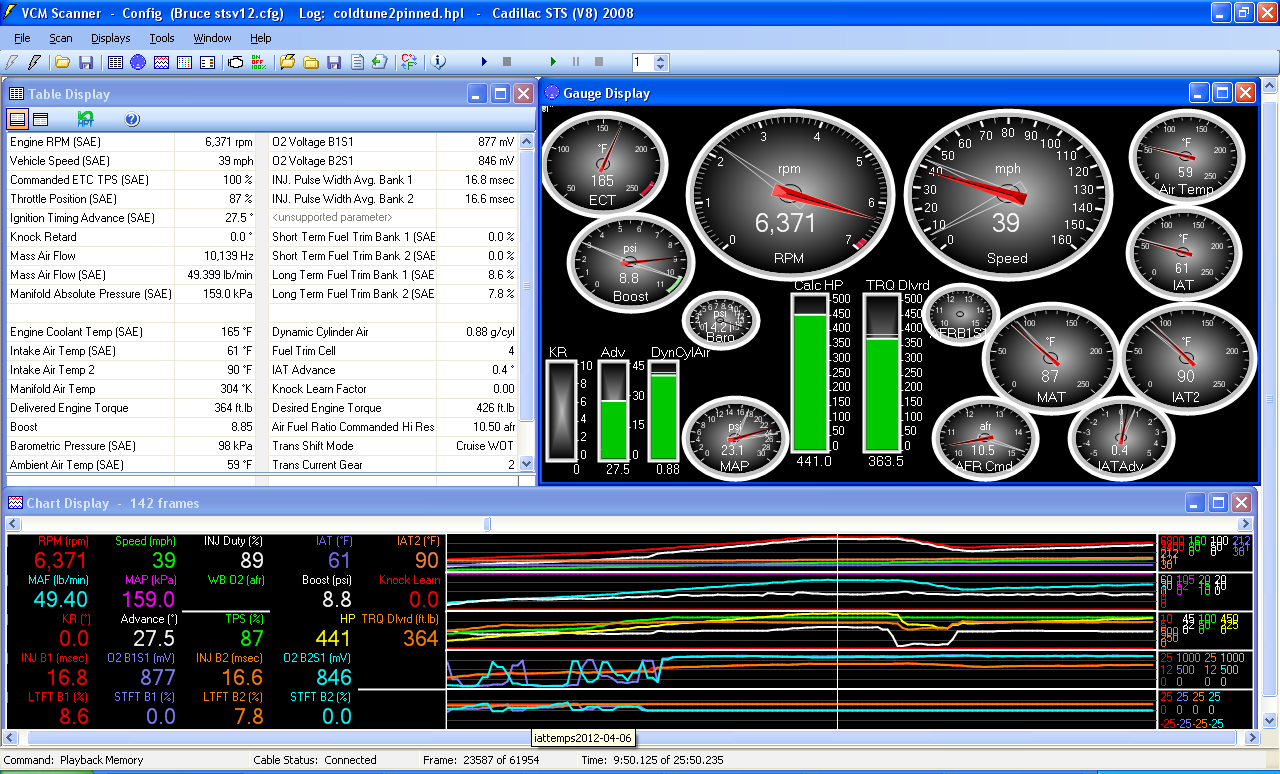
Peak Hp was calculated at 6,371 RPM: [click on the image to zoom, hit back to return]

Peak calculated HP at 6,371 RPM

Calculated HP has steadily run less than expected on this V, but I am not clear why.  It uses the Delivered Torque calculated by the engine at RPM to calculate theoretical HP.  The value is a notional figure and not considered accurate for tuning, but I use it as a relative indicator.  I am also not able to run flat out in 4th gear as on the dyno though.

Same run, peak HP at 65 mph at top of 2nd gear:

Top of 2nd gear at 65 mph

Interesting that boost in 2nd gear was running 10.6 psi vs 8.8 psi at the top of 1st gear.  I do not think this is a tuning issue but may have just been a transient thing.  The boost was trending in the 9s then dips and then peaks at 10.2 psi at the 1-2 shift in the scan.

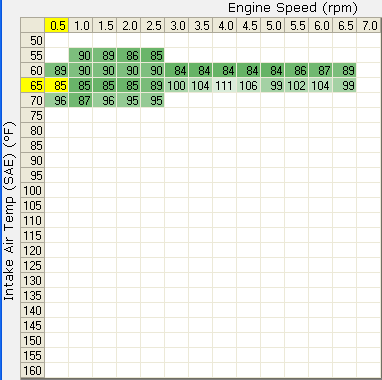
Due to the low temps, the IAT Advance was actually ADDING timing instead of retarding!

Here is the cold air IAT / IAT2 histogram for the whole test cycle:

No KR anywhere on the run.   PE is commanding AFRs down to 10.5, so that is something to consider.  Safe AFR for a supercharged engine probably up at 11.5 to 11.8 where the engine should make more power.

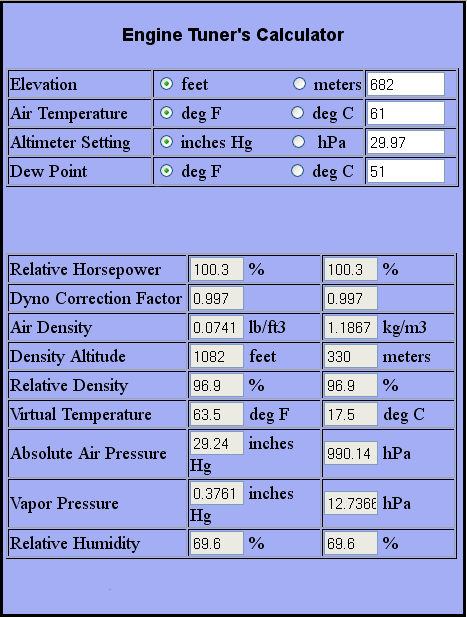
Atmospheric Conditions:

Atmospheric conditions and effect on HP


Taking Cooling Cues from the ZL1

The May 2012 GM High Tech Performance Magazine has a nice article (not on the website yet)  about the new Chevrolet Camaro ZL1 development.  The ZL1 uses some parts in common with the Cadillac CTS-V, only with the opportunity for the team to tweak a few things.

  • Intercooler pump:  the ZL1 uses the water pump from the Chevrolet Volt — which is super efficient — but runs it at 80W instead of the Volt’s 50W.
  • Dual mode muffler setup
  • Secondary air inlet to the airbox
  • Redesigned intercooler brick with higher water flow rate and higher air flow rate so less pressure drop

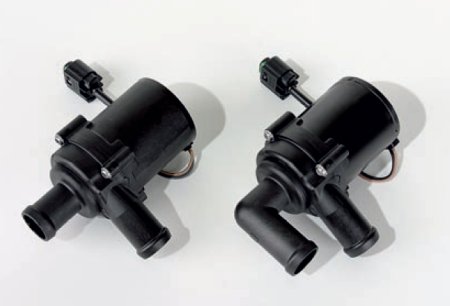
Is this the battery cooling pump perhaps:

13579713 PUMP. Drive Motor Battery Cooling. Engine Coolant.
PUMP,DRV MOT BAT COOL. Required: 01

and the Volt Battery cooling radiator is this one:

20925998 RADIATOR. Drive Motor Battery
RADIATOR, DRV MOT BAT COOL. Required: 01For: RC (2011-2011)

Actually, the Volt battery cooling system looks a lot like an intercooler heat exchanger system:

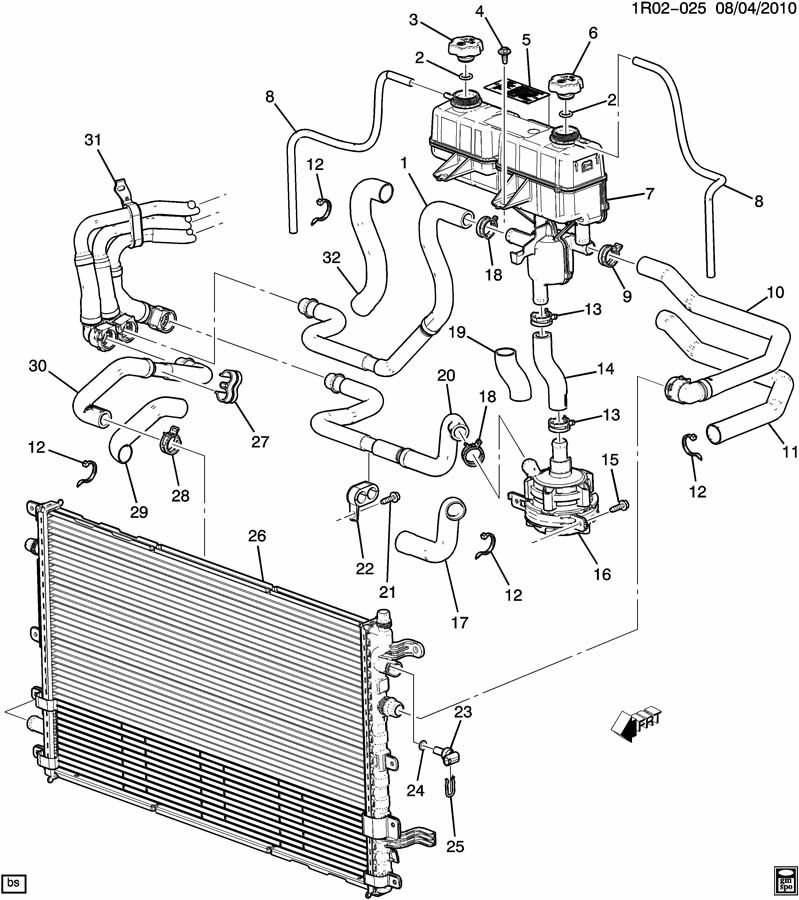
Chevrolet Volt Battery Cooling System


The ZL1 is rated for 580 hp instead of the CTS-V’s 556 hp — and based on the improved intercooler work it should be more resistant to heat soak.