
Project Cadillac Tuning Plan

I am enjoying my 2008 Cadillac STS-V; it is a terrific design right out of the box.   Cadillac pulled out some stops in developing this unique 4.4L Supercharged Northstar variant.  For example, the exhaust manifold was extrude honed to optimize flow.  Originally the V was rumored to get 440 hp, but with some final tuning the team was able to raise the STS-V to 469 hp.
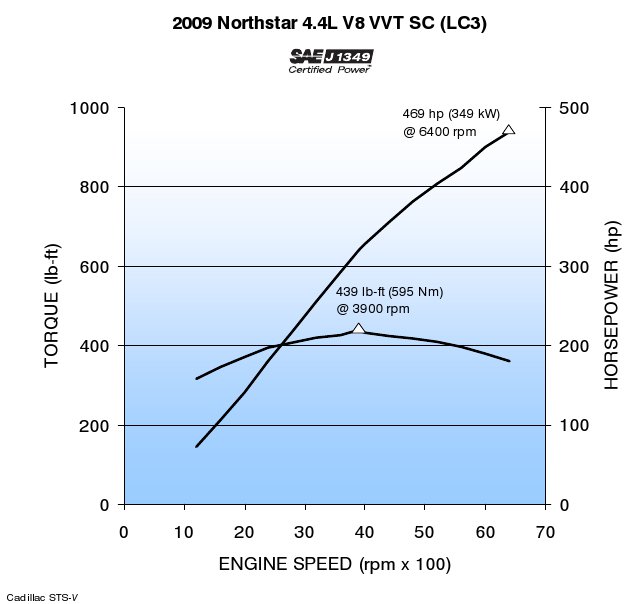
An engine dyno as in the graph above measures horepower at the crank (hp).  A chassis dyno measures horsepower at the wheels (whp).  Horsepower at the wheels includes inefficiencies of the powertrain.

For an automatic RWD automobile, powertrain inefficiencies often run 20% of the power.  So for a 469 hp STS-V, one might expect to measure 469 x 0.8 = 375 hp at the wheels.  From my research, most STS-Vs measure 360-370 hp at the wheels, so perhaps a bit more than 20% loss at 22-24% due to luxury isolation in the powertrain. One outlier pulled 379-387 whp however.

HP is often used to indicate hp at the crank, and whp, or wheel horsepower, is used to indicate horsepower at the wheels.

To go from chassis dyno wheel hp to hp at the crank, divide by 1-inefficiency.  So if inefficiency = 20%, WHP/(1-20%) = WHP/80% = crank hp.

The classic hot rodding questions are,

  • How much money do you have?  and
  • How fast do you want to go?

The hidden gem in this discussion is, before you sink a ton of money into your car, you should have a plan.  If you want to achieve a specific goal, then you might start with a different car, for an extreme example.
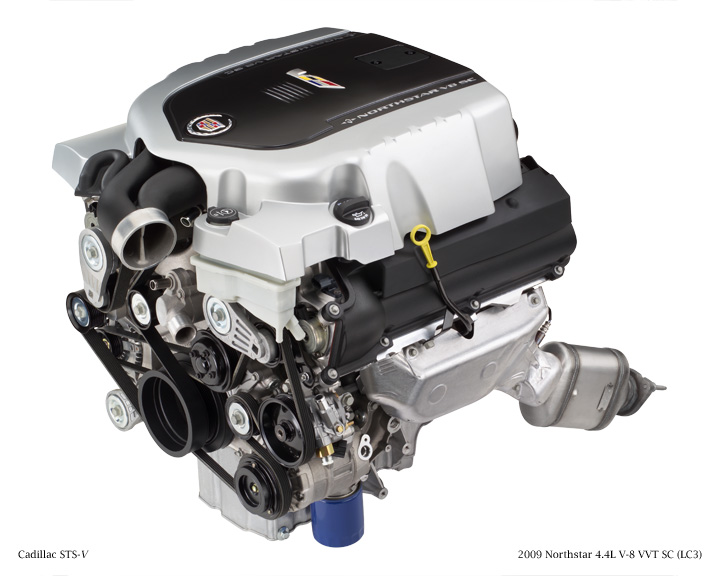
Supercharged Northstar

My goals for developing my STS-V:

  • It is a Cadillac: maintain luxury features,  & avoid “noise for noise sake”
  • Test and Tune:  only add / change items which prove to add performance
  • Phase 1:  500 hp, so 400 whp
  • Phase 2: 550 hp, so 440 whp

What will that let me do?

  • Be happy that the Cadillac STS-V is tuned to optimum performance
  • Enjoy the journey of researching, selecting, testing, and writing about the Cadillac Project

My first Project looks set to be a Spectre intake from Jaime at StreetSideAuto.  In Spectre’s tests the intake added 40+ whp.  True Street Motorsports has agreed to help with testing the new intake once it arrives using their Dynojet dyno.  First we’ll establish a baseline for the STS-V stock.  Then hopefully we can get clear before/after apples to apples tests with and without each modification.

In my True Streets Motorsports correspondence they refer to the test as “Project Cadillac”, hence today’s title.

Other project ideas in sight:

  • Custom Tuning
  • Intercooler pump, reservoir or heat exchanger mods

More to come as things change, arrive, and evolve.

What would you like to see tested on a Cadillac STS-V?  If you have a performance product you would like to have independently tested on a Cadillac STS-V, please let me know.
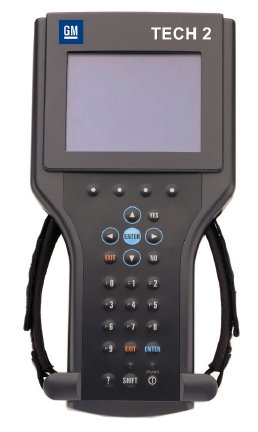
GM Bosch Vetronix HP Tech 2 with CANDI

General Motors Repair Technicians use a hand-held computer called the “Tech 2” to diagnose and tune modern vehicles.   It is called the Tech 2 because there was originally a Tech 1, and this is the update.

GM Tech 2

Tech 2

The Tech 2 is like a scan tool on steroids, with some additional tuning options thrown in.  As a scanning tool, the Tech 2 excels.  While an off the shelf scanner will read the Engine Diagnostic Trouble Codes (DTCs), the Tech 2 will read and report information from all the car’s systems, including ABS, Air Conditioning, Air Bags, and other systems a standard scanner will not read.  For example, in my CTS Seat experiment after the seat was replaced the Tech 2 must be used to run a Passenger Presence System relearn.  There is no other way to run this tuning step other than with the Tech 2.  Similarly some vehicle customizations or radio resets require a Tech 2 to perform.

Bosch has this informative video on the Tech 2: Bosch Tech 2 Video

Vetronix made the Tech 1.  The original GM Tech 2 was made by Hewlett Packard and used Vetronix software.  Vetronix purchased the Tech 2 manufacturing rights from HP.  In 2003, Vetronix was acquired by ETAS, a supplier of standardized development and diagnostic tools for electronic control units. In 2006, the Vetronix Aftermarket division merged with Bosch Automotive Aftermarket, responsible for supply, sales and logistics of automotive parts for service of the vehicle.  So today the Tech 2 is ‘made’ by Bosch.

The Tech 2 is used for GM Vehicles from 1992-present.  It is kept up to date by updating the 32  MB Pcmcia memory card with the latest diagnostic software.  Current cars with the CAN bus require the CANDI interface for the Tech II to communicate with the vehicle.

A Tech 2 costs — pick a number.  New models appear to cost as much as $4K, and the retail price is shown as even higher — as much as $8K or $9K depending on the site.  Discount new units are available for as low as $2300 on ebay for example, and used units run a bit less.  There appears to be a market in Chinese clones for the Tech 2 and software, although I am opposed to piracy of intellectual property.  My impression from shopping is that you should budget around $2K for an authentic Tech 2 in good condition with all accessories, 32 MB card, and CANDI module.

In the future GM appears to be moving to a laptop based scanning and diagnostic tool using the GM Multiple Diagnostic Interface (MDI) EL-47955.  The GM MDI will replace the Tech 2 for diagnostics in the future, but will not replace the Tech 2 for 1992-2009 vehicles.

The GM MDI is a compact communication module that manages the transfer of data between a vehicles onboard ECU network and a PC.  The GM MDI offers faster programming speed at a lower cost. Depending on the vehicle architecture, the MDI can be 20%-70% faster than the Tech2.  The GM MDI allows the user to perform Pass-Thru programming procedures using software running on a laptop or desktop PC.   Any PC can be used.

G/1kMi? Making MPG more understandable

I suggest we mirror the Europeans and turn our mpg upside down, and start tabulating gallons per mile.  More specifically, gallons per thousand miles.

The problem with MPG is that it is not really very good for comparison.  As MPG goes up, the difference between changes is progressively less important.    For example improve a 20 mpg car by 5 mpg and it saves 10 gallons in 1000 miles.  Improve a 50 mpg car by 5 mpg and it saves 2 gallons in 1000 miles.  Sounds like the same gain, but is a very different improvement.  Flip it upside down though, and it becomes more clear.  Improve a 35 Gallons / 1K Miles (G/1kMi) car by 5 G/ 1kMi and has a similar effect to improving a  50 G/1kMi by 5 G/1kMi.  Both save 5 gallons in 1K Miles.

The Cadillac CTS is rated at 27 mpg highway.  So over a course of 1,000 miles it would require 1,000 miles / 28 mpg = 35.7 gallons of fuel, or 35.7 G/1kMi

The latest Chevrolet Cruze may be rated at up to 44 mpg, or 22.7 G/1kMi.  Clearly by comparison with the CTS, the Cruze will require around 13 G/1kMi less, and I know that gas costs around $2.50 this week, so I can surmise that the Cruze would cost around $32 less to drive 1K miles.  For my annual 15K miles the Cruze would save me 15 x $32 = $480 per year.

On the other hand, a Cadillac Escalade gets around 20 mpg highway, or 50 G/1kMi.  So it would require 24 gallons more than the CTS to go 1,000 miles, at $2.50 around $60 more per 1K.

Why choose 1K miles instead of 100 miles?  So that the variance between models is very clear.  Also it makes it even easier to consider total monthly usage.  If you drive your vehicle 15K miles a year, multiple by 15, etc.

We would still want to measure City G/1kMi and Highway G/1kMi perhaps, and Mixed G/1kMi.

Adoption of G/1kMi as our fuel efficiency standard would help people understand and strive for better fuel economy.