What can we expect of a Cadillac XTS AWD Twin-Turbo?

Motor Trend measured performance for the Cadillac XTS AWD 3.6L normally aspirated model at 6.9 sec for 0-60 mph, and the quarter mile in 15.2 seconds.  What can we expect from the upcoming 410 hp / 359 lb-ft of torque twin-turbo 3.6L V6?

The new Cadillac Twin-Turbo 3.6L V-6 is available in the XTS, delivering SAE-certified 410 horsepower (306 kW) and 369 lb.-ft. of torque (500 Nm), making it one of the most power-dense six-cylinder engines in the segment. A pair of smaller turbochargers and an efficient charge air cooler help provide more immediate power delivery, while peak torque is sustained over a broad range – 1,900 to 5,600 rpm – for a confident feeling of power in almost all driving conditions, such as accelerating or overtaking traffic on the highway.

One thumb rule is for every 10 hp added, 0-60 mph goes down by 0.2 sec.  Another rule is for every 100 lbs added, 0-60 goes up by 0.1 sec.

The XTS TTV6 is likely to add around 200 lbs, so we’ll keep up with that +0.2 sec change.

Horsepower
(hp / kW @ rpm):
304 / 224 @ 6800 (SAE certified) 410 / 306 @ 6000 (SAE certified)
Torque
(lb.-ft. / Nm @ rpm):
264 / 355 @ 5200 (SAE certified) 369 / 500 @ 1900-5600 (SAE certified)

The 3.6L in the normally aspirated XTS is rated at 304 hp, so the new model adds 106 hp.  At 0.2 sec reduction for 10 hp that would be a 2 second reduction in 0-60 time — which might drive the 0-60 time down under 5 seconds.

Now, usually reduction don’t perfectly translate for large changes in horsepower.  Energy is lost to spinning tires etc.  But in this case we are looking at an AWD model only, so traction should be assured.

Let’s think of this another way:  the CTS VSport will have 420 hp and 430 ft-lb of torque (the XTS variant loses a lot of torque to protect the AWD drivetrain).  Cadillac said the CTS VSport will do 0-60 in around 4.6 seconds.  With 10 hp less, and perhaps 500 lbs more weight, we might expect the XTS AWD TTV6 to be 0.7 sec slower, at 5.3 seconds?

A full size Cadillac XTS AWD TTV6 then might be expected to come in at 4.9-5.5 sec for a 0-60 mph metric.

That will certainly be surprising performance on the street for the big Cadillac.
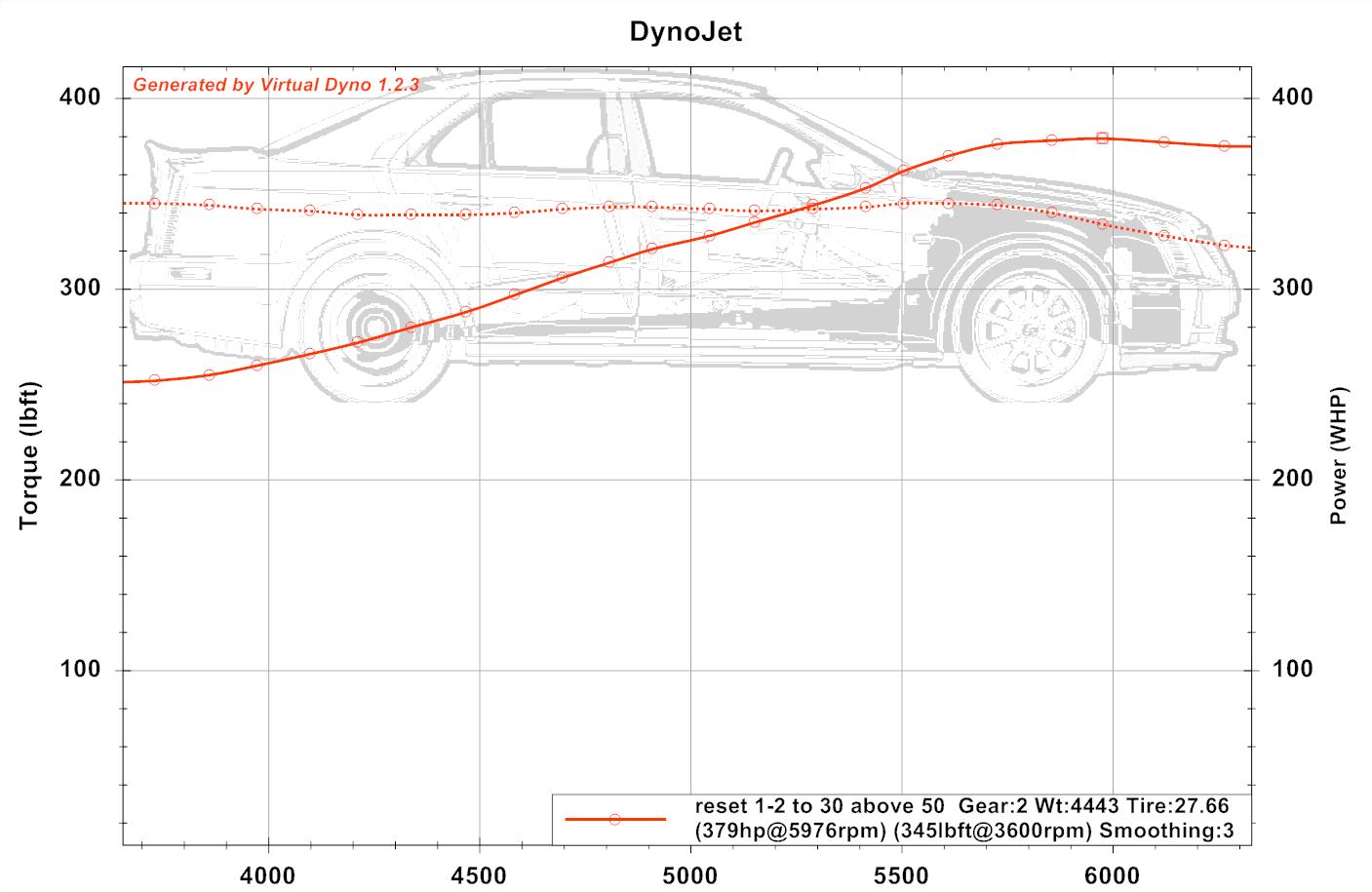
Virtual Dyno vs HPTuners Delivered Torque Curve

Here is an Virtual Dyno analysis of a 2nd gear run up for my STS-V.  The Virtual Dyno considers the change in speed and estimates the hp & torque, much as a regular dyno.  The difference here is that the V is in 2nd gear and pushing against the wind.

2013-05-11 reset hot test

Virtual Dyno makes beautiful dyno graphs; one can get the full size by clicking on the image above, then hit return to return.

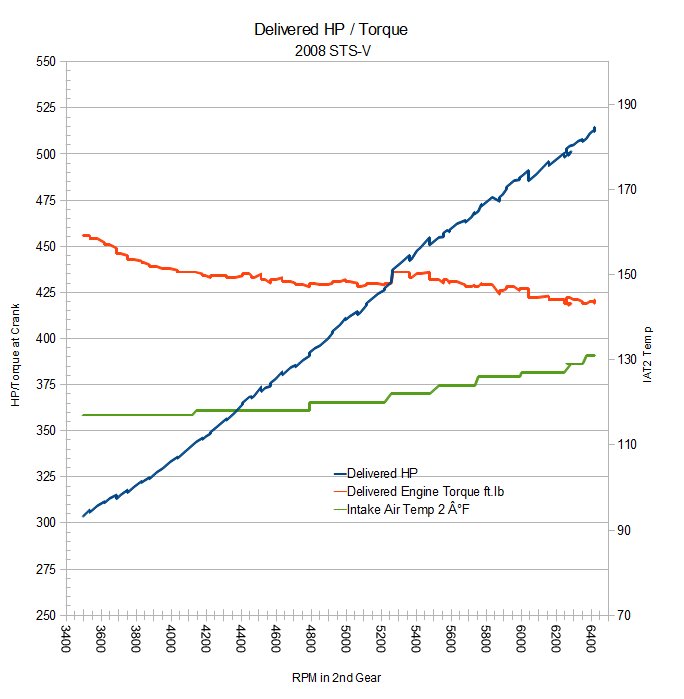
Here is the same info for the same run, graphed using the STS-V’s reported delivered torque and calculated hp for that torque, along with the IAT2 temps:

resetruncomparedeliveredhptorque

The Delivered Torque is an estimated value by the V computer based on engine parameters, and is equivalent to an engine dyno as opposed to a chassis dyno as in  Virtual Dyno.

Both show an item of interest and why I was graphing — the peak torque for the V is not up in the 5K’s but is still around 3500 RPM.  Certainly the torque curve is very flat for the supercharged V8.

Somewhat surprising how much the two disagree on the slope of the HP above 6000 RPM.  The transmission is already thinking about shifting to 3rd at that point, which could effect the incremental results measured by the Virtual Dyno more — the engine output doesn’t care if the engine is ‘clutched’ or not.

Do you have any suggestions on how to get more info out of this data?  I am using HPTuners to capture sensor data from a test drive, then saving as a .csv file, and using Virtual Dyno to analyze the .csv, or Calc to create the lower graphic from the .csv data.


Cadillac STS-V shift testing, adjustment 1

[Note the video quality can be adjusted up (click on the gear), and the video can be made full screen.]

Adjustment 1 set: Kept the 1-2 shift at 30 mph, and raised the 2-3 shift to 60 mph across all shift modes.  Raised the absolute fuel cutoff from 6700 rpm to 7000 rpm.  TM adjusted to 25%.

Interestingly, with no change in shift points the 1-2 shift revved to 6600 rpm and hit a new higher calculated hp value.

Shifttest2013-05-11max15

Previously the 2-3 shift was commanded at 58 but happened at 60 mph.  When I moved the commanded mph up to 60 mph it continued to be commanded at 60 mph.  More testing needed there to understand.

I observe that the car is actually slowing down during shifts, perhaps due to engine braking in sport mode.  I will plan to retest with the transmission in drive, which does not use engine braking, to see if that is advantageous.

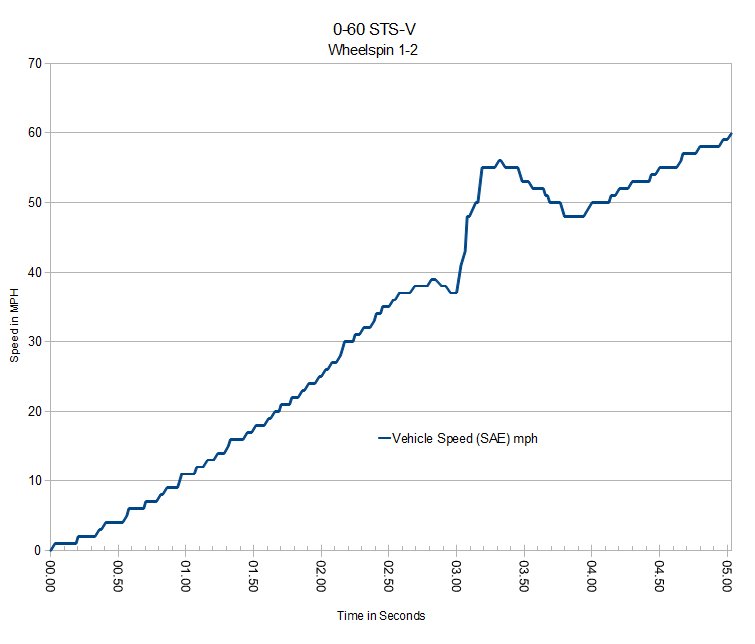
Update:  I see a source of delay in the 0-60 time — wheelspin after the 1-2 shift is a problem.

Mph Time
0 0
5 0.56
10 0.95
15 1.31
20 1.66
25 1.98
30 2.17
35 2.45
40 3.03
45 3.08
50 3.14
55 3.19
60 5.03
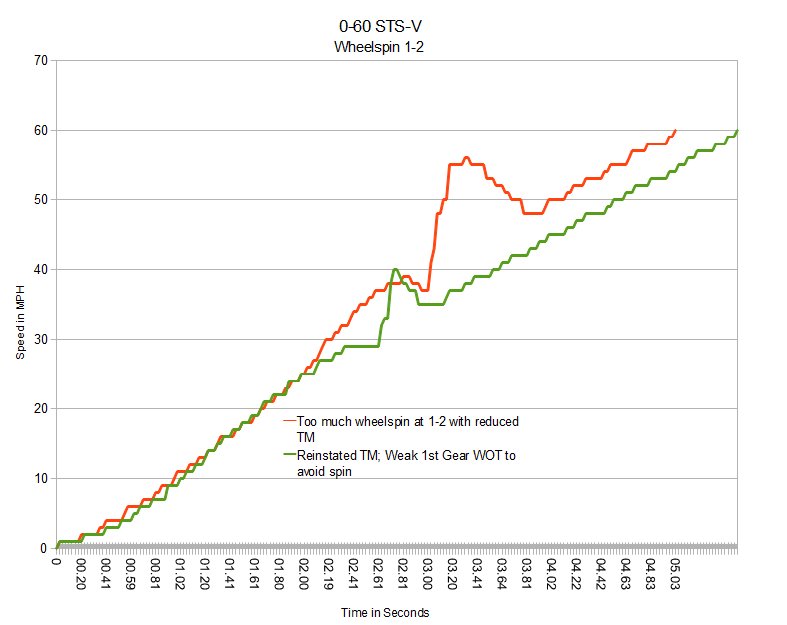
Too much wheel spin after the 1-2 shift at 3 seconds is causing a false mph indicator for a spike to 55 mph after the shift.
The 40-55 run in the middle is due to spinning tires.

run1at15accelerationgraph

Reinstated TM and retested.  Didn’t go WOT early enough in the retest to avoid the transmission shifting early 1-2 (shift commanded at 23 mph).

run1at15accelerationgraph2ReinTM