
When Can a Single V6 work well in a Cadillac or a Camaro?

When can a single V6 engine work well in a Cadillac or a Camaro?  When it is as good as the LLT V6.
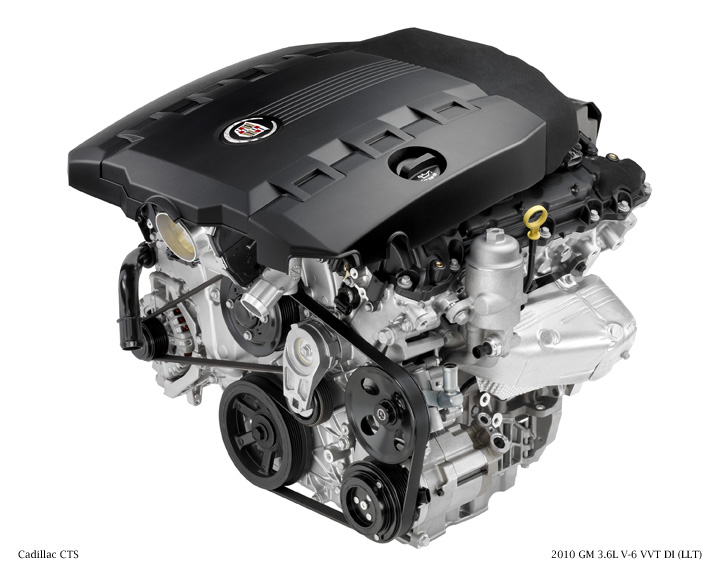
2010 GM 3.6L V-6 VVT DI (LLT) for Cadillac CTS

What are the features one would need to fit these disparate platforms?  For the Camaro, you might might focus on maximum torque, and maximum peak horsepower.  For the Cadillac, you might focus on noise, vibration, and harshness while delivering maximum power in a fluid manner.  The LLT V6 manages to fulfill both bills with aplomb.

First, the LLT V6 is a 60 degree V-angle engine.  The ideal V angle for balance alone for a 6 cylinder is 120 degrees, to time when opposing cylinders fire and offset the secondary moment.  This is determined by dividing 720 degrees (2 revolutions for a 4-cycle engine) by the number of cylinders.   Due to packaging (width of the engine) and because it results in a very smooth running engine, 60 degrees is generally accepted as the optimal V-angle for a modern V6.

Variable Valve Timing: The LLT uses variable valve timing to optimize its power range.  Dual overhead cam (DOHC) engines such as the LLT have the advantage of different cams for the intake and exhaust.  VVT engines have the further advantage of phasing the input and output camshafts to provide the optimum low rpm Torque and high RPM power.

Cam phasing also pays big dividends in reducing exhaust emissions. By closing the exhaust valves late at appropriate times, the cam phasers create an internal exhaust-gas recirculation system. The 3.6L V-6 VVT DI meets all emissions mandates without complex, weight-increasing emissions control systems such as EGR and air injection reaction (AIR).

Direct Injection is a relatively new technology that directly injects fuel into the combustion chamber at high pressure.  This results in more complete and regulated combustion.  Traditional fuel injection systems inject a fuel air mixture upstream of the intake valve.  Further, the combination of DOHC, VVT, and DI work synergistically to deliver power, fuel economy, and low emissions.

What is next for the LLT V6? This engine family was originally designed to support displacements up to 4L, and to support Supercharging or Turbocharging.   We may see the 3L variant with a power adder instead of the 3.6L  variant, but the 3.6L will always be close to my heart; I have been driving these 3.6L’s in the non-DI LY7 version for six years now and they are very reliable, flexible engines.  With the addition of forced induction they will be even better.

Performance Tires vs Performance Suspension?

I am hard on tires.  I enjoy driving safely but accelerating briskly from a stop, and not slowing down for corners.    In fact, an ideal passage through a corner is if you hit the apex and just scrub off enough speed to keep the car on track.   That process, scrubbing off enough speed, is part of the problem, because it also tends to means shorter tire life.

As I once mentioned to a friend, if the tires are not squealing as you proceed through the corner, you are not challenging the car.

My current 2005 Cadillac CTS 3.6L has the FE1 (soft) suspension, and the same size wheels and tires all the way around, 225/55R16s.    The car came with Goodyear tires, which I replaced with some take-off OEM Goodyear tires which then were replaced with some Kumho’s and now I have some Continental Touring tires on it.  You begin to see the problem.

Further complicating my planning is that the current performance Cadillacs have staggered wheels/tires, so the rear wheels and tires are larger than the front wheels and tires.  So one cannot rotate the tires front to rear, thus extending the life a bit.

But a key issue is that while the tires on the 2005 Cadillac CTS tend to cost around $110 each, modern high performance tires as used on the V-series tend to run $200-250 each.  Yes, they are great tires.  Yes, they put up great skidpad numbers and help acceleration.  Yes, they are expensive.  And if you are a frequent tire buyer (which I prefer to tire addict) then the expensive part can come up a lot.

Now, I have considered that part of the problem is in fact the FE1 suspension is not designed for the more sporty driving, but is designed for more comfort.  So if I move to a Cadillac that was designed with the expectation of more cornering it perhaps would lead to less tire wear.  I keep trying to find comfort in that line of thought at least.

Meanwhile, I probably need to start saving up for new tires.

Power versus MPG

In selecting my next Cadillac, I am drawn the to highest performance models available within my budget.  More is always better right?

My model for the ‘right’ 0-60 time for a sport sedan is 5.5 to 6  seconds this year.   Performance of cars as a whole changes over time, as automobile performance improves.

The current CTS DI 3.6L will do 0-60 mph in 6.3-6.5 sec.  The CTS should be below 6 seconds with 304 hp, but it also gained a bit of weight with added features, and has fuel economy minded gearing.  Yes I recognize that is kind of in the same range, but let’s assume for this discussion that quicker is important.  So the CTS 3.6L is just on the upper edge of my desired performance envelope, and is right in the right zone for MPG.

Now, the 2006-2009 STS-V with 469 hp will go 0-60 in around 5 sec, or as Cadillac measured in under 5 seconds.  However, this model gets 19 mpg highway compared to the CTS DI 3.6L V6 MPG of 28 MPG highway.

One compromise candidate is the 2005-2009 STS 4.6L V8, with the 320 hp VVT Northstar.  This sedan gets very close to 0-60 mph in 6 sec in most tests, and has fair fuel economy at 24 mpg highway.

The new Gen2 CTS-V with 556 hp supercharged 6.2L V8 will do 0-60 mph in under 4 seconds with a Cadillac test driver, or just over 4 seconds with a magazine writer driving.  The new CTS-V is still outside of my budget however, and also gets 19 mpg highway.

The 2006-2007 Cadillac CTS-V with 6L LS2 V8 engines would do 0-60 in under 5 seconds, and are rated at 24 mpg highway.  So these are interesting, but they will soon be out of warranty.  I like to keep my daily driver under warranty, so if there is an issue I can simply drop it off for service, pick up a loaner car, and be on my way.  These are also only available in manual transmissions.  A manual is okay for me, but is challenging for other members of my household.

So this thought process leaves me wondering if I should change my target from “as quick as possible” to “as quick as possible and still get more than 24 mpg highway”, or similar.

In this range that 5 mpg costs around $1000 per year given my mileage per year and average gas prices.  So would you pay $1000 per year for another 150 hp, or 47% more power?  I suppose over the 5 years I plan to drive the car that is less than the cost of a Supercharger or similar power adder.

How many MPG is more power worth to you?