Cadillac AWD Technology, the videos

Driver interview while driving an All-Wheel Drive 2010 SRX  helps explain in lay-person’s terms why an All-wheel drive vehicle is superior as an all-weather vehicle:

For 2010 we have an all new, All wheel drive system.  The new feature is an electronic limited slip differential that is able to deliver torque across the rear axle of the vehicle to put power to the tire that has traction available to it.   This is really helpful in terms of your safety and security, making the car go where you want it to, getting started in tough conditions on hills and so on.  Just a great feature, and makes the car really enjoyable to drive when the going gets tough like this.

One of the great things about our Cadillac systems is the refinement that we offer, the smoothness of application and the sense of security that  the systems will give to you as you drive under tough conditions.  The vehicle  feels very sure footed, and makes you confident that you are going to get where you want to go, and get there safely.

This animation shows the system with shift in torque front to back or left to right:

You can read more about the AWD Haldex System here.  The new Cadillac XTS Platinum Concept car uses a similar AWD system as standard equipment.

To date all-wheel drive systems do not give advantages in terms of absolute cornering on a dry surface.  They can be an advantage in acceleration on a slick or dry surface, but because traditional AWD systems also brought a significant weight penalty the net advantage of the additional traction is more than offset by the added weight and thus reduced acceleration.  The new system is somwhat lighter, but also responds more quickly than traditional systems.

Test Gear: ContourHD Camera

I received a ContourHD helmet camera for Christmas. We shopped these and discovered that the latest 1080p version was out, and the previous 720p version was on sale at Amazon with a gift card deal, so we got the previous version, the ContourHD, and my Wife kept the gift card.  Win-win.

After a quick setup and experimentation, here is a test video along a tree-lined road.  Not dramatic video, but the video angle, lens, and video quality seem good:

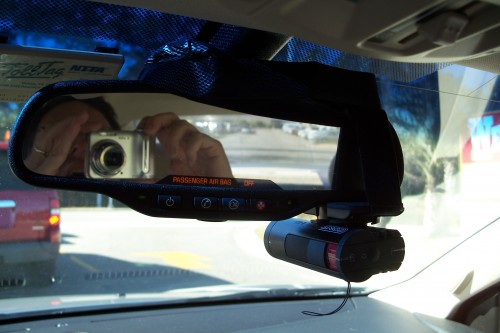
The VHoldR ContourHD is a video camera in the shape of a small cylinder with attachment points.  It records video to a micro-SD card.  It runs off a battery so is self-contained.  Because it is very light (4 oz) it is also easy to mount on a helmet, or in my case in the Cadillac CTS on the rear view mirror.

The camera came with a 2GB microSD card, although additional cards (extended recording by swapping cards) and larger capacity cards can be used, up to 16 GB.  The battery recharges when you attach the camera via a cable to the USB port on the PC; easy.

ContourHD

The ContourHD like the one I have records in either HD (1280×720 pixels), 720p, or in SD (848×480 pixels), 480p. The latest model, the Contour HD 1080p, records in:

Video Choices for the 1080p:

Video Resolutions
Window Size Frame Rate Record
Full HD – 1080p 1920×1080 pixels 30fps 15min/GB
Tall HD – 960p 1280×960 pixels 30fps 15min/GB
Action HD – 720p 1280×720 pixels 60fps 15min/GB
Contour HD – 720p 1280×720 pixels 30fps 30min/GB
Fast SD – WVGA 848×480 pixels 60fps 30min/GB

a variety of resolutions.

The ContourHD does not have a video display for realtime video review.  To understand and test the best mounting points for the camera in the Cadillac CTS I would try it at different points, then connect it to my netbook, download the video, and review it.  I decided that attaching the ContourHD to the rearview mirror with a clear view out the front of the CTS was best.

The Rearview mirror in the CTS is a large one, with the OnStar access built in to the mirror.  One advantage is that the bottom of the mirror is a flat surface, so it made it easier to attach the camera.  I shopped Walmart in Georgetown, SC where we are vacationing this week and found a Velcro strap to use to attach the camera to the mirror.

camera mounted on mirror

Mirror Mount with Velcro One-wrap

I used a Velcro One-wrap 3ft x 1 in to attach the ContourHD. A more permanent and repeatable mounting would be more desirable, but this worked for my test drive.

The ContourHD captures video in Quicktime format. It comes with an editing program that can be used to crop the video, but does not offer options to resize. VHoldR does offer online storage of captured video; the video above is on their site.

Overall I am happy with the ContourHD. Because it is light and battery powered, it is easy to mount in interesting places to capture video. It is inexpensive, but appears to be well made. I am not a fan of their side rail mounting system so far, but as I become more familiar with it perhaps it will grow on me.

For inside the Cadillac footage my cruisecam shortbar mount and digital camera really work well.  I think the ContourHD would be more interesting strapped to the exterior mirror or front air scoop.  I plan to keep experimenting with placement and see what works.

Update: Steering the Cadillac ATS #NewGM

Automotive news has a good article about changes at GM to the way that purchasing is organized.  Here is a link to the original article: GM purchasing gets a re-engineering – Automotive News.

The Cadillac ATS (new vehicle on the way that is Smaller than a CTS, also known sometimes as Alpha, or BMW Fighter) steering info:

Stephens said the integration already is paying off. GM executives point to their recent selection of a more expensive power-steering supplier over a cheaper offer because the winning supplier offered a more desirable technology. That decision — for a future rear-wheel-drive Cadillac sedan that GM employees call the “BMW fighter” — was made jointly by purchasing and engineering, Stephens said.

This was previously mentioned in this article Re: GM to lavish cash on new vehicles [Like the ATS], although from a different point of view.  Clearly the ATS is getting some interesting steering setup that will allow it to meet or exceed state of the art steering ‘feel’.  Because the ATS is aimed squarely at the BMW 3-series, steering feel and performance can be a make-or-break attribute for this new Cadillac.  Spending money on a terrific steering system is perfectly value added, because it may directly influence purchasing decisions.

One of the slogans that Mercedes uses for their E class is “Built to a standard”, not to a price point.  By this they would like to suggest that the vehicle vision and specification were attained with cost as a dependent variable to the selected design.  This appears to be what Cadillac is doing with the ATS as well — building it as a better, more capable Cadillac, seeking best value rather than the lowest cost supplier in each case.  This makes tremendous sense to me, although I am somewhat troubled with  highlighting this as a change — I would have expected it to be the way that GM was previously making Cadillacs.

The article goes on to detail that Engineering and Purchasing have now aligned their organization structures and are co-locating their personnel so that they can more easily team with each other and with suppliers.  All good, and certainly good to start doing now if it was not already being done.

The article also mentions Amerigon thermoelectrics.  Amerigon makes the heating/cooling elements for Cadillac seats.  They also offer heated or cooled cup holders.  They use a peltier effect system.

BENEFITS OF THERMOELECTRIC HEATING AND COOLING:

  • Ability to cool or heat by simply reversing the current flow
  • Solid-state, few or no moving parts
  • Rugged, highly reliable assemblies
  • Very effective for automatic temperature control
  • Quiet, small, lightweight
  • Environmentally safe

It will be interesting to see what else GM has in mind for this system. Perhaps we will yet see the return of the heated washer fluid reservoir, or heated/cooled steering wheels.