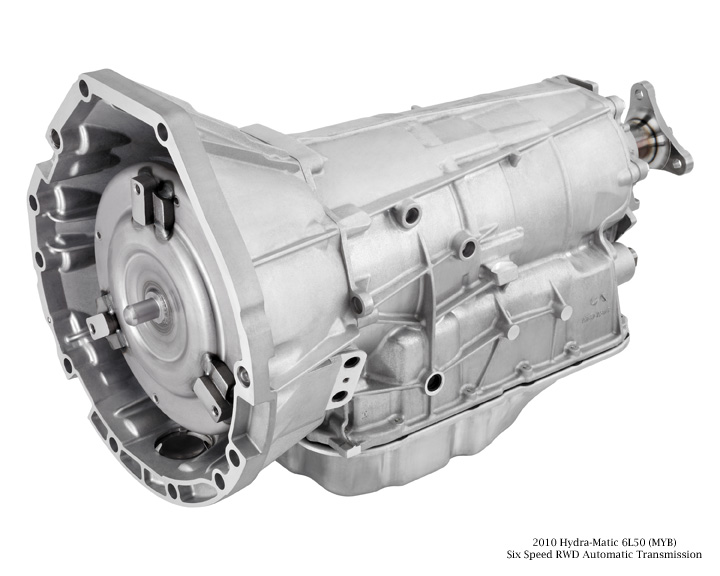
The current Cadillac CTS and STS both use a 6-Speed Automatic Transmission designated 6L50 by GM. The RWD and AWD variants of each car all use the same versatile automatic transmission. In the case of the STS, both the V6 and the Northstar V8 use this transmission. The CTS-V uses the beefed up for the power 6L90 variant.
2010 Hydra-Matic 6L50 Transmission: Type: six speed RWD / AWD, electronically controlled automatic overdrive transmission with torque converter clutch. Clutch-to-clutch architecture, with integral Electro / Hydraulic Controls Module.
Only the Cadillac DTS continues with the 4L80e 4-Speed Automatic. The addition of a 6-speed automatic in the CTS and STS allows for more responsive acceleration at a variety of speeds while still having good gearing for highway touring. Cadillac and GM Power train continue to design tremendous flexibility into their key components. When a single well-engineered, proven component such as the 6-Speed Auto 6L50 can be used in multiple configurations and multiple installations everyone benefits.
In the GM transmission naming scheme, 6 is for 6-speed, L is for longitudinally mounted (versus transverse as in FWD cars), and 50 indicates a mid-range torque capability. Mid-range is relative, as this transmission’s power ranges exceed the top-end of the previous generation. However, the V-Series and Corvette engines have established new definitions for high-torque.
The 6L50 is a ‘smart’ transmission. It uses Enhanced Performance Algorithm Shifting to react appropriately for the dynamics of the situation the Cadillac is executing — holding gears through corners to avoid the disruption of a shift and torque transition. It also allows driver gear selection similar to an automated manual transmission, but at no time does it lose the aplomb one expects of a luxury performance automobile.
| Maximum engine power: |
315 bhp ( 235 kw ) |
| Maximum engine torque: |
332 lb-ft ( 450 Nm ) |
| Maximum gearbox torque: |
480 lb-ft ( 651Nm ) |
| Gear ratios: |
MYB |
| First: |
4.06 |
| Second: |
2.37 |
| Third: |
1.55 |
| Fourth: |
1.16 |
| Fifth: |
0.85 |
| Sixth: |
0.67 |
| Reverse: |
-3.2 |
| Maximum shift speed |
7000 rpm |
| Maximum Validated Weights: ( Target ) |
GVW: 6613 lb ( 3000 kg ), GCVW: 12505 lb ( 5672kg ) |
| 7-position quadrant: |
P, R, N, D, X, X, X ( X = available calibratable range position ) |
| Case description: |
3-piece ( Bell, main, extension ) |
| Case material: |
die cast aluminum |
| Shift pattern: |
(2) Three-way on/off solenoids |
| Shift quality: |
Five variable bleed solenoid |
| Torque converter clutch: |
Variable Bleed Solenoid ECCC |
| Converter size: |
240, 258mm ( reference ) |
| Fluid type: |
DEXRON® VI |
| Fluid capacity: w/258mm converter |
9.1 kg |
| Transmission weight: w/258mm converter |
wet: 85-90 kg ( 187-198 lb ) estimated |
| Pressure taps available: |
line pressure |
| Assembly sites: |
GMPT Strasbourg, France |
| GMPT Ypsilanti, MI |
|
GMPT Silao, MX |
| Applications: |
Cadillac STS |
| Cadillac CTS |
|
Cadillac CTS Wagon |
|
Chevrolet Camaro |
|
Buick Park Ave (China) |
| Available Control Features: |
Multiple Shift Patterns ( Selectable ) |
|
Driver Shift Control ( Tap Up / Tap Down ) |
|
Enhanced Performance Algorithm Shifting ( PAS ) |
|
Selectable Tow / Haul Mode |
|
Engine Torque Management On All Shifts |
|
Altitude and Temperature Compensation |
|
Adaptive Shift Time |
|
Neutral Idle |
|
Reverse Lockout |
|
Automatic Grade Braking |
| Additional Features: |
OBDII / EOBD |
|
Integral Electro/Hydraulic Controls Module ( Tehcm ) |
|
Control Interface Protocol – GMLAN |
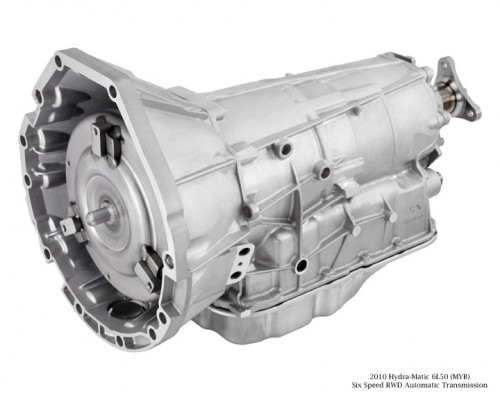
2010 Hydra-Matic 6L50 (MYB)
Hydra-Matic 6L50 six-speed automatic RWD / AWD Car & Truck transmission
2010 Model Year Summary
Cadillac CTS and CTS Sport Wagon are new applications for 2010.
Modular Design for Application Flexibility
The major focus of activities for the 2010 will be quality improvements.
Modular design for application flexibility
The 6L50 was designed to accept different engines and different mounting locations, as well as the ability to mate to transfer cases for all-wheel-drive capability. For 2010, the applications are Cadillac CTS and CTS Wagon, STS, and Chevrolet Camaro. It is derived from the similar 6L80 rear- and all-wheel-drive capable six-speed automatic transmission available in the Chevrolet Corvette, Chevrolet Camaro, as well as Chevrolet, Cadillac, and GMC full-size SUVs.
Overview
The Hydra-Matic 6L50 six-speed automatic transmission for rear- and all-wheel-drive cars is designed with the same modular flexibility as the larger 6L80, as well as being fully compatible with advanced electronic controls. Its unique output gearset configuration enables it to have a wider range of ratios than a conventional planetary gearset automatic transmission.
The main housing for both the Northstar V8 and High Feature V6 in the CTS, STS sedans and the SRX crossover vehicle is identical. The modular concept of the new Hydra-Matic 6L50 centers on the desire for common components and manufacturing tooling for four different size variants of the new 6-speed family. Like the larger 6L80, the 6L50 uses three gearsets, a simple input planetary gearset, and two output gearsets, one of which is a compound gearset with three pairs of two pinion gears on the output carrier, one pair meshing with the sun gear and the other with the ring gear. This arrangement allows for optimal ratio steps with a 6.04:1 overall spread.
All applications feature adaptive shift controls. Several additional features such as grade braking, Performance Algorithm Shifting, and Driver Shift Control are available on some of the applications. Performance Algorithm Shifting (PAS), which detects when the vehicles are being driven in a spirited fashion and remains in its current gear ratio even when the driver lifts a foot off the accelerator pedal. PAS monitors how assertively the driver is using engine output to determine at what engine speed to upshift of downshift. Driver Shift Control, available in the STS and SRX, allows the driver to shift the transmission like a clutchless manual gearbox. Electronic safeguards prevent over-revving should the wrong gear position be accidentally selected.
The wide overall ratio spread of 6.04:1 allows a “steep” first gear, as well as very “tall” overdrive top gear for low-rpm highway cruising. Acceleration is maximized, as is fuel economy. Engine noise is also lower during cruising. Both fifth and sixth gears are “overdrive” gears, for example.
Gear changes from second to sixth gear ratios are accomplished with clutch-to-clutch action, where an “oncoming” clutch is engaged and an “offgoing” clutch is released in a precise manner to achieve the ratio change. The first-to-second upshift, however, is a freewheeling action, where the second gear clutch engages while the first gear one-way clutch spins freely. This allows a greater degree of smoothness at lower vehicle speeds. The manner in which each gear is selected in the 6L50 is optimized for best performance.
Advances in transmission control modules allow the modules to exist reliably inside the transmission, where temperatures remain fairly constant compared to a body-mounted module. The transmission and module are assembled together, so no additional steps are necessary during vehicle assembly.
The 32-bit transmission control module (TCM) monitors transmission performance and compensates for normal wear in components such as clutch plates, so transmission performance remains consistent for the life of the transmission. The control module also “tests” the components of the transmission following assembly to optimize the interaction of the components. The module strategy, developed by GM, is compatible with future global applications.
The CTS and STS V6 use a 258mm diameter torque converter which features a lockup clutch, which also makes use of GM’s proprietary electronic controlled capacity clutch (ECCC) technology. ECCC uses a small, regulated amount of slip to dampen out engine pulses. This creates a smoother running drivetrain, especially during shift events.
The 6L50 all-wheel-drive transfer case in the Cadillac CTS application uses an active center differential, responding to traction conditions and assigning torque to the axle with most available traction.
Low maintenance
The 6L50 uses DEXRON VI premium fluid, which is validated to improve durability and shift stability over the life of the transmission. DEXRON VI, was developed to have a more consistent viscosity profile; a more consistent shift performance in extreme conditions; and less degradation over time. Internal GM tests have demonstrated DEXRON VI delivers more than twice the durability and stability in friction tests compared to existing fluids. The DEXRON VI fluid was designed specifically and validated for the new family of GM six-speed automatic transmissions.
The Hydra-Matic 6L50 is produced in Ypsilanti, Michigan, Strasbourg, France, and Silao, Mexico.