Cool Air, new Cadillac STS-V times

I have some dyno time scheduled for Saturday, so I wanted to get a current baseline on my 08 Cadillac STS-V.

Racelogic PerformanceBox GPS times:

Speed(mph) Time(s) W/Rollout Dist(f)
10 0.95 0.56 6.34
20 1.64 1.25 21.45
30 2.31 1.92 45.86
40 3.05 2.66 84.29
50 3.94 3.55 143.25
60 4.94 4.55 223.83

New low time today — a 4.55 sec 0-60 mph with rollout, or 4.94 sec w/o rollout.  This was my goal for the V — to get to a solid <5 sec without rollout.  Car had 3/4 tank of fuel and the run not heat soaked.   The STS-V has the Spectre cold air intake and a Corsa axle-back exhaust system.  I weigh 35 lbs more than the standard 160 lbs for the buff magazine journalists who get the great times for car mag tests.    Local fuel is 93 octane E10.  The backup 0-60 run was 4.74/5.13 sec.

The 60′ time was 2.2 sec, which is an improvement from my usual 2.4 sec.  PkAccelG was 0.77G. The 1-2 shift was recorded at 0.4 seconds.

Peak Hp was calculated at 6,371 RPM: [click on the image to zoom, hit back to return]
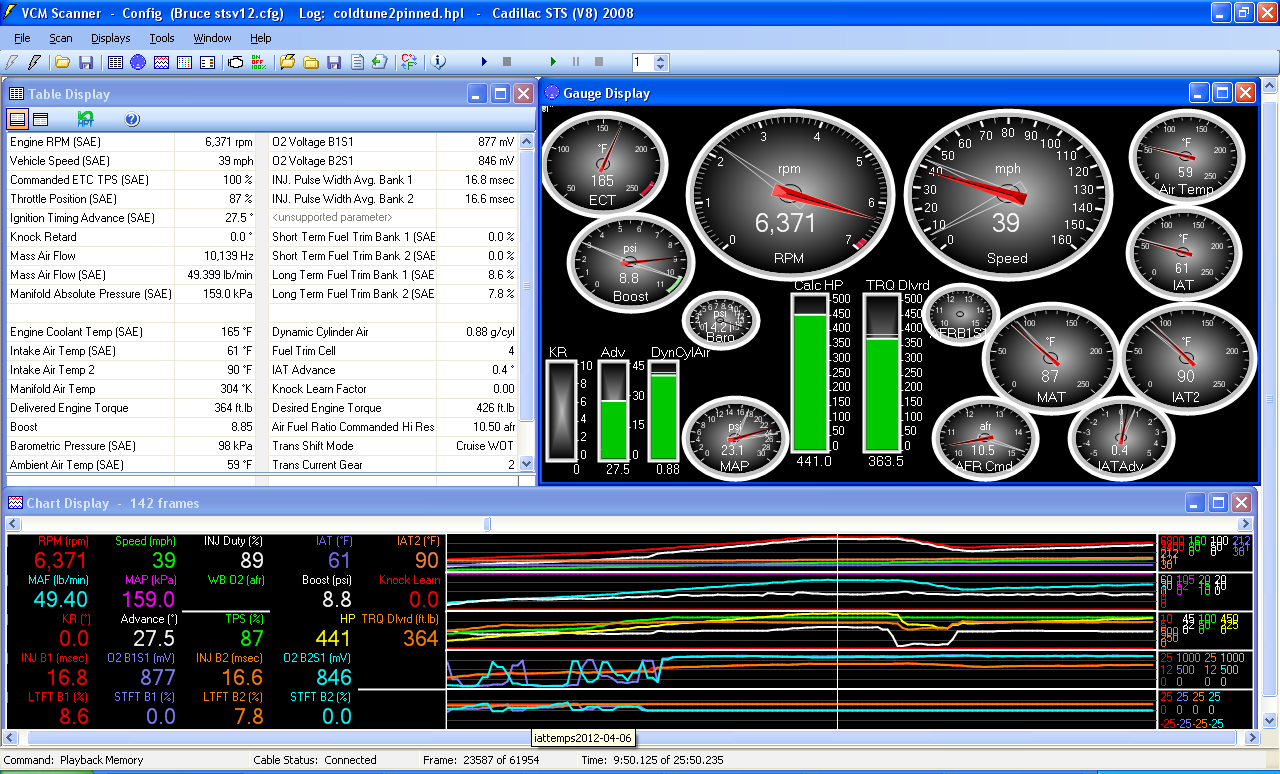
Peak calculated HP at 6,371 RPM

Calculated HP has steadily run less than expected on this V, but I am not clear why.  It uses the Delivered Torque calculated by the engine at RPM to calculate theoretical HP.  The value is a notional figure and not considered accurate for tuning, but I use it as a relative indicator.  I am also not able to run flat out in 4th gear as on the dyno though.

Same run, peak HP at 65 mph at top of 2nd gear:
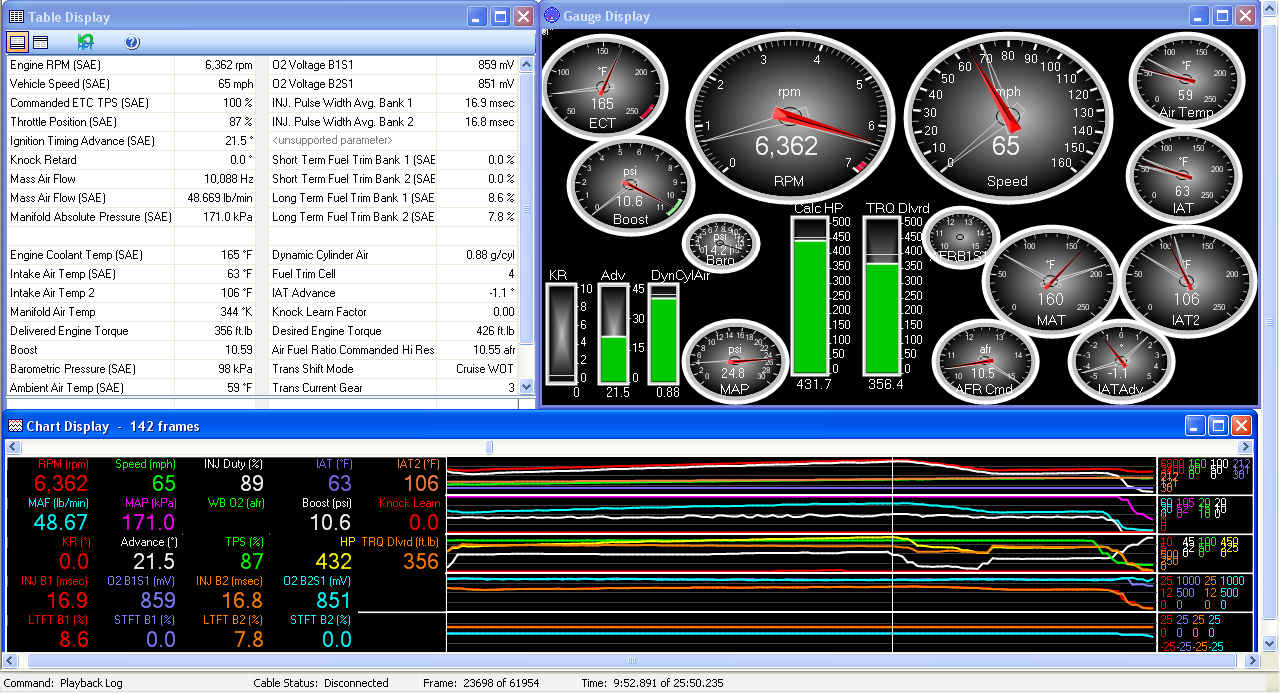
Top of 2nd gear at 65 mph

Interesting that boost in 2nd gear was running 10.6 psi vs 8.8 psi at the top of 1st gear.  I do not think this is a tuning issue but may have just been a transient thing.  The boost was trending in the 9s then dips and then peaks at 10.2 psi at the 1-2 shift in the scan.

Due to the low temps, the IAT Advance was actually ADDING timing instead of retarding!

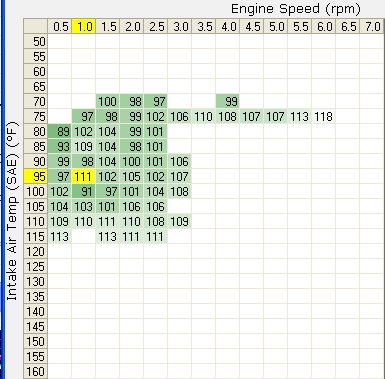
Here is the cold air IAT / IAT2 histogram for the whole test cycle:
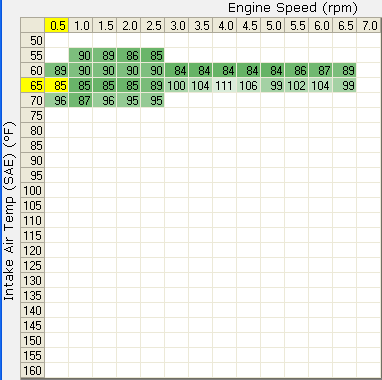
No KR anywhere on the run.   PE is commanding AFRs down to 10.5, so that is something to consider.  Safe AFR for a supercharged engine probably up at 11.5 to 11.8 where the engine should make more power.

Atmospheric Conditions:
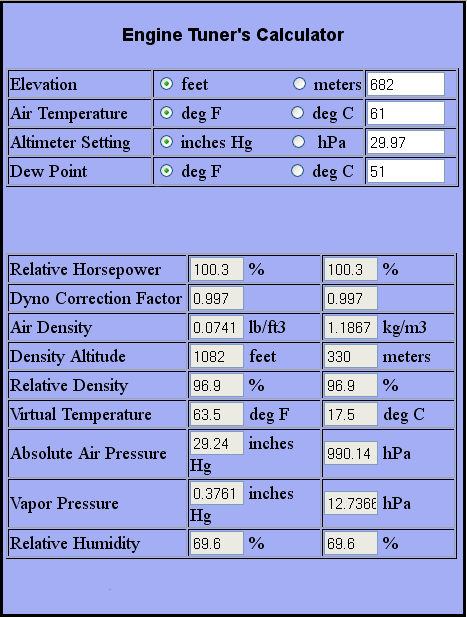
Atmospheric conditions and effect on HP
 

Taking Cooling Cues from the ZL1

The May 2012 GM High Tech Performance Magazine has a nice article (not on the website yet)  about the new Chevrolet Camaro ZL1 development.  The ZL1 uses some parts in common with the Cadillac CTS-V, only with the opportunity for the team to tweak a few things.

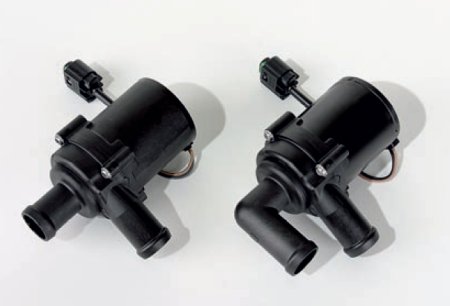
  • Intercooler pump:  the ZL1 uses the water pump from the Chevrolet Volt — which is super efficient — but runs it at 80W instead of the Volt’s 50W.
  • Dual mode muffler setup
  • Secondary air inlet to the airbox
  • Redesigned intercooler brick with higher water flow rate and higher air flow rate so less pressure drop

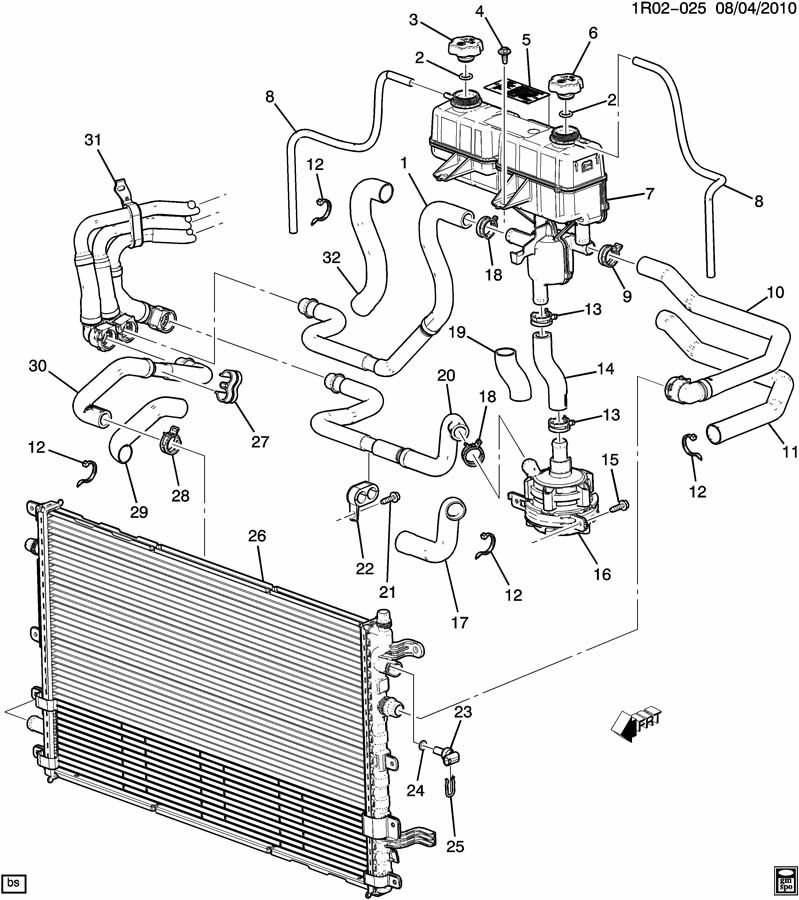
Is this the battery cooling pump perhaps:

13579713 PUMP. Drive Motor Battery Cooling. Engine Coolant.
PUMP,DRV MOT BAT COOL. Required: 01

and the Volt Battery cooling radiator is this one:

20925998 RADIATOR. Drive Motor Battery
RADIATOR, DRV MOT BAT COOL. Required: 01For: RC (2011-2011)

Actually, the Volt battery cooling system looks a lot like an intercooler heat exchanger system:

Chevrolet Volt Battery Cooling System


The ZL1 is rated for 580 hp instead of the CTS-V’s 556 hp — and based on the improved intercooler work it should be more resistant to heat soak.

Comparing IAT1, IAT2, RPM & different cooling strategies

Just getting the hang of histograms in HPtuners.  These are powerful analysis tools that allow comparison of occurences of a variable, say IAT2 temperature in the manifold after the supercharger, in a table defined by IAT1, intake temperature, and engine RPM.  The higher the RPM, the faster the supercharger spins, and the more likely the IAT2 will heat up.

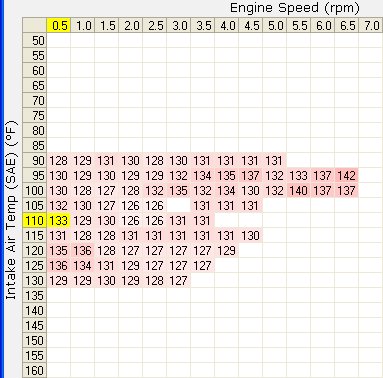
Here is an example heatsoaked from my STS-V with the OEM cooling system:

Bruce Heat-soaked Run

Reading the histogram:  down the left axis are a range of values for the IAT1, intake air.  Across the top are various engine speeds in RPM/1000, so 2 means 2000 rpm.  The values in the body of the table show what the average IAT2 or manifold air temperature after the supercharger heats up the air and the intercooler cools it back down was at the given IAT1 and RPM.  The cells are colored green for cooler temps up to red for hotter temps to make it easy to read.

We can see in this diagram that anytime the engine was at  6500 RPM and the intake temp at 95F the average IAT2 temp was 142F, or +47F hotter.

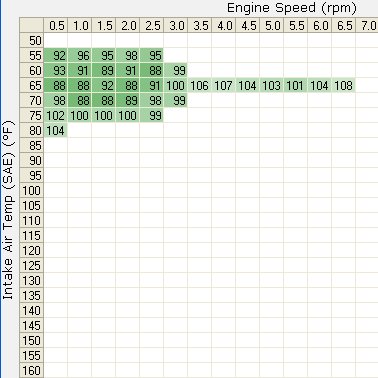
The STS-V has plenty of opportunity for heat soak.  Heat soak is when the engine has been run and retained the heat so that the intake tubing, manifold, and IAT2 sensor are all hot.  For contrast, here is a run with my STS-V not heat soaked:

Bruce not heat soaked run

We see here that when the IAT1 was 65F and the engine hit 6500 the average IAT2 was 108F, or +43F.

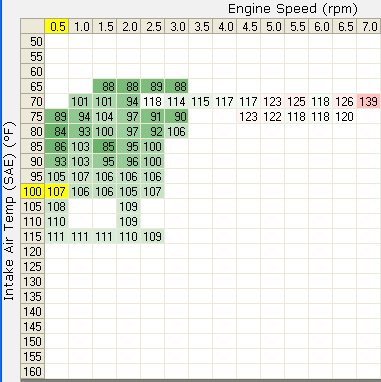
Jaimie has a custom intercooler cooling system on his STS-V consisting of a replacement for the OEM heat exchanger, a 2nd front-mounted heat exchanger, and a high-flow intercooler coolant pump. He was nice enough to send me some scans from his STS-V and I have run them on the same histogram below:

Run 3-23-12

Jaimie 3-23-12

In Jaimie’s run, when IAT1 was 70F, when the engine passed 6500 RPM the IAT2 averaged 126F or +56F.

Run 3-23-22

Jaimie Run 3-23-22

Run 3-27-12

Jaimie run 3-27-12

Obviously the sets of runs are on different days, different regions, different cars.  Also while I tend to mix in a variety of stop and go and 0-60 runs, Jaime tends to have stop and go and a single long run from 30-40 up through the gears to higher speeds.

I am however struck that none of Jaimie’s runs look like my heat-soaked all red first snapshot.   This may be because while the OEM intercooler heat exchanger is sufficient to maintain steady state in a cool V, it can’t overcome the heat stored on a heat soaked run.  Jaimie’s additional intercooler cooling capacity allows his system to overcome the heat soak load and get back in the green.

What do you think?  How would you further analyze this info?