GM Gains, But Weaknesses Remain – BusinessWeek

Business Week:

GM Gains, But Weaknesses Remain – BusinessWeek.

GM has also been crowing about its newest models, especially its important family-oriented sedans and SUVs. Crossover SUVs like the Chevrolet Equinox and Cadillac SRX both sell for at least $4,000 a vehicle more than the models they replaced. The Buick LaCrosse sedan sells for $9,400 more than the old model.  Docherty says GM has added third shifts to the plants that build the Chevy Malibu, LaCrosse, and Equinox and GMC Terrain SUVs. When the company gets up to full production for those new vehicles, “we can get market-share increases,” Docherty said.

Apparently GM is at 53% of plant capacity overall, which is bad.  However, they have burned off a ton of inventory and taken a deep breath toward holding the right number of days of inventory in the system instead of thousands of cars in float.  I am cautiously optimistic that these are good signs that GM is headed into profitable territory.

October 2009 Cadillac Sales — Strong for SUVs

The 2009 October numbers for Cadillac look challenging for cars, and very good for Cadillac SUVs.  The DTS sales were up for the month, so let’s lead with a DTS photo:
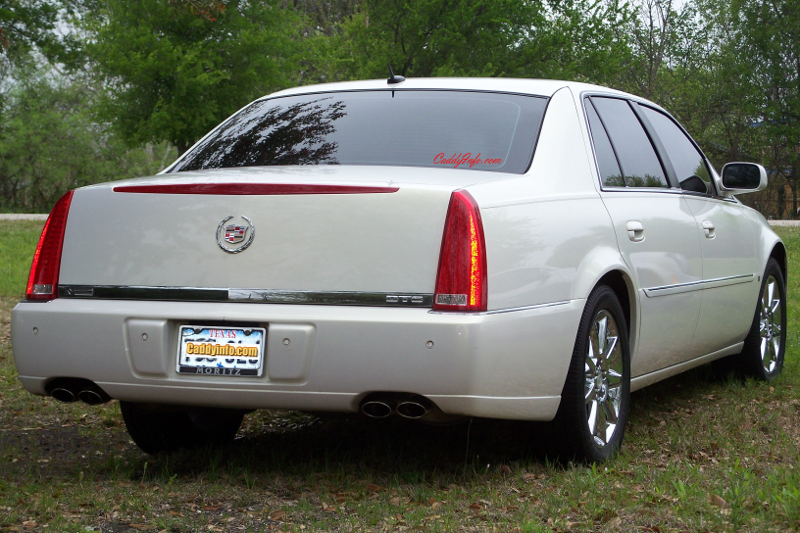
TexasJim's 2006 DTS Performance Sedan

TexasJim's 2006 DTS Performance Sedan © Bruce W. Nunnally

Here are the production numbers just for Cadillac:


October
(Calendar Year-to-Date)

January –  October
Cars 2009 2008 % Chg Volume %Chg per S/D
2009 2008 %Chg Volume
Selling Days (S/D) 28 27 28 27
CTS 2921 3997 -26.9 -29.5 31932 51476 -38
DTS 1896 1590 19.2 15 14021 27380 -48.8
STS 355 632 -43.8 -45.8 5398 13253 -59.3
XLR 49 52 -5.8 -9.1 689 1091 -36.8
Cadillac Total 5221 6271 -16.7 -19.7 52040 93200 -44.2
Trucks


Escalade 2127 1556 36.7 31.8 13118 19275 -31.9
Escalade ESV 599 533 12.4 8.4 5206 9076 -42.6
Escalade EXT 178 265 -32.8 -35.2 2015 3779 -46.7
SRX 3477 916 279.6 266 12247 13779 -11.1
Cadillac Total 6381 3270 95.1 88.2 32586 45909 -29

The good news is that the SRX sales are blooming.  Cadillac has a good hit on their hands and is playing to the right audience with this new model.  The Escalade Full-size SUV is also doing well.  This likely reflects the current moderate fuel prices, since SUV sales suffer with high fuel prices.  Overall truck sales are up 88% over the same month last year.
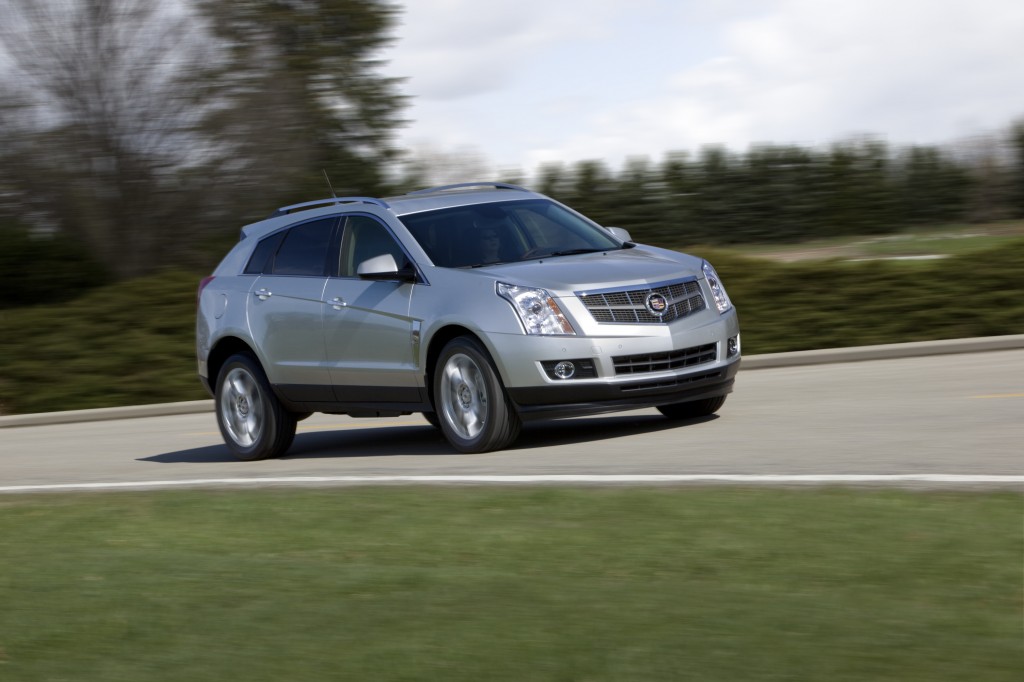
2010 Cadillac SRX

© GM Corp

The bad news is the CTS sales are down.  This is especially disappointing as it includes CTS Sport Wagon numbers, since the Sport Wagon is in Dealer showrooms now.  DTS sales are up 15%, which brings overall Cadillac car sales to only 20% behind last year.   The STS and XLR are both on their way out of production.

So Cadillac sold 1,050 fewer cars, and 3,111 additional trucks in Oct, 2009 compared to Oct, 2008, or a total of 2,061 more vehicles this year than last year for the month of October.  Overall that seems a good result.  If the SRX is siphoning some CTS sales that’s fine, as long as the overall sales numbers for Cadillac grow, which they have, increasing by 22% compared to last October.

Comparative BMW October sales by model: [Reuters]

Sales BMW of North America, LLC, October 2009

                           Oct.    Oct.            YTD Oct.  YTD Oct.
                            09      08    %           09       08       %

    1 Series               501   1,173  -57.3%      9,453    10,453   -9.6%
    3 Series             8,239   9,059   -9.1%     75,459    97,329  -22.5%
    Z4                     486     455    6.8%      2,792     5,464  -48.9%
    5 Series             3,043   3,958  -23.1%     32,733    39,289  -16.7%
    6 Series               152     454  -66.5%      3,207     5,627  -43.0%
    7 Series             1,209   1,096   10.3%      7,159    11,021  -35.0%
    BMW passenger cars  13,630  16,195  -15.8%    130,803   169,183  -22.7%
    ------------------  ------  ------  -----     -------   -------  -----
    X3                     182   1,294  -85.9%      5,280    15,914  -66.8%
    X5                   2,137   2,358   -9.4%     20,787    27,021  -23.1%
    X6                     494     356   38.8%      3,796     3,718    2.1%
    BMW light trucks
    (SAVs)               2,813   4,008  -29.8%     29,863    46,653  -36.0%
    ----------------     -----   -----  -----      ------    ------  -----
    BMW brand           16,443  20,203  -18.6%    160,666   215,836  -25.6%
    ---------           ------  ------  -----     -------   -------  -----
    Cooper /S Hardtop    2,309   3,539  -34.8%     24,248    31,226  -22.3%
    Cooper /S
     Convertible           465      62  650.0%      5,395     4,760   13.3%
    Cooper /S Clubman    1,402   1,671  -16.1%      9,529     9,980   -4.5%
    MINI brand           4,176   5,272  -20.8%     39,172    45,966  -14.8%
    ----------           -----   -----  -----      ------    ------  -----
    TOTAL BMW of North
     America, LLC       20,619  25,475  -19.1%    199,838   261,802  -23.7%
    ------------------  ------  ------  -----     -------   -------  -----

The SRX outsold the BMW X-CUV's 3,477 to 2,813 vehicles.
The CTS has to get numbers competitive with the 3-Series.

BMW total sales for Oct of 16,443 vehicles surpassed
Cadillac Oct sales of 11,602 vehicles.

In the United States, October was the best month of the year so far for Mercedes-Benz.
 Sales bucked the general market trend, rising by 21 percent to 18,200 units
(October 2008: 15,000).
2010 Cadillac CTS vs 2010 Camaro Suspension

The Cadillac CTS has a 3L or 3.6L (LLT) Direct-injection V6 on a premium “Sigma II” chassis.  The new 2010 Chevrolet Camaro has a 3.6L (LLT) Direct Injection V6 or choice of 6.2L V8s (auto/manual have different V8s), on the “Zeta” chassis.

So what is the difference between these two mid-size, rear-wheel drive chasses?  Let’s read through the product catalogs:

Driving dynamics– 2010 Cadillac CTS

The CTS chassis enables a great balance of performance and luxury. The hardware includes structural enhancements via a tower-to-tower brace; large, four-wheel disc brakes and premium steering. Three suspension tuning levels are available: FE1 (standard), FE2 (standard on 3.6L models and optional on 3.0L models) and the FE3 sport suspension with a summer-only tire (RWD only).

All models feature an independent short/long arm (SLA) front suspension system, with performance characteristics optimized with the use of low-mass aluminum for the upper and lower control arms, as well as the knuckles. Hydraulic control arm front bushings are used for motion control and help minimize high-speed road vibration by damping energy transmitted through the vehicle structure. Also, hollow front stabilizer bars bring weight savings and are sized specifically to each of the three available suspension levels.

A multi-link rear suspension, with a fully isolated subframe that delivers excellent kinematics, contributes to a superior ride with excellent handling. The CTS Sport Wagon also features advanced chassis technology in the form of Cadillac’s StabiliTrak electronic chassis control system. It integrates the car’s standard four-channel ABS with the full-function traction control, hydraulic brake assist and engine drag control systems.

2010 Cadillac CTS Suspension choices:

FE1 FE2 FE3 CTS-V
Configuration RWD or AWD RWD or AWD RWD RWD
Differential: open limited-slip limited-slip limited-slip
Front: independent SLA with monotube shock absorbers; 24-mm hollow stabilizer bar (RWD); 33-mm hollow stabilizer bar (AWD) independent SLA with monotube shock absorbers; 29-mm hollow stabilizer bar (RWD); 33-mm hollow stabilizer bar (AWD) independent SLA with monotube shock absorbers; 29-mm hollow stabilizer bar independent SLA; 29-mm hollow stabilizer bar; elastomeric handling and ride bushings; 65-N/mm spring rate; Magnetic Ride Control with electro-magnetically controlled shocks
Rear : independent multi-link with monotube shock absorbers; 18-mm hollow stabilizer bar (RWD); 19 mm hollow stabilizer bar (AWD) independent multi-link with monotube shock absorbers; 20-mm hollow stabilizer bar (RWD); 19-mm hollow stabilizer bar (AWD) independent multi-link with monotube shock absorbers; 20-mm hollow stabilizer bar independent SLA; 24-mm solid stabilizer bar; elastomeric trailing arm bushing; 90-N/mm spring rate; Magnetic Ride Control with electro-magnetically controlled shocks

Here is the product catalog description for the Camaro suspension:

Chassis and suspension– 2010 Chevrolet Camaro

Fully independent front and rear suspensions are the underpinnings of the 2010 Camaro. The standard independent rear suspension is a first for Camaro and is designed to compete with the best in the world. It’s a 4.5-link system that includes a unique, L-shaped upper control arm that attaches to the knuckle at one end and incorporates a ride bushing in the rear.

Two suspension packages are offered: FE2 sport on V-6 models and FE3 performance with the V-8. The front suspension has a dual ball strut system, with a direct-acting stabilizer bar that measures 22.2 x 4 mm on FE2 and 23 x 4.2 mm on FE3. Hollow bars are used for mass savings. Rear suspension features include high lateral stiffness for handling via three lateral ball joints per side. A sub-frame at the rear is double-isolated to minimize vehicle body motions and dampen road imperfections. Coil-over shock absorbers are used in the rear with a decoupled, hollow stabilizer bar. FE2 includes a 21.7 x 3 mm rear bar, while the FE3’s large bar measures 23 x 3 mm.

2010 Camaro Chassis / Suspension

Front: double-ball-joint, multi-link strut; direct-acting stabilizer bar; progressive-rate coil springs; fully adjustable camber, caster and toe
Rear: 4.5-link independent; progressive-rate coil springs over shocks; stabilizer bar; fully adjustable camber and toe

Conclusion?  Very similar descriptions.  In summary one might say:

  • The CTS suspension has more aluminum components and more isolation as one would expect from a Luxury chassis. The CTS uses a short/long arm front suspension and a mult-link rear suspension.
  • The Camaro suspension features a double pivot McPhearson front strut suspension, and an independent rear suspension system very similar to that of Sigma II but using cheaper steel rather than aluminum to save cost.