Video camera image vs still camera video image

Here are a single image from a video still captured from my Kodak C875 camera vs the Flip Ultra Series video camera.  Hopefully I have done these fairly with justice to each camera.  The C875 video has to be processed in quicktime and saved as an H264 image to use with my video software, but I think that the image is not recompressed along the way.

Both are at 640×480 (click on images to see full size):

C875:

C875 Captured off Quicktime by FRAPS and saved to PNG

C875 Captured off Quicktime by FRAPS and saved to PNG

Flip ultra:
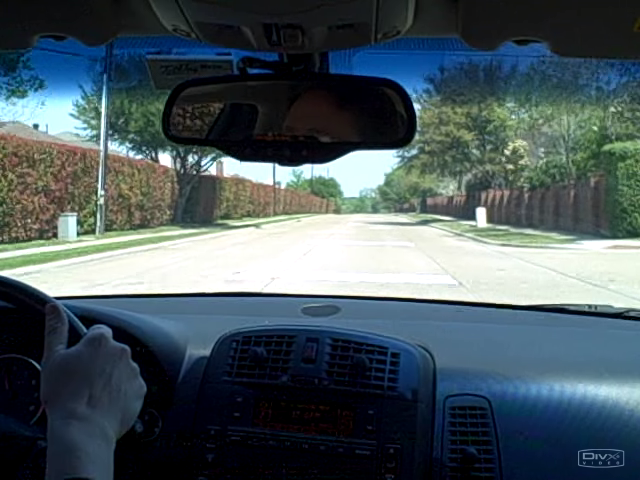
Flip video exported to png image

Flip video exported to png image

I think the Flip actually does a better job for use on the web, although it does have some visible compression artifacts. The image appears to be sharper.

Another key factor is that the Flip will capture up to 30 min of video with no intervention.  The C875 has an adjustable setting for up to 10 min of video prior to going into power saver mode.  The C875 saves to a SD card and can capture up more minutes of video in terms of capacity, but has to be turned back on every 10 min.  One fewer thing to keep up with during vehicle testing is better.  Both / either appear to work properly with Trackvision.

The C875 is tons better for still images.  My thinking now is use the Flip for in car video, and the C875 for session still shots on a tripod.

It appears that the DivX decoder puts up a DivX watermark into the video on some frames, as caught here.  Interesting.  This may have been an effect of cueing the video to the section I wanted and windows media.

Smaller-than-a-CTS due in 24 to 28 months? So 2012 or 2013?

The Detroit Bureau blog has this quote from Steve Shannon (GM Premium Channel Marketing) about the upcoming Cadillac model that will slot below the CTS (Background on “Alpha” Cadillac) :

The project is well underway, he hints, and could reach market “probably in 24 to 30 months.”  Beyond that, Shannon goes mum, though he concedes a variety of body styles are under study, including the requisite sedan, and alternatives including a 3-door hatchback, a 5-door wagon and a convertible.

hmm.  That appears to make the Alpha Cadillac a 2012 or 2013 model.  This is disappointingly slow from my point of view, but may be ‘rapid’ development for GM.

Here was the Motor Trend concept drawing for what the Alpha might look like:

Alpha Cadillac

Alpha Cadillac

So we got the new CTS-V and Sport Wagon in 2009, the SRX in 2010.  2011 perhaps will bring the CTS Coupe, then if 2012 the Alpha Cadillac premiers I suppose that keeps the product release momentum rolling along.

We have more parts in place for the Alpha now, with the new DI 3.0 V6 engine released at 260hp, and a nice 2.8L Turbo V6 on the way at 300hp.

Testing the test gear

I have been testing for the last few years with the Race Technology AP-22, which is a nice accelerometer based performance meter.  Recently I have acquired a Race Logic PerformanceBox, which is a gps-based performance meter.  The PerformanceBox is targeted as a consumer version of the Vbox unit that some car magazines use for acceleration testing.

The first tests I ran with the AP-22 back when I acquired it were to test it side by side with my previous test unit, a Tesla G/Tech Pro.   The AP-22 has the advantage of providing more detail about the test run, in that it provides 0-10, 10-20, 20-30 mph acceleration etc up to the max velocity set for the test.  The earlier G/tech Pro only gave 0-60mph or 60 ft, 330 ft as part of a quartermile run.  Having the greater detail of the intermediate results makes it much easier to determine exactly how a modification to the Cadillac has effected performance.

So, my next test need to be side-by-side comparisons between the AP-22 and the new PerformanceBox.  That will help me consider future runs with the Performancebox in context with the history I have from testing with the AP-22.

I would like to make the tests with Premium fuel and the current, unmodified suspension setup.  So once I have run through a tank of premium I should be able to get the acceleration testing done.  Then I can work on baseline lateral G-force test setup and execution with the base / stock suspension.  Finally, we can re-run the lateral G-force tests with the CTS-V sway bars in place.

My intuition is that I will also need to decide how to handle the runs with regard to roll-out.  Roll-out is the first 10-12 inches that on a traditional quartermile track, due to deep staging, a vehicle can move before it triggers the timing system.  Rollout tends to make a 0-60mph measurement 0.4-0.5 sec faster than if it were an absolute measurement from 0 feet.  Because magazine tests used 0-60 times from their best quartermile time measure, their 0-60mph times also used the same rollout assumptions.  After some thought on the topic I suspect the best solution is to show the data  both ways.  The PerformanceBox datalogger makes it easy to determine the exact time that the car reached around 1 foot of travel, and this time can then be provided as an offset to the data.  So the data can be shown with and without rollout.