Updates as Cadillac CTS Coupe & V-Coupe come to market

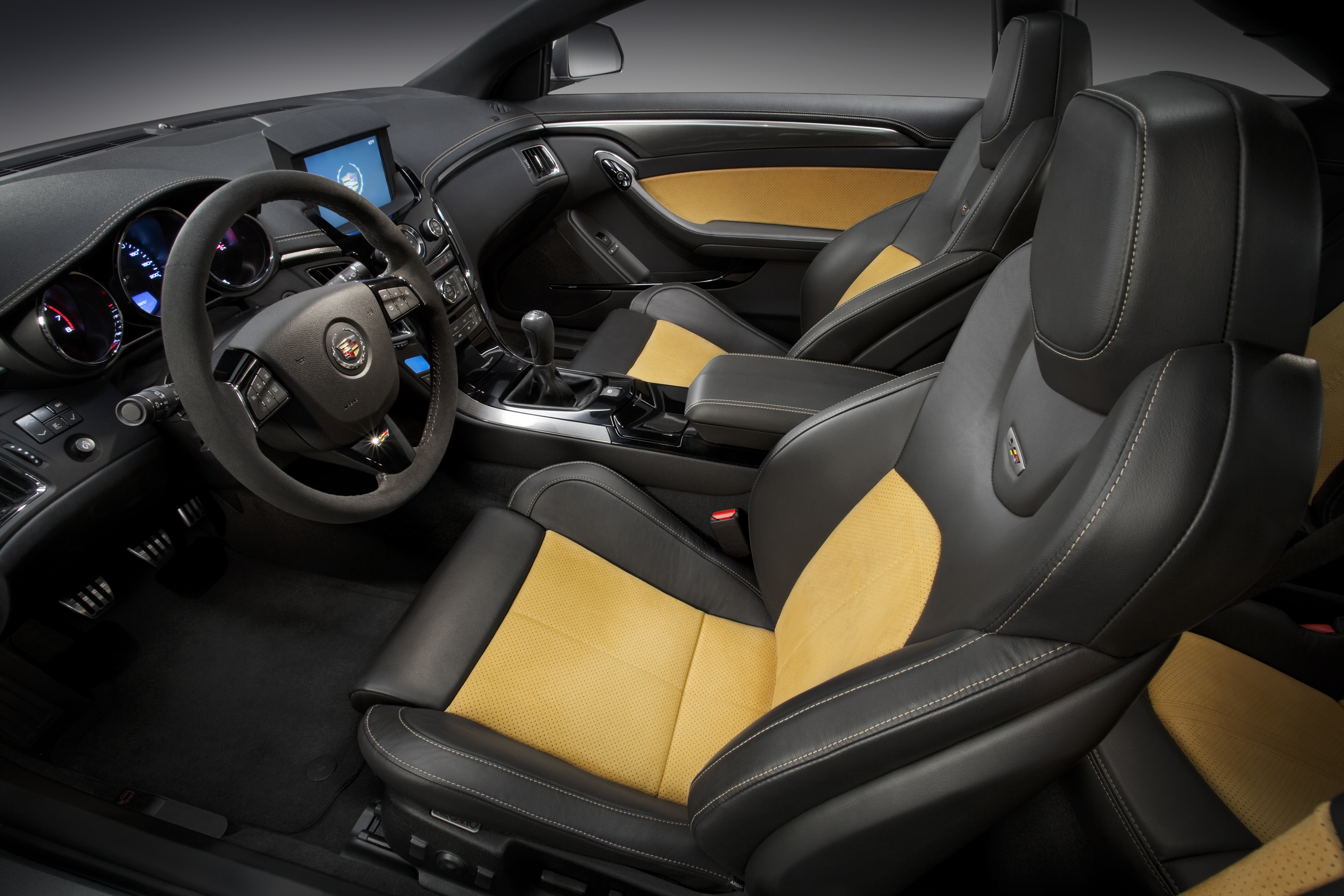
I like to see these Vehicle Order Guide updates for the CTS Coupe and CTS Coupe-V because they give me some re-assurance that the Coupe and V-Coupe are approaching  production on schedule.  Also it is interesting to get more insight into the details of the various option combinations.  Some changes perhaps are just final edits of the Order Guide:
Week of 4/5/2010

Effective 4/5/2010, the following changes will be made to the Vehicle Order Guide:
• Interior section-(Y41) Luxury Level Two Package, added “and new steering wheel” to Package content.
• Color and Trim section-Interior color (AFE), changed interior column header from “Cashmere seats with Cocoa interior
accents” to “Cashmere seats with Ebony interior accents”. This change only applies to CTS Coupe.
• Color and Trim section-Deleted exterior color (GAR) Black Ice Metallic. This change only applies to CTS Coupe.

Week of 3/29/2010

Effective 3/29/2010, the following changes will be made to the Vehicle Order Guide:
• Interior section-(U2K) XM Radio, changed description to read “is standard on nearly all 2011 GM models and includes 3 months of trial service. Get over 170 channels, including: commercial-free music, sports, news, talk, entertainment, comedy, family and kids’ channels, and much more. With XM’s incredible range of programming, everything worth listening to is on XM”. Also added a new footnote that reads “Requires a subscription sold separately by XM after the first 90 days. Available only in the 48 contiguous United States and District of Columbia. Visit gm.xmradio.com for details.”.

Week of 3/8/2010

Effective 3/8/2010, the following changes will be made to the Vehicle Order Guide:
• Interior section-(KB7) Steering wheel mounted Paddle Shift Controls, changed availability for Model 6DP47 1SH PEG from “–” to “A” with footnote #1.

Week of 3/1/2010

Effective 3/1/2010, the following changes will be made to the Vehicle Order Guide:
• Interior section-(A45) Memory Package, changed availability for both 1SF PEGs from “A” with a footnote #1 to a black box with no footnote.
• Interior section-(AL2) Seat adjusters, 2-way power driver and front passenger lumbar control, changed availability for both 1SH PEGs from “A” with a footnote #1 to a black box with no footnote.
• Interior section-(KA1) Seats, heated driver and front passenger, changed availability for both 1SF PEGs from “A” with a footnote #1 to a black box with no footnote.
• Interior section-(KB6) Seats, heated/ventilated driver and front passenger, changed availability for both 1SH PEGs from “A” with a footnote #1 to a black box with no footnote.
• Interior section-(W2E) Recaro performance seats, added the following at the end of footnote #1 “Deletes (AM9) rear split folding seat when (W2E) Recaro performance seats are ordered.”
• Interior section-(KB7) Steering wheel mounted Paddle Shift Controls, changed availability for Model 6DP47, 1SH PEG from “A” with a footnote #1 to “–“.
• Interior section-(UG1) Universal Home Remote, changed availability for both 1SF PEGs from “A” with a footnote #1 to a black box with no footnote.

Better to have a V6 for MPG, but what if you want MORE?

The Automotive Press in the last few years suddenly seems to be warming to the idea that there is a point when you have enough speed.  I know that sounds a bit heretical; a car can never be fast enough that it could not use a bit more horsepower surely?

The trades however are also there — with a V8 comes more weight, and more thirst,  and more thirst due to weight.   Less balanced handling due to the weight.  A V6 with the right level of power can be enough.  The 2010 Camaro V6 with the LLT 3.6L DOHC VVT Direct Injected engine seems a very tidy package.  The 2011 Mustang 3.7L V6 with a similar 305 hp is getting rave reviews.

But what if you want good handling and great balance and a tidy, efficient V6 engine that gets good MPG but you have outgrown a ‘pony’ car?  What if you also really want the creature comforts and luxury appointments that someone with a bit more refined sensibilities craves?

2011 Cadillac CTS

The Cadillac CTS 3.6L Performance Sedan or 3.6L Premium Sedan are exactly that luxury.  Offering a well-turned 304 hp LLT V6 engine, almost perfect 50/50 weight distribution, Nurburgring-tuned advanced suspension, and elegant, luxurious appointments throughout.

Of course if you really have a Supercharged V8 in mind, the CTS-V Sedan or upcoming V-Coupe or V-Sport Wagon may be just your cup of tea.

Shopping for a Cadillac STS-V

Cadillac created the V-Series Concept in 2004, with the release of the 2004 Cadillac CTS-V.  V stands for Velocity.  V-Series Cadillacs are luxury vehicles, as are all Cadillacs.  But they are also Gentleman Racers.  The V-Series features more than adequate  power plants, high performance track-tuned suspensions, high performance braking systems, additional engine and transmission cooling, and generally heavy-duty, series gear for enthusiasts who want to have serious fun with their Cadillac.

The Cadillac STS-V was produced from 2006 through 2009.  It featured the Sigma platform, Sachs tuned suspension, 4-piston Brembo Brakes front and rear, a 469 hp Supercharged (MP122) 4.4L DOHC VVT V8, and all the luxury features and accommodations available on the Cadillac STS.

Performance: the performance of the STS-V should be similar across the various production years, because the weight and power did not vary.  0-60 mph time was measured in around 4.8-5.1 sec depending on the magazine and the day.  Quartermile time is 13.1-13.3 sec at around 106 mph.   Skidpad performance was measured as high as 0.90g and as low as 0.83g.  Knowing the hardware I feel that 0.87g – 0.90g is probably representative.  Top speed is electronically limited to 155 mph.

The STS-V uses a Magnusson MP122 supercharger, putting out 12 psi.   So for argument sake, knowing that atmospheric pressure at sea level is 14.7 psi, and knowing that a supercharger adds approximately 4% power per psi, we can calculate that the supercharger adds 48% power.  Max efficiency is 7%/psi, but 4%/psi with real-world efficiencies and pumping losses. So the base 4.4L DOHC VVT V8 unblown might make 316 hp.  And we can recognize that the tuning that this hand-built gem of an engine received at the Tech Center allows the lower-displacement 4.4L Northstar without the supercharger would make similar power to the normally aspirated 4.6L DOHC VVT Northstar, which makes 320 hp.

One example of the detail work on the STS-V is that the exhaust ports and head of the engine are extrude honed.  This is a process that forces an abrasive material through the heads.  Typically used in racing applications, this increases horsepower by increasing the airflow through the engine.

The STS-V’s 469 horses arrive at 6400 rpm, but at least 395 of the 439 peak pound-feet of torque are available between 2200 and 6000 rpm.  The idle quality of the STS-V is even more stable than the already exemplary STS, due to the increased rolling inertia of the Supercharger.

All Superchargers generate heat; it is a by-product of compression.  The STS-V uses an air to liquid intercooler to help reduce the heat of the incoming air charge, with a separate cooling system for the intercooler.

Pricing:

Kbb.com is a great resource for used vehicle pricing.  Currently they suggest the following STS-V pricing for a used example with 30K miles:

2006: $24-26K Private Sale; $29K Retail

2007: $28k-30K Private Sale; $33K Retail

2008: $30-32K Private Sale; $36k Retail

2009: $43-46K Private Sale; $50k Retail

Newer models will continue to be under Warranty.  Also, in 2008 the STS-V gained a Heads-Up-Display (HUD), which is a desirable feature.  I hope to continue to monitor STS-V pricing, and pick up a 2008 Model once they are available around $25K for a very good example with under 30K miles.