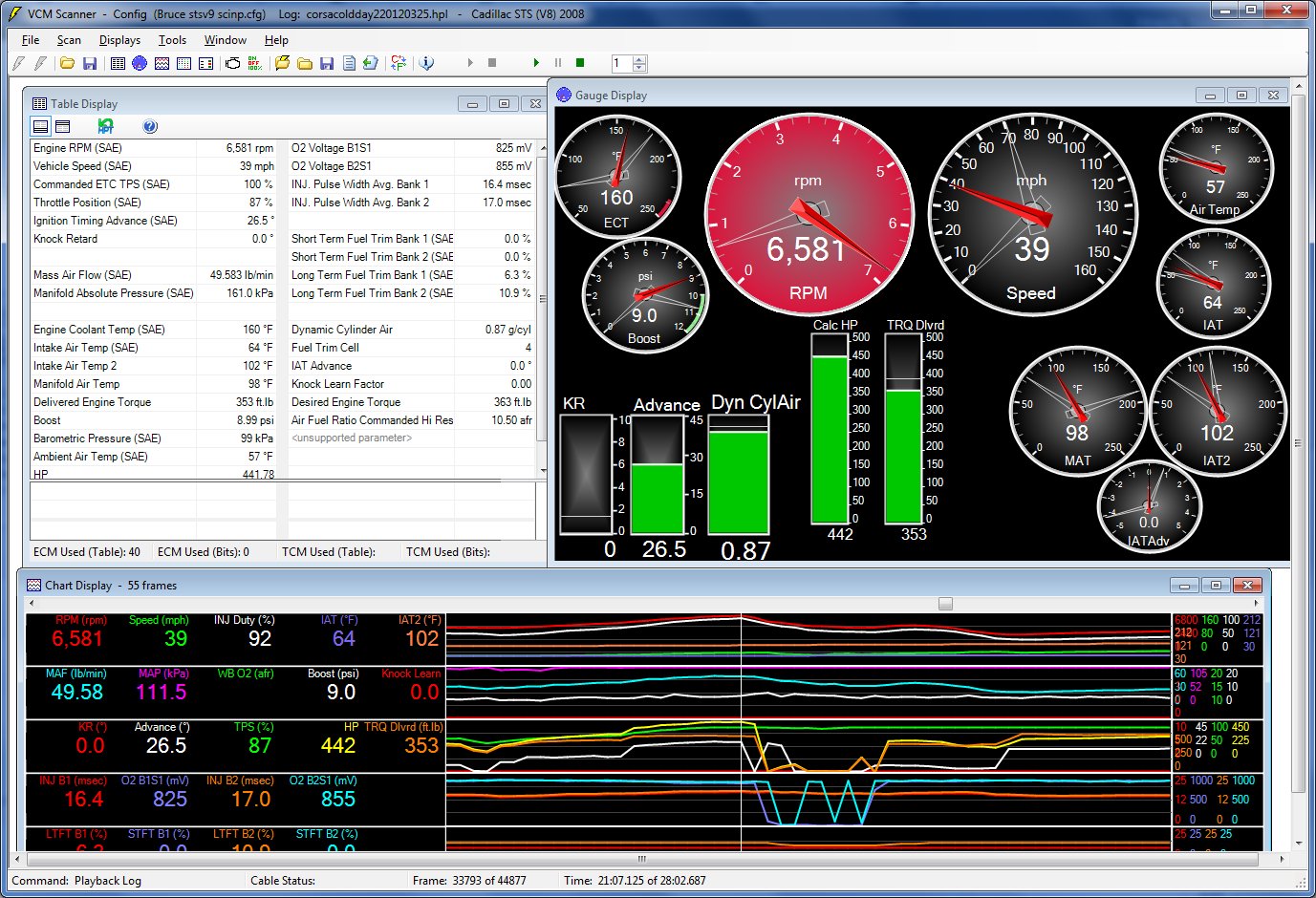
2008 Cadillac STS-V Spectre CAI + Corsa 394.3 whp 380.4 lb ft

Today I headed back to True Street Motorsports in McKinney Texas to get some dyno time in and check my air fuel ratios after the addition of the Corsa axle back exhaust.  Click on the graph to zoom in, then hit back on your browser to get back.
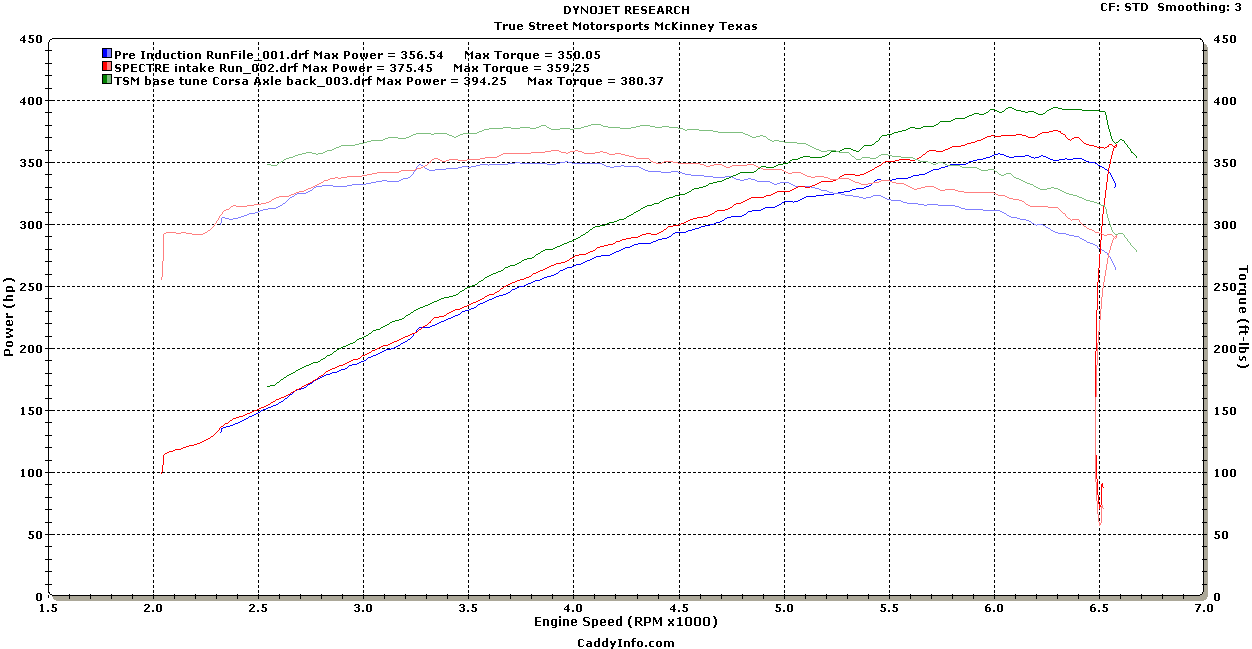
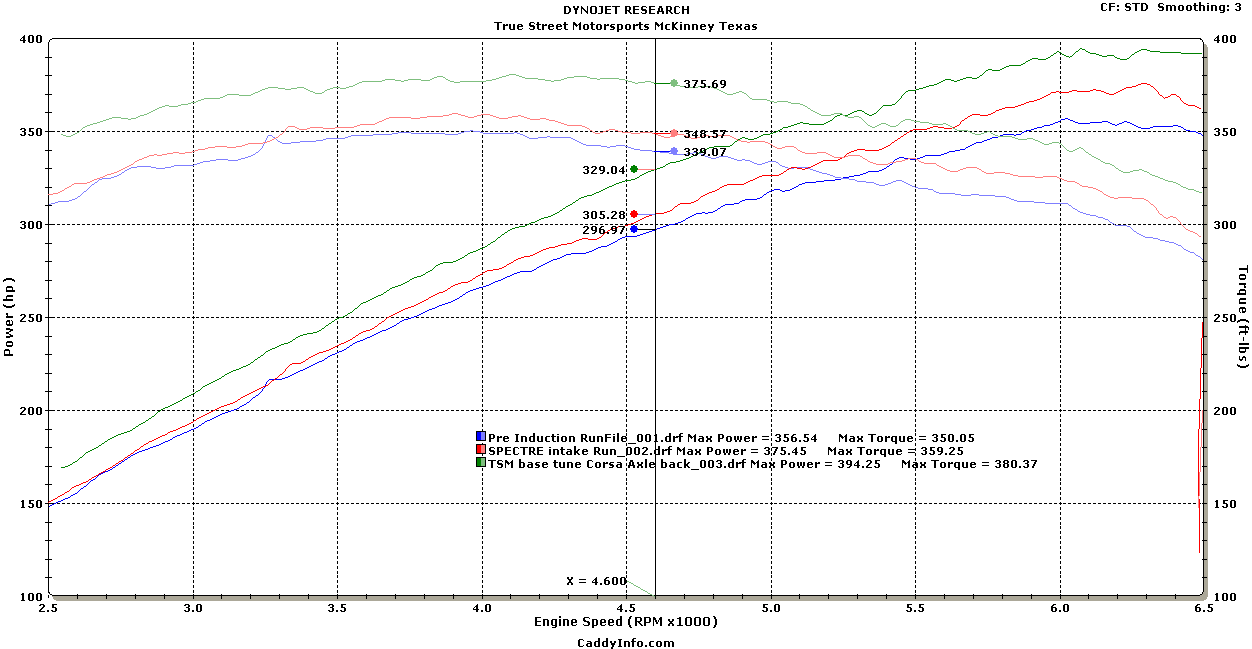
STS-V WHP and Torque vs Engine RPM

Coincidentally, the Spectre Cold Air Intake (CAI) added 19 wheel horsepower (whp) over the baseline pre-Spectre CAI, and the Cora axle-back with the Spectre added another 19 whp for a total of 38 whp.  The Corsa addition opened up a nice 20 ft lb of torque.

A dyno measures horsepower at the wheels, or whp.  This is always less than the manufacturer’s advertised engine horsepower, or hp at the crank of the engine.  WHP is hp after losses through the transmission and drivetrain.  A reasonable figure for these losses on the STS-V’s 6L80e transmission is 20-24%.  On my STS-V, the stock car was rated for 469 crank hp and made 356 whp on the dyno, or  a 24% loss.  if we use 22% as an average then the V originally made 456 hp stock.  The addition of the Spectre got the car to 375 whp or +24 crank hp, and the addition of the Corsa with the Spectre CAI got the STS-V to 394 whp or +49 crank hp.  Overall a nice gain for two easy bolt-ons, and the STS-V is now making 394 whp which at 20-24% losses equates to 492-518 hp at the crank.
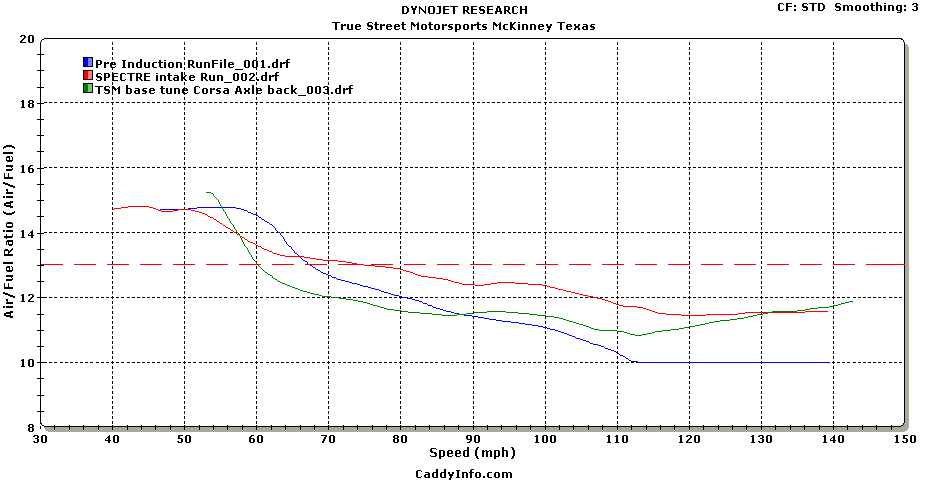
Air Fuel Ratios

Part of the point of the visit was to ensure the Air Fuel ratio was in the right range and stayed there throughout the Wide Open Throttle dyno run.    The resulting fuel levels are safe and consistent with commanded.

This graph shows the same info zoomed in a bit and with a detail point showing that the new exhaust at key points actually adds +27 lb ft of torque:
I am close to my power goal of over 400 whp on the dyno at 394 whp.   I want to run a new baseline on the dyno with the car cool and not heat-soaked for comparison.  In fact, our 3rd run was at the same whp as the initial run today, but with the intercooler Intake Air Temp 2s (IAT2) hitting 150F+ due to the stress of repeat dyno runs on the original,  stock intercooler cooling system.    That suggests that the V may put down 400 whp when not heat soaked.

Fun day, and as always the True Street Motorsports team is easy to work with and helpful.
Comparing IAT1, IAT2, RPM & different cooling strategies

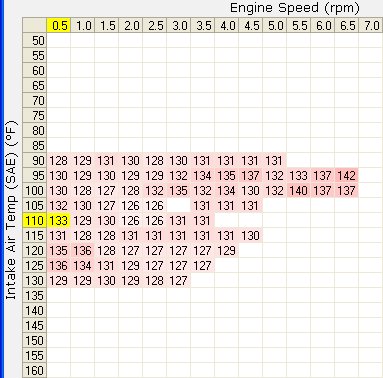
Just getting the hang of histograms in HPtuners.  These are powerful analysis tools that allow comparison of occurences of a variable, say IAT2 temperature in the manifold after the supercharger, in a table defined by IAT1, intake temperature, and engine RPM.  The higher the RPM, the faster the supercharger spins, and the more likely the IAT2 will heat up.

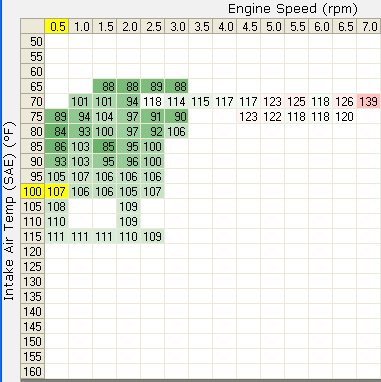
Here is an example heatsoaked from my STS-V with the OEM cooling system:

Bruce Heat-soaked Run

Reading the histogram:  down the left axis are a range of values for the IAT1, intake air.  Across the top are various engine speeds in RPM/1000, so 2 means 2000 rpm.  The values in the body of the table show what the average IAT2 or manifold air temperature after the supercharger heats up the air and the intercooler cools it back down was at the given IAT1 and RPM.  The cells are colored green for cooler temps up to red for hotter temps to make it easy to read.

We can see in this diagram that anytime the engine was at  6500 RPM and the intake temp at 95F the average IAT2 temp was 142F, or +47F hotter.

The STS-V has plenty of opportunity for heat soak.  Heat soak is when the engine has been run and retained the heat so that the intake tubing, manifold, and IAT2 sensor are all hot.  For contrast, here is a run with my STS-V not heat soaked:

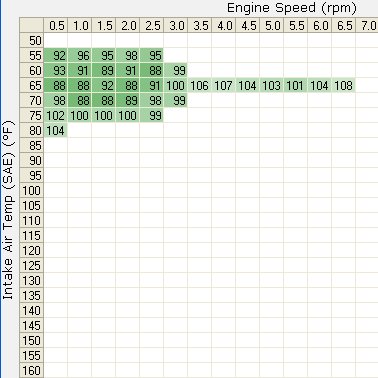
Bruce not heat soaked run

We see here that when the IAT1 was 65F and the engine hit 6500 the average IAT2 was 108F, or +43F.

Jaimie has a custom intercooler cooling system on his STS-V consisting of a replacement for the OEM heat exchanger, a 2nd front-mounted heat exchanger, and a high-flow intercooler coolant pump. He was nice enough to send me some scans from his STS-V and I have run them on the same histogram below:

Run 3-23-12

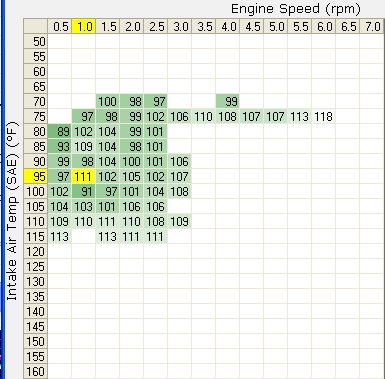
Jaimie 3-23-12

In Jaimie’s run, when IAT1 was 70F, when the engine passed 6500 RPM the IAT2 averaged 126F or +56F.

Run 3-23-22

Jaimie Run 3-23-22

Run 3-27-12

Jaimie run 3-27-12

Obviously the sets of runs are on different days, different regions, different cars.  Also while I tend to mix in a variety of stop and go and 0-60 runs, Jaime tends to have stop and go and a single long run from 30-40 up through the gears to higher speeds.

I am however struck that none of Jaimie’s runs look like my heat-soaked all red first snapshot.   This may be because while the OEM intercooler heat exchanger is sufficient to maintain steady state in a cool V, it can’t overcome the heat stored on a heat soaked run.  Jaimie’s additional intercooler cooling capacity allows his system to overcome the heat soak load and get back in the green.

What do you think?  How would you further analyze this info?

Update: 2008 Cadillac STS-V Corsa cold run day 2

I did a fresh morning baseline with the Spectre intake + Corsa exhaust.


0.4

Speed W/o Rollout W/Rollout Dist
0 0 0 0.0
10 1.03 0.63 6.9
20 1.75 1.35 22.7
30 2.48 2.08 49.5
40 3.33 2.93 93.1
50 4.26 3.86 154.3
60 5.24 4.84 233.9

60′ time was 2.3 sec, so still not good.  Unfortunately my pre-corsa cold air pre-run earlier in the week — also a 4.8s but 4.8s/5.12s — there was no usable Performancebox data file to compare the details from (tech glitch).

Accel results
Speed(mph)     Time(s)
0-60                   04.8
Distance()     Time(s)     @Speed(mph)
0-60′                  02.3                 32.8
PkAccelG     0.67G
I did disconnect the battery yesterday to speed up relearn, but the transmission is still hitting the rev limiter before shifting on some runs. Over time I suspect it will adjust, although it may need to be tuned to shift sooner.

My prediction is that the Corsa frees up 12-20 hp but I’ll have to get a better test run to prove that.  Today’s raw data is no improvement over the 4.8/4.9s posted prior to the new exhaust.

Compared to running hot in August pre-Corsa:

Today 0.4

August 90F
w/rollout
Speed W/o Rollout W/Rollout Dist Speed(mph) Time 0.44 Dist(f)
10 1.03 0.63 6.9 10 1.01 0.57 6
20 1.75 1.35 22.7 20 1.75 1.31 23
30 2.48 2.08 49.5 30 2.46 2.02 49
40 3.33 2.93 93.1 40 3.31 2.87 93
50 4.26 3.86 154.3 50 4.30 3.86 159
60 5.24 4.84 233.9 60 5.42 4.98 248

The difference appears to be from 50-60 mph.

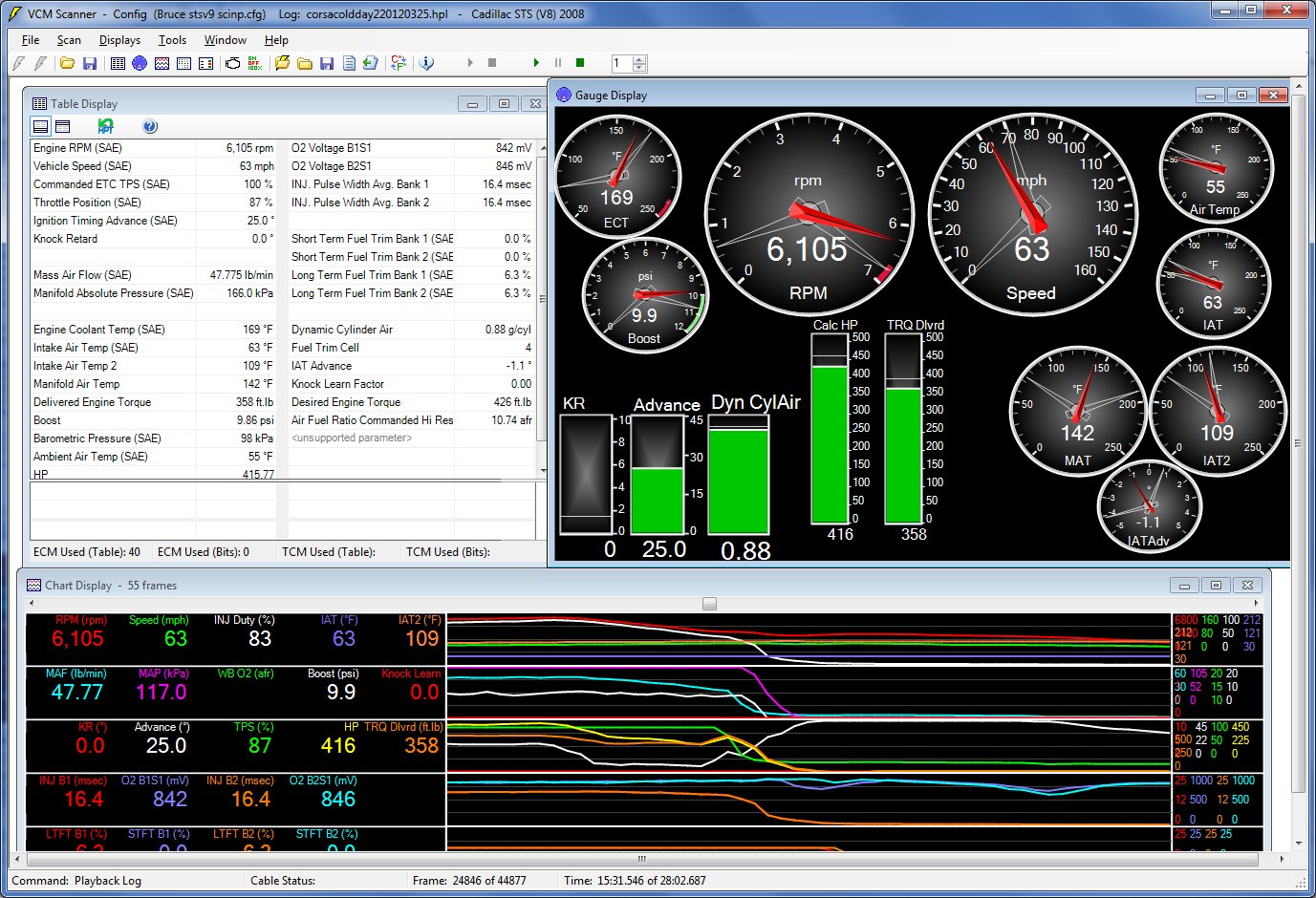
Max calculated power on this 0-60 run was at 6105 rpm

Max calculated power based on torque delivered for the morning caused traction control to come on at the shift — an unusable run because I had not switched it off —

Here are my IATs for trending:

Corsa Cold Baseline Mar 25 2012 2nd Run


Down Delta MPH (Temps in Deg Fahrenheit)
Item 0 30 45 60 Across Run Heat Add
Ambient 55 55 55 55 0
6 IAT1 61 63 63 63 2 8
32 IAT2 93 93 100 106 13 43
0 MAT 93 93 107 129 36 23

I plan to start recording Richard’s correction calculator for runs so I have that info.  Today was about perfect for a correction factor near ‘1’.  I am using the air temp from IAT1 for the adjustment; Richard suggests use the actual air into the engine, which is IAT1.

Conditions:  Cold run, 3/4 fuel; Weather for this run:

Note: The relative horsepower calculations are made in accordance with  SAE J1349. The standard reference conditions for SAE J1349 are:  Air temp 77 deg F (25 deg C),   29.235 Inches- Hg (990 mb) actual pressure and 0% relative humidity.