In Pursuit of Max Torque Timing #Motorama

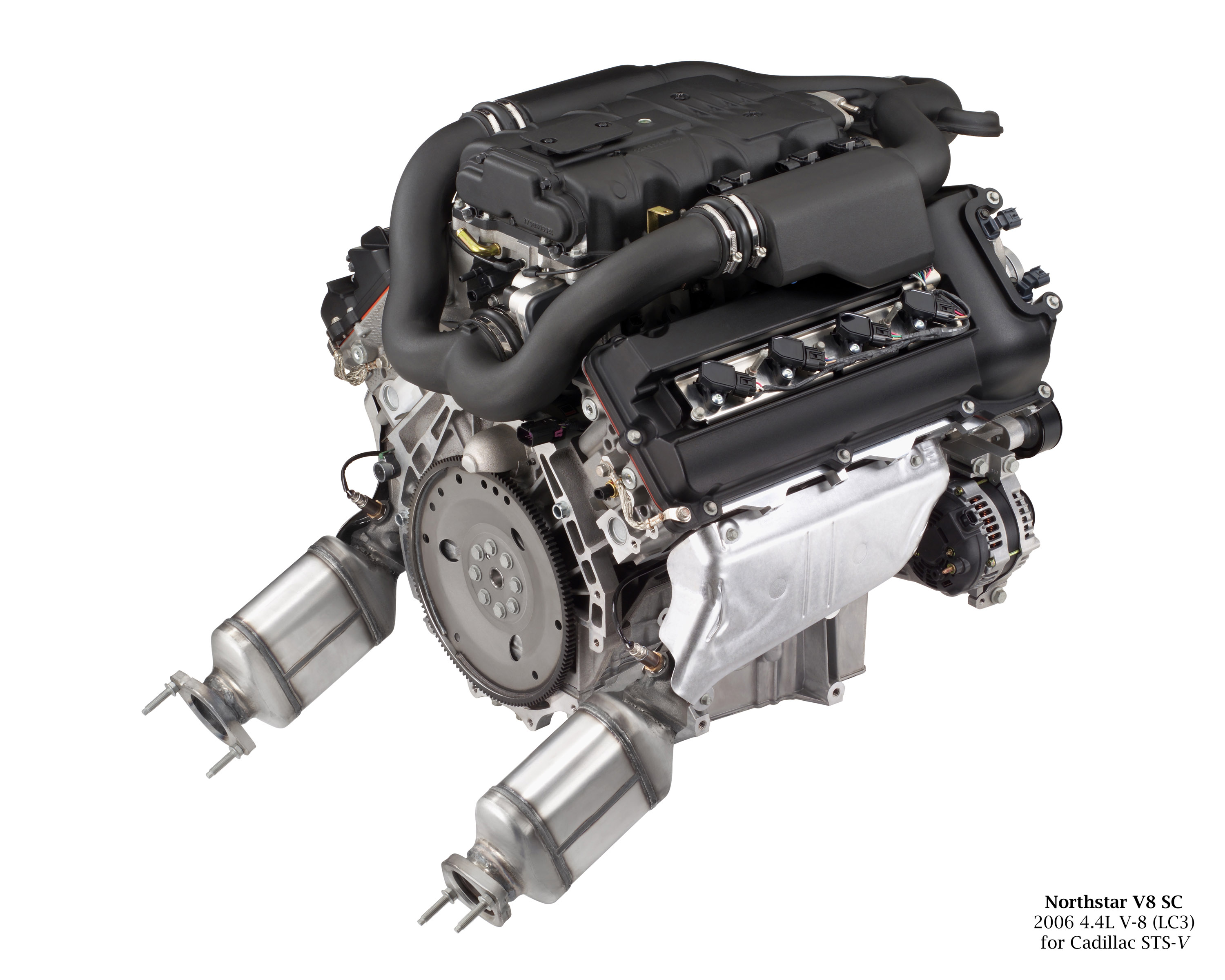
Northstar V8 SC 2006 4.4L V-8 (LC3) for Cadillac STS-V

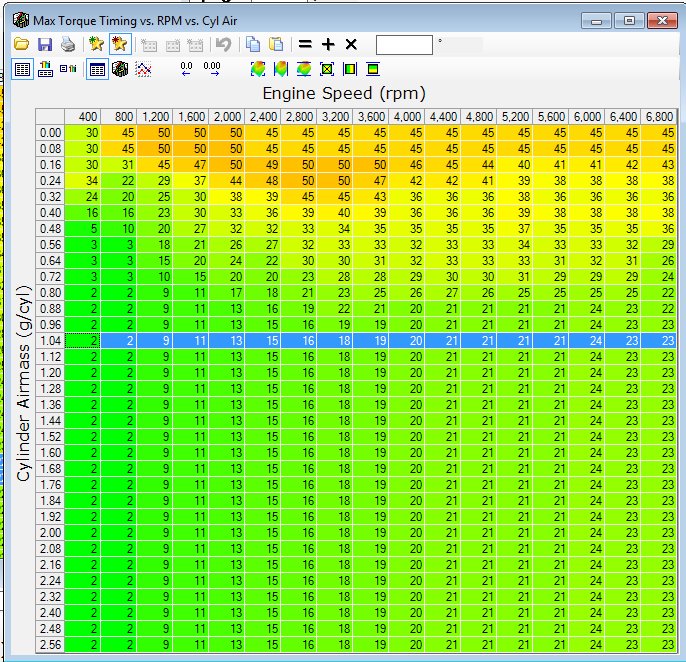
Each engine has a perfect timing advance across RPM that results in the maximum torque for that engine.  GM tucks this info into a table that HPTuners refers to as Max Torque Timing vs RPM vs Cylinder Air — the theoretical timing that provides maximum torque for the engine.

Max Torque Timeing vs RPM vs Cylinder Air

Max Torque Timing vs RPM vs Cylinder Air

The advance at various RPM points in this table may not be achievable — there could be knock or detonation at those points at this advance.  The PCM uses the table as a reference to determine delivered torque.  This is one of the few tables that HPTuners recommends the user not change.

Comparison of Actual Timing to Max Torque Timing

Comparison of Actual Timing to Max Torque Timing

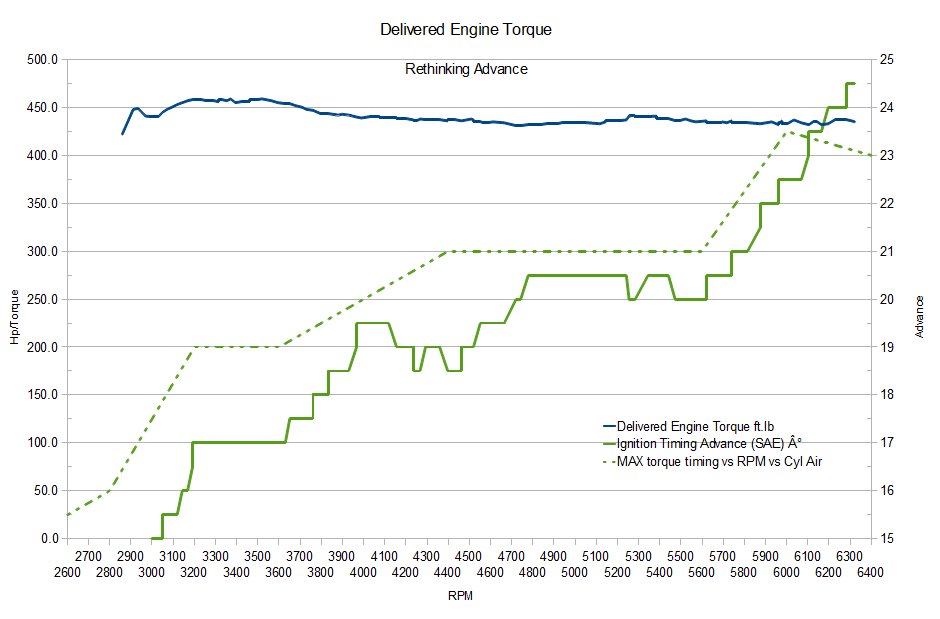
This graph shows the actual timing during a 2nd gear run in green vs the theoretical max timing in the green dashed line.  You can see that the actual timing follows along with the general shape of the maximum torque timing, although generally 0.5-2 degrees behind.

Theoretically, if I add timing to move the actual timing toward the theoretical maximum torque timing — without detonating — the STS-V will make the most power.

Now my STS-V also has an aftermarket intake, and an aftermarket exhaust.  Those change the ‘equation’ a bit.  But this is what I will be inching toward as an experiment — maximum torque timing.

Feedback

What do you think?  Have you used this table as a guide for tuning?  Or are you with the “more advance is always better” school?

Rethinking Total Timing Advance Cadillac LC3 HpTuners #Motorama

In the tuning process adjusting total timing advance on a modern engine can be tricky.  There are timing adjustments coming in from a variety of sources, which may change from one pull to another.  To simplify the dyno process, it is inviting to isolate the total timing to a single table and adjust.

The files below relate to my 2008 Cadillac STS-V with the DOHC, VVT, supercharged 4.4L V8 engine:
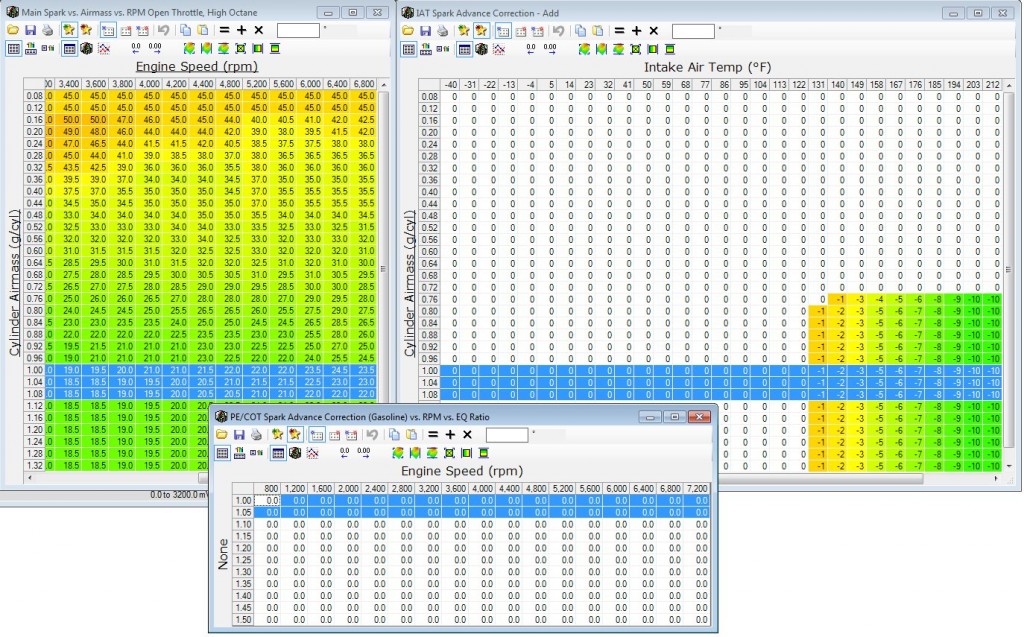
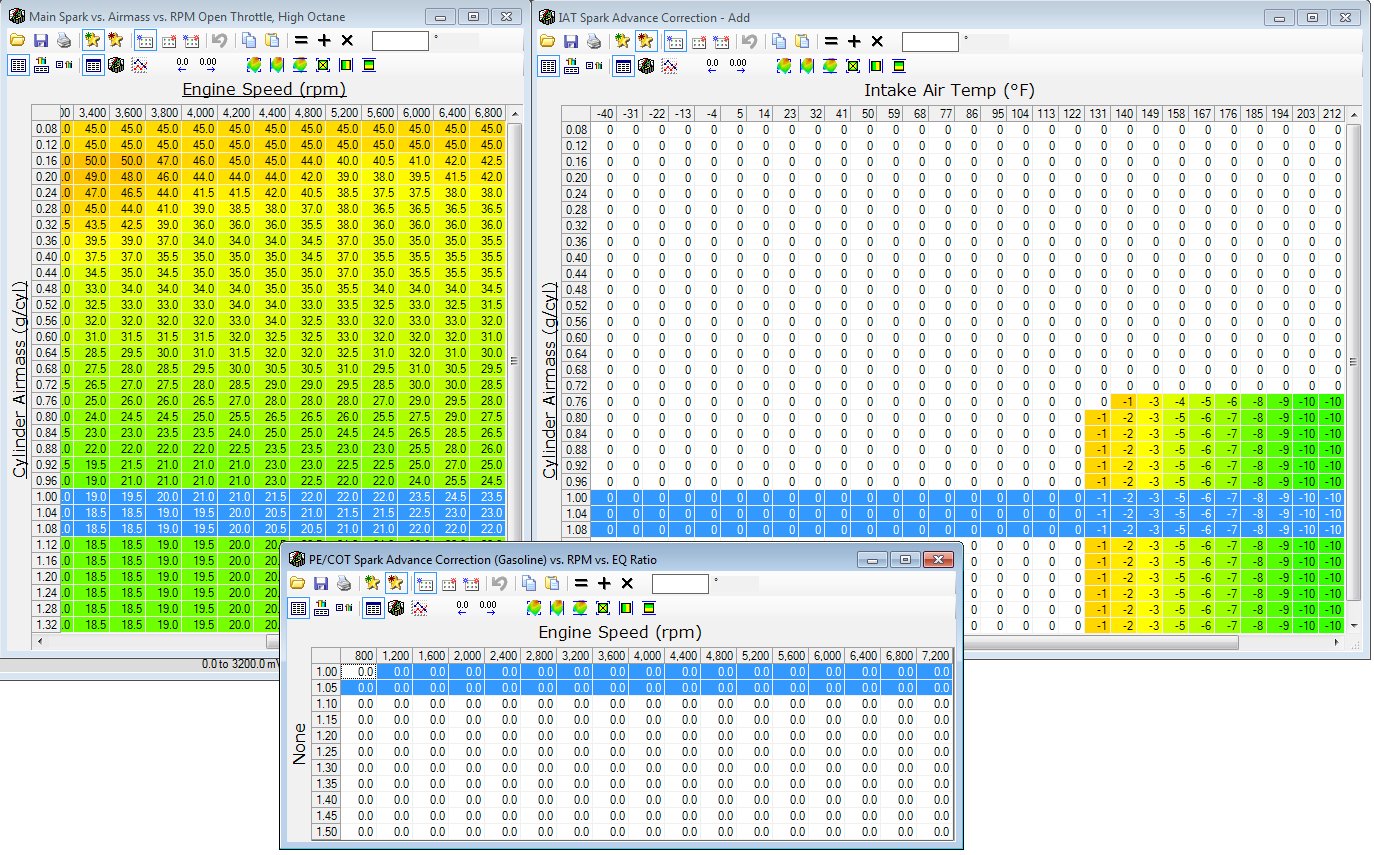
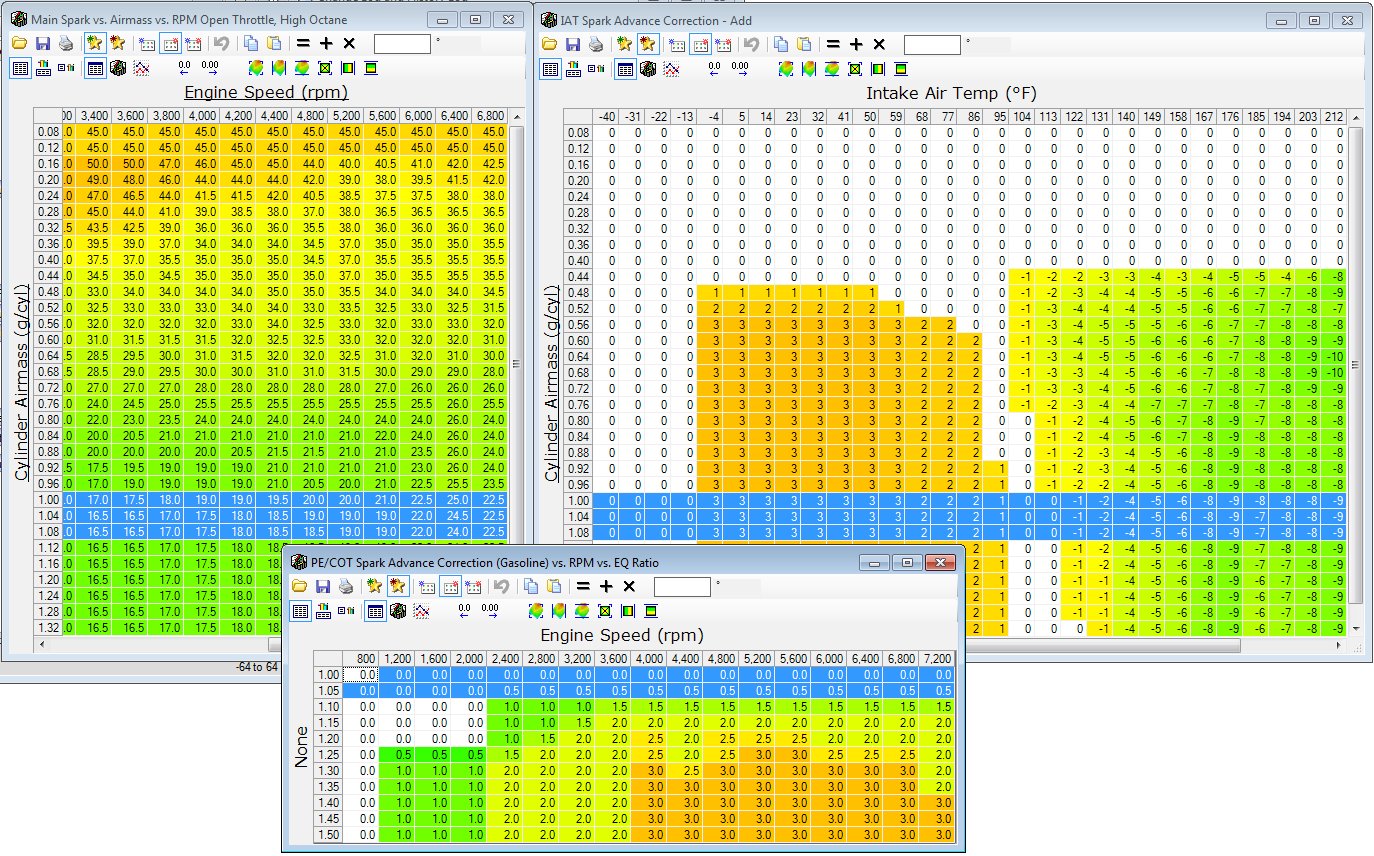
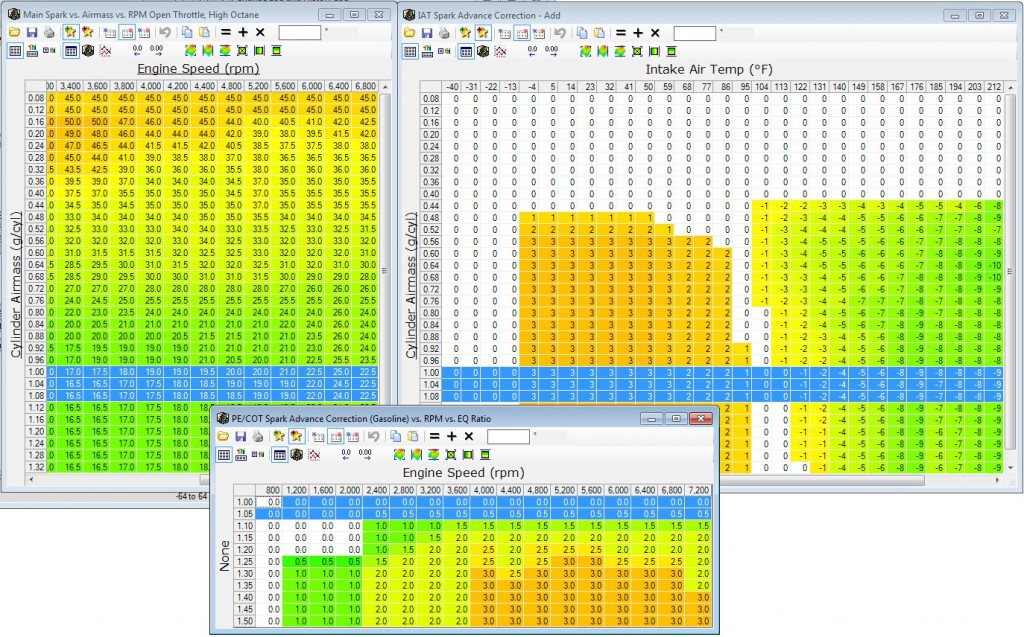
Tuned Timing -- more in the main (left) table, removed IAT timing below 122F (right), removed PE/COT timing adders (bottom)

Tuned Timing — added ~2 in the main (left) table, removed IAT timing below 122F (right), removed PE/COT timing adders (bottom)

However, holding all the timing on the main table is not ideal for how I would prefer for the engine to operate — we actually want timing from each table and adder because they offer diverse inputs for specific situations.  For example, I prefer to add timing via the intake air temperature table (IAT), which will only add timing only if the air is cool.

The image above shows an HPTuners screen shot of 3 related timing tables after tuning.
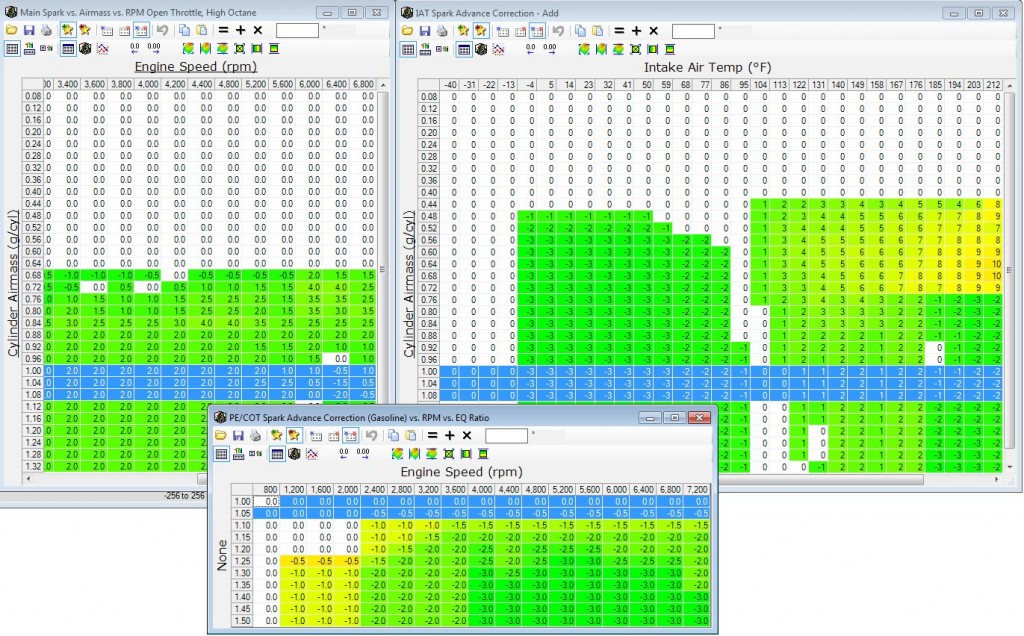
Timing for OEM calibration file

Timing for OEM calibration file

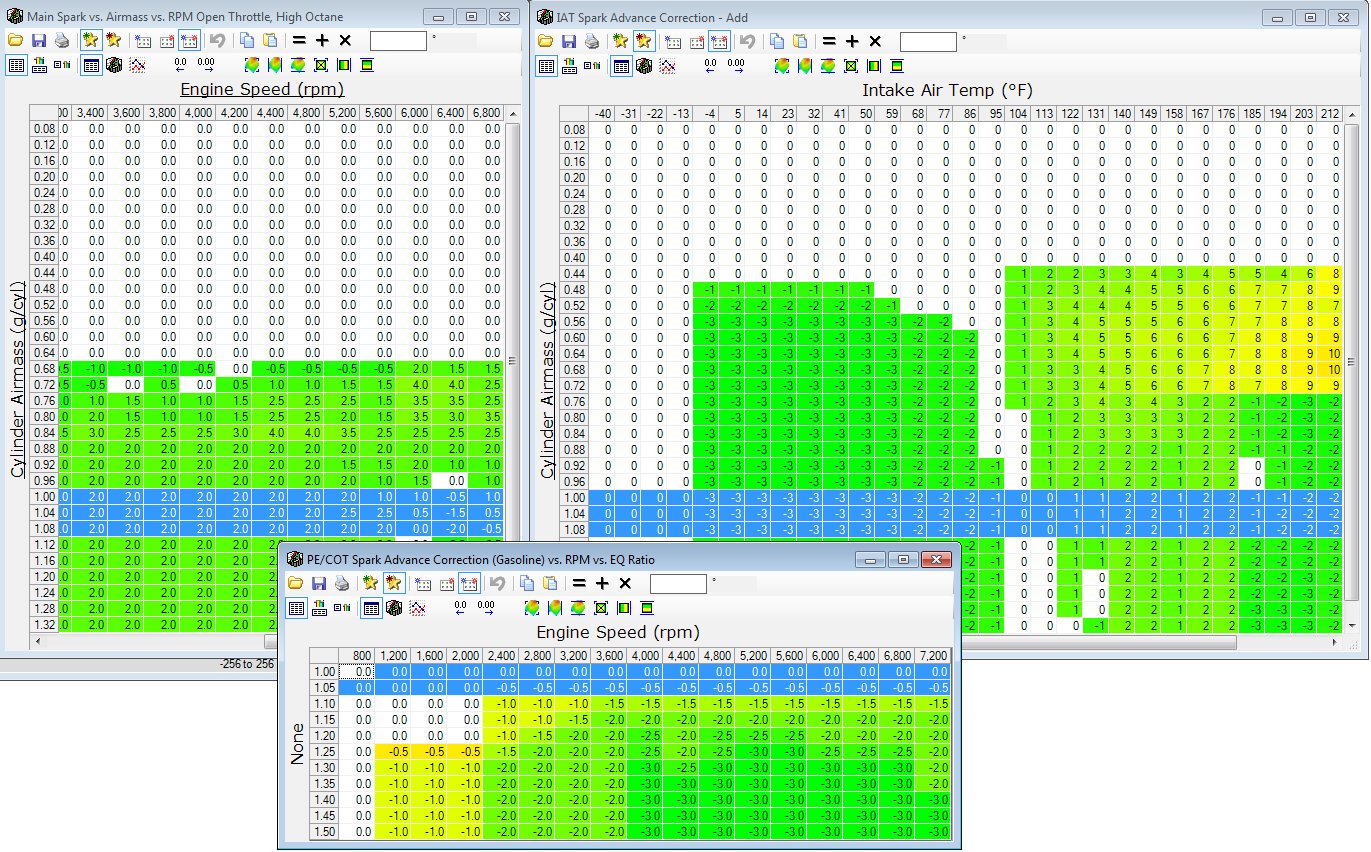
This second image shows the same tables in the OEM calibration.  In the OEM tables, the main table had slightly (2 deg) less advance, the IAT table adds advance below 95F and takes out advance above 122F, and the PE/COT table adds advance above 1.05 g/cyl.

Finally, the following table shows just delta values between these 2 tunes, or differences in the files:
Difference by comparison -- tables show just the +added timing or -removed timing for the tuned vs OEM

Difference by comparison — tables show just the +added timing or -removed timing for the tuned vs OEM

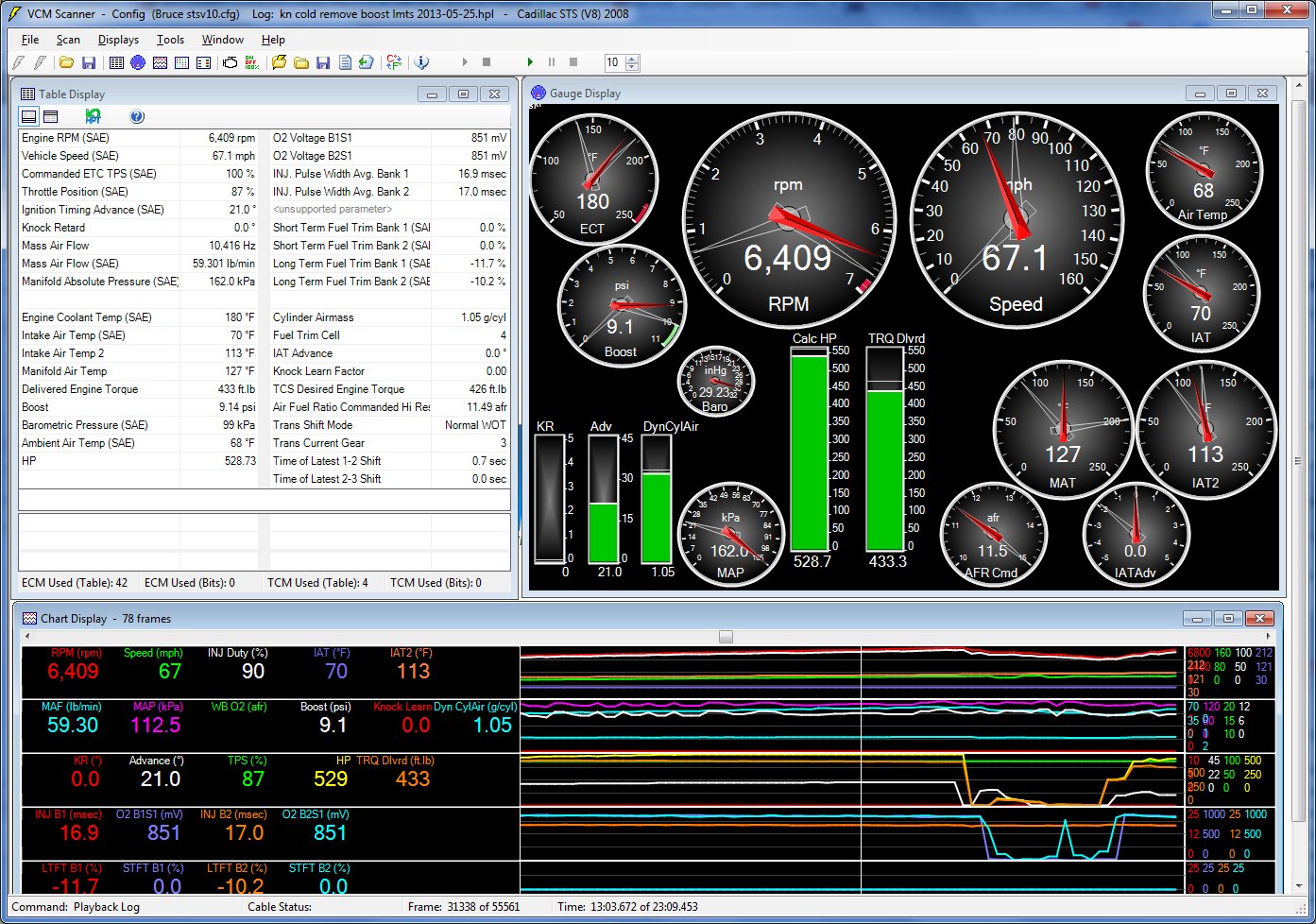
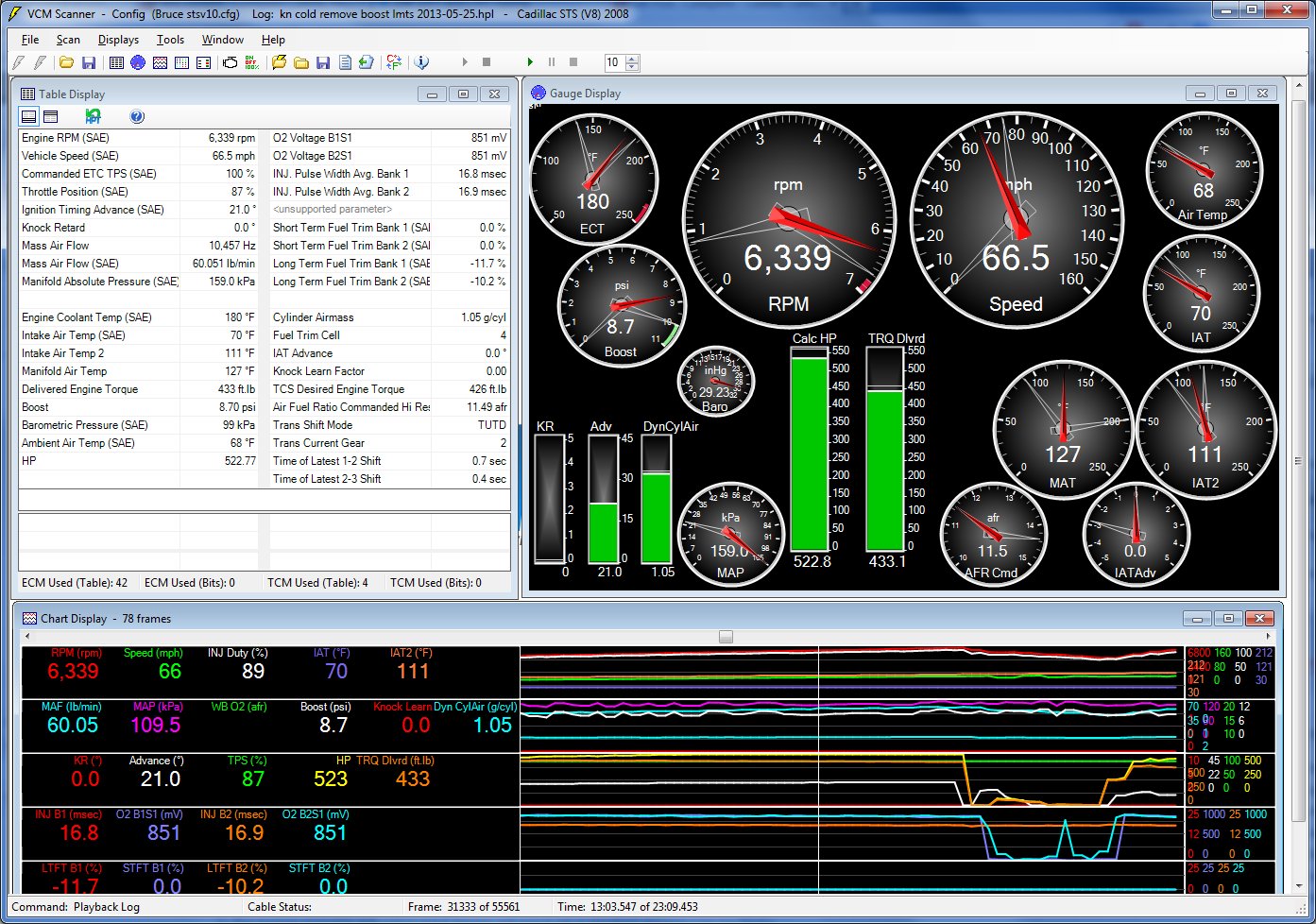
Here is the test for the ‘tuned’ timing:  we can see in scans that at 6409 RPM the STS-V is running total timing of about 21 degrees advanced at 1.05 g/cyl.
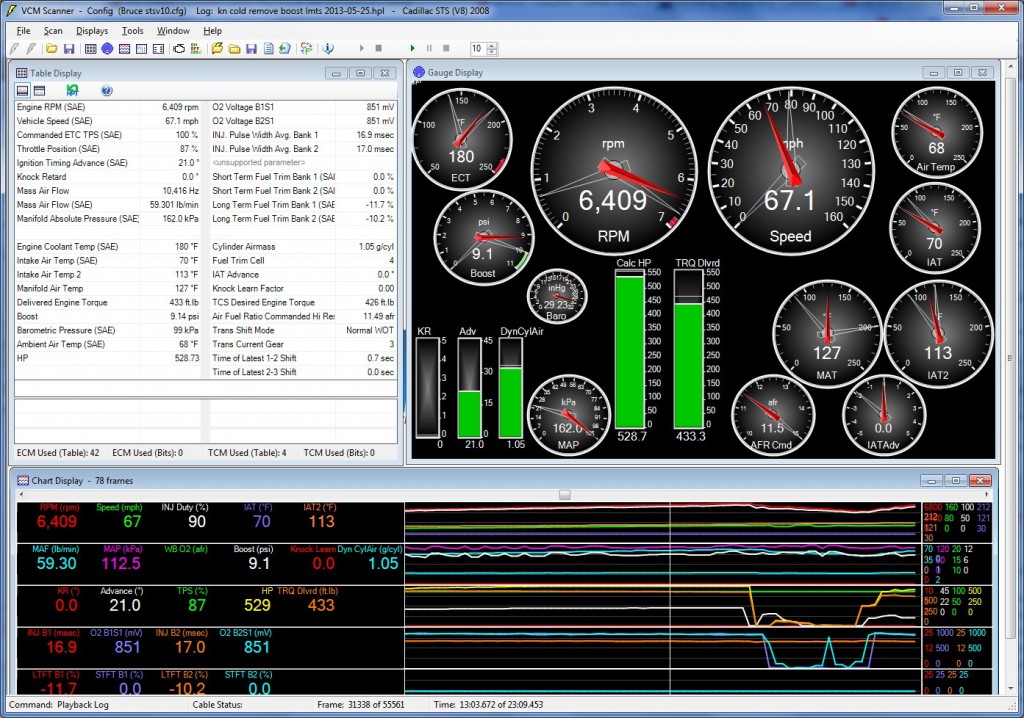
HPtuners at 6409 RPM shows 21.0 degrees total advance

HPtuners at 6409 RPM shows 21.0 degrees total advance

Looking at the Tuned tables (top ones above),

  • the main table (left) has 23 degrees at 1.04 and 22 at 1.08, so likely uses ~22.75 at 1.05 g/cyl.
  • the IAT2 was 106F on that run, so the IAT advance was 0.
  • the PE/COT table is stripped in the Tuned file, so no change there.
  • No knock retard (KR)
  • So where is our missing timing, 22.75 from these tables vs 21 degrees observed?

There is a static retard vs rpm vs cylinder table which is unchanged from Tuned to OEM:
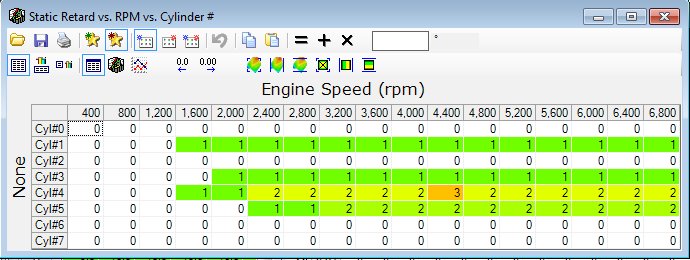
Static Retard vs RPM vs Cylinder (degrees of retard)

Static Retard vs RPM vs Cylinder (degrees of retard)

which is pulling 2 degrees of retard (minus advance) from a couple of cylinders. This appears to be an as-designed adjustment to the timing by cylinder and RPM.  The SAE total advance appears to include that 0-2 degrees retard for 23 – 2 = 21 Degrees as tuned.

Going back to the OEM files, at 6400 RPM and 1.05 g/cyl we will expect:

  • Main timing table 24.4 degrees
  • IAT Table 0 degrees
  • PE/COT table 0.5 degrees
  • Static Retard  -2 degrees
  • Total advance:  24.4 main + 0 IAT + .5 PE/COT – 2 Retard = 21.9 total

So although the tuned file added +2 degrees of advance to the main table, in this circumstance the result was it reduced the timing slightly.  In colder air the tuned table had also stripped the low-temp IAT advance adds, so it would lose power there.

Next I am restoring the various advance tables to OEM calibration.  I’ll log data running the OEM advance tables.  Then I can look at adding a bit of timing via the IAT table as a way to proceed in a fail-safe manner.  I also need to recalibrate my MAF to get the LTFTs back slightly negative.

Feedback

Any advice or feedback?  Am I missing any logic or key tables in my timing thinking?

Update:

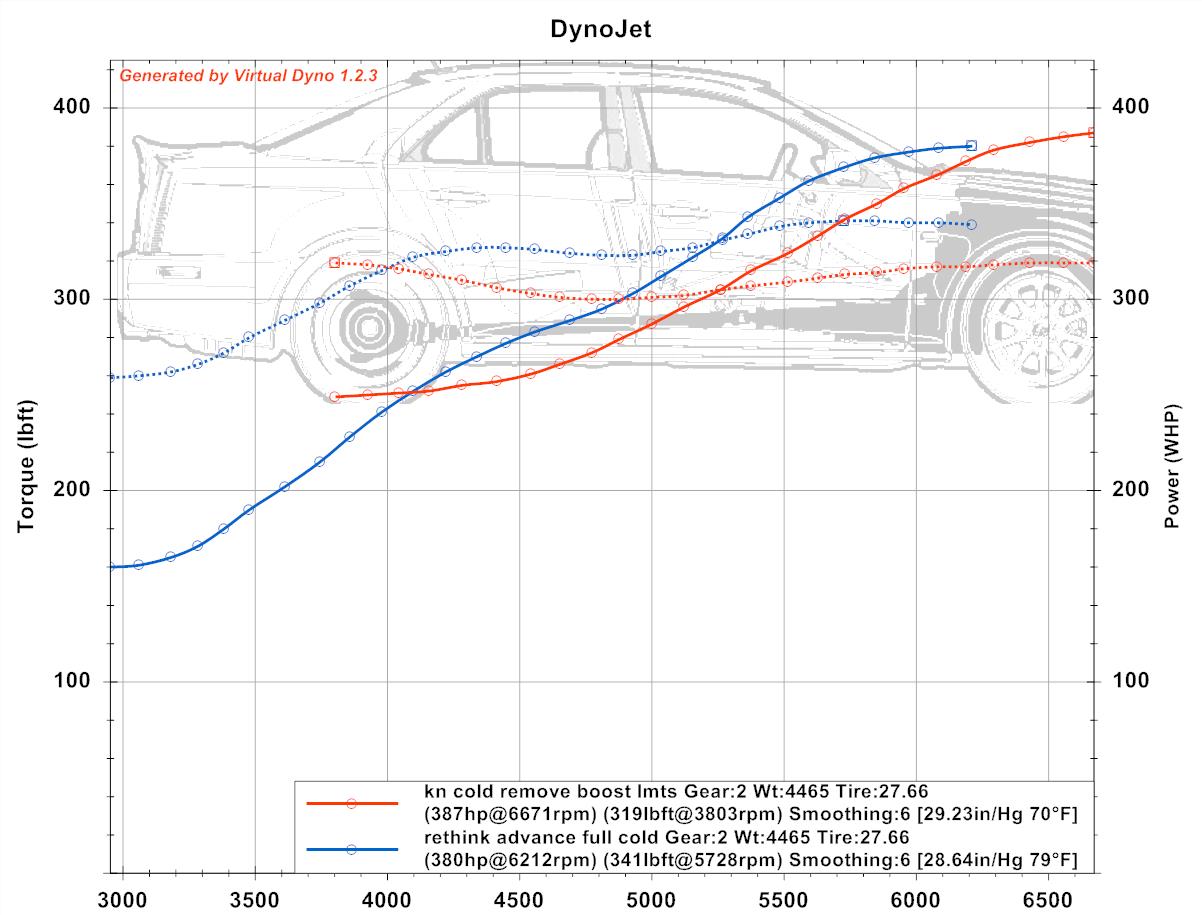
My initial run with the timing strategy adjust looks promising
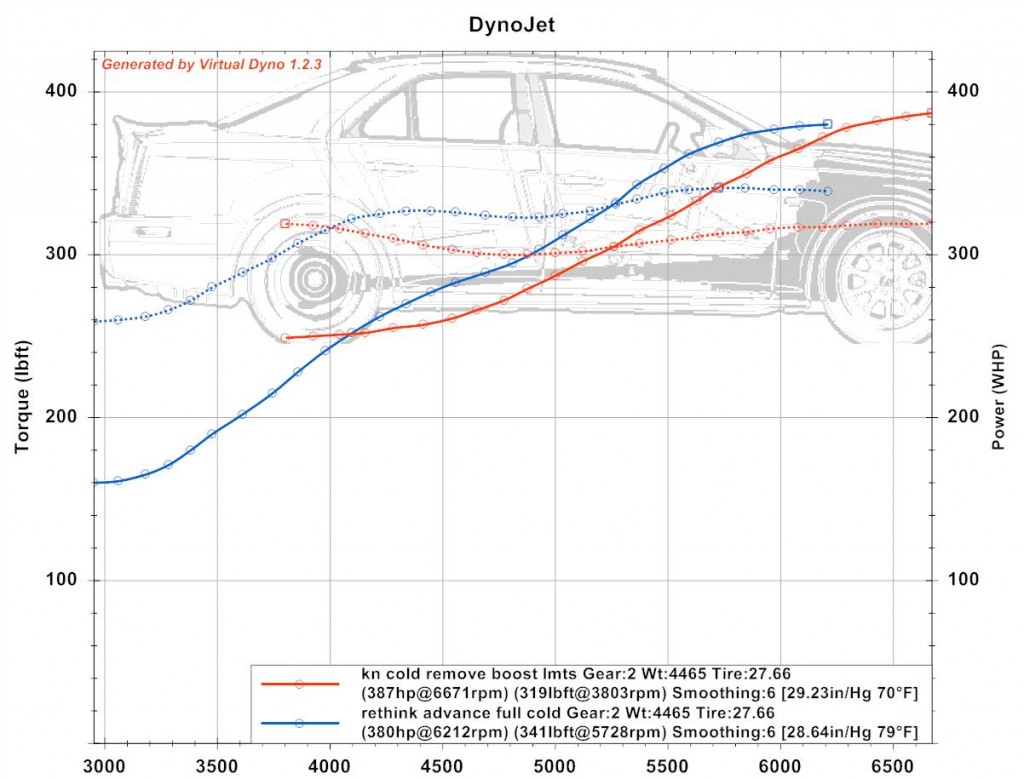
Rethink Advance comparison

What this graph shows is a comparison of today’s run (blue) with a previous tune (red), both cold (not heat soaked) and full of fuel.  Hotter day today, lower baro.  Although the peak hp was higher for the previous run in red, the today’s result is 20-25 whp above the previous for much of the run.  Today I let the transmission shift 2-3 instead of red-lining in 2, so that muted the high RPM result.
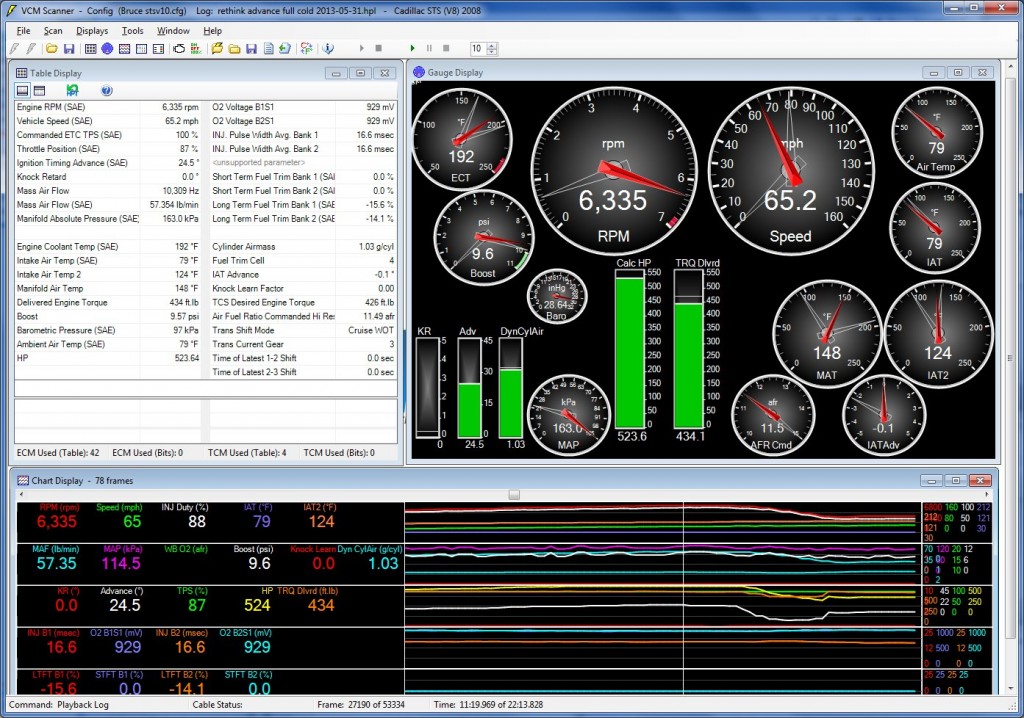
Total Timing snapshot after retuning

Total Timing snapshot after retuning

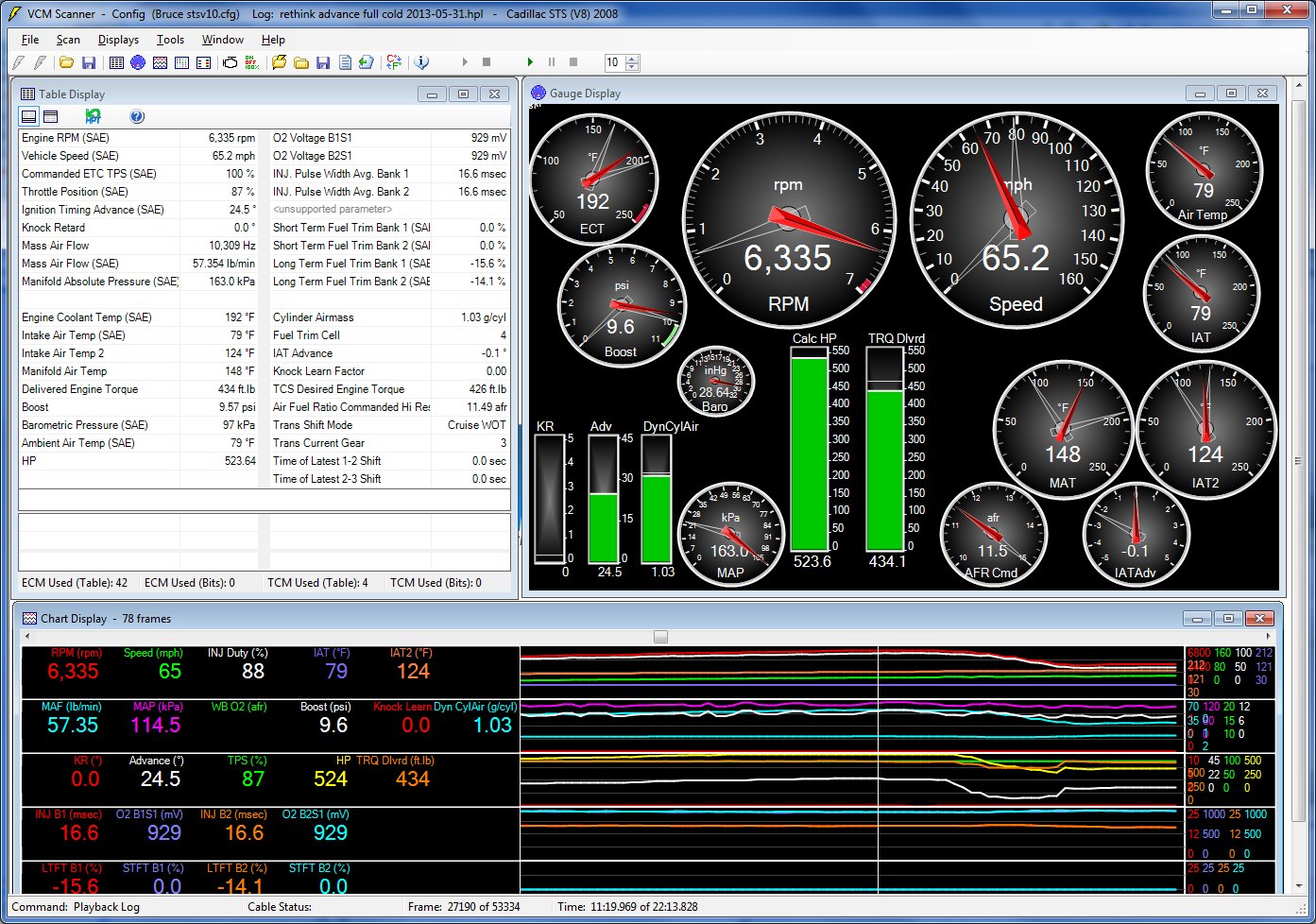
Total timing for the run ran 24.5 degrees of advance, with 0.1 IAT2 retard at that point.  I’ll have to study to see why this was more than our expected 21.9 degrees.  We were in a slightly different pressure zone — 1.03 g/sec dynamic cylinder air (57.35 MAF lb/min) vs 1.05 on the previous run / day.

A screen capture from the previous run at a similar 6339 rpm:
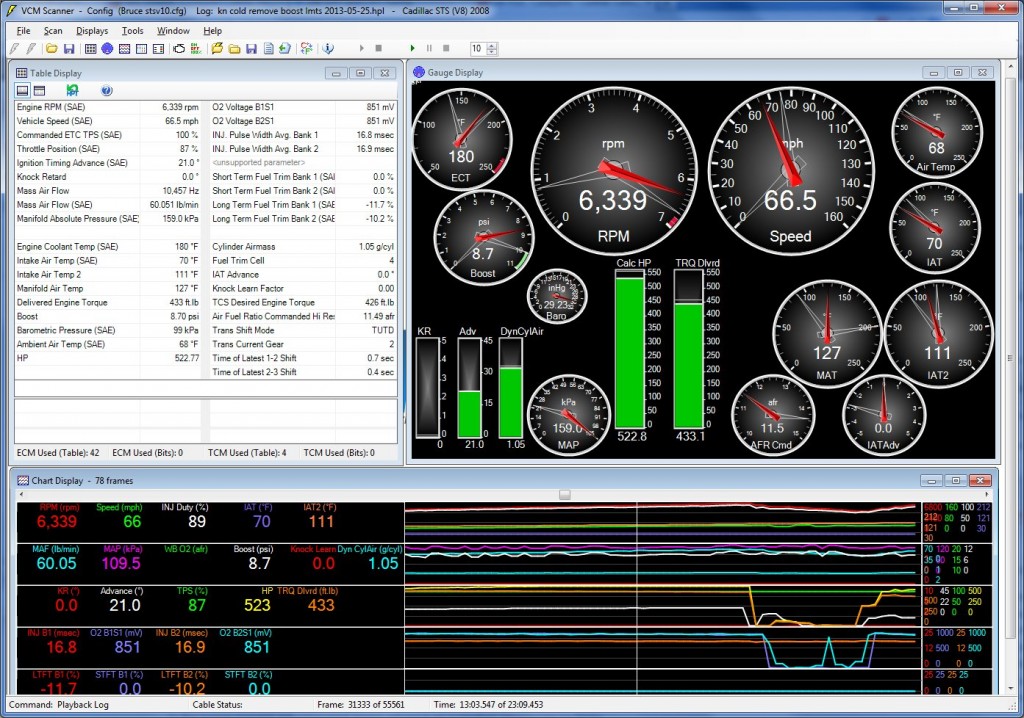
Previous cold run HP Tuners display

Previous cold run HP Tuners display

Shows a comparable set of readings.

Next as an exploration I graphed delivered torque vs total ignition timing:
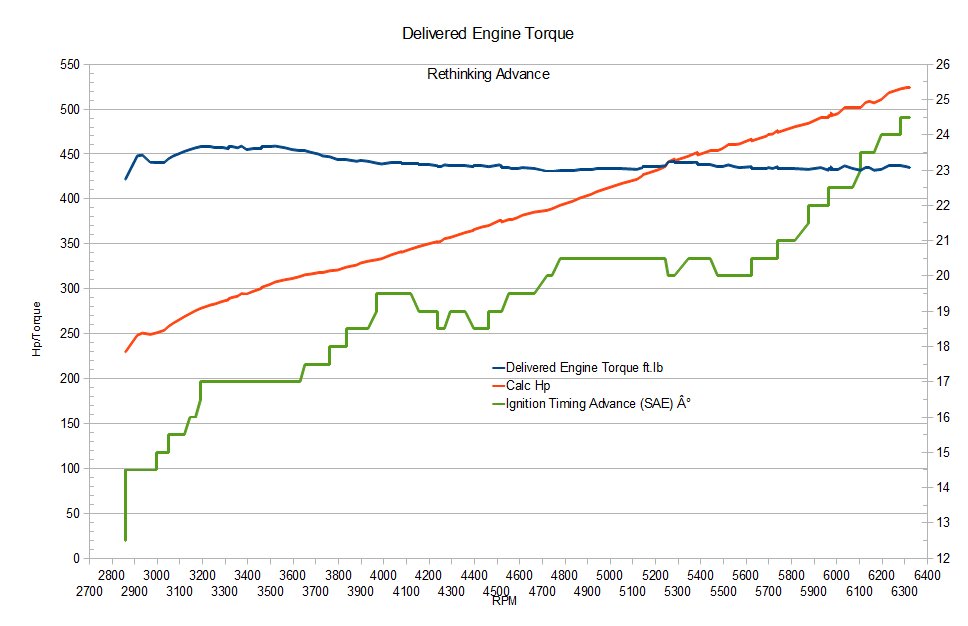
Delivered Torque and Calc Hp vs Total Timing

Delivered Torque and Calc Hp vs Total Timing

which shows the complexity of the total timing result across the RPM band.

Max calc values were 459 ft-lbs at 3371 and 3520 rpm, 523.6 hp at 6322 rpm (gear shift).


VVT Tuning & Info for the Cadillac STS-V LC3 V8

I plan to update this page with notes on variable valve timing tuning for the LC3 DOHC VVT Supercharged V8 in the STS-V.

highbaro_vvt_intake

HPTuners Table — Intake Cam position

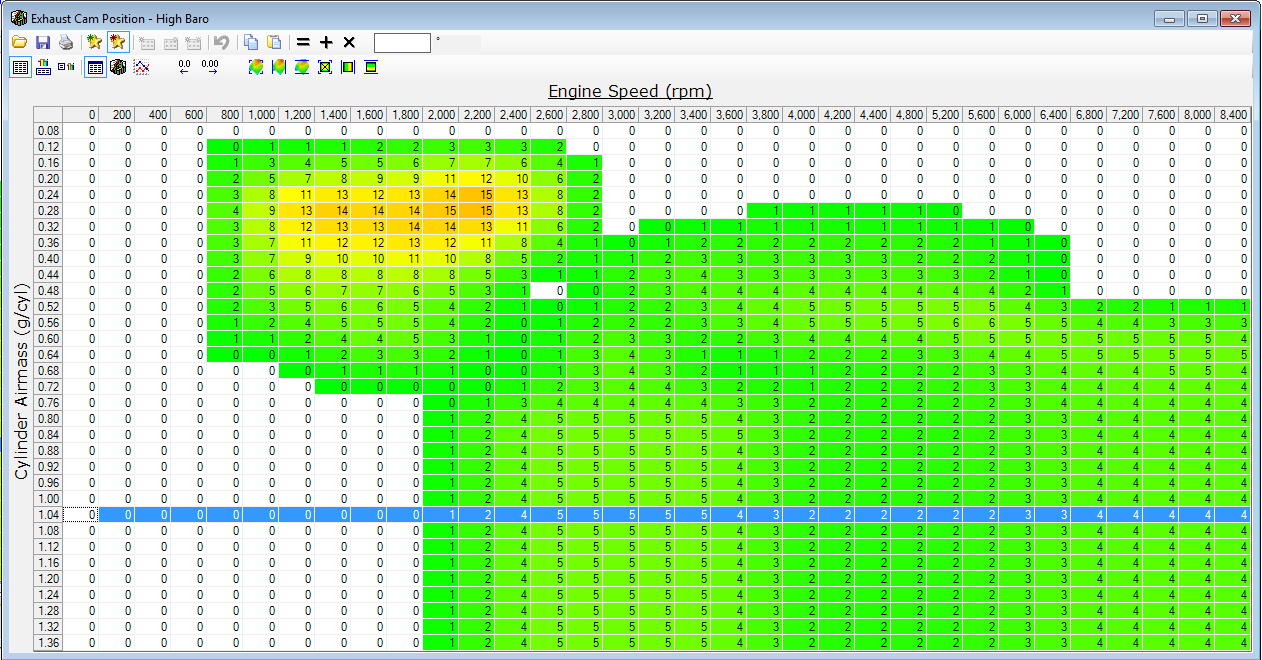
highbaro_ExhaustCamPosition

HPTuners table — exhaust cam position

Cam Phasers: [ref]
Intake: Initial timing 133 degrees ATDC with 40 degrees advance authority
Exhaust: Initial timing 117 degrees BTDC with 50 degrees retard authority

Valve Lift: Intake: 10.5mm (.413 inch)
Exhaust: 10.0mm (.394 inch)
Duration @ .050″
Intake: 202 degrees
Exhaust: 214 degrees

VALVETRAIN VARIATIONS
One of the key elements in achieving the broad output of the LC3 is the variable valve timing (VVT) system. With VVT, the seemingly opposed objectives of smooth and torquey low-end output, and massive specific output to a peak at 6400 rpm become possible, using individual hydraulically actuated phasers on each of the four camshaft. “Four-cam VVT is an exceptional performance enabler, but also provides the control flexibility needed for highly advanced NVH and emissions characteristics,” said Dave Caldwell, Northstar V-8 SC development and calibration engineer. “The supercharger module and VVT system complement one another, resulting in a genuine luxury and performance engine.”

This system allows the camshaft phasing to be altered in relation to the piston position, as well as in terms of event timing between the intake and exhaust camshafts. The VVT system was introduced last year on the normally aspirated Northstar 4.6 liter V-8, and the system received all-new command strategy optimized for the supercharged 4.4 liter application. The variable valve timing system makes it possible to target optimal idle quality, control cylinder pressure and detonation, and enhance drive-ability, while providing for the high-speed breathing necessary to turn a number at the top of the power band. Another advantage of the system is a reduction in exhaust emissions, which effectively eliminated the need for supplemental emissions equipment in the form of air injection or exhaust-gas recirculation systems while meeting today’s stringent emissions standards.

Simple cam tuning rules for BOOSTED engines: [ref]

  • Advance intake and exhaust => more low-RPM power, less high-RPM power
  • Retard intake and exhaust => more high-RPM power, less low-RPM power
  • Less overlap => lower EGTs, faster turbo spool, less fuel
  • More overlap => higher EGTs, slower turbo spool, more fuel
  • Conclusion: Advance Both at Low RPM, Retard both at High RPM

What is happening in the VVT cam programming for the LC3:

Intake:  From 3200 to 6400 RPM, position set at 20 degrees
Exhaust:  At low RPM position set at 5 degrees, decreasing to 2 degrees at mid and back to 5 degrees at high RPM

The VVT strategy the factory tune is using seems odd — the hope of VVT is to change the position of the valve timing from low (3200) rpm to high (6400) rpm, but the system appears to command a similar intake (20) and exhaust position (5) for both rev ranges.  The conventional wisdom for boosted engines is more advance for both at low RPM and more retard for both at high RPM.

Challenge:[ref]

The challenge of tuning a motor with VVT is that every change of the cam timing must have a corresponding change to the ignition timing and fuel tables. In one example, a change to the cam timing caused the PCM to enter a different cell on the spark table, which killed the timing and power in the mid to upper rpm as the result.

Feedback

What do you think?  Why did the factory take this strategy?