Cadillac XTS Safety Seat Alerts Drivers to Dangers

Industry-first directional seat vibrations alert drivers to crash threats

DETROIT – When the all-new Cadillac XTS luxury sedan begins production this spring, it will be the industry’s first car to use directional tactile sensation – vibrations of the driver’s seat bottom – to warn of crash threats while driving and parking.

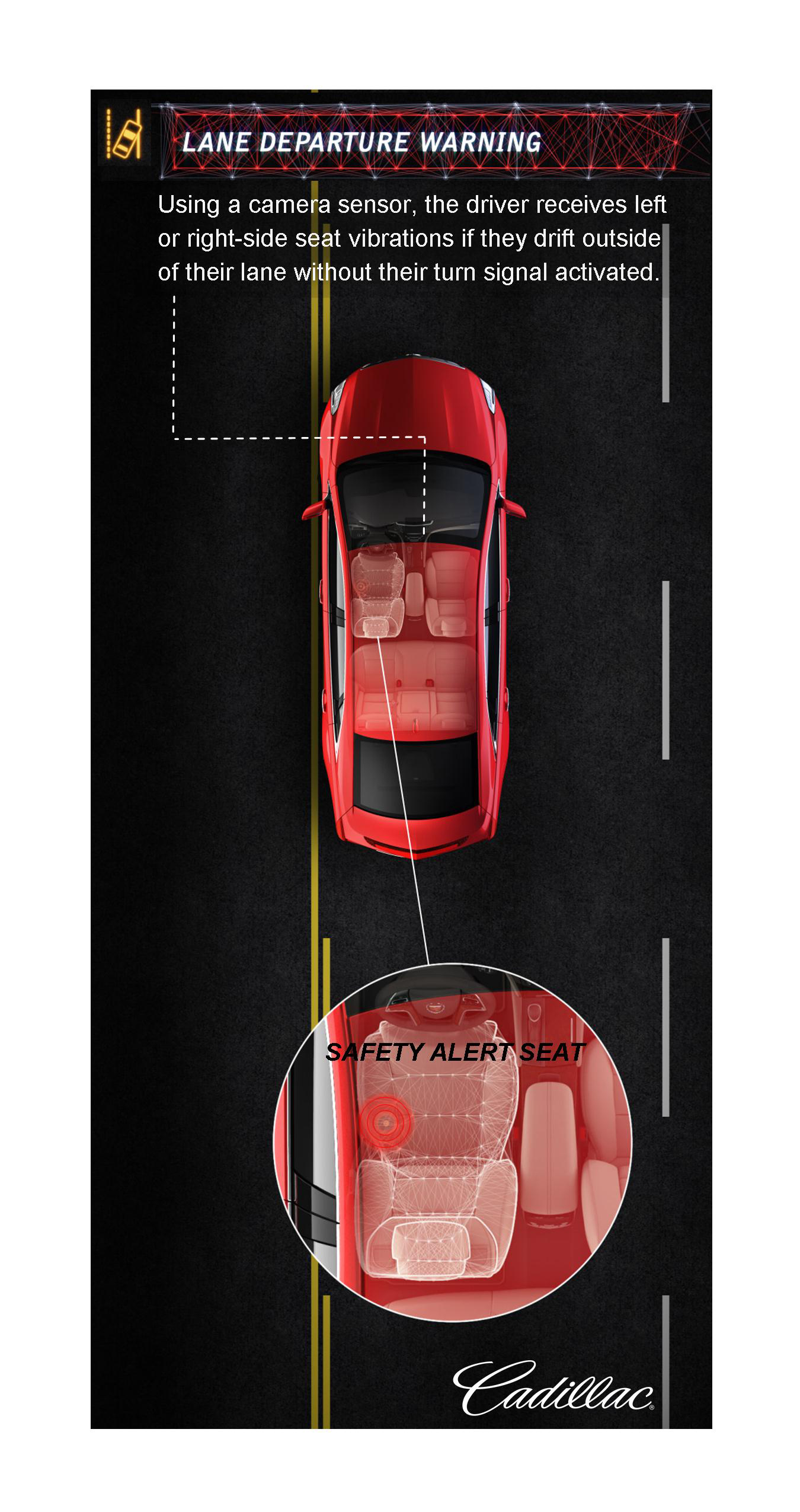
The patented Cadillac Safety Alert Seat generates vibrating pulse patterns on the left and/or right side of the lower bolster to alert the driver of potential dangers, such as drifting from a traffic lane or toward nearby objects while parking. Threats from the front and rear trigger pulses on both sides of the seat.
“It’s good to see automakers experimenting with new technology to help communicate to drivers when their driving is about to get them into trouble,” said Adrian Lund, president of the Insurance Institute for Highway Safety. “We commend GM for their innovative use of haptic feedback and hope that drivers find it helpful.”

The system works in tandem with other visual alerts, and research shows that it can quickly and accurately focus driver attention to the direction of potential dangers.

“It’s akin to someone tapping on your shoulder in a crowd to get your attention,” said, General Motors Active Safety Technical Fellow Raymond Kiefer. “Using the tactile sense to communicate crash threat direction provides an effective and intuitive way to cut through the clutter of visual and auditory sensory information that drivers routinely experience.”

The seats are part of the Cadillac Driver Awareness and Driver Assist packages, a combination of active safety systems designed to help drivers avoid crashes. The Driver Awareness Package, available for the launch of the Cadillac XTS this spring, includes Forward Collision Alert, Lane Departure Warning, Side Blind Zone Alert and Rear Cross Traffic Alert.

The Driver Assist Package, available this fall, also uses the Safety Alert Seat and features Adaptive Cruise Control, Automatic Collision Preparation, and Front and Rear Automatic Braking Systems.

The Drive Assist Awareness and Driver Assist packages will also be available this year in the Cadillac ATS luxury sedan and SRX luxury crossover.

According to Kiefer, GM research shows that the seat may direct driver attention to the location of a crash threat more quickly and accurately than beeping alerts.

“Vibrating alerts also may help drivers who do not hear beeping alerts due to hearing loss or competing noises, and may be preferred by drivers and passengers who might be annoyed by beeps and shut crash avoidance features off,” Kiefer said. “The last thing we want is for drivers to turn off features with safety benefits.”

The Safety Alert Seat works with a variety of sensors and cameras installed in the car that help “intelligently” decide when to activate warnings. For example, if a turn signal is on, lane departure warnings are not presented.

Safety Alert Seat vibrations can be selected by the driver, via an in-vehicle menu, to replace the audible beeping alerts used across much of the industry.

The seats also will be connected to the XTS Park Assist system and Rear Cross Traffic Alert system to help make parking in tight spaces easier.

Using exterior cameras, drivers can see the outside of the car along with dynamic parking guides on the eight-inch LCD screen, located on the center instrument panel. As the car backs up, the seat provides a few quick pulses to both sides of the seat when an object is first detected directly behind the car, and then provides repeated pulses when an object is closer. Meanwhile, the Rear Cross Traffic Alert system looks for approaching cross traffic behind the vehicle that is signaled with either left or right pulses to the driver.

“We feel customers will appreciate the intuitive elegance of the Safety Alert Seat, and more importantly, will appreciate the ‘good vibrations’ afforded by the features linked to this seat,” Kiefer said.
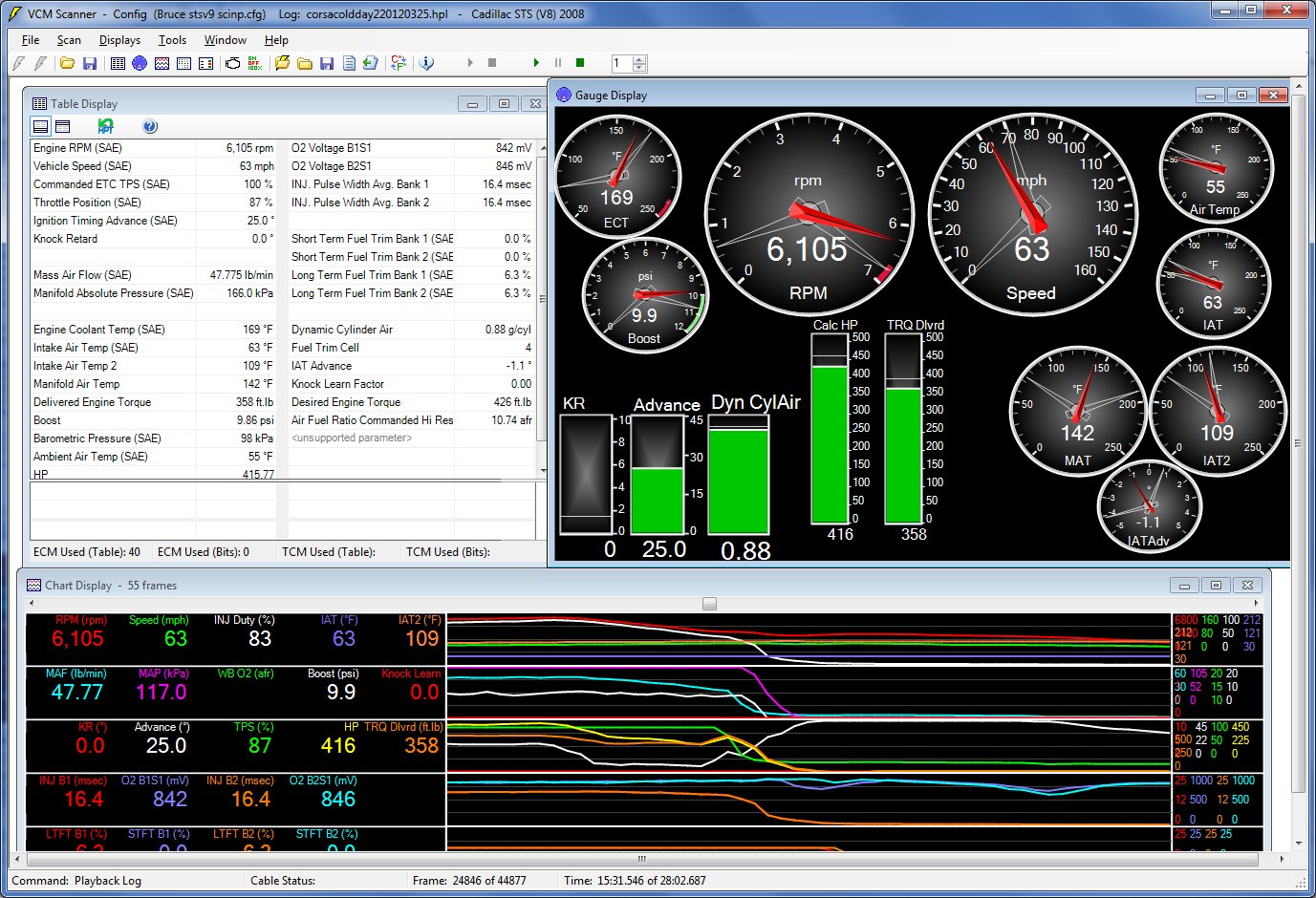
Minor adjustments and temperature trends Cadillac STS-V

Making more room for fast revving at gear changes:

  • Raised Cutoff by 200 rpm: Engine Fuel Cutoff DFCO Cutoff vs RPM
  • Raised cam disable by 300 rpm: Engine Airflow Variable Camshaft Hi RPM Disable
  • Lowered Transmission torque management by 50% at WOT — Transmission Torque Management — Adder Modifier -0.50 at RPM 4500

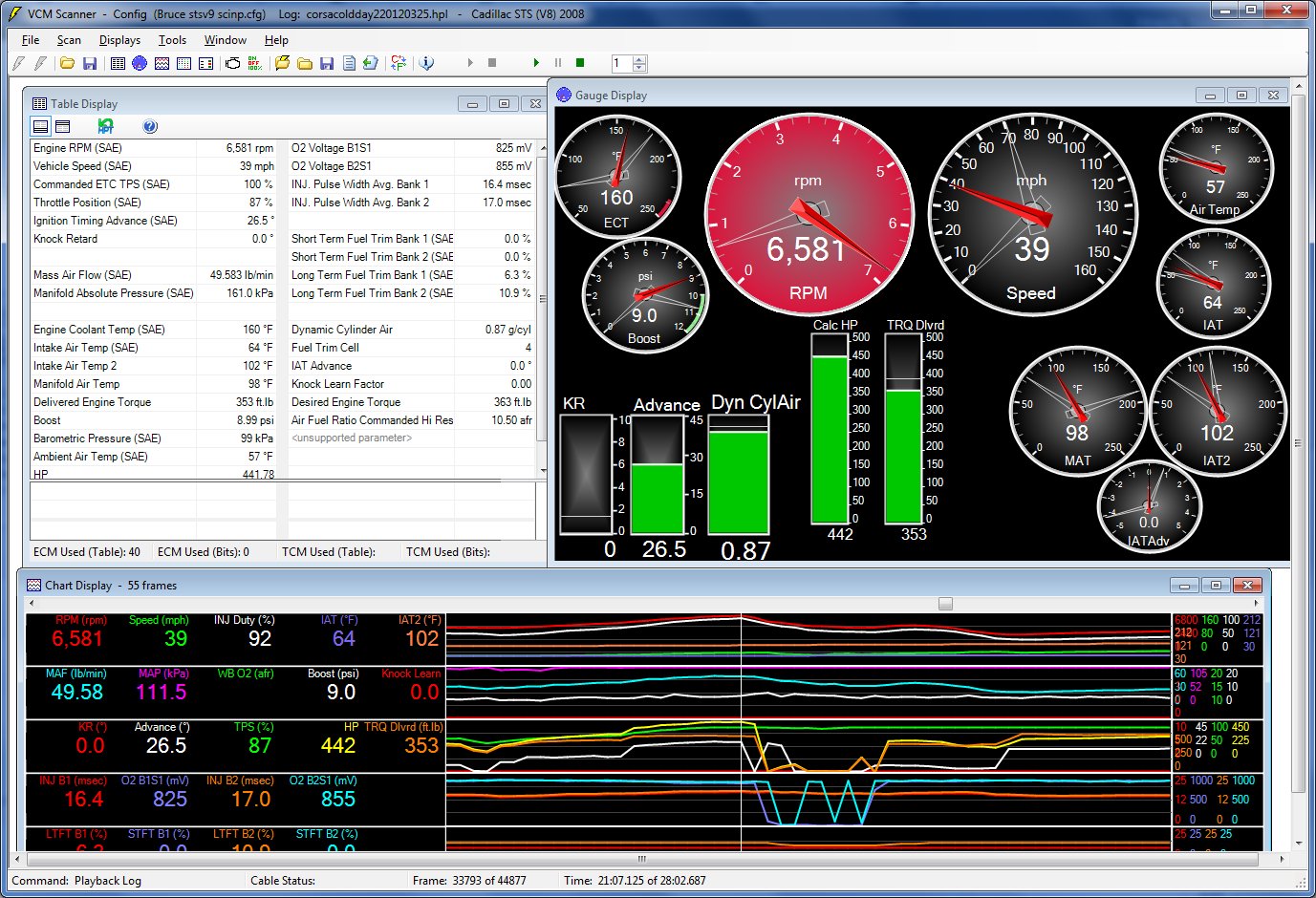
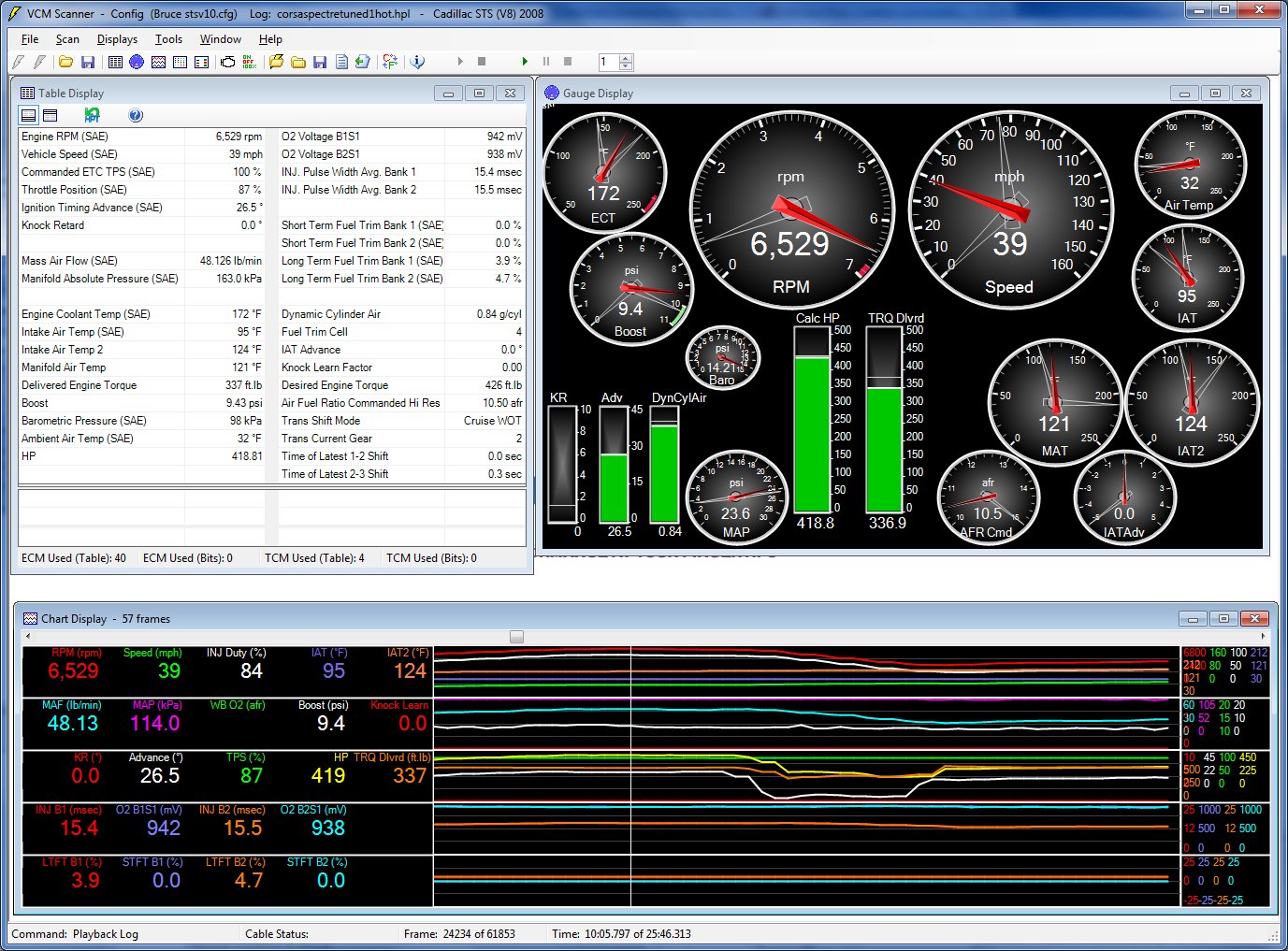
1-2 Shift max rpm 6529 (target 30 mph / 6500 rpm)

Resulting shift 1-2 took 0.3sec then 0.4s on 2nd test. Need to retest cold due to the engine making more power cold.

Temperature trends hot / heatsoaked versus cold:

Corsa Cold Baseline Mar 25 2012 2nd Run


Down Delta MPH (Temps in Deg Fahrenheit)
Item 0 30 45 60 Across Run Heat Add
Ambient 55 55 55 55 0
6 IAT1 61 63 63 63 2 8
32 IAT2 93 93 100 106 13 43
0 MAT 93 93 107 129 36 23
Corsa Hot Run 1 3/26


Down Delta MPH (Temps in Deg Fahrenheit)
Item 0 30 45 60 Across Run Heat Add
Ambient 82 82 82 82 0
8 IAT1 90 95 95 93 3 11
30 IAT2 120 120 127 135 15 42
1 MAT 121 120 126 159 38 24
Corsa Hot Run 2 3/26


Down Delta MPH (Temps in Deg Fahrenheit)
Item 0 30 45 60 Across Run Heat Add
Ambient 82 82 82 82 0
9 IAT1 91 93 91 90 -1 8
27 IAT2 118 118 126 131 13 41
1 MAT 119 118 125 152 33 21

Interesting consistency that IAT2 uniformly starts ~30F and ends ~40F hotter than IAT1 regardless of ambient.  This suggests a way to check effectiveness of changes to the intercooler cooling system.  Other runs show a end range of 40-47F.

Update: 2008 Cadillac STS-V Corsa cold run day 2

I did a fresh morning baseline with the Spectre intake + Corsa exhaust.


0.4

Speed W/o Rollout W/Rollout Dist
0 0 0 0.0
10 1.03 0.63 6.9
20 1.75 1.35 22.7
30 2.48 2.08 49.5
40 3.33 2.93 93.1
50 4.26 3.86 154.3
60 5.24 4.84 233.9

60′ time was 2.3 sec, so still not good.  Unfortunately my pre-corsa cold air pre-run earlier in the week — also a 4.8s but 4.8s/5.12s — there was no usable Performancebox data file to compare the details from (tech glitch).

Accel results
Speed(mph)     Time(s)
0-60                   04.8
Distance()     Time(s)     @Speed(mph)
0-60′                  02.3                 32.8
PkAccelG     0.67G
I did disconnect the battery yesterday to speed up relearn, but the transmission is still hitting the rev limiter before shifting on some runs. Over time I suspect it will adjust, although it may need to be tuned to shift sooner.

My prediction is that the Corsa frees up 12-20 hp but I’ll have to get a better test run to prove that.  Today’s raw data is no improvement over the 4.8/4.9s posted prior to the new exhaust.

Compared to running hot in August pre-Corsa:

Today 0.4

August 90F
w/rollout
Speed W/o Rollout W/Rollout Dist Speed(mph) Time 0.44 Dist(f)
10 1.03 0.63 6.9 10 1.01 0.57 6
20 1.75 1.35 22.7 20 1.75 1.31 23
30 2.48 2.08 49.5 30 2.46 2.02 49
40 3.33 2.93 93.1 40 3.31 2.87 93
50 4.26 3.86 154.3 50 4.30 3.86 159
60 5.24 4.84 233.9 60 5.42 4.98 248

The difference appears to be from 50-60 mph.

Max calculated power on this 0-60 run was at 6105 rpm

Max calculated power based on torque delivered for the morning caused traction control to come on at the shift — an unusable run because I had not switched it off —

Here are my IATs for trending:

Corsa Cold Baseline Mar 25 2012 2nd Run


Down Delta MPH (Temps in Deg Fahrenheit)
Item 0 30 45 60 Across Run Heat Add
Ambient 55 55 55 55 0
6 IAT1 61 63 63 63 2 8
32 IAT2 93 93 100 106 13 43
0 MAT 93 93 107 129 36 23

I plan to start recording Richard’s correction calculator for runs so I have that info.  Today was about perfect for a correction factor near ‘1’.  I am using the air temp from IAT1 for the adjustment; Richard suggests use the actual air into the engine, which is IAT1.

Conditions:  Cold run, 3/4 fuel; Weather for this run:

Note: The relative horsepower calculations are made in accordance with  SAE J1349. The standard reference conditions for SAE J1349 are:  Air temp 77 deg F (25 deg C),   29.235 Inches- Hg (990 mb) actual pressure and 0% relative humidity.